More than fixing things: Singapore’s volunteer-led movement builds community muscle不仅仅是解决问题:新加坡的志愿者运动增强了社区力量
From repairing household appliances to rescuing unwanted food, these groups are plugging gaps they see around them. Read more at straitstimes.com.
From repairing household appliances to rescuing tonnes of unwanted food, small volunteer-led groups are plugging gaps they see around them, and their impact goes beyond the immediate problem.
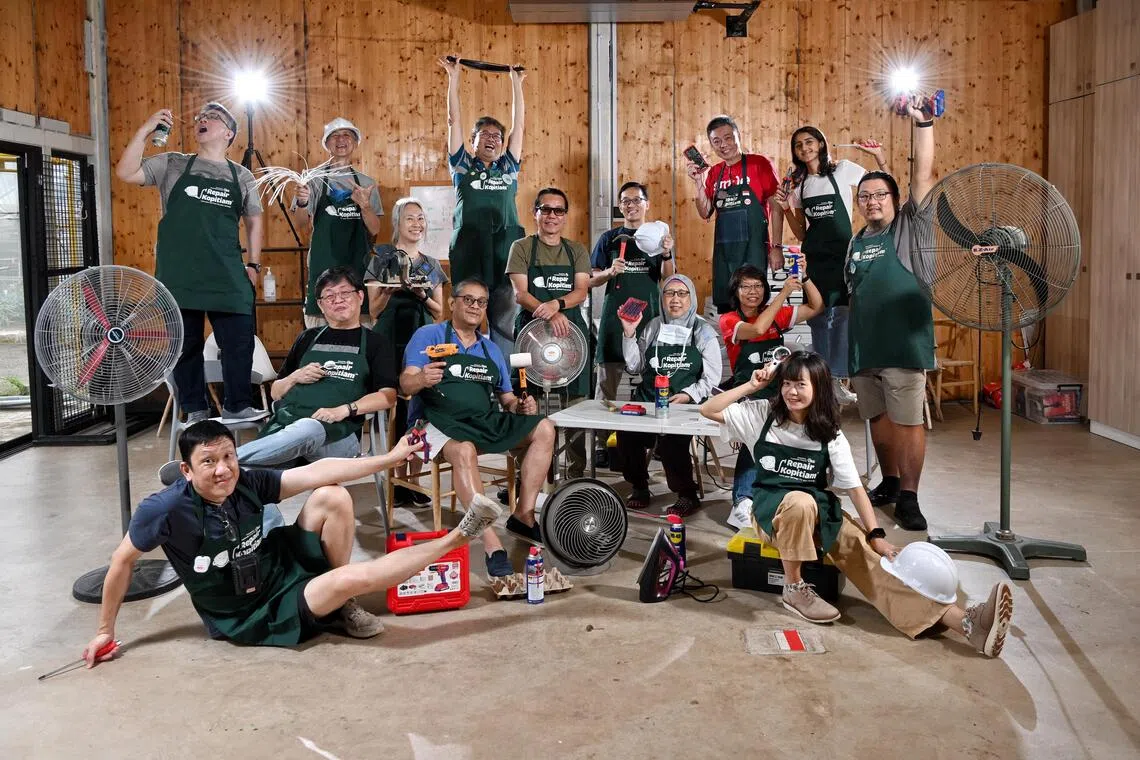
Repair Kopitiam coaches and volunteers posing with the tools of their trade.
Published Oct 26, 2026, 05:30 AM
Updated Oct 26, 2026, 05:30 AM
What do fixing broken fans and rescuing unwanted fruit and vegetables have in common?
In Singapore, both have given ordinary people a reason to do something they believe in.
Some repair appliances so old they can be new again; others save edible food that would otherwise go to waste.
Along the way, these efforts have grown into communities sharing skills, resources and responsibility – sometimes driven by uncertainty, but often simply because people saw an opportunity to make a difference.
At Repair Kopitiam, Danny Lim wants that participation to go even further. He does not want volunteers simply fixing someone else’s broken fan.
Instead, he wants the owner to pick up the tools, sit alongside a volunteer repair coach and learn how to work out what went wrong.
Lim, 58, is director of SL2 Impact, the non-profit arm of Sustainable Living Lab, a sustainability consultancy, innovation lab and social enterprise. Repair Kopitiam was started by Sustainable Living Lab in 2014 after its founders noticed usable appliances being discarded around HDB estates.
Today, repair coaches work alongside owners on everything from fans to rice cookers to vacuum cleaners, passing on practical skills that Lim believes have gradually disappeared as Singapore became more affluent, urbanised and accustomed to replacing rather than repairing things.
In 2025 , more than 2,300 items were brought to its sessions, including 552 fans. Of the roughly 6.3 tonnes of items recorded, excluding those categorised as “others”, 69% by weight were repaired – recovering goods with an estimated value of more than $57,000.
Repair Kopitiam now has 10 sites and around 300 regular coaches.
But Lim is aiming beyond repairs. “Now I’m not teaching them to fish any more. I’m teaching them how to make the fishing rod.”
He is developing a troubleshooting platform where participants can tap collective repair knowledge and contribute what they have learnt for others to use.
Elsewhere, other groups are applying their instincts to very different problems.
The Red Collective’s co-founder Winnie Cheong, 52, had been involved in food rescue years before the group was formally established in 2022.
She and her co-founders spotted a particular gap: fresh fruit and vegetables were difficult for conventional food charities to handle because perishables need to be collected, sorted and redistributed quickly.
The Red Collective now links donors with smaller community groups and distribution points.
Behind it is an operation involving drivers, vehicles, loading arrangements, distribution points and pallets of goods.
Cheong jokes that on some days she feels like a logistics coordinator. The work, as she describes it, is “not glamorous” but “heavy, dirty and dusty”.
Still, The Red Collective grew from an initial core of around 20 to 30 volunteers to more than 100, with tasks ranging from collection to distribution. It collects an estimated 23.6 tonnes of food a month, mostly vegetables and bakery items.
Here, too, the idea is not to do everything for everybody.
The Red Collective collects food from vendors and partners and distributes it to smaller local community groups, who then run their own ground operations.
Cheong believes this gives the model longevity because there is “co-creation at every single level”, while giving people within individual neighbourhoods the confidence and leadership skills to organise themselves.
The Red Collective co-founder Winnie Cheong (centre) works with volunteers to distribute food in the Eunos neighbourhood. PHOTO: THE RED COLLECTIVE
The Red Collective co-founder Winnie Cheong (centre) works with volunteers to distribute food in the Eunos neighbourhood.
PHOTO: THE RED COLLECTIVE
Colin Tan, 47, is one of those doing it on the ground.
His food rescue and distribution programme in Haig Road began almost accidentally during the Covid-19 pandemic, after a supplier handed him a large bag of bread and baked goods and asked him to give them away rather than waste them. It is now into its fifth year.
He runs it on top of his day job in events management.
Yet it is the relationships, rather than the food, that keep him going.
“Because I live here as well... these people I got to know are my neighbours,” he says, adding that the familiarity “creates that whole kampung feeling”.
“Instead of ignoring each other, people have gotten comfortable with one another and the community is a bit closer,” says Tan.
A movement that outlasted Covid-19
Ground-up action is not new, but the pandemic produced a marked surge. The National Volunteer and Philanthropy Centre’s (NVPC) inaugural Groundup Initiative Study 2023, released in January 2024, found that 109 ground-ups were formed in 2020, compared with 28 in 2019.
NVPC estimated that around 450 were active and of known status. Its definition covers ground-ups as voluntary, self-organised, not-for-profit community initiatives that are not registered organisations.
Support for the ecosystem has since expanded.
In 2024, national platform BAGUS Together was launched to connect ground-ups with resources and partners, while Budget 2026 introduced a $50 million SG Partnerships Fund to help citizen-led initiatives start, grow and, in some cases, scale.
Justin Lee, senior research fellow and head of IPS Policy Lab, says he thinks there is a “thirst for community” and a desire to participate in purposeful activities beyond recreational or hobby groups.
Such groups play a useful role because policies operate at a broad level while relationships are built at the micro level, he says.
People with different skills and lived experiences can come together to solve practical problems.
In doing so, they build what Lee calls “civic capacity” or the ability to identify problems, pool resources and try to solve them through collective initiative.
Fridge Restock Community SG offers another example.
It began in November 2020 after founder Daniel Yap saw large amounts of food being discarded at Pasir Panjang Wholesale Centre when the pandemic had left some people struggling financially.
From 13,900kg rescued in its first two months, the group has collected more than 630,400kg in the first nine months of 2026.
It now has about 80 active volunteers and supplies 46 distribution points, with 2025 data putting its reach at some 6,700 households a month.
Fridge Restock Community SG volunteers loading a car with rescued fruit and vegetables at Pasir Panjang Wholesale Centre. PHOTO: CAROLINE CHIA/FRIDGE RESTOCK COMMUNITY SG
Fridge Restock Community SG volunteers loading a car with rescued fruit and vegetables at Pasir Panjang Wholesale Centre.
PHOTO: CAROLINE CHIA/FRIDGE RESTOCK COMMUNITY SG
Fridge Restock Community SG’s volunteer Caroline Chia says demand can be intense as queues at its largest distribution point at Bishan Community Club can reach 500 people.
She adds that the group makes it a point not to means-test those receiving rescued food, partly because some households struggling financially may fall outside formal assistance schemes and others may be uncomfortable proving that they need help.
Running such groups is not easy.
There are volunteers to find and retain, operations to organise and bills to pay.
But Repair Kopitiam’s Lim sees another obstacle – mindset.
He recalls another repair initiative initially being viewed as his competitor. His response was simple: “You think I can take care of the whole of Singapore?”
There are more broken appliances than his volunteers can fix.
He says if another group repairs them instead, the original goal of keeping usable things out of the waste stream is still being met.
For Lim, greater collaboration and sharing of knowledge are part of building resilience.
IPS Policy Lab’s Lee sees a similar challenge.
Singapore, he says, has lost some of the communal relationships and kampung culture of the past as people increasingly turn to markets and public services to meet their needs.
“We have transactions instead of community, so it is now awkward for neighbours to get to know one another and offer to help,” he says.
Saving a bag of apples or a fan will not by itself make Singapore more resilient to the next crisis.
But Lee says communities that are used to identifying problems, pooling resources and drawing on different skills may be better equipped to deal with future challenges.
He adds that Singapore could do better at giving participants a meaningful say in community-led groups, which could unlock a wider pool of skills, strengths and ideas.
Perhaps that is Lim’s fishing rod: not merely solving today’s problem, but giving people the skills, confidence and one another to tackle tomorrow’s.
Elevated insights from seasoned perspectives. Crafted by journalists. Powered by Purpose: The Straits Times Signature Series is a new editorial project helmed by experienced journalists to shine a light on people, themes and ideas that rarely get the attention they deserve in everyday news cycles.
This article is part of a special collaboration between The Straits Times and Nexus – the lead agency that drives Singapore’s national education and Total Defence efforts – to spotlight national issues.
The writer was a journalist at The Straits Times’ business desk.
从修理家用电器到拯救数吨无人问津的食物,小型志愿者团体正在填补他们周围发现的空白,他们的影响远远超出了眼前的难题。
维修咖啡店的教练和志愿者们与他们的工作工具合影。
发布于2026年10月26日 上午5:30
更新于2026年10月26日上午5:30
修理坏掉的风扇和拯救无人问津的水果蔬菜有什么共同之处?
在新加坡,这两者都让普通人有理由去做自己相信的事情。
有些维修人员能将老旧电器修复得焕然一新;还有一些人能挽救原本会被浪费掉的可食用食物。
在此过程中,这些努力发展成为共享技能、资源和责任的社区——有时是出于不确定性,但通常只是因为人们看到了做出改变的机会。
在维修咖啡店,丹尼·林希望这种参与能更进一步。他不希望志愿者只是简单地修理别人坏掉的风扇。
相反,他希望店主拿起工具,和一位志愿维修指导员一起学习如何找出问题所在。
现年58岁的林先生是SL2 Impact的负责人,SL2 Impact是可持续生活实验室(Sustainable Living Lab)的非营利分支机构,后者是一家集可持续发展咨询、创新实验室和社会企业于一体的机构。“维修咖啡店”(Repair Kopitiam)由可持续生活实验室于2014年创办,其创始人注意到组屋区周围有很多可用的家电被丢弃。
如今,维修教练与业主一起维修从风扇、电饭煲到吸尘器等各种电器,传授实用技能。林认为,随着新加坡变得更加富裕、城市化,人们习惯于更换物品而不是修理物品,这些技能已经逐渐消失了。
2025年,该机构共收到2300多件物品,其中包括552名粉丝。在记录在案的约6.3吨物品中(不包括被归类为“其他”的物品),按重量计算,69%的物品得到了修复——修复后的物品估计价值超过57000美元。
Repair Kopitiam 目前拥有 10 个站点和约 300 辆定期班车。
但林的目标远不止于修补。“现在我不再教他们钓鱼了,而是教他们如何制作鱼竿。”
他正在开发一个故障排除平台,参与者可以利用集体的维修知识,并将他们所学到的知识贡献出来供其他人使用。
另一方面,其他一些团体正在将他们的直觉应用于截然不同的问题。
红色联盟的联合创始人 Winnie Cheong 现年 52 岁,在 2022 年该组织正式成立之前,她已经参与食物救援多年。
她和她的联合创始人发现了一个特别的缺口:新鲜水果和蔬菜对于传统的食品慈善机构来说难以处理,因为易腐烂的食品需要快速收集、分类和重新分配。
红色联盟现在将捐赠者与较小的社区团体和分发点联系起来。
其背后是一个涉及司机、车辆、装载安排、配送点和货物托盘的复杂运作过程。
张女士开玩笑说,有时候她觉得自己像个物流协调员。她形容这份工作“并不光鲜亮丽”,而是“繁重、肮脏、尘土飞扬”。
尽管如此,“红色联盟”的志愿者队伍还是从最初的20到30人发展到100多人,他们的工作涵盖了从收集到分发的各个环节。该组织每月收集约23.6吨食物,主要包括蔬菜和烘焙食品。
这里也一样,我们的理念不是为所有人做所有事。
红色联盟从供应商和合作伙伴处收集食物,然后分发给较小的当地社区团体,由这些团体开展自己的地面运营。
Cheong认为,这种模式能够长久发展,是因为“每个层面都有共同创造”,同时赋予各个社区的人们组织起来的信心和领导能力。
红社联合创始人张慧敏(中)与志愿者们在友诺士社区分发食物。图片:红社
红社联合创始人张慧仪(中)与志愿者一起在友诺士社区分发食物。
照片:红色集体
47岁的Colin Tan就是其中一位在一线工作的人员。
他在海格路开展的食物救援和分发项目几乎是偶然地始于新冠疫情期间。当时,一位供应商给了他一大袋面包和烘焙食品,请他把它们分发出去而不是浪费掉。如今,这个项目已经开展了五年。
他除了日常的活动策划工作之外,还经营着这家公司。
然而,真正让他坚持下去的,是人际关系,而不是食物。
“因为我也住在这里……我认识的这些人都是我的邻居,”他说,并补充说,这种熟悉感“营造了那种乡村氛围”。
“人们不再互相忽视,而是彼此熟悉起来,社区关系也更加紧密了,”谭说道。
一场持续时间超过了新冠疫情的运动
自下而上的行动并非新鲜事物,但疫情导致其显著激增。国家志愿服务和慈善中心(NVPC)于2024年1月发布的首份《2023年自下而上倡议研究》发现,2020年成立了109个自下而上的组织,而2019年只有28个。
NVPC估计约有450个活跃且状态已知的组织。其定义涵盖了基层组织,即自愿的、自组织的、非营利性的社区倡议,这些组织并非注册机构。
此后,对该生态系统的支持不断扩大。
2024 年,国家平台 BAGUS Together 正式启动,旨在将基层组织与资源和合作伙伴联系起来;同时,2026 年财政预算案推出了 5000 万美元的新加坡伙伴关系基金,以帮助公民主导的倡议启动、发展,并在某些情况下扩大规模。
IPS政策实验室高级研究员兼负责人贾斯汀·李表示,他认为人们“渴望融入社区”,并希望参与除娱乐或兴趣小组之外的有意义的活动。
他表示,这类团体发挥着有益的作用,因为政策是在宏观层面运作的,而人际关系则是在微观层面建立的。
拥有不同技能和生活经历的人可以走到一起解决实际问题。
通过这样做,他们培养了李所说的“公民能力”,即识别问题、汇集资源并通过集体行动尝试解决问题的能力。
Fridge Restock Community SG 提供了另一个例子。
2020 年 11 月,创始人 Daniel Yap 看到巴西班让批发中心大量食物被丢弃,当时疫情导致一些人经济困难,于是他创办了这家公司。
该组织在前两个月救出了 13,900 公斤的垃圾,到 2026 年前九个月,已收集了超过 630,400 公斤的垃圾。
目前,该项目拥有约 80 名活跃志愿者,并设有 46 个物资分发点。根据 2025 年的数据,该项目每月可惠及约 6700 户家庭。
Fridge Restock Community SG 的志愿者们在巴西班让批发中心将回收的水果和蔬菜装上车。照片:CAROLINE CHIA/FRIDGE RESTOCK COMMUNITY SG
Fridge Restock Community SG 的志愿者们在巴西班让批发中心将抢救出来的水果和蔬菜装上车。
照片:CAROLINE CHIA/FRIDGE REStock COMMUNITY SG
Fridge Restock Community SG 的志愿者 Caroline Chia 表示,需求可能非常旺盛,其位于碧山民众俱乐部的最大分发点排队人数可达 500 人。
她补充说,该组织特意不对领取救济食品的人进行经济状况调查,部分原因是有些经济困难的家庭可能不在正式援助计划的覆盖范围内,而另一些家庭可能不愿证明自己需要帮助。
管理这样的团队并不容易。
我们需要寻找和留住志愿者,组织各项活动,并支付各种账单。
但 Repair Kopitiam 的 Lim 认为还有另一个障碍——思维方式。
他回忆起另一项维修计划最初被视为他的竞争对手。他的回应很简单:“你觉得我能照顾好整个新加坡吗?”
坏掉的电器比他的志愿者能修理的多得多。
他表示,如果由其他团体进行修理,那么将可用物品从废物流中分离出来的最初目标仍然能够实现。
林认为,加强合作和知识共享是增强韧性的一部分。
IPS政策实验室的Lee也看到了类似的挑战。
他表示,随着人们越来越多地转向市场和公共服务来满足自身需求,新加坡已经失去了一些过去的社区关系和甘榜文化。
他说:“我们现在更多的是交易而不是社区,所以邻里之间很难互相认识,也很难主动提供帮助。”
仅仅保存一袋苹果或一台风扇并不能使新加坡更能抵御下一次危机。
但李表示,习惯于发现问题、汇集资源和利用不同技能的社区,可能更有能力应对未来的挑战。
他还补充说,新加坡可以做得更好,让参与者在社区主导的团体中拥有有意义的发言权,这可以释放更广泛的技能、优势和想法。
也许这就是林先生的钓竿:不仅要解决今天的问题,还要赋予人们技能、信心和彼此,以应对明天的问题。
资深记者以独到的视角,带来深刻的见解。由资深记者精心打造,秉持“使命驱动”的理念:《海峡时报》特色系列是《海峡时报》推出的全新编辑项目,旨在聚焦那些在日常新闻报道中鲜少获得应有关注的人物、主题和观点。
本文是《海峡时报》与新加坡国家教育和全民防卫牵头机构 Nexus 合作推出的特别专题报道的一部分,旨在聚焦国家议题。
作者曾是《海峡时报》财经版的记者。