Not every maritime threat needs a warship: Why Singapore is turning to offshore patrol vessels并非所有海上威胁都需要军舰:新加坡为何转向近海巡逻艇
From maritime terrorism to drones, navies face a wider range of threats that do not always fit neatly into either law enforcement or conventional warfare.
新闻视频
From maritime terrorism to drones, navies face a wider range of threats that do not always fit neatly into either law enforcement or conventional warfare.
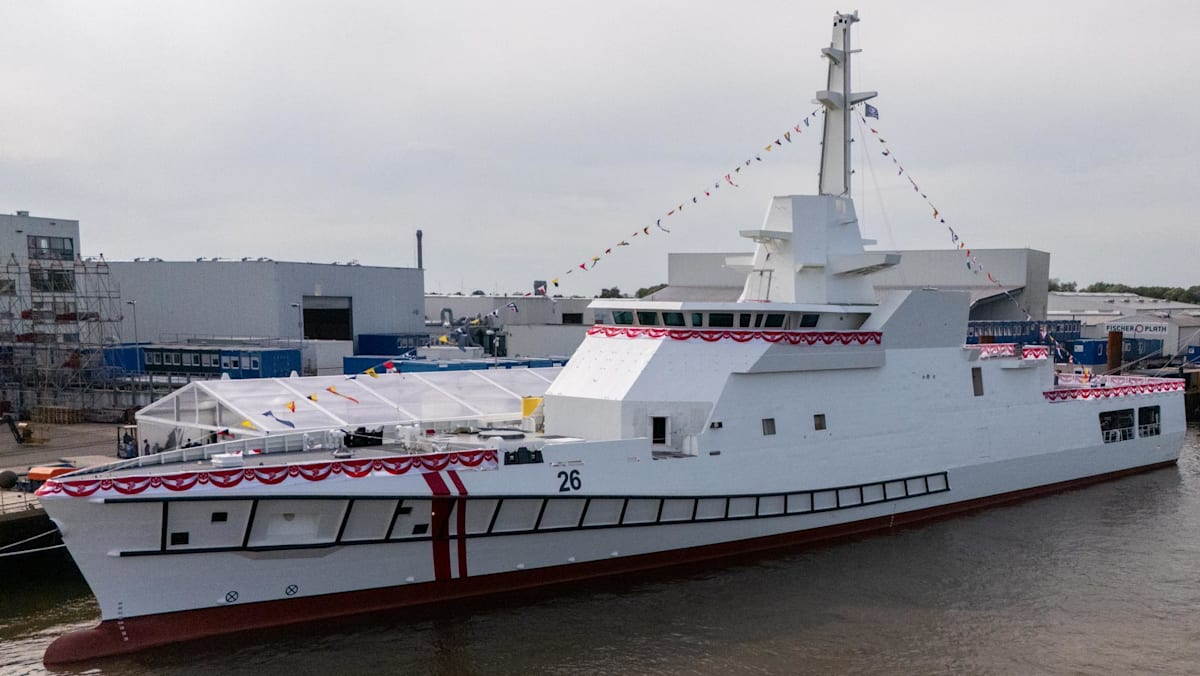
The Republic of Singapore Navy's new Sentinel-class offshore patrol vessel launched in Berne, Germany on Oct 1, 2026. (Photo: MINDEF)
This audio is generated by an AI tool.
SINGAPORE: Deploying heavily armed, grey-hulled warships to tackle every maritime security threat along important sea lanes is akin to taking a hammer to every problem, defence experts said, adding that increasingly complex challenges call for more measured responses at sea.
Earlier this month, the Republic of Singapore Navy (RSN) launched its first Sentinel-class offshore patrol vessel, christened Sentinel. It is the first of four government vessels built to meet a broader spectrum of maritime security operations.
Their calibrated capabilities will allow Singapore to respond to incidents in a measured and proportionate manner, giving the government "more options" at sea, the Ministry of Defence (MINDEF) said during the vessel’s launch.
They offer an alternative to conventional warships, said Mr Nicholas Lim, senior fellow and coordinator of defence and military relations at the S Rajaratnam School of International Studies (RSIS) in Nanyang Technological University.
Unlike the standard grey hull on most combatant and auxiliary surface ships that keeps them camouflaged against the marine backdrop, the offshore patrol vessels sport white hulls.
"You cannot deploy your grey-hulled warships for everything. It's like you're using a hammer for every single problem," said Mr Lim.
Regional countries have made similar moves. In 2024, Malaysia's Maritime Enforcement Agency took delivery of a new offshore patrol vessel while the Indonesian navy launched two such ships.
Unlike the heavily militarised environment in the Middle East, the sea lanes around Singapore face a different breed of risk, experts said.
From maritime terrorism and trafficking to drones and threats to undersea infrastructure, modern navies in the region must manage risks that sit in the ambiguous grey zone between routine law enforcement and conventional warfare.
More than just dealing with piracy and sea robbery, navies need to respond to different types of security challenges, said Mr Lim.
Recent tensions across vital global choke points like the Strait of Hormuz demonstrated the urgent demand for vessels that can deter threats and defuse flashpoints before they disrupt international trade.
Like the Strait of Hormuz, the Straits of Malacca and Singapore are among the world's most important shipping routes, carrying nearly a quarter of global seaborne trade and almost a third of global oil and gas supplies.
But their geopolitical and security environments are worlds apart, experts stressed.
Maritime security in the Strait of Hormuz is closely intertwined with broader military and geopolitical tensions, said associate research fellow from the RSIS' maritime security programme Chong De Xian.
"In contrast, the Straits of Malacca and Singapore operate in a relatively stable security environment, where the littoral states share a strong interest in keeping the waterways open and secure," he added, referring to Indonesia, Malaysia and Singapore.
CNA Games Guess Word Crack the word, one row at a time Buzzword Create words using the given letters Mini Sudoku Tiny puzzle, mighty brain teaser Mini Crossword Small grid, big challenge Word Search Spot as many words as you can Show More Show Less
Beyond these threats, geopolitical tensions and armed conflict have exposed the vulnerability of international shipping routes.
The Strait of Hormuz carried about one-fifth of the world's energy shipments before the war between the United States and Iran began earlier this year.
On Oct 14, two Singapore-registered container vessels were struck by unknown projectiles while transiting the strait. One sank after sustaining damage and catching fire.
It was the second vessel to sink since the war began on Feb 28, according to the International Maritime Organization.
Meanwhile, reports emerged in September that the Iranian-backed Houthi rebel group had taken control of Yemen's entire Red Sea coast and advanced onto islands in the Bab al-Mandeb Strait.
The narrow waterway at the southern tip of the Red Sea, which serves as a gateway to the Suez Canal from the Indian Ocean, is a key shipping route and an alternative for the world's largest oil exporter Saudi Arabia to export crude oil.
Such developments show how threats to commercial shipping can disrupt international trade and energy flows even without physically closing maritime chokepoints, Mr Chong said.
However, experts cautioned against drawing direct comparisons with the Straits of Malacca and Singapore.
"The two situations are not comparable," said Dr Storey.
"The most important difference between the two is that in Southeast Asia the littoral states are committed to keeping the Straits of Malacca and Singapore free, open and safe for international shipping while Iran has weaponised the Strait of Hormuz."
Mr Lim similarly pointed to the strong cooperation among Singapore, Malaysia and Indonesia, which share an interest in keeping the waterways open.
He said the situation in the Strait of Hormuz nevertheless offered an important lesson on the need to uphold international law, particularly the United Nations Convention on the Law of the Sea (UNCLOS), a set of rules that governs the world's oceans.
It allocates rights and legal authority to states, and establishes regulations for the peaceful use of the sea and its resources.
"The one big lesson learnt from the Strait of Hormuz is that we cannot take it for granted that access is always there. We have to protect this UNCLOS to ensure that the key international straits are open," he said.
But he was confident that a similar situation would not unfold in the Straits of Malacca and Singapore, given the differences in geography, history, culture and shared interests.
The launch of Singapore's first Sentinel-class Offshore Patrol Vessel on Oct 1, 2026. (Photo: MINDEF)
HOW MARITIME THREATS HAVE EVOLVED
Today, regional threats at sea include illegal fishing, smuggling and maritime terrorism, said Mr Lim, who served in the RSN for about 30 years before retiring as a colonel last year.
Fishing vessels, for instance, can be exploited to transport drugs or be used for smuggling, while maritime terrorism could involve the hijacking of liquefied natural gas (LNG) carriers and turning them into potential "floating bombs".
While piracy and armed robbery incidents remain ever-present concerns in the Straits of Malacca and Singapore, Mr Lim said the numbers fluctuate based on enforcement drives and weather patterns.
"We do not have any serious kind of piracy or sea robbery incidents. By serious I mean (the) hijacking of entire ships. We have not seen that, fingers crossed, for many, many years," he said, crediting the coordinated efforts of Singapore, Malaysia and Indonesia.
Dr Ian Storey, principal fellow at the ISEAS-Yusof Ishak Institute, agreed that piracy and sea robbery have been effectively managed, with closer cooperation among the three countries' navies and law enforcement agencies significantly reducing maritime crime over the past two decades.
Nonetheless, Southeast Asia's wider maritime security landscape presents a "mixed picture", he said.
Transnational trafficking in narcotics, weapons as well as people still persist, alongside longstanding territorial disputes and overlapping maritime boundaries that continue to generate tensions, particularly in the South China Sea.
Technological shifts can also expose new vulnerabilities, said experts.
The proliferation of aerial and underwater drones poses an increasing threat to the region, while critical infrastructure, including undersea cables and energy pipelines, remains vulnerable to both accidents and sabotage, Dr Storey said.
Because undersea assets are spread across vast seabed tracts, protecting them from deliberate foul play is difficult.
What complicates efforts are the geographical challenges and evidential difficulties in proving deliberate interference, said RSIS’ Mr Chong.
Such disruptions to critical maritime infrastructure can have far-reaching economic and security consequences, he said.
Hegave examples of how cyberattacks could disrupt port and shipping operations and manipulate vessel-tracking information so as to compromise navigational safety.
Illicit maritime activities have also become more sophisticated, with deceptive shipping practices, sanctions evasion and shadow fleets making surveillance and enforcement harder, he added.
RESPONDING WITHOUT ESCALATION
Singapore's location alongside one of the world's busiest shipping routes, and its reliance on maritime trade and essential supplies, have always presented particular challenges for the RSN, said Mr Chong, himself a former RSN officer.
"Such situations require responses that are appropriate and proportionate to the circumstances. Some incidents may be resolved through warnings and other less-lethal measures, while others may require more forceful intervention."
Having a wider range of capabilities allows maritime security forces to take graduated responses as situations develop, without prematurely resorting to more forceful options, he said.
"This is particularly important in Singapore’s congested maritime environment where incidents must be managed without unnecessarily disrupting commercial shipping or escalating tensions."
There can also be significant political and diplomatic implications, especially when foreign vessels are involved.
"Dedicated maritime security vessels with a less militaristic posture compared to conventional warships further support this approach by allowing Singapore to protect its maritime interests while minimising the risk of escalation," Mr Chong said.
The growing complexity of maritime security threats has also placed greater demands on navies to manage incidents that fall between routine law enforcement and conventional naval warfare, he added.
The vessels' white hulls are significant in this regard.
White hulls and red racing stripes are in line with vessels operated by maritime security agencies around the world, Mindef previously said.
Unlike the grey hulls traditionally associated with heavily armed warships, white-hulled vessels are seen as less threatening or provocative, Dr Storey said.
Mr Lim similarly noted that conventional warships with their grey hulls carry a "certain signature" that may be unnecessary for some maritime security operations.
Raising an example of a sea robbery, he said there is no need to deploy a warship to deal with a pirate boat.
"Can't you just use, for example, an offshore patrol vessel that's big enough, that has the manpower and the equipment to deal with it? Why do you need to send an advanced warship with missiles to deal with a pirate boat?"
Singapore's new offshore patrol vessel will “inherit” the maritime security missions of the existing Sentinel-class Maritime Security and Response Vessels (MSRVs) while also safeguarding the country's territorial waters, said Mindef when the vessels were launched.
The MSRVs were also touted to provide more calibrated options to respond to maritime incidents. While they also have grey-coloured hulls, the MSRVs all bear a red “racing” stripe on their bow.
While these responsibilities remain largely unchanged, the new offshore patrol vessels offer enhanced capabilities and a wider range of options to take on these missions, Mr Chong said.
For instance, responding to a suspicious or non-compliant vessel may require first establishing its identity and intentions, issuing warnings and intercepting it before more forceful intervention becomes necessary.
The offshore patrol vessel can deploy smaller craft for closer investigation or intervention as situations develop.
They are also equipped to address emerging threats. Their weapons suite features the STRALES guided gun, which enables the vessels to counter unmanned threats, Mr Chong noted.
The vessels could also support other agencies in responding to suspicious activities near sensitive maritime installations
Their greater endurance would allow them to maintain a more sustained presence at sea.
The offshore patrol vessels have more than five times the displacement of the existing MSRVs and are designed for longer operations.
Each of the new vessels has a displacement of 2,700 tonnes, measures 94.85m long and 15.2m wide, and carries a baseline crew of about 40.
In comparison, the MSRVs have a displacement of 525 tonnes, measure 55m long and 8.6m wide, and carry a baseline crew of about 30.
The existing vessels have an endurance of 1,800 nautical miles, compared with more than 4,000 nautical miles for the new vessels, allowing the latter to travel farther without refuelling or resupply.
But their increased size and endurance do not necessarily signal an expansion of Singapore's maritime security operations farther from home, experts said.
Instead, they offer the RSN greater flexibility to remain at sea longer and for extended periods.
"While their enhanced capabilities provide the option of operating farther offshore when required, they are equally valuable for maintaining a more persistent maritime security presence closer to home," Mr Chong said.
Ultimately, the new vessels reflect the need for maritime security forces to adapt to grey-zone threats, ensuring that Singapore, as well as its regional partners, can protect vital waterways without reaching for a sledgehammer.
Get our pick of top stories and thought-provoking articles in your inbox
Stay updated with notifications for breaking news and our best stories
Join our channel for the top reads for the day on your preferred chat app
从海上恐怖主义到无人机,海军面临着更广泛的威胁,这些威胁并不总是能简单地归入执法或常规战争的范畴。
新加坡共和国海军新型“哨兵”级近海巡逻舰于2026年10月1日在德国伯尔尼下水。(图片:新加坡国防部)
这段音频是由人工智能工具生成的。
新加坡:国防专家表示,在重要航道上部署装备精良的灰色船体军舰来应对每一个海上安全威胁,就好比用锤子解决每一个问题。他们还补充说,日益复杂的挑战需要在海上采取更加审慎的应对措施。
本月初,新加坡共和国海军(RSN)下水了其首艘“哨兵”级近海巡逻舰,并将其命名为“哨兵”号。这是为满足更广泛的海上安全行动需求而建造的四艘政府舰艇中的第一艘。
国防部在舰艇下水仪式上表示,这些经过校准的能力将使新加坡能够以审慎和适度的方式应对突发事件,从而为政府在海上提供“更多选择”。
南洋理工大学拉惹勒南国际研究院 (RSIS) 高级研究员兼国防与军事关系协调员林尼古拉斯先生表示,它们为传统军舰提供了一种替代方案。
与大多数作战舰艇和辅助水面舰艇的标准灰色船体(使其与海洋背景融为一体)不同,近海巡逻舰采用白色船体。
林先生说:“你不能什么事都动用你的灰色船体的军舰。这就像你用锤子解决所有问题一样。”
区域内其他国家也采取了类似举措。2024年,马来西亚海事执法机构接收了一艘新的近海巡逻舰,而印度尼西亚海军则下水了两艘此类舰艇。
专家表示,与中东高度军事化的环境不同,新加坡周围的海上航道面临着另一种风险。
从海上恐怖主义和人口贩运到无人机和对海底基础设施的威胁,该地区的现代海军必须管理那些处于常规执法和常规战争之间模糊灰色地带的风险。
林先生表示,海军除了应对海盗和海上抢劫之外,还需要应对不同类型的安全挑战。
最近,霍尔木兹海峡等重要全球咽喉要道的紧张局势表明,迫切需要能够威慑威胁、化解冲突点,防止其扰乱国际贸易的船只。
与霍尔木兹海峡一样,马六甲海峡和新加坡海峡也是世界上最重要的航运路线之一,承载着全球近四分之一的海上贸易和近三分之一的全球石油和天然气供应。
但专家强调,它们的地缘政治和安全环境截然不同。
RSIS海上安全项目副研究员庄德贤表示,霍尔木兹海峡的海上安全与更广泛的军事和地缘政治紧张局势密切相关。
“相比之下,马六甲海峡和新加坡海峡的安全环境相对稳定,沿岸国家都强烈希望保持水道的畅通和安全,”他补充道,这里指的是印度尼西亚、马来西亚和新加坡。
CNA游戏 猜词游戏 逐行破解单词 流行词游戏 用给定的字母组成单词 迷你数独 小小谜题,挑战你的大脑 迷你填字游戏 小方格,大挑战 单词搜索 尽可能多地找出单词 显示更多 显示更少
除了这些威胁之外,地缘政治紧张局势和武装冲突也暴露了国际航运路线的脆弱性。
在今年早些时候美国和伊朗之间的战争爆发之前,霍尔木兹海峡承载了全球约五分之一的能源运输。
10月14日,两艘新加坡注册的集装箱船在通过海峡时遭到不明飞行物袭击。其中一艘在受损起火后沉没。
据国际海事组织称,这是自2月28日战争爆发以来第二艘沉没的船只。
与此同时,9 月份有报道称,伊朗支持的胡塞武装已经控制了也门整个红海沿岸,并向曼德海峡的岛屿推进。
红海南端的狭窄水道是连接印度洋和苏伊士运河的门户,也是一条重要的航运路线,同时也是世界最大石油出口国沙特阿拉伯出口原油的替代路线。
钟先生表示,这些事态发展表明,即使不实际关闭海上咽喉要道,对商业航运的威胁也会扰乱国际贸易和能源流动。
然而,专家告诫不要将马六甲海峡与新加坡直接比较。
斯托里博士说:“这两种情况没有可比性。”
“两者之间最重要的区别在于,东南亚沿岸国家致力于保持马六甲海峡和新加坡海峡的自由、开放和安全,以保障国际航运,而伊朗却将霍尔木兹海峡武器化。”
林先生也指出,新加坡、马来西亚和印度尼西亚之间有着密切的合作,它们都希望保持水道畅通。
他表示,霍尔木兹海峡的局势仍然给我们上了一堂重要的课,让我们认识到维护国际法,特别是《联合国海洋法公约》(UNCLOS)的必要性,该公约是一套管辖世界海洋的规则。
它赋予各国权利和法律权力,并制定和平利用海洋及其资源的规章制度。
他说:“从霍尔木兹海峡事件中吸取到的一个重要教训是,我们不能想当然地认为通行权永远畅通无阻。我们必须保护《联合国海洋法公约》,以确保重要的国际海峡保持畅通。”
但他相信,鉴于马六甲海峡和新加坡在地理、历史、文化和共同利益方面的差异,类似的情况不会在这两个地方发生。
新加坡首艘“哨兵”级近海巡逻舰于2026年10月1日下水。(图片:新加坡国防部)
海上威胁的演变
林先生说,如今海上区域威胁包括非法捕鱼、走私和海上恐怖主义。林先生曾在新加坡海军服役约30年,去年以陆军上校军衔退役。
例如,渔船可能被用来运输毒品或进行走私,而海上恐怖主义可能涉及劫持液化天然气 (LNG) 运输船,并将其变成潜在的“漂浮炸弹”。
林先生表示,虽然海盗和武装抢劫事件在马六甲海峡和新加坡仍然是人们持续关注的问题,但这些事件的数量会根据执法行动和天气模式而波动。
“我们没有发生任何严重的海盗或海上抢劫事件。我所说的严重事件是指劫持整艘船只。希望很多很多年以后都不会再发生这种情况了,”他说道,并将此归功于新加坡、马来西亚和印度尼西亚的协调努力。
尤索夫伊萨克东南亚研究所首席研究员伊恩·斯托里博士也认为,海盗和海上抢劫问题得到了有效控制,过去二十年来,三国海军和执法机构之间更紧密的合作显著减少了海上犯罪。
不过,他表示,东南亚更广泛的海上安全形势呈现出“喜忧参半”的局面。
跨国贩运毒品、武器和人口的活动依然存在,长期存在的领土争端和重叠的海上边界也持续引发紧张局势,尤其是在南海。
专家表示,技术变革也可能暴露新的漏洞。
斯托里博士表示,空中和水下无人机的扩散对该地区构成越来越大的威胁,而包括海底电缆和能源管道在内的关键基础设施仍然容易受到事故和破坏的影响。
由于海底资产分布在广阔的海底区域,因此很难保护它们免受蓄意破坏。
RSIS的Chong先生表示,地理上的挑战和证明蓄意干预的证据困难,使得调查工作变得更加复杂。
他表示,此类对关键海上基础设施的破坏可能会产生深远的经济和安全后果。
他举例说明了网络攻击如何扰乱港口和航运作业,如何操纵船舶跟踪信息,从而危害航行安全。
他还补充说,非法海上活动也变得更加复杂,欺骗性的航运手段、逃避制裁和影子船队使得监视和执法更加困难。
不升级冲突的回应
曾任新加坡海军军官的张先生表示,新加坡地处世界上最繁忙的航运路线之一,并且依赖海上贸易和基本物资供应,这始终给新加坡海军带来了特殊的挑战。
“这种情况需要采取与具体情况相符的适当应对措施。有些事件可以通过警告和其他非致命措施解决,而另一些事件则可能需要更强硬的干预措施。”
他表示,拥有更广泛的能力可以让海上安全部队根据形势发展采取渐进式应对措施,而不会过早诉诸更强硬的手段。
“这在新加坡拥挤的海域环境中尤为重要,因为必须妥善处理各种事件,避免不必要地扰乱商业航运或加剧紧张局势。”
也可能产生重大的政治和外交影响,尤其是当涉及外国船只时。
“与传统军舰相比,专用海上安全舰艇的军事姿态较弱,这进一步支持了这一方针,使新加坡能够在保护其海上利益的同时,最大限度地降低局势升级的风险,”张先生说。
他还补充说,海上安全威胁日益复杂化,也对海军提出了更高的要求,要求其处理介于日常执法和常规海战之间的事件。
就这一点而言,这些船只的白色船体具有重要意义。
国防部此前曾表示,白色船体和红色条纹与世界各地海上安全机构运营的船只一致。
斯托里博士说,与传统上与重型武装军舰相关的灰色船体不同,白色船体的船只被认为威胁性或挑衅性较小。
林先生也指出,传统的军舰由于船体呈灰色,具有“某种特征”,这对于某些海上安全行动来说可能是不必要的。
他以海上抢劫为例,表示没有必要部署军舰来对付海盗船。
“难道不能用一艘足够大、人员和装备都足够的近海巡逻舰来处理吗?为什么非要派一艘配备导弹的先进军舰去对付一艘海盗船呢?”
新加坡国防部在舰艇下水时表示,新加坡的新型近海巡逻舰将“继承”现有哨兵级海上安全与响应舰(MSRV)的海上安全任务,同时还将保卫该国的领海。
MSRV(海上救援艇)也被誉为能够提供更多精准的应对海上事故的方案。虽然它们的船体也是灰色的,但所有MSRV的船首都涂有一条红色的“竞速”条纹。
钟先生表示,虽然这些职责基本保持不变,但新型近海巡逻舰艇提供了更强大的能力和更广泛的选择来执行这些任务。
例如,应对可疑或不合规的船只可能需要先确定其身份和意图,发出警告并对其进行拦截,然后再采取更强硬的干预措施。
根据事态发展,近海巡逻舰可以部署小型船只进行更近距离的调查或干预。
他们还配备了应对新出现的威胁的能力。钟先生指出,他们的武器系统包括STRALES制导炮,使舰艇能够对抗无人威胁。
这些舰艇还可以协助其他机构应对敏感海上设施附近的可疑活动。
他们更强的耐力将使他们能够在海上保持更持久的存在。
近海巡逻舰的排水量是现有海上支援船的五倍以上,设计用于更长时间的作业。
每艘新船的排水量为 2,700 吨,长 94.85 米,宽 15.2 米,基本船员人数约为 40 人。
相比之下,MSRV 的排水量为 525 吨,长 55 米,宽 8.6 米,基本乘员约为 30 人。
现有船舶的续航里程为 1,800 海里,而新船舶的续航里程超过 4,000 海里,这使得后者无需加油或补给即可航行更远的距离。
但专家表示,它们规模和续航能力的提升并不一定意味着新加坡的海上安全行动会扩展到离本土更远的地方。
相反,它们为新加坡海军提供了更大的灵活性,使其能够在海上停留更长时间。
“虽然增强后的能力使其能够在必要时进行更远距离的海上作业,但它们对于在更靠近本土的地方维持更持久的海上安全存在同样具有价值,”钟先生说。
最终,这些新舰艇反映了海上安全部队需要适应灰色地带威胁,以确保新加坡及其区域伙伴能够在不诉诸武力的情况下保护重要水道。
订阅我们的邮件,即可获取精选热点新闻和引人深思的文章。
订阅通知,第一时间获取突发新闻和精彩报道。
加入我们的频道,即可在您常用的聊天应用上获取当日热门文章。