SAF revamps active infantry battalions with drone suite, real-time battle map新加坡武装部队利用无人机系统和实时作战地图改造现役步兵营
Companies will also be reshuffled to create 2 new sections focusing on unmanned systems. Read more at straitstimes.com.
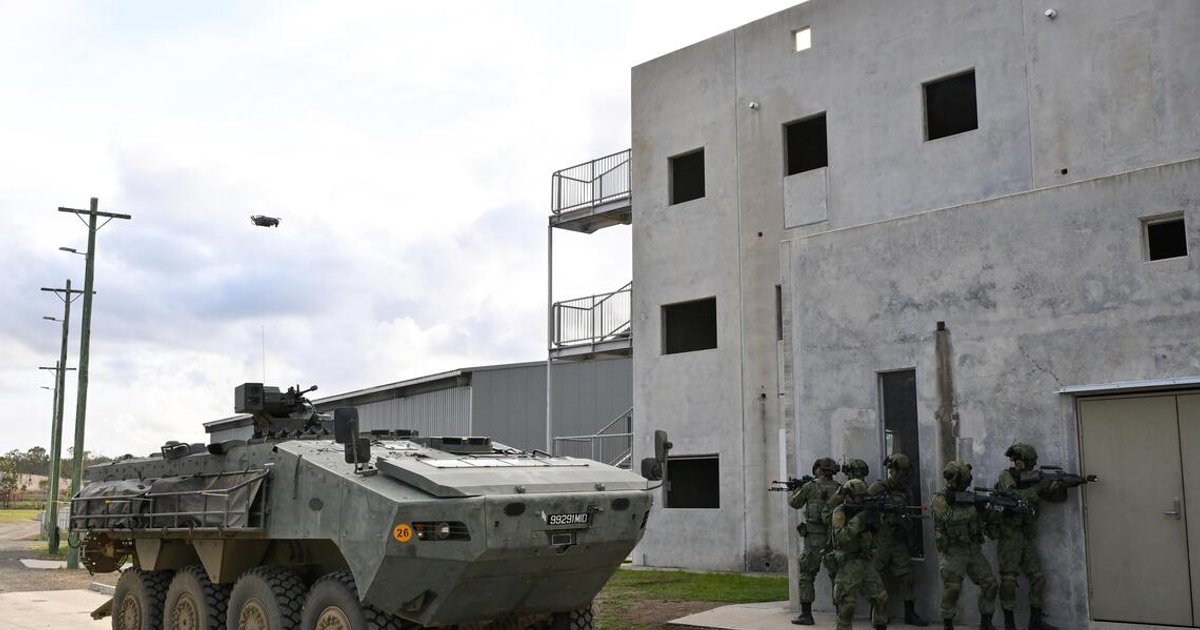
New infantry units will be outfitted with drones and a digital map of the battlefield which will reduce combat risk while boosting their fighting capabilities.
ST PHOTO: LIM YAOHUI
Published Oct 26, 2026, 06:00 PM
Updated Oct 26, 2026, 10:11 PM
The SAF has transformed its active infantry battalions into Next Generation Infantry Battalions, which use drones and a real-time digital map to boost flexibility and safety.
At Exercise Wallaby, 5SIR tested drones such as Vesper, Artos, Ares and the M6F, which help scout, track and attack enemies in urban warfare.
Commanders said the new system gives faster decisions and better battlefield awareness, while still requiring soldiering skills like marksmanship and fitness.
ROCKHAMPTON – The Singapore Armed Forces has reorganised its ground forces into Next Generation Infantry Battalions (NGIBs), which are more versatile and resilient in the field with the help of a suite of drones.
Unveiled on Oct 26 at the ongoing Exercise Wallaby, the transformation means that each NGIB rifle company will consist of more but smaller squads, which gives commanders greater flexibility to organise forces and undertake simultaneous missions.
In addition, each company will have two dedicated Steel Net sections dedicated to drone operations. They will each be equipped with an Artos strike drone, which can home in on an enemy and explode with the firepower of a grenade.
The change to infantry operations embodies the military saying “bots before boots”, which is the strategy of first sending robotic systems into dangerous environments ahead of human soldiers, said the Defence Science and Technology Agency’s director for army technology Dominic Li.
At Exercise Wallaby, soldiers from the Singapore Infantry Regiment’s 5th battalion (5SIR) validated their updated tech during urban operations missions.
The soldiers used a Vesper drone to scope out the presence of hostile forces in a second-storey room from some distance away. This drone is capable of longer-range surveillance of up to 8km, and can fly for close to an hour.
After the drone’s camera system confirmed the presence of enemies, an Artos drone was flown through the open window to neutralise the threat, before soldiers then entered the building to mop up.
Each of the ten sections in an NGIB rifle company are equipped with a pocket-sized Ares drone, which is geared towards short-range surveillance in urban or confined spaces. There is also the M6F quadcopter, which can be flown both indoors and outdoors and is suitable for medium-range reconnaissance.
Soldiers from the Singapore Infantry Regiment’s 5th battalion have already begun incorporating the tech into their urban operations at Exercise Wallaby. ST PHOTO: LIM YAOHUI
Soldiers from the Singapore Infantry Regiment’s 5th battalion have already begun incorporating the tech into their urban operations at Exercise Wallaby.
Despite there being four different unmanned systems, soldiers are able to control them using a single universal controller which can pair with each of the drones. This also means soldiers do not have to relearn how to fly each drone separately.
NGIB soldiers also have greater battlefield awareness through a new Battlefield Management System (Soldier) (BMS), a device which connects users to a shared digital picture of their environment.
About the size of a smartphone, the digital map can be updated in real-time with information that soldiers gather on the ground.
Chief Infantry Officer Brigadier-General Fairoz Hassan said the BMS enables soldiers to fight better on distributed fronts by providing a common platform where information on threats, objects and boundaries can be shared.
“We don’t need to subject our people to the dangers and the risks that they previously had to take,” he said. “Now, we are able to have a larger and longer reach and that helps the survivability of our soldiers.”
The introduction of drone training at the Basic Military Training Centre in 2025 has raised the baseline for the whole army to be familiar with drone operations, he noted.
All active SAF infantry battalions have been converted into NGIBs. The Singapore Army has six active infantry battalions, including 5SIR.
Even with the added tech, the SAF’s enhanced infantry battalions will still emphasise soldiering fundamentals, such as marksmanship, individual fieldcraft and fitness for its men, said Fairoz.
For 5SIR commanding officer Lieutenant-Colonel Shahreel Rajaratnam, the BMS (Soldier) has helped him to make quicker tactical decisions by showing him the frontline through his soldiers’ eyes.
“We can sense-make and pull video feeds from our drones straight into it, giving our commanders that immediate intel turn-around,” he said, adding that this is an improvement from the old method of using voice communications to convey information.
Given that his men have grown up as digital natives with touchscreen devices at their fingertips, they have taken to the new tech naturally, Shahreel added.
Steel Net section commander Third Sergeant Scott Michael Thomas said the array of drones has given soldiers greater peace of mind going into missions.
“Since they know exactly where the enemy are, they know exactly where they can attack,” he said. “It gives us a ‘home ground advantage’ when it comes to these operations.”
MINDEF said the NGIB will continue to evolve to meet changing operational requirements.
Shahreel, the 5SIR commanding officer, described the system as a swiss army knife that gives SAF commanders a bigger toolkit in the field.
“We are able to leverage technology in putting a machine-first approach in all that we do, thereby keeping our soldiers safe and sending machines first in anything that is dangerous or onerous,” he said.
(From top left, clockwise) The Vesper unmanned aerial system, Artos, Ares and M6F quadcopter on display in the Shoalwater Bay Training Area in Queensland, Australia, on Oct 22. ST PHOTO: LIM YAOHUI
(From top left, clockwise) The Vesper unmanned aerial system, Artos, Ares and M6F quadcopter on display in the Shoalwater Bay Training Area in Queensland, Australia, on Oct 22.
The Battlefield Manage System (Soldier) app, which connects users to a shared digital picture of the battlefield. ST PHOTO: LIM YAOHUI
The Battlefield Manage System (Soldier) app, which connects users to a shared digital picture of the battlefield.
Chief Infantry Officer Fairoz Hassan said the NGIB limits the risks soldiers face during high-risk operations. ST PHOTO: LIM YAOHUI
Chief Infantry Officer Fairoz Hassan said the NGIB limits the risks soldiers face during high-risk operations.
Steel Net section commander Scott Michael Thomas, 20, holding the Artos attack drone in the Shoalwater Bay Training Area in Queensland, Australia, on Oct 22. ST PHOTO: LIM YAOHUI
Steel Net section commander Scott Michael Thomas, 20, holding the Artos attack drone in the Shoalwater Bay Training Area in Queensland, Australia, on Oct 22.
5SIR commanding officer Shahreel Rajaratnam said the BMS (Soldier) allows him and commanders to make tactical decisions quicker. ST PHOTO: LIM YAOHUI
5SIR commanding officer Shahreel Rajaratnam said the BMS (Soldier) allows him and commanders to make tactical decisions quicker.
新的步兵部队将配备无人机和战场数字地图,这将降低战斗风险,同时提高其作战能力。
ST 照片:林耀辉
发布于2026年10月26日下午6:00
更新于2026年10月26日晚上10:11
新加坡武装部队已将其现役步兵营转型为新一代步兵营,利用无人机和实时数字地图来提高灵活性和安全性。
在“袋鼠”演习中,第5战略情报团测试了Vesper、Artos、Ares和M6F等无人机,这些无人机有助于在城市战争中侦察、跟踪和攻击敌人。
指挥官们表示,新系统能够加快决策速度,提高战场态势感知能力,同时仍然需要士兵具备射击和体能等技能。
罗克汉普顿——新加坡武装部队已将其地面部队重组为新一代步兵营(NGIB),借助一系列无人机,这些部队在战场上更加灵活多变、更具韧性。
10 月 26 日在正在进行的“袋鼠”演习中,这一变革正式亮相。变革意味着每个 NGIB 步枪连将由更多但规模更小的班组成,这使得指挥官在组织部队和执行同时进行的任务方面拥有更大的灵活性。
此外,每家公司都将设立两个专门负责无人机作战的“钢铁网”小队。每个小队都将配备一架“阿托斯”攻击无人机,该无人机能够追踪敌人并引爆,其火力堪比手榴弹。
国防科技局陆军技术主管李多米尼克表示,步兵作战方式的改变体现了军方“机器人先于士兵”的策略,即先将机器人系统派往危险环境,然后再派出士兵。
在“袋鼠”演习中,新加坡步兵团第5营(5SIR)的士兵在城市作战任务中验证了他们升级后的技术。
士兵们使用一架“维斯珀”无人机从远处侦察二楼房间内敌军的动向。这种无人机能够进行最远8公里的远程侦察,并且可以飞行近一个小时。
在无人机的摄像头系统确认有敌人存在后,一架 Artos 无人机飞入敞开的窗户消除威胁,然后士兵进入建筑物进行清剿。
NGIB步枪连的十个排都配备了一架袖珍型Ares无人机,主要用于城市或狭小空间内的短程侦察。此外,还有M6F四旋翼无人机,可在室内外飞行,适用于中程侦察。
新加坡步兵团第五营的士兵已开始在“袋鼠行动”演习中将这项技术运用到城市作战中。(海峡时报照片:林耀辉)
新加坡步兵团第5营的士兵已经开始在“袋鼠”演习中将这项技术应用到他们的城市作战行动中。
尽管有四种不同的无人系统,士兵们可以使用一个通用控制器来控制它们,该控制器可以与每架无人机配对。这也意味着士兵们无需分别重新学习如何操控每架无人机。
NGIB 士兵还可以通过新的战场管理系统(士兵)(BMS)获得更强的战场感知能力,该系统可将用户连接到其环境的共享数字图像。
这款数字地图大小与智能手机相仿,可以根据士兵在地面收集的信息实时更新。
步兵司令费罗兹·哈桑准将表示,BMS 提供了一个可以共享威胁、目标和边界信息的通用平台,使士兵能够在分散的战线上更好地作战。
他说:“我们不必再让我们的士兵承受以前不得不承担的危险和风险。现在,我们的作战范围更广、射程更远,这有助于提高我们士兵的生存率。”
他指出,2025 年在基础军事训练中心引入无人机训练,提高了全军熟悉无人机操作的基本水平。
新加坡武装部队所有现役步兵营均已改编为国民警卫队步兵营。新加坡陆军目前有六个现役步兵营,其中包括第5步兵营。
费罗兹表示,即使增加了技术,新加坡武装部队增强后的步兵营仍将强调士兵的基本技能,例如射击、个人野战技能和体能。
对于第 5 特种步兵团指挥官沙赫里尔·拉贾拉特南中校来说,BMS(士兵)通过士兵的视角向他展示了前线情况,帮助他更快地做出战术决策。
“我们可以直接将无人机的视频流导入系统,为指挥官提供即时的情报反馈,”他说道,并补充说,这比以前使用语音通信传递信息的方式有所改进。
沙赫里尔补充说,鉴于他的队员们从小就是数字原住民,触屏设备就在他们手中,他们很自然地就接受了这项新技术。
钢铁网部队指挥官三等军士长斯科特·迈克尔·托马斯表示,无人机的出现让士兵们在执行任务时更加安心。
他说:“由于他们确切地知道敌人在哪里,所以他们也确切地知道在哪里可以发起攻击。这使我们在这些行动中拥有‘主场优势’。”
国防部表示,国家地质情报局将不断发展以满足不断变化的作战需求。
5SIR 指挥官 Shahreel 将该系统描述为一把瑞士军刀,为新加坡武装部队指挥官在战场上提供了更大的工具包。
他说:“我们能够利用科技,在所有工作中采取机器优先的方式,从而保障士兵的安全,并在任何危险或繁重的任务中优先派遣机器。”
(从左上角顺时针方向)10月22日,在澳大利亚昆士兰州肖尔沃特湾训练区展出的Vesper无人机系统、Artos、Ares和M6F四旋翼飞行器。(海峡时报摄影:林耀辉)
(从左上角顺时针方向)10 月 22 日,在澳大利亚昆士兰州肖尔沃特湾训练区展出的 Vesper 无人机系统、Artos、Ares 和 M6F 四旋翼飞行器。
战场管理系统(士兵)应用程序,可将用户连接到共享的战场数字图像。ST PHOTO:林耀辉
战场管理系统(士兵)应用程序,将用户连接到共享的战场数字图像。
步兵总军官费罗兹·哈桑表示,国民警卫队步兵营(NGIB)能够降低士兵在高风险行动中面临的风险。(海峡时报照片:林耀辉)
首席步兵军官费罗兹·哈桑表示,NGIB 可以降低士兵在高风险行动中面临的风险。
10月22日,在澳大利亚昆士兰州肖尔沃特湾训练区,20岁的“钢铁网”部队指挥官斯科特·迈克尔·托马斯手持Artos攻击无人机。(海峡时报摄影:林耀辉)
10 月 22 日,20 岁的“钢铁之网”小队指挥官斯科特·迈克尔·托马斯在澳大利亚昆士兰州肖尔沃特湾训练区手持 Artos 攻击无人机。
第5步兵团指挥官沙赫里尔·拉贾拉特南表示,士兵作战管理系统(BMS)使他和指挥官们能够更快地做出战术决策。(海峡时报照片:林耀辉)
5SIR指挥官沙赫里尔·拉贾拉特南表示,BMS(士兵)系统使他和指挥官能够更快地做出战术决策。