Singapore, Germany to expand industrial AI cooperation as part of updated 5-pillar work plan新加坡和德国将扩大工业人工智能合作,作为更新后的五大支柱工作计划的一部分。
At a joint press conference with German Chancellor Friedrich Merz, who is on an official visit to Singapore, Prime Minister Lawrence Wong said that there is “much more” both countries can do together under their strategic partnership.
At a joint press conference with German Chancellor Friedrich Merz, who is on an official visit to Singapore, Prime Minister Lawrence Wong said that there is “much more” both countries can do together under their strategic partnership.
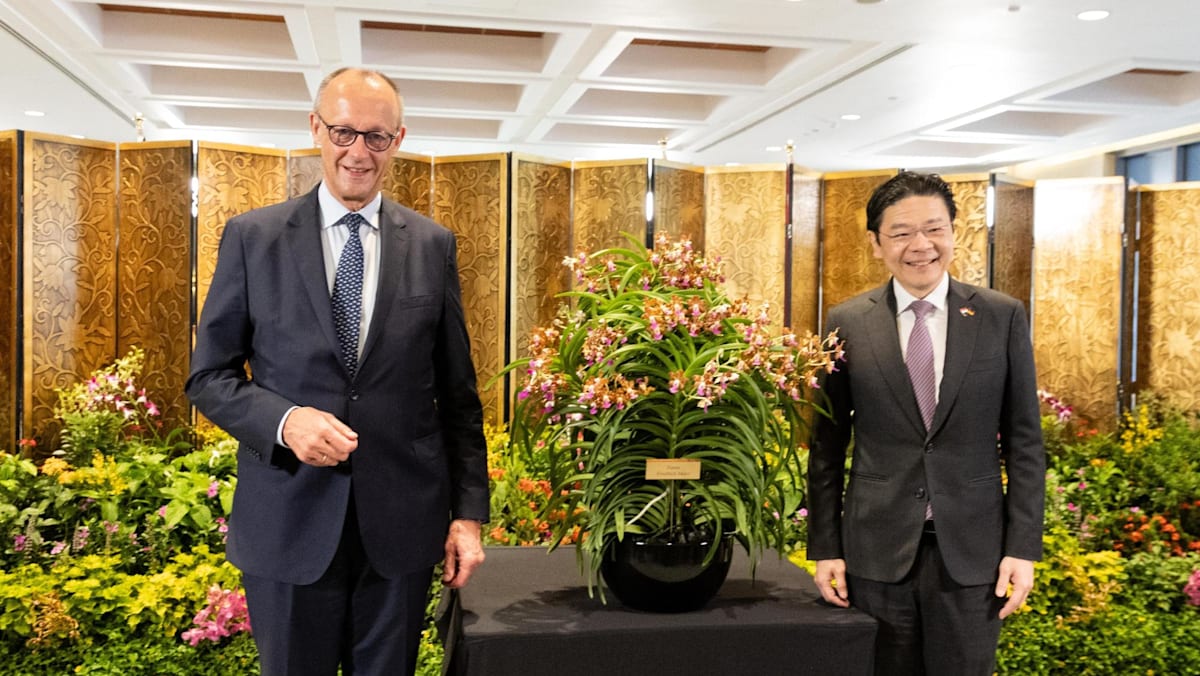
Germany Chancellor Friedrich Merz and Prime Minister Lawrence Wong during an orchid naming ceremony at the Parliament House on Oct 27, 2026. (Photo: CNA/Ili Mansor)
This audio is generated by an AI tool.
SINGAPORE: Singapore and Germany will make industrial artificial intelligence (AI) a bigger part of their economic partnership as part of an updated five-pillar work plan spanning security, trade and energy, the leaders of both nations said on Tuesday (Oct 27).
Speaking at a joint press conference at Parliament House with German Chancellor Friedrich Merz, Singapore Prime Minister Lawrence Wong said Singapore and Germany recognise the “enormous potential” of digital technologies and AI to transform economies.
AI can also create new opportunities for businesses and workers, he said, adding that the EU-Singapore Digital Trade Agreement that was signed in 2025 provides a foundation for cross-border digital transactions.
To this end, Mr Wong said both countries “now want to go further”.
“Particularly in the development and deployment of industrial AI, where the strengths of our two countries can complement each other,” he said.
Industrial AI is the application of machine learning, computer vision, and autonomous systems to physical operations, manufacturing plants, energy systems and supply chains.
Mr Merz, who is in Singapore for a two-day official visit, noted in German the high volume of international trade that passes through the region, describing it as an area where political, economic and technological forces are at play.
He said that he is visiting Singapore to deepen partnerships against this backdrop, noting that Germany also wants to have a say in major technological innovations.
The visit is his first since he was elected chancellor in 2025.
CNA Games Guess Word Crack the word, one row at a time Buzzword Create words using the given letters Mini Sudoku Tiny puzzle, mighty brain teaser Mini Crossword Small grid, big challenge Word Search Spot as many words as you can Show More Show Less
Germany Chancellor Friedrich Merz and Prime Minister Lawrence Wong at the Parliament House on Oct 27, 2026. (Photo: CNA/Ili Mansor)
Both countries elevated relations to a strategic partnership in November 2024, share strong economic and defence ties, and are mutual partners in advancing multilateralism. Among European Union nations, Germany is Singapore’s largest trading partner in goods and the third largest in services.
“Chancellor Merz and I both agree that there is much more we can do together under our strategic partnership,” said Mr Wong, adding that both countries have also agreed to the updated joint work plan.
The plan includes initiatives across five pillars:
Political, defence, security and intelligence
Trade, investment, transport, and urban development
Digitalisation and artificial intelligence
Research, science, technology, and innovation
Energy transition, green economy and climate
On trade, both countries will encourage economic collaboration through the Germany-Singapore Framework for Sustainability and Innovation (FSI), including exchanges on issues of mutual interest.
On the security front, for example, both countries will continue to deepen military-to-military cooperation and defence exchanges in digitalisation and cybersecurity, research and development and innovation, armament, and service and maintenance. The plan also includes ways to intensify collaboration opportunities between the Singapore Armed Forces and the Bundeswehr.
On energy, the plan aims to support the development of the ASEAN Power Grid through commercial participation in renewable energy and grid interconnection projects, including via existing bilateral trade promotion platforms and industry networks.
In February, both countries announced an ongoing “year of innovation” initiative, which placed AI and future technologies such as quantum, microelectronics and biotechnology as key focus areas, among other things.
"Singapore intends to build momentum and pursue more joint research and innovation projects in areas such as AI, advanced manufacturing, green technologies, semiconductors, quantum and space technologies," said Mr Wong.
At the same time, Singapore and Germany both recognise that AI poses new risks and challenges, he added.
"So even as we both cooperate on AI deployment, we can ensure that this is done in a way that remains safe, trusted and human-centred," said Mr Wong.
Prime Minister Lawrence Wong welcomes Germany Chancellor Friedrich Merz at the Parliament House on Oct 27, 2026. (Photo: CNA/Ili Mansor)
COMMITTED TO COOPERATION
Mr Wong said both countries share many common interests and convictions that have underpinned their friendship over the past six decades despite Singapore and Germany being "geographically far apart".
These shared convictions will bring the two countries closer together in a world that is becoming more uncertain and fragmented, he added.
"Singapore and Germany are both deeply connected to the global economy. We depend on open markets and strong international partnerships," said Mr Wong.
"The zeitgeist is turning against openness and trade. But our response cannot be to turn inwards. Instead, we want to work with like-minded partners to build new connections," said Mr Wong.
To this, Mr Wong said Singapore and Germany are "natural partners" in upholding the international rules-based order.
"We believe that countries, large and small, benefit from a world where rules are respected, commitments are honoured, and disputes are resolved peacefully.”
He then cited Germany’s endorsement of the Guiding Principles for Underwater Infrastructure Defence Exchanges (GUIDE), a voluntary framework by 17 nations including Singapore to safeguard critical underwater infrastructure, such as telecommunications, energy and pipeline systems.
GUIDE is one practical example of how countries can work together to support multilateral frameworks and initiatives, said Mr Wong.
Germany became an ASEAN Sectoral Dialogue Partner in July. Mr Wong said this marked an important step towards strengthening ties between Germany and Southeast Asia.
"As ASEAN Chair next year, Singapore will work to deepen ASEAN’s partnerships with both Germany and the EU (European Union), including by making progress towards an ASEAN-EU Free Trade Agreement," said Mr Wong.
ASEAN and the EU will also mark 50 years of Dialogue Relations during Singapore’s ASEAN Chairmanship next year.
Following the joint press conference, Mr Merz will be calling on President Tharman Shanmugaratnam and be hosted to lunch by Senior Minister Lee Hsien Loong.
In the afternoon, Mr Merz will deliver the 49th Singapore Lecture, organised by the ISEAS-Yusof Ishak Institute.
Mr Wong will also host a dinner in the chancellor’s honour.
Get our pick of top stories and thought-provoking articles in your inbox
Stay updated with notifications for breaking news and our best stories
Join our channel for the top reads for the day on your preferred chat app
在与正在新加坡进行正式访问的德国总理弗里德里希·默茨举行的联合新闻发布会上,新加坡总理黄循财表示,两国在战略伙伴关系框架下还有“更多”可以共同做的事情。
2026年10月27日,德国总理弗里德里希·默茨和加拿大总理黄循财在国会大厦出席兰花命名仪式。(图片:CNA/Ili Mansor)
这段音频是由人工智能工具生成的。
新加坡:新加坡和德国领导人周二(10月27日)表示,作为一项涵盖安全、贸易和能源的更新版五大支柱工作计划的一部分,两国将使工业人工智能(AI)成为其经济伙伴关系中更重要的一部分。
新加坡总理黄循财在国会大厦与德国总理弗里德里希·默茨举行的联合新闻发布会上表示,新加坡和德国都认识到数字技术和人工智能在改变经济方面具有“巨大潜力”。
他还表示,人工智能还可以为企业和劳动者创造新的机会,并补充说,2025年签署的欧盟-新加坡数字贸易协定为跨境数字交易奠定了基础。
为此,黄先生表示,两国“现在都希望更进一步”。
“尤其是在工业人工智能的开发和部署方面,我们两国的优势可以互补,”他说道。
工业人工智能是将机器学习、计算机视觉和自主系统应用于物理操作、制造工厂、能源系统和供应链。
正在新加坡进行为期两天正式访问的梅尔茨先生用德语指出,该地区的国际贸易量巨大,并将其描述为政治、经济和技术力量相互作用的地区。
他表示,此次访问新加坡是为了在这种背景下深化合作关系,并指出德国也希望在重大技术创新中拥有发言权。
这是他自 2025 年当选总理以来的首次访问。
CNA游戏 猜词游戏 逐行破解单词 流行词游戏 用给定的字母组成单词 迷你数独 小小谜题,挑战你的大脑 迷你填字游戏 小方格,大挑战 单词搜索 尽可能多地找出单词 显示更多 显示更少
2026年10月27日,德国总理弗里德里希·默茨与加拿大总理黄循财在国会大厦会面。(图片:CNA/Ili Mansor)
两国于2024年11月将关系提升为战略伙伴关系,拥有牢固的经济和防务联系,并在推进多边主义方面互为合作伙伴。在欧盟国家中,德国是新加坡最大的货物贸易伙伴和第三大服务贸易伙伴。
黄先生表示:“我和默茨总理都认为,在我们的战略伙伴关系框架下,我们可以做更多的事情。”他还补充说,两国也已同意更新后的联合工作计划。
该计划包含五大支柱领域的各项举措:
政治、国防、安全和情报
贸易、投资、交通和城市发展
数字化和人工智能
研究、科学、技术和创新
能源转型、绿色经济和气候
在贸易方面,两国将通过德新可持续发展与创新框架(FSI)鼓励经济合作,包括就共同关心的问题进行交流。
例如,在安全领域,两国将继续深化军事合作和防务交流,涵盖数字化和网络安全、研发创新、武器装备以及服务和维护等领域。该计划还包括加强新加坡武装部队与德国联邦国防军之间合作机会的途径。
在能源方面,该计划旨在通过参与可再生能源和电网互联项目(包括通过现有的双边贸易促进平台和行业网络)来支持东盟电网的发展。
今年2月,两国宣布启动“创新年”计划,将人工智能和量子、微电子、生物技术等未来技术列为重点关注领域。
黄先生表示:“新加坡打算在人工智能、先进制造、绿色技术、半导体、量子和空间技术等领域积蓄力量,开展更多联合研究和创新项目。”
他补充说,与此同时,新加坡和德国都认识到人工智能带来了新的风险和挑战。
“因此,即使我们在人工智能部署方面进行合作,我们也可以确保这项工作以安全、可信和以人为本的方式进行,”黄先生说。
2026年10月27日,总理黄循财在国会大厦迎接德国总理默茨。(图片:中央社/伊利·曼苏尔)
致力于合作
黄先生表示,尽管新加坡和德国“地理位置相距遥远”,但两国拥有许多共同的利益和信念,这些都巩固了两国过去六十年的友谊。
他补充说,这些共同的信念将使两国在一个日益不确定和分裂的世界中更加紧密地联系在一起。
黄先生表示:“新加坡和德国都与全球经济紧密相连。我们依赖开放的市场和强大的国际伙伴关系。”
黄先生表示:“时代精神正在转向反对开放和贸易。但我们不能闭关锁国。相反,我们希望与志同道合的伙伴合作,建立新的联系。”
对此,黄先生表示,新加坡和德国是维护以规则为基础的国际秩序的“天然伙伴”。
“我们认为,在一个规则得到尊重、承诺得到履行、争端得到和平解决的世界里,无论大小国家都能从中受益。”
然后,他提到德国对《水下基础设施防御交流指导原则》(GUIDE)的支持,该原则是由包括新加坡在内的 17 个国家自愿制定的框架,旨在保护电信、能源和管道系统等关键水下基础设施。
黄先生表示,GUIDE是各国如何携手支持多边框架和倡议的一个实际例子。
德国于7月成为东盟部门对话伙伴。黄先生表示,这标志着德国与东南亚关系加强的重要一步。
黄先生表示:“新加坡作为明年的东盟轮值主席国,将致力于深化东盟与德国和欧盟(欧洲联盟)的伙伴关系,包括在东盟-欧盟自由贸易协定方面取得进展。”
明年新加坡担任东盟轮值主席国期间,东盟和欧盟也将庆祝建立对话关系50周年。
联合新闻发布会结束后,默兹先生将拜会总统尚达曼,并由高级部长李显龙款待共进午餐。
下午,梅尔茨先生将发表由尤索夫伊萨克东南亚研究院组织的第49届新加坡讲座。
黄先生还将举办晚宴,以款待财政大臣。
订阅我们的邮件,即可获取精选热点新闻和引人深思的文章。
订阅通知,第一时间获取突发新闻和精彩报道。
加入我们的频道,即可在您常用的聊天应用上获取当日热门文章。