SKH, NUH save more $1.1m in annual energy costs with innovations in operating theatres圣文森特医院 (SKH) 和新加坡国立大学医院 (NUH) 通过手术室创新,每年节省超过 110 万美元的能源成本。
Singapore healthcare clusters commit to greener clinical care, with operating theatre changes and sustainability awards cutting energy use and costs. Read more at straitstimes.com.
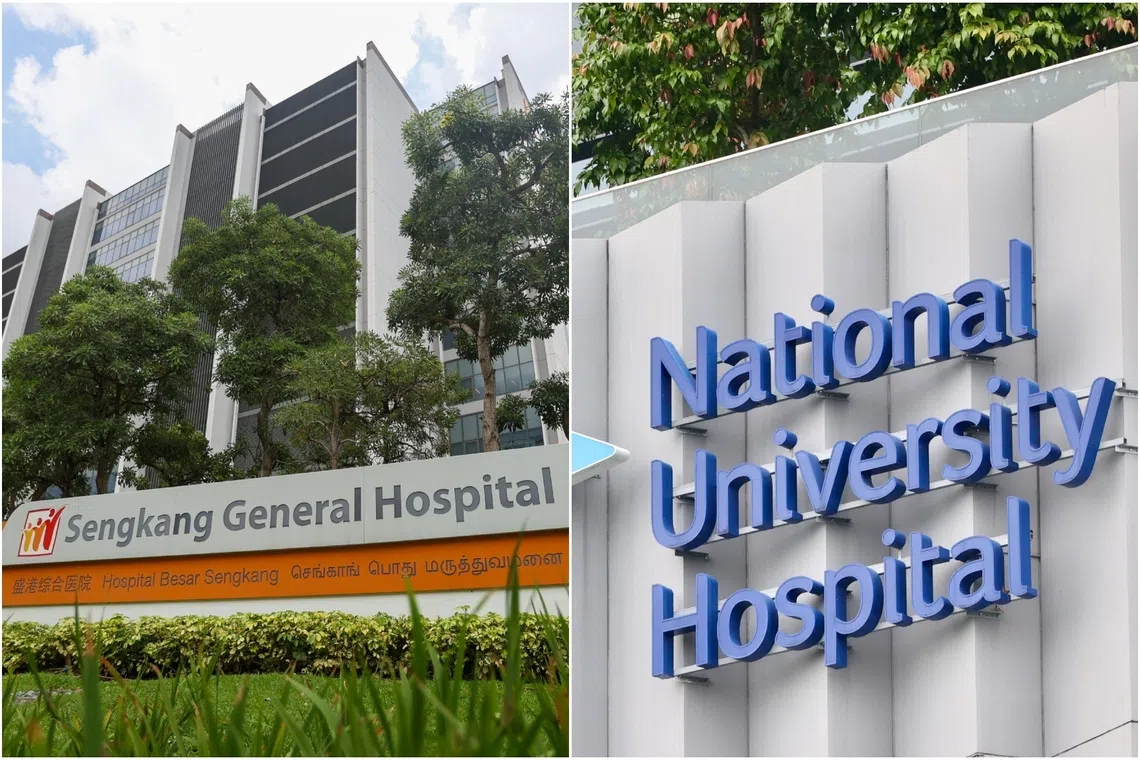
The projects from SKH and NUH each received the Sustainability Star Award at a competition held in conjunction with the Singapore Healthcare Sustainability Symposium on Oct 27.
PHOTOS: JASEL POH, LIANHE ZAOBAO
Published Oct 27, 2026, 09:00 PM
Updated Oct 27, 2026, 09:00 PM
Singapore healthcare clusters are cutting hospital emissions through greener operating theatres and lower-carbon care, while keeping patient safety and outcomes unchanged.
Sengkang General Hospital and National University Hospital saved more than 4.5 GWh a year and over $1.1 million, winning Sustainability Star Awards for scalable energy cuts.
The three clusters will expand reusable products, recycling and green procurement, as Singapore pushes to reduce healthcare waste and emissions across the supply chain.
SINGAPORE – Sengkang General Hospital (SKH) and National University Hospital (NUH) have introduced energy-saving innovations in their operating theatres that reduced their power bills by more than $1.1 million every year.
The two projects each received the Sustainability Star Award at a competition held in conjunction with the Singapore Healthcare Sustainability Symposium on Oct 27.
Singapore’s three public health clusters submitted 150 entries to the competition on the theme Low Carbon Healthcare. Projects were evaluated on criteria such as environmental impact and potential for scalability across healthcare settings.
Operating theatres are among the most energy-intensive areas in acute care, using up to six times more energy than standard hospital wards due to needs such as ventilation and air-conditioning.
Working with infection control specialists, a team from SKH introduced a recirculated air-conditioning system between 8pm and 6am across 28 operating rooms at the hospital in 2025.
Unlike conventional air-conditioning, where air is drawn from outside a room, a recirculated air-conditioning filters and cools air that is already inside the room, thus requiring less energy.
SKH’s enhancement has reduced its annual energy consumption by 3.38 gigawatt-hours ( GWh) – equivalent to the monthly electricity use of 12,000 four-room HDB flats – without compromising patient safety. Power bill is cut by $818,000.
At NUH, a team implemented operational changes that reduced energy required for ventilation systems during lull periods across 26 operating theatres at NUH, while maintaining continuous control of temperature, humidity and room pressure.
This has helped the hospital save 1,123,200 kilowatt-hours and $300,000 in recurring costs annually, as well as reduce CO2 emissions by 456 tonnes a year. The reduction in energy consumption is equivalent to the annual electricity use of 270 four-room HDB flats.
The competition’s Big Impact award went to a team from Woodlands Hospital, where clinicians developed a risk stratification framework to reduce tuberculosis (TB) patients’ usage of isolation rooms, while maintaining infection control standards.
This has freed up isolation rooms by an estimated 652 bed-days annually, resulting in $620,400 in combined recurring savings and cost avoidance.
Held at Woodlands Hospital, the symposium also saw Singapore’s three public healthcare clusters – NHG Health, the National University Health System and SingHealth – commit to accelerating greener clinical care.
This includes exploring the use of lower-carbon alternatives while maintaining patient care standards, as well as reducing the use of tests and treatments which do not improve patient outcomes, said Senior Minister of State for Sustainability and the Environment Janil Puthucheary, who attended the event.
(Back row, from left) National University Health System group chief operating officer Jeffrey Chun, SingHealth group director for sustainability Chow Wan Cheng, Senior Minister of State for Sustainability and the Environment Janil Puthucheary, NHG Health group chief executive officer Joe Sim, and Kwong Wai Hsiu Hospital chief executive officer Mok Ying Jang with children from Learning Vision pre-school on Oct 27. PHOTO: NHG HEALTH
(Back row, from left) National University Health System group chief operating officer Jeffrey Chun, SingHealth group director for sustainability Chow Wan Cheng, Senior Minister of State for Sustainability and the Environment Janil Puthucheary, NHG Health group chief executive officer Joe Sim, and Kwong Wai Hsiu Hospital chief executive officer Mok Ying Jang with children from Learning Vision pre-school on Oct 27.
He noted that since 2019, hospitals here have reduced the use of desflurane and nitrous oxide – greenhouse gases used as anaesthetics – by 45% and 35% respectively without affecting patient outcomes.
In July, Changi General Hospital became the first hospital in Singapore to eliminate the use of desflurane in all surgical procedures.
Local hospitals and clinics emit 4.1 million tonnes of greenhouse gases each year, or about 7% per cent of the country’s emissions, according to a study by the NUS Yong Loo Lin School of Medicine and the Ministry of Health which was published in 2025.
Globally, the healthcare industry is responsible for about 5% of greenhouse gas emissions per year, Janil noted . While the carbon intensity of Singapore’s healthcare system is about 20% lower than those in other advanced economies, there is still more that can be done, he said.
The clusters have also committed to strengthen circular economy in healthcare, referring to a model that aims to reduce waste and keep materials in use for as long as possible.
“The three clusters will increase the use of reusable products, improve waste separation at source, and expand the recycling of materials such as stainless steel, linen and plastics,” said Janil, who is also Senior Minister of State for Education.
He added that this circularity should extend beyond hospitals to the healthcare supply chain.
In line with this, the first green procurement course designed specifically for healthcare will be launched by the Centre for Healthcare Innovation’s Sustainability Academy, along with the Agency for Logistics and Procurement Services and consulting and investment advisory firm NanRise.
The one-day course, which will begin in April 2027, will help healthcare professionals consider sustainability “more systematically in purchasing decisions, alongside cost, quality and clinical needs”, said Janil.
NHG Health group chief executive Joe Sim said the progression of sustainability in healthcare requires more than individual efforts.
“Such collective commitment helps us set new benchmarks for sustainable healthcare, and safeguard both health and the environment for future generations,” he said.
Zhaki Abdullah is a correspondent at The Straits Times. He is on the health beat, in addition to occasionally covering science, environmental, tech and Muslim affairs issues.
在 10 月 27 日与新加坡医疗保健可持续发展研讨会同期举行的比赛中,SKH 和 NUH 的项目均获得了可持续发展之星奖。
照片:JASEL POH、联合早报
发布于2026年10月27日晚上9点
更新于2026年10月27日晚上9点
新加坡的医疗保健集群正在通过更环保的手术室和低碳护理来减少医院排放,同时保持患者安全和治疗效果不变。
盛港综合医院和新加坡国立大学医院每年节省超过 4.5 吉瓦时和 110 万美元,因其可扩展的节能措施而荣获可持续发展之星奖。
这三个产业集群将扩大可重复使用产品、回收利用和绿色采购,以推动新加坡减少整个供应链的医疗废物和排放。
新加坡——盛港综合医院 (SKH) 和新加坡国立大学医院 (NUH) 在其手术室引入了节能创新技术,每年可节省超过 110 万美元的电费。
这两个项目在 10 月 27 日与新加坡医疗保健可持续发展研讨会同期举办的比赛中分别获得了可持续发展之星奖。
新加坡三大公共卫生集群共提交了150份以“低碳医疗”为主题的参赛作品。项目评估标准包括环境影响和在不同医疗机构中推广应用的潜力。
手术室是急症护理中最耗能的区域之一,由于通风和空调等需求,其耗能是普通病房的六倍。
2025 年,SKH 的一个团队与感染控制专家合作,在医院的 28 个手术室中引入了循环空调系统,该系统在晚上 8 点至早上 6 点之间运行。
与从室外吸入空气的传统空调不同,循环式空调过滤并冷却室内已有的空气,因此需要的能源更少。
圣公会医院的升级改造使其年度能耗降低了3.38吉瓦时(GWh),相当于12000套四房式组屋的月用电量,且未影响患者安全。电费也因此节省了81.8万新元。
在新加坡国立大学医院 (NUH),一个团队实施了运营变更,在 26 个手术室的空闲时段减少了通风系统所需的能源,同时保持了对温度、湿度和房间压力的持续控制。
这使得医院每年节省了112.32万千瓦时的电力和30万美元的经常性成本,并减少了456吨二氧化碳排放。减少的能源消耗相当于270套四房式组屋的年用电量。
本次比赛的“重大影响奖”颁给了伍德兰兹医院的一个团队,该团队的临床医生制定了一个风险分层框架,以减少结核病 (TB) 患者使用隔离病房的情况,同时保持感染控制标准。
据估计,这每年可腾出 652 个隔离病床日,从而节省 620,400 美元的经常性开支和避免成本。
此次研讨会在兀兰医院举行,新加坡的三大公共医疗保健集团——NHG Health、国立大学医疗系统和新加坡保健集团——也承诺加快推进绿色临床护理。
出席活动的永续发展与环境部高级政务部长贾尼尔·普图切里表示,这包括在保持患者护理标准的同时探索使用低碳替代方案,以及减少使用不能改善患者预后的检查和治疗。
(后排,从左至右)新加坡国立大学医疗系统集团首席运营官Jeffrey Chun、新加坡保健集团可持续发展总监周婉贞、永续发展及环境部高级政务部长Janil Puthucheary、NHG Health集团首席执行官Joe Sim以及广惠秀医院首席执行官莫英章于10月27日与来自Learning Vision幼儿园的孩子们合影。照片:NHG Health
(后排,从左至右)新加坡国立大学医疗系统集团首席运营官Jeffrey Chun、新加坡保健集团可持续发展总监周婉贞、永续发展及环境部高级政务部长Janil Puthucheary、NHG Health集团首席执行官Joe Sim和广惠秀医院首席执行官莫英章与Learning Vision幼儿园的孩子们于10月27日合影。
他指出,自 2019 年以来,这里的医院已将地氟醚和一氧化二氮(用作麻醉剂的温室气体)的使用量分别减少了 45% 和 35%,而没有影响患者的治疗效果。
7 月,樟宜综合医院成为新加坡第一家在所有外科手术中停止使用地氟醚的医院。
根据新加坡国立大学杨潞琳医学院和卫生部于 2025 年发布的一项研究,当地医院和诊所每年排放 410 万吨温室气体,约占该国排放量的 7%。
贾尼尔指出,全球医疗保健行业每年约占温室气体排放量的5%。他表示,虽然新加坡医疗保健系统的碳排放强度比其他发达经济体低约20%,但仍有许多工作可以做。
这些集群还致力于加强医疗保健领域的循环经济,指的是一种旨在减少浪费并尽可能长时间地保持材料使用状态的模式。
“这三个集群将增加可重复使用产品的使用,改善源头垃圾分类,并扩大不锈钢、亚麻布和塑料等材料的回收利用,”贾尼尔说道,他同时也是教育部高级国务部长。
他还补充说,这种循环性应该从医院扩展到医疗保健供应链。
为此,医疗创新中心可持续发展学院将联合物流和采购服务机构以及咨询和投资顾问公司 NanRise,推出首个专门为医疗保健行业设计的绿色采购课程。
贾尼尔表示,这项将于 2027 年 4 月开始的为期一天的课程将帮助医疗保健专业人员“在采购决策中,除了成本、质量和临床需求之外,更系统地考虑可持续性”。
NHG Health集团首席执行官Joe Sim表示,医疗保健领域可持续发展的进程需要的不仅仅是个人的努力。
他说:“这种集体承诺有助于我们为可持续医疗保健设定新的标准,并为子孙后代保护健康和环境。”
扎基·阿卜杜拉是《海峡时报》的记者。他主要负责健康新闻报道,偶尔也报道科学、环境、科技和穆斯林事务等议题。