Green wall of Singapore teeming with life新加坡生机勃勃的绿色墙
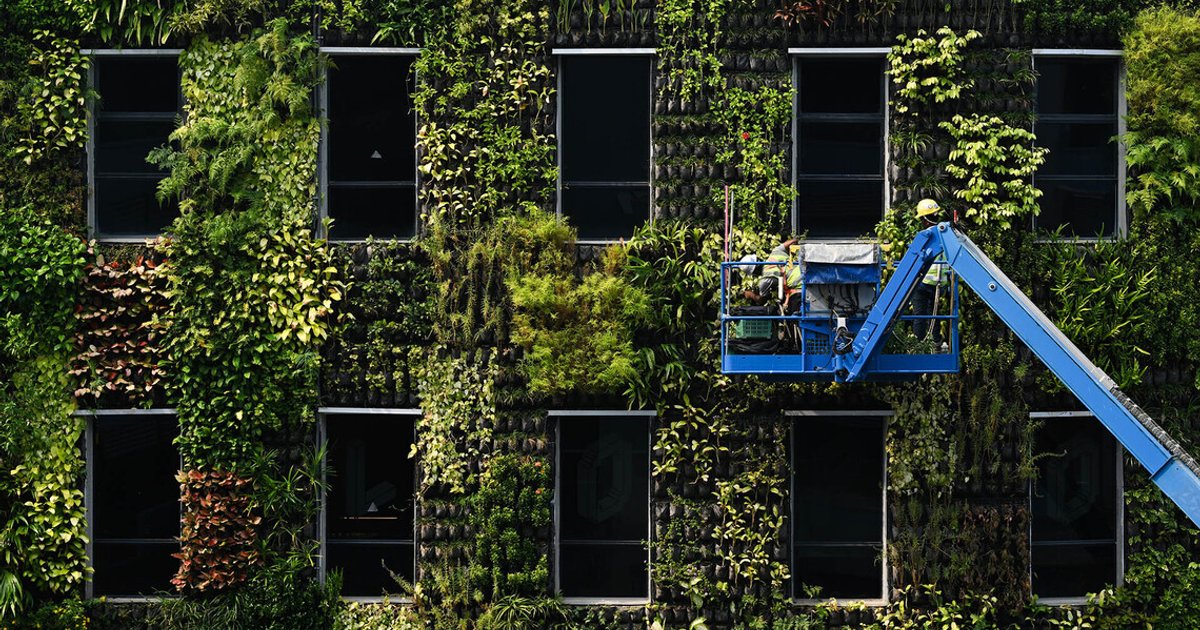
The Asia-Pacific’s most biodiverse living green wall, located in one-north, features 400 plant species and cultivars grown across four storeys of a building. It is a laboratory for vertical greenery solutions in Singapore’s tropical climate. Read more at straitstimes.com.
新闻视频
Published: Oct 28, 2026, 05:00 AM
Over 37,000 plants are growing on the wall of a four-storey building in Ayer Rajah Crescent.
The wall is designed as a living test bed for new planting approaches, installation and maintenance methods, and environmental performance in Singapore’s urban conditions.
Data generated by the wall will provide practical insights for the architects, developers and planners deciding how nature can be integrated into dense city spaces.
“Let’s say you got this wall, (but) you haven’t even thought of doing a green wall. You just draw it up and (indicate where it is) east-facing or north-facing. (Using the data), we can automatically churn out what your light level is at different levels, and propose to you what species that have been tried before. Once you input the correct type of plant, we auto-generate the green wall for you to have a look,” said Zac Toh, founder of GWS Living Art, the company behind the green wall.
Zac Toh, founder of GWS Living Art, at Vidacity @ one-north on Sept 21.
His aim is to develop a free AI tool for everyone based on all the data collected from the research after two or three years.
The living green wall, to be launched on Oct 30, is located at Vidacity @ one-north at Block 69 Ayer Rajah Crescent.
Horticulture workers from GWS Living Art installing plants on the green wall, which has a total area of 1,035.4 sq m spanning four storeys.
Its total area is 1,035.4 sq m, about one-sixth the size of a standard football field, covering about 68% of the four-storey building.
The green wall at Vidacity @ one-north is designed as a living test bed for new planting approaches, installation and maintenance methods, and environmental performance in Singapore’s urban conditions.
The tens of thousands of plants comprise 400 naturally occurring species and cultivated varieties specially selected for features such as colourful foliage, distinctive shapes and flowers.
Horticulture workers from GWS Living Art unloading bags of plants taken from the nursery for installation on the green wall.
Some of the cultivars include Lemon Swirl ( Lantana camara ‘Samantha’), Indian Laurel Fig ( Ficus microcarpa ‘Golden’) and Brazilian Snowflower ( Alternanthera ficoidea ‘Snow on the Mountain’).
Various plants on the living green wall at Vidacity @ one-north include Lemon Swirl (yellow), Narrowleaf Angelon (purple) and Thornless Crown of Thorns (red).
It is the most diverse living green wall in the Asia-Pacific, according to GWS Living Art.
Australia’s One Central Park’s green wall in Sydney is known to have 350 different species .
The vertical garden at One Central Park in Sydney designed by French botanist Patrick Blanc. The building is designed by architect Jean Nouvel. PHOTO: PATRICK BLANC
Associate Professor Adrian Loo, deputy director at the NUS Centre for Nature-based Climate Solutions, is helping to verify the cultivars for Vidacity using botanical descriptions, guides and taxonomic keys, together with other botanical experts who may be specialised in particular families of plants.
Supervisor Velu Sengamalam removing a plastic bag holding soil from a plant before installing the plant on the green wall from a boom lift.
The plants are grown on the green wall in a “soilless” medium mix of cocopeat, pumice stone, perlite and peat moss.
The wall uses GWS Living Art’s proprietary GaiaWall system, which requires maintenance only every two to three months and is easy to install on sloped and curved surfaces of building facades, as well as automated irrigation and monitoring technology.
Supervisor Velu operating the boom lift and installing the plants on the green wall of Vidacity @ one-north.
Among other tests carried out on the wall, the growth of the 400 plant species and cultivars in different light and environmental conditions is under study.
There are a few surprises.
Plants like the Spicy Jatropha ( Jatropha integerrima ), Cherry Shrub ( Memecylon pauciflorum ) and Ixora are shrubby and their roots normally do not adapt well to a vertical system. But they seem to be surviving on the green wall.
A bee attracted by the flower of the Spicy Jatropha that is growing on the green wall at Vidacity @ one-north.
Vidacity was formerly Ayer Rajah Amenity Centre, built in the 1970s to provide essential services and food to the industrial estate community.
As part of JTC’s LaunchPad @ One-North transformation, older buildings like this are being repurposed.
The former Ayer Rajah Amenity Centre on Dec 7, 2023. PHOTO: JTC
Vidacity @ one-north, a dedicated sustainability innovation hub, was officially launched on April 15, 2026.
Vidacity’s green wall and green roof were supported by the National Parks Board’s Skyrise Greenery Incentive Scheme, which provides funding of up to 50% of installation costs for rooftop greenery and vertical greenery projects on existing buildings.
Supervisor Velu carrying out planting work while on a boom lift. Some challenges with growing plants on a wall facade include less space for the roots, and the reflective heat from building surfaces.
Timers for the automated irrigation system on the rooftop of Vidacity @ one-north. The green wall is supplied with water across 27 zones managed by three automated timers, with timings scheduled three times a day.
According to GWS Living Art’s Toh, the green wall has reduced temperatures and maintained narrower temperature ranges throughout the day.
On average, the green wall temperature is 0.2 deg C to 2.2 deg C lower than that of concrete walls, and can be up to 2.9 deg C cooler.
The concrete control sensors also showed larger daily temperature fluctuations – up to 13.4 deg C – whereas the green wall sensors have greater temperature stability.
The living green wall will be officially launched on Oct 30. Research details will be released on a live website as well, which will include how successful each plant is growing, and how much heat it can withstand.
Toh said: “We wanted to see how we can help the industry have open data (on green walls) that they can model after. It (will provide) a very clear picture of how green walls work. We don’t want green walls to be this elusive thing.”
A new report examining the role and performance of vertical greenery will generate practical insights for the architects, developers and planners deciding how nature can be integrated into dense city spaces.
Asked how this project differs from other green walls with fewer cultivars, he explained: “If the research shows that a more diverse green wall can be maintained affordably and effectively, it could help make the case for greater planting diversity in future projects.”
Produced by: Andy Chen, Irene Ang, Lim Yaohui and Neo Xiaobin
Main photographs and videos by : Lim Yaohui
发布时间:2026年10月28日 上午5:00
超过 37,000 株植物生长在亚逸拉惹弯路一栋四层楼房的墙壁上。
这面墙被设计成一个活体试验场,用于测试新加坡城市条件下新的种植方法、安装和维护方法以及环境性能。
墙体产生的数据将为建筑师、开发商和规划师提供实用见解,帮助他们决定如何将自然融入密集的城市空间。
“假设你有一面墙,但你之前从未想过要建一面绿植墙。你只需画出墙的轮廓,并标明朝向(东或北)。(利用这些数据),我们可以自动计算出不同光照强度下的数值,并为你推荐一些之前尝试过的植物品种。一旦你输入正确的植物种类,我们就会自动生成绿植墙效果图供你参考。” 绿植墙设计公司GWS Living Art的创始人Zac Toh说道。
GWS Living Art 的创始人 Zac Toh 于 9 月 21 日在 One-north 的 Vidacity 举办活动。
他的目标是在两三年后,基于研究中收集的所有数据,开发一款面向所有人的免费人工智能工具。
这面将于 10 月 30 日亮相的活体植物墙位于 One-North 的 Vidacity,地址是 Ayer Rajah Crescent 69 座。
来自 GWS Living Art 的园艺工人在绿墙上安装植物,该绿墙总面积为 1,035.4 平方米,横跨四层楼。
它的总面积为 1,035.4 平方米,大约是标准足球场的六分之一,覆盖了这座四层建筑的约 68%。
位于 One-north 的 Vidacity 的绿墙被设计成一个活体试验场,用于测试新加坡城市条件下新的种植方法、安装和维护方法以及环境性能。
数万株植物包括 400 个天然物种和栽培品种,这些品种经过精心挑选,具有色彩鲜艳的叶子、独特的形状和花朵等特点。
GWS Living Art 的园艺工人正在卸下从苗圃运来的植物袋,这些植物将被安装在绿墙上。
其中一些栽培品种包括柠檬旋风(Lantana camara 'Samantha')、印度月桂榕(Ficus microcarpa 'Golden')和巴西雪花莲(Alternanthera ficoidea 'Snow on the Mountain')。
位于纬壹科技城 (one-north) 的 Vidacity 的活体绿墙上种植着各种植物,包括柠檬旋花(黄色)、狭叶天使花(紫色)和无刺铁海棠(红色)。
据GWS Living Art称,它是亚太地区物种最丰富的活体绿墙。
澳大利亚悉尼中央公园的绿墙据传拥有 350 种不同的植物。
悉尼中央公园一号的垂直花园由法国植物学家帕特里克·布兰克设计。该建筑由建筑师让·努维尔设计。照片:帕特里克·布兰克
新加坡国立大学自然气候解决方案中心副主任、副教授 Adrian Loo 正在与其他可能专攻特定植物科的植物专家一起,利用植物学描述、指南和分类检索表,帮助 Vidacity 验证栽培品种。
主管 Velu Sengamalam 正在用高空作业车将植物安装到绿墙上之前,先从植物上取下装有土壤的塑料袋。
这些植物生长在绿墙上,采用椰糠、浮石、珍珠岩和泥炭藓混合而成的“无土”介质。
该墙体采用 GWS Living Art 专有的 GaiaWall 系统,只需每两到三个月进行维护,易于安装在建筑物立面的倾斜和弯曲表面上,并配备自动灌溉和监控技术。
主管 Velu 正在操作高空作业平台,在 One-north 的 Vidacity 绿墙上安装植物。
除了对墙体进行的其他测试外,还在研究 400 种植物和栽培品种在不同光照和环境条件下的生长情况。
有些地方出乎意料。
像麻风树(Jatropha integerrima)、樱桃灌木(Memecylon pauciflorum)和龙船花这样的植物都是灌木状,它们的根系通常难以适应垂直系统。但它们似乎在绿墙上存活了下来。
一只蜜蜂被生长在纬壹科技城 Vidacity 绿墙上的麻风树的花朵吸引。
Vidacity的前身是Ayer Rajah便利中心,建于20世纪70年代,旨在为工业区社区提供基本服务和食品。
作为裕廊集团“纬壹科技城 LaunchPad”改造项目的一部分,像这样的老旧建筑正在被重新利用。
2023年12月7日,原亚逸拉惹便利中心。照片:裕廊集团
位于纬壹科技城 (one-north) 的可持续发展创新中心 Vidacity 于 2026 年 4 月 15 日正式启动。
Vidacity 的绿墙和绿屋顶得到了国家公园局“摩天大楼绿化奖励计划”的支持,该计划为现有建筑物的屋顶绿化和垂直绿化项目提供高达 50% 的安装成本资金。
主管维鲁正在高空作业车上进行植物种植工作。在墙面上种植植物面临的一些挑战包括根系生长空间有限以及建筑表面反射的热量。
位于纬壹科技城 (one-north) 的 Vidacity 屋顶自动灌溉系统设有定时器。这面绿植墙分为 27 个区域供水,由三个自动定时器控制,每天浇水三次。
据GWS Living Art的Toh称,这面绿墙降低了温度,并在一天中保持了更窄的温度范围。
平均而言,绿植墙的温度比混凝土墙低 0.2 摄氏度至 2.2 摄氏度,最高可低 2.9 摄氏度。
混凝土控制传感器还显示出更大的每日温度波动——高达 13.4 摄氏度——而绿墙传感器具有更高的温度稳定性。
这面活体绿墙将于10月30日正式启用。研究详情也将在官方网站上公布,其中包括每种植物的生长情况以及其耐热程度。
Toh表示:“我们希望了解如何帮助业界获得(关于绿墙的)开放数据,以便他们能够以此为基础进行建模。这将清晰地展现绿墙的运作原理。我们不希望绿墙仍然是一种难以捉摸的东西。”
一份研究垂直绿化作用和性能的新报告将为建筑师、开发商和规划师提供实用见解,帮助他们决定如何将自然融入密集的城市空间。
当被问及该项目与其他品种较少的绿墙有何不同时,他解释说:“如果研究表明,更多样化的绿墙可以经济有效地维护,那么这将有助于证明在未来的项目中增加植物多样性的必要性。”
制作人:Andy Chen、Irene Ang、Lim Yaohui 和 Neo Xiaobin
主要照片和视频由林耀辉拍摄。