All MOE kindergartens to provide full-day care by 2030; pilot to start at 2 centres in 2027教育部所有幼儿园将于2030年前提供全日制托育服务;试点项目将于2027年在两所幼儿园启动。
MOE Kindergarten teachers will take over care from external operators. Read more at straitstimes.com.
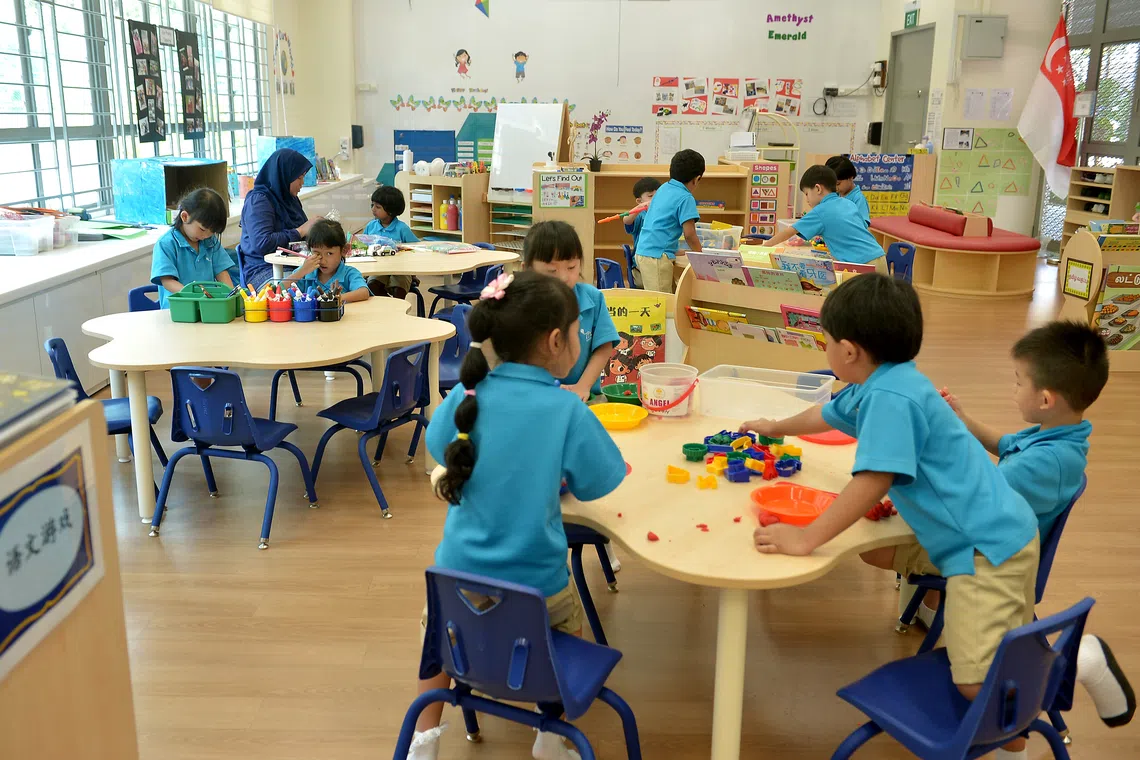
Currently, MOE operates 56 kindergartens offering four-hour programmes for Kindergarten 1 and 2 children aged five and six.
Published Oct 28, 2026, 12:30 PM
Updated Oct 28, 2026, 12:30 PM
MOE Kindergartens will move to a full-day model by 2030, with learning, play and care from 7am to 7pm for children aged five and six.
The new model will be piloted in 2027 at MK@Rivervale and MK@West View, then rolled out to all centres from 2028 to 2030.
MOE says the change will give children more continuity and support, and parents will pay one fee instead of separate kindergarten and KCare charges.
SINGAPORE - By 2030, all MOE Kindergartens will offer a new full-day model with learning, play and care for children from 7am to 7pm.
The new model will be piloted in 2027 at two kindergartens - MK@Rivervale and MK@West View - before it is rolled out across all centres between 2028 and 2030, the ministry said on Oct 28.
Currently, MOE operates 56 centres offering four-hour programmes for Kindergarten 1 and 2 children aged five and six.
Parents requiring full-day care can opt for Kindergarten Care (KCare), which is after-school care provided by external operators appointed by MOE.
Under the new model, education, play and care will be integrated into a single programme run by MOE Kindergarten educators.
They will be supported by MK Programme Officers employed by the ministry. MOE said MK educators will remain primarily responsible for delivering the curriculum, while programme officers will support children’s care and supervision, including during meals and other daily routines.
Speaking to the media on Oct 28, Senior Parliamentary Secretary for Education Syed Harun Alhabsyi said the changes were driven by feedback from parents and MK educators, as well as “evolving needs in the pre-school sector”.
The integrated model would allow educators to better understand children’s needs and provide more targeted support, he added.
MOE said in a briefing on Oct 28 that many parents said they require a full-day service.
The ministry said it will hire more staff, and the number of educators and programme officers deployed to each kindergarten will depend on enrolment. There are currently around 1,100 MK teachers.
Existing KCare employees may be recruited as programme officers if found suitable.
The kindergartens will operate from 7am to 7pm on weekdays during school terms and holidays, excluding public holidays, designated school holidays and centre closure days.
Parents who do not require full-day care can continue to opt for a half-day programme, from 7am to 12.30pm.
MOE said the change would provide children with greater continuity in learning and more sustained interactions with staff, allowing them to build stronger relationships.
Children from disadvantaged backgrounds would also benefit from a more seamless and supportive learning environment, it added.
MOE said about 65 per cent of the over 8,000 children attending MKs currently use KCare.
The new model will introduce more experiences, including exploring play in mother tongue languages where children can take greater ownership of their learning , outdoor play using materials such as planks and tyres, and holiday activities involving science, technology, engineering and mathematics, drama and visual arts.
Parents will also pay a single fee to MOE Kindergartens, instead of separate fees for kindergarten and KCare.
At the two pilot kindergartens, monthly full-day fees for Singaporean children will range from $3 to $425 after applicable subsidies, compared with $1 to $160 for the half-day programme.
Before subsidies, the monthly fees will be $665 and $310 respectively.
MOE said the out-of-pocket fees would be comparable to existing combined MK and KCare fees, as well as fees at anchor operator full-day childcare centres.
Currently, Singaporean children pay $160 a month for MK, and KCare fees of up to $275 a month after a basic subsidy.
Fees for the centres coming onboard later will be shared when available, MOE said. The list of kindergartens adopting the new model each year will be announced during the preceding year’s MK registration exercise in March.
MOE said it would work with kindergartens, schools and KCare operators to ensure a smooth transition to the full-day model.
The changes follow Prime Minister Lawrence Wong’s announcement at the National Day Rally in August that the Government aims to lower full-day childcare fees at government-supported pre-schools to $150 a month by 2030. This is part of efforts to ensure quality affordable pre-school education is within reach for all families.
The existing outsourced KCare arrangement came under scrutiny earlier in 2026 after MOE terminated its contracts with student care operator Little Professors Learning Centre in February over contractual breaches, including unpaid staff salaries.
Around 1,800 children across eight primary schools were affected, including children attending KCare at six of the schools.
MOE later tightened financial checks on operators and introduced additional safeguards.
Syed Harun said the move to the full-day model was not prompted by the case. “This review was done even before the Little Professors incident,” he said.
The ministry said discussions about moving towards an integrated full-day model began several years before the incident, in response to feedback from parents who wanted a more seamless experience for their children.
Some parents had found it confusing to navigate separate MK and KCare providers, particularly when trying to determine which programme their child was attending when an incident occurred.
On MK teachers’ workload, MOE said their daily working hours will remain unchanged under the new model. They will work earlier or later shifts.
Currently, MK teachers’ workdays run from 6.45am to 4pm, or 7.45am to 5pm. After teaching ends at 12pm, they attend to lesson planning or administrative duties.
MOE added that the amount of time teachers spend interacting directly with children is expected to remain largely unchanged, but will be spread throughout the day instead of concentrated in the current four-hour programme.
Teachers will also retain their protected vacation time during school holidays, but will have to take turns going on leave to allow MKs to remain open.
For instance, during the four-week June holidays, teachers will still have two weeks of protected vacation time, but may take them during different weeks.
Addressing concerns about teachers’ workloads, Syed Harun said: “We are studying how best we can support their workload as they educate our young ones.”
He said MOE also aims to further strengthen professional development for them.
“Because the better we take care of our MK educators, the more our students continue to benefit, and learn well in our schools.”
Ministry of Education
目前,教育部运营 56 所幼儿园,为 5 岁和 6 岁的幼儿园 1 年级和 2 年级儿童提供 4 小时课程。
发布于2026年10月28日下午12:30
更新于2026年10月28日下午12:30
教育部幼儿园将于 2030 年实行全日制模式,为 5 岁和 6 岁儿童提供从早上 7 点到晚上 7 点的学习、游戏和照护。
新模式将于 2027 年在 MK@Rivervale 和 MK@West View 进行试点,然后从 2028 年到 2030 年推广到所有中心。
教育部表示,这项改革将为孩子们提供更多连续性和支持,家长只需支付一笔费用,而无需分别支付幼儿园和 KCare 的费用。
新加坡——到 2030 年,所有教育部幼儿园都将提供全新的全日制模式,从早上 7 点到晚上 7 点为儿童提供学习、游戏和照护。
教育部于 10 月 28 日表示,新模式将于 2027 年在两所幼儿园——MK@Rivervale 和 MK@West View——进行试点,然后在 2028 年至 2030 年间推广到所有中心。
目前,教育部运营着 56 个中心,为 5 岁和 6 岁的幼儿园 1 年级和 2 年级儿童提供 4 小时的课程。
需要全天照护的家长可以选择幼儿园托管(KCare),这是由教育部指定的外部运营商提供的课后照护服务。
在新模式下,教育、游戏和保育将整合到一个由教育部幼儿园教师负责的单一项目中。
他们将得到教育部聘用的MK项目官员的支持。教育部表示,MK教师仍将主要负责课程教学,而项目官员将协助照料和监管儿童,包括用餐和其他日常活动。
10 月 28 日,教育部高级政务次长赛义德·哈伦·阿尔哈布西在接受媒体采访时表示,这些变化是由家长和 MK 教育工作者的反馈以及“学前教育领域不断变化的需求”所驱动的。
他补充说,这种综合模式可以让教育工作者更好地了解孩子的需求,并提供更有针对性的支持。
教育部在10月28日的简报会上表示,许多家长表示他们需要全日制服务。
教育部表示将增聘人手,每所幼儿园配备的教师和项目官员人数将根据入学人数而定。目前,马来西亚幼儿园约有1100名教师。
现有 KCare 员工如合适,可被聘为项目官员。
幼儿园在学期期间和假期的工作日从早上 7 点到晚上 7 点开放,公共假期、学校指定假期和中心关闭日除外。
不需要全天照护的家长可以继续选择半天课程,时间为早上 7 点至下午 12 点 30 分。
教育部表示,这一改变将为孩子们提供更连贯的学习体验和与教职员工更持久的互动,使他们能够建立更牢固的关系。
报告还指出,来自弱势背景的儿童也将受益于更加顺畅和支持性的学习环境。
教育部表示,目前在马来西亚幼儿园就读的8000多名儿童中,约有65%的人使用KCare服务。
新模式将引入更多体验,包括用母语进行游戏,让孩子们在学习中拥有更大的自主权;使用木板和轮胎等材料进行户外游戏;以及开展涉及科学、技术、工程和数学、戏剧和视觉艺术的假期活动。
家长只需向教育部幼儿园缴纳一笔费用,而不是分别缴纳幼儿园和 KCare 的费用。
在两所试点幼儿园,新加坡儿童的全日制月学费在享受适用补贴后为 3 新元至 425 新元,而半日制课程的学费为 1 新元至 160 新元。
补贴前,每月费用分别为 665 美元和 310 美元。
教育部表示,自费费用将与现有的 MK 和 KCare 的综合费用以及主要运营商全日制托儿中心的费用相当。
目前,新加坡儿童每月缴纳 MK 费用 160 美元,KCare 费用在基本补贴后每月最高可达 275 美元。
教育部表示,后续加入该计划的中心的收费标准将在确定后公布。每年采用新模式的幼儿园名单将在前一年的3月份幼儿园注册活动中公布。
教育部表示将与幼儿园、学校和 KCare 运营商合作,确保顺利过渡到全日制模式。
此次调整是继总理黄循财在8月国庆群众大会上宣布政府计划到2030年将政府资助的学前教育机构的全日制托儿费用降至每月150新元之后进行的。此举旨在确保所有家庭都能获得优质且价格合理的学前教育。
2026年初,现有的外包KCare安排受到审查,此前教育部于2月份终止了与学生托管运营商Little Professors Learning Centre的合同,原因是该公司违反合同,包括拖欠员工工资。
受影响的儿童约有 1800 名,分布在八所小学,其中包括六所小学的 KCare 儿童。
教育部后来加强了对运营商的财务审查,并引入了额外的保障措施。
赛义德·哈伦表示,改为全日制教学模式并非受此案影响。“这项审查早在‘小教授事件’之前就已经进行了,”他说。
教育部表示,关于转向全日制一体化模式的讨论早在事件发生前几年就开始了,这是为了回应家长们希望为孩子提供更无缝衔接的教育体验的反馈。
有些家长发现,要了解 MK 和 KCare 这两个不同的服务提供商的信息很困难,尤其是在发生事故时,很难确定他们的孩子正在参加哪个项目。
关于MK教师的工作量,教育部表示,在新模式下,他们的每日工作时长将保持不变,只是会轮班工作,例如提前或延后上班。
目前,MK教师的工作时间为早上6点45分至下午4点,或早上7点45分至下午5点。中午12点下课后,他们会进行备课或处理行政事务。
教育部补充说,教师与学生直接互动的时间预计不会有太大变化,但会分散到一天中,而不是集中在目前的四个小时课程中。
教师在学校假期期间也将保留其受保护的假期时间,但必须轮流休假,以便 MKs 能够继续开放。
例如,在为期四周的六月假期期间,教师仍将享有两周的受保护假期,但可以在不同的周休假。
针对教师工作量过重的问题,赛义德·哈伦表示:“我们正在研究如何才能最好地支持他们的工作,让他们在教育我们的孩子时能够更好地承担起这份责任。”
他表示,教育部还计划进一步加强他们的专业发展。
“因为我们越善待我们的幼儿园教师,我们的学生就越能继续受益,并在学校里学得越好。”
教育部