From lab breakthroughs to new businesses: How AI is accelerating innovation in Singapore从实验室突破到新兴企业:人工智能如何加速新加坡的创新
Artificial intelligence is speeding up scientific discoveries and product development, but industry leaders say turning innovations into successful businesses remains a challenge.
新闻视频
Artificial intelligence is speeding up scientific discoveries and product development, but industry leaders say turning innovations into successful businesses remains a challenge.
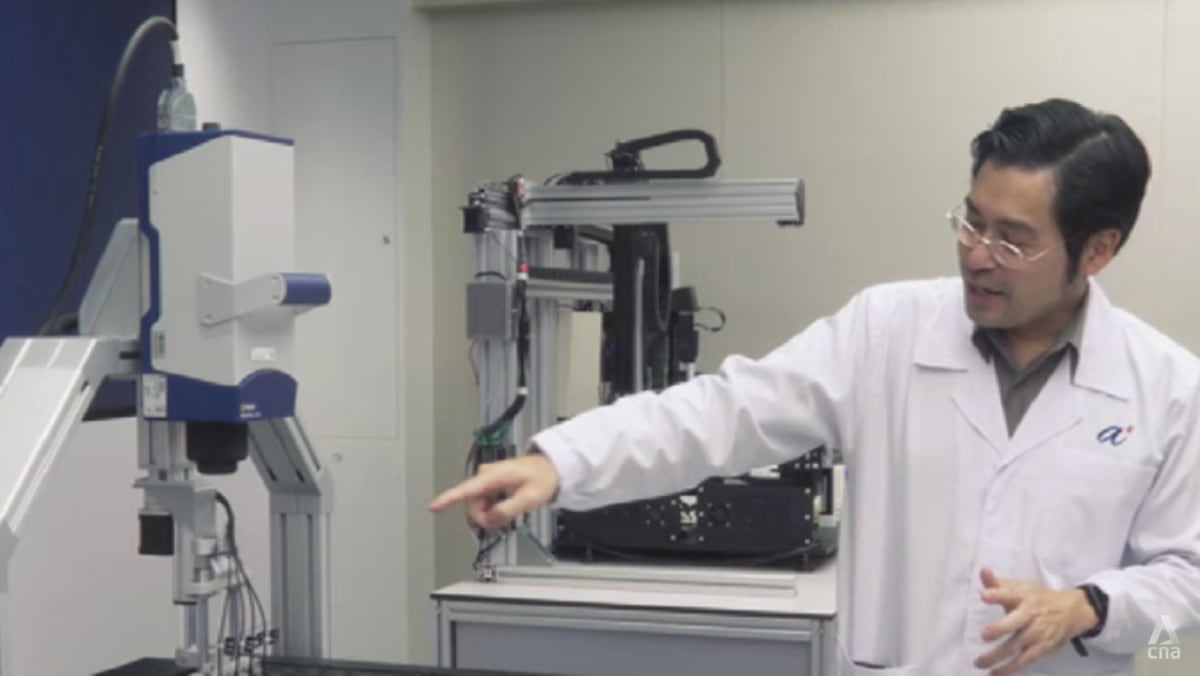
Professor Loh Xian Jun, executive director of A*STAR's Institute of Materials Research and Engineering, demonstrating automated laboratory equipment used to test materials. (Image: CNA)
This audio is generated by an AI tool.
SINGAPORE: Artificial intelligence is accelerating the journey from scientific discoveries to commercially viable products, potentially shortening lengthy research and development processes, industry leaders say.
Singapore is seeking to capitalise on these advances through a new initiative aimed at accelerating materials innovation using AI and automation, backed by an initial S$150 million (US$117 million) government investment.
Called MARVEL-AI, the initiative was announced on Tuesday (Oct 27) at the Singapore Week of Innovation and Technology (SWITCH) 2026.
Led by the Agency for Science, Technology and Research (A*STAR), it will combine advanced AI models with automated laboratories to speed up materials discovery and development.
But turning these breakthroughs into commercially viable products and successful businesses remains a challenge.
CNA Games Guess Word Crack the word, one row at a time Buzzword Create words using the given letters Mini Sudoku Tiny puzzle, mighty brain teaser Mini Crossword Small grid, big challenge Word Search Spot as many words as you can Show More Show Less
SPEEDING UP SCIENTIFIC DISCOVERIES
Traditional materials development can be a lengthy process, involving repeated experiments, validating results and prototyping before a product is ready for commercial use.
AI could help researchers shorten these processes, said Professor Loh Xian Jun, executive director of A*STAR’s Institute of Materials Research and Engineering, in an interview with CNA on the sidelines of SWITCH on Wednesday.
“We are able to shortcut the discovery time by maybe up to 10 times,” said Prof Loh.
“We are able to process validation and characterisation much faster using automation and AI combined, and using these insights, we are able to develop industrially relevant solutions at a very quick time span.”
One example is a hydrogel that was developed by Prof Loh and his research team that could potentially be used to treat retinal detachment.
“This type of hydrogel is a novel material that is a liquid at room temperature. And when you inject it at body temperatures into the eye, it turns into a hydrogel,” he said.
Prof Loh added that the development of the material took a long time to fine tune its composition but advances in AI have helped to speed up the work.
“Today, with a very good AI-assisted platform, we are able to create many different combinations of these materials and screen them for properties. This allows us to reduce the time by more than 10 times,” he said.
Researchers are also exploring how wood waste can be converted into components typically extracted from fossil fuels, potentially reducing waste and reliance on petroleum-based products.
However, developing a promising material in a laboratory is only the first step.
“Maybe I can produce five grams of materials today, (but) can I produce a tonne of it?” Prof Loh asked.
He explained that scaling up production is far from straightforward, as factors such as heat and mass transfer are difficult to predict.
Under the MARVEL-AI initiative, companies can work with researchers to develop solutions for specific industrial problems.
“We (can) use AI combined with automation to fast-charge the development process so that we can develop the solutions much faster,” said Prof Loh. “This also results in time and cost savings for the company.”
FASTER ENGINEERING, LOWER DEVELOPMENT COSTS
Beyond scientific laboratories, AI is also transforming how companies design and manufacture complex industrial equipment.
Mr Jacomo Corbo, CEO and co-founder of engineering and deep-tech AI company PhysicsX, said AI could dramatically accelerate simulations used to test and refine designs.
“We can increase the speed of doing the same simulations by a factor of 10,000, 100,000, in certain cases, almost a billion times,” he told CNA.
“It also means being able to take high-fidelity simulation to parts of the product development lifecycle where it can’t go today,” he said, citing examples of being able to control semiconductor manufacturing equipment to create a chip, or making components in a jet engine.
In semiconductor equipment manufacturing, Mr Corbo said PhysicsX’s work had helped reduce the development time for a new machine by almost 20 per cent.
But faster simulations do not eliminate the need for accuracy, particularly in industries where design failures could have serious consequences in the real world.
“The risk of hallucination with AI models is a very real one,” said Mr Corbo. The term refers to instances when AI systems generate information that sounds plausible but is actually wrong or misleading.
He added that AI-generated results should still be validated through methods such as physical testing, while established safety limits remain in place.
TURNING INNOVATIONS INTO SUCCESSFUL BUSINESSES
While AI is accelerating scientific research and engineering, turning technological advances into commercially successful businesses requires more than faster development.
Mr Howard Wright, Nvidia’s vice-president of startup ecosystem, said there is no single formula for startup success, but common factors include the strength of a company’s leadership team, its investors and board members, as well as its ability to protect its intellectual property.
His observations were based on Nvidia’s experience working with startups globally through its Inception programme.
Mr Wright pointed to how AI has made technical capabilities more accessible to entrepreneurs, reducing the need for specialised expertise.
“Years ago … access was really beholden to folks only in certain metropolitan cities,” he said. “Now, as easy as AI is, you don't need a PhD from a world class university in computer science to prompt, to teach, to ask the AI, to teach you how to train it.”
For AI start-ups with small teams and limited funding, Mr Wright advised being strategic about when to secure financing.
However, he cautioned that some startups limit their growth potential by focusing too narrowly on their domestic markets.
“We've noticed in different pockets of the world, they're focused on just servicing that local (area), that city, that state, that government entity,” he said.
“In fact they've written code that can traverse boundaries, that could traverse other verticals.”
Mr Wright said Nvidia works with more than 1,000 startups in Singapore, pointing to the country’s engineering talent, universities and access to investment capital as strengths.
“It's not too ambitious to say maybe the next trillion-dollar market cap startup could come from this very city.”
Get our pick of top stories and thought-provoking articles in your inbox
Stay updated with notifications for breaking news and our best stories
Join our channel for the top reads for the day on your preferred chat app
人工智能正在加速科学发现和产品开发,但业内人士表示,将创新转化为成功的商业模式仍然是一个挑战。
新加坡科技研究局(A*STAR)材料研究与工程研究院执行院长罗贤俊教授正在演示用于材料测试的自动化实验室设备。(图片:CNA)
这段音频由人工智能工具生成。
新加坡:业内领袖表示,人工智能正在加速从科学发现到商业可行产品的进程,有可能缩短漫长的研发过程。
新加坡正寻求利用这些进步,推出一项旨在利用人工智能和自动化加速材料创新的新举措,并为此投入了1.5亿新元(1.17亿美元)的政府初始投资。
这项名为 MARVEL-AI 的计划于周二(10 月 27 日)在 2026 年新加坡创新与科技周 (SWITCH) 上宣布。
该项目由新加坡科技研究局(A*STAR)牵头,将先进的人工智能模型与自动化实验室相结合,以加快材料的发现和开发。
但将这些突破性成果转化为具有商业价值的产品和成功的企业仍然是一个挑战。
CNA游戏 猜词游戏 逐行破解单词 流行词游戏 用给定的字母组成单词 迷你数独 小小谜题,挑战你的大脑 迷你填字游戏 小方格,大挑战 单词搜索 尽可能多地找出单词 显示更多 显示更少
加速科学发现
传统材料开发可能是一个漫长的过程,需要反复进行实验、验证结果和制作原型,产品才能投入商业使用。
新加坡科技研究局材料研究与工程研究所执行主任罗贤俊教授周三在SWITCH大会间隙接受CNA采访时表示,人工智能可以帮助研究人员缩短这些流程。
罗教授说:“我们或许能将发现时间缩短多达 10 倍。”
“通过自动化和人工智能的结合,我们能够更快地进行验证和表征,并利用这些见解,在很短的时间内开发出与工业相关的解决方案。”
例如,罗教授及其研究团队开发了一种水凝胶,该水凝胶有可能用于治疗视网膜脱离。
他说:“这种水凝胶是一种新型材料,在室温下呈液态。当以体温将其注射到眼睛中时,它就会变成水凝胶。”
罗教授补充说,这种材料的研发花了很长时间来微调其成分,但人工智能的进步有助于加快这项工作。
他说:“如今,借助非常优秀的AI辅助平台,我们能够创建这些材料的多种不同组合,并筛选它们的性能。这使我们能够将时间缩短10倍以上。”
研究人员还在探索如何将木材废料转化为通常从化石燃料中提取的成分,从而有可能减少浪费和对石油产品的依赖。
然而,在实验室里研发出有前景的材料仅仅是第一步。
“也许我今天可以生产五克材料,(但是)我能生产一吨吗?”罗教授问道。
他解释说,扩大生产规模远非易事,因为传热和传质等因素难以预测。
在漫威人工智能计划下,企业可以与研究人员合作,为特定的行业问题开发解决方案。
罗教授表示:“我们可以利用人工智能结合自动化技术来加快开发流程,从而更快地开发出解决方案。这也能为公司节省时间和成本。”
更快的工程设计,更低的开发成本
除了科学实验室之外,人工智能也在改变公司设计和制造复杂工业设备的方式。
工程和深度科技人工智能公司 PhysicsX 的首席执行官兼联合创始人 Jacomo Corbo 先生表示,人工智能可以极大地加速用于测试和改进设计的模拟。
“我们可以将同样的模拟速度提高 10,000 倍、100,000 倍,在某些情况下,甚至可以提高近 10 亿倍,”他告诉 CNA。
“这也意味着能够将高保真模拟应用到产品开发生命周期中目前无法应用的环节,”他说道,并举例说明,例如能够控制半导体制造设备来制造芯片,或者制造喷气发动机中的组件。
Corbo 先生表示,在半导体设备制造领域,PhysicsX 的工作帮助将新机器的开发时间缩短了近 20%。
但是,更快的模拟并不能消除对准确性的需求,尤其是在设计缺陷可能在现实世界中造成严重后果的行业中。
科尔博先生表示:“人工智能模型产生幻觉的风险是真实存在的。” 他所说的幻觉是指人工智能系统生成的信息听起来合情合理,但实际上是错误或误导性的。
他还补充说,人工智能生成的结果仍然应该通过物理测试等方法进行验证,同时既定的安全限制仍然有效。
将创新转化为成功的企业
虽然人工智能正在加速科学研究和工程发展,但要将技术进步转化为商业上成功的企业,需要的不仅仅是更快的发展速度。
英伟达创业生态系统副总裁霍华德·赖特表示,创业成功没有单一的公式,但共同因素包括公司领导团队、投资者和董事会成员的实力,以及保护其知识产权的能力。
他的观察是基于英伟达通过其“Inception”计划与全球初创公司合作的经验。
赖特先生指出,人工智能使企业家更容易获得技术能力,从而减少了对专业知识的需求。
“多年前……只有某些大都市的人才能真正接触到人工智能,”他说。“现在,人工智能虽然很容易上手,但你不需要拥有世界一流大学的计算机科学博士学位就能引导、教导、询问人工智能,或者学习如何训练它。”
对于团队规模小、资金有限的人工智能初创公司,赖特先生建议在何时获得融资方面要采取策略。
然而,他提醒说,一些初创企业过于专注于国内市场,从而限制了自身的增长潜力。
他说:“我们注意到,在世界各地,他们专注于服务当地(地区)、城市、州或政府机构。”
“事实上,他们编写的代码可以跨越边界,也可以跨越其他垂直领域。”
赖特先生表示,英伟达与新加坡的 1000 多家初创公司合作,并指出该国的工程人才、大学和投资资本渠道是其优势所在。
“说下一个市值万亿美元的初创公司可能就来自这座城市,这并不算太雄心勃勃。”
订阅我们的邮件,即可获取精选热点新闻和引人深思的文章。
订阅通知,第一时间获取突发新闻和精彩报道。
加入我们的频道,即可在您常用的聊天应用上获取当日热门文章。