Vending machines selling local veggies under $2 to be rolled out; support for fish farms to scale up售卖本地蔬菜的自动售货机将推出,售价低于2美元;支持鱼类养殖场扩大规模。
The aim is to roll out 30 to 40 pairs of seafood and vegetable vending machines within the next six months. Read more at straitstimes.com.
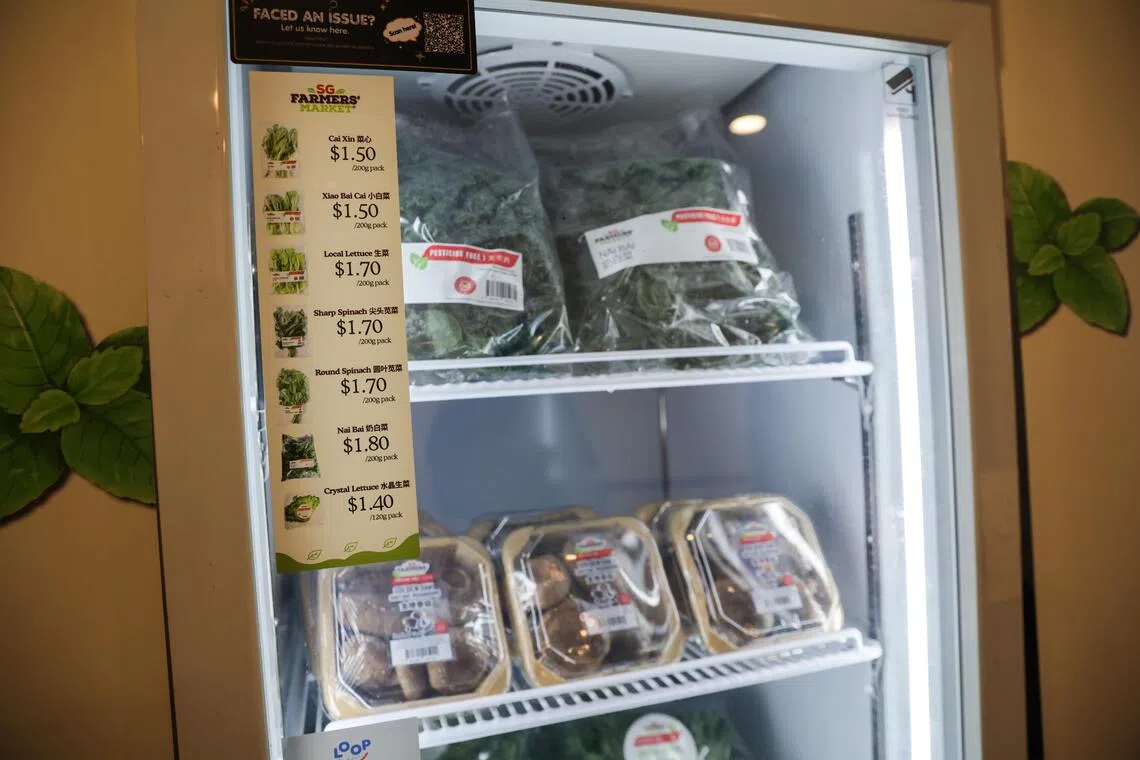
The vegetable vending machine unveiled at NCS Hub on Oct 28.
Published Oct 28, 2026, 07:15 PM
Updated Oct 28, 2026, 07:15 PM
SINGAPORE – Residents and university students could soon buy more affordable local vegetables and seafood at their doorstep, with an agri-food organisation looking to roll out vending machines selling farmed produce islandwide over the next six months.
A pack of lettuce and nai bai costs between $1.40 and $1.80 and is sold under the SG Farmers’ Market brand, which consolidates produce from several local vegetable farms.
At FairPrice, each pack of leafy greens under the brand costs $2 to $3.50.
Ken Cheong, chief executive of the Singapore Agro-Food Enterprises Federation (SAFEF), which runs the brand, said he was able to lower the prices of vegetables at the vending machines because he could limit indirect business expenses along the supply chain.
Such expenses include storage costs and losses from wastage.
But to sustain vegetable prices below $2, he needs to have consistent sales, Cheong stressed, to keep costs down.
The organisation is aiming to roll out 30 to 40 pairs of seafood and vegetable vending machines within the next six months at places including Active Ageing Centres, community centres, condominiums and university dorms. Cheong did not reveal the specific locations where SAFEF is in talks with potential partners.
As part of a trial, a pair of vending machines has been set up at information technology company NCS Group’s headquarters in Ang Mo Kio, and the machines were unveiled at SAFEF’s annual reception at NCS Hub on Oct 28.
This link-up came from a chance corporate partnership between NCS Group and the federation.
One chilled machine currently sells seven types of greens, including bok choy, local lettuce, sharp spinach and crystal lettuce.
Another frozen-food vending machine will soon sell tilapia, Asian sea bass and vannamei shrimp, also under SAFEF’s brands. A 1kg pack of shrimp costs $15, while a 250g pack of marine tilapia fillet costs $7.
The five urban farms under SG Farmers’ Market that have committed to supplying vegetables and mushrooms for the vending machines are CropCiti, The Veggie Patch, Vegeponics, Arista Farming, and Spore Gardens, which grows gourmet mushrooms.
Once more machines are rolled out over the coming months, SAFEF intends to create micro-jobs for members of the community to help run the machines and restock them.
Those hired can also teach seniors how to use the machines, which accept only digital payment through QR codes.
SAFEF, which has more than 50 members, has been helping farms market their produce and get it on supermarket shelves under umbrella brands like SG Farmers’ Market.
The frozen vending machine stocked with local seafood was unveiled at NCS Hub on Oct 28. ST PHOTO: GIN TAY
The frozen vending machine stocked with local seafood was unveiled at NCS Hub on Oct 28.
The branding initiative started in late 2023 with The Straits Fish label for a handful of sea-based tilapia farms in the West Johor Strait, off Lim Chu Kang, to help them jointly produce the fish at scale. This initiative was later expanded to sea-based sea bass farms and vannamei shrimp farms on land.
The federation is now expanding into vending machines to bring local produce closer to customers. The aim is to create a dedicated sales channel for local produce, away from direct competition with imports on retail shelves.
Local produce is known to be more expensive than most imported vegetables and fish, largely due to the higher cost of operating a farm in Singapore.
“We needed to create our own supply line. Trying to feed local produce into the import line is very tough,” said Cheong.
Selling through vending machines could also be an option for smaller high-tech farms that struggle to enter physical retail stores, he pointed out.
In July, The Straits Times reported that local vegetables from at least three farms here would no longer be available in FairPrice supermarkets.
The SAFEF reception was attended by its new patron, Minister for Sustainability and the Environment Grace Fu.
Minister for Sustainability and the Environment Grace Fu speaking at the SAFEF reception on Oct 28. ST PHOTO: GIN TAY
Minister for Sustainability and the Environment Grace Fu speaking at the SAFEF reception on Oct 28.
Under SAFEF’s direction, four fish farms off Pasir Ris recently banded together to produce and sell premium fish like pompano, also known as golden pomfret, and red snapper that can weigh up to 4kg.
Having created a market for tilapia, smaller sea bass and vannamei shrimp, the federation is now eyeing the East Johor Strait – where more fish species are grown – to scale up the sale of bigger fish that can command higher prices.
Restaurants, hotels and other food and beverage businesses prefer bigger fillet chunks to cook with, and large fish to serve at buffets, said Cheong.
The farms involved in this initiative are Smith Marine, which mainly farms pompano, De Kelong, which mainly produces red snapper, Tropical Mariculture and Ah Hua Kelong.
Smith Marine's farm off Pasir Ris also has a floating restaurant. ST PHOTO: KEVIN LIM
Smith Marine's farm off Pasir Ris also has a floating restaurant.
Forming a coalition helps the farms secure better quality eggs and sustain demand. By working together, they can increase their bargaining power when importing pompano eggs from suppliers in Taiwan and China, Cheong added.
This is because when a small farm sources eggs from a supplier, it tends to receive lower quality eggs that take longer to grow. Better quality eggs are saved for larger customers.
Smith Marine has started distributing some juvenile pompano to the other farms. They aim to start importing the fish eggs from early 2027.
Smith Marine founder Ong Jong Yang (right) observing a net of pompano, also known as golden pomfret. ST PHOTO: KEVIN LIM
Smith Marine founder Ong Jong Yang (right) observing a net of pompano, also known as golden pomfret.
Each farm’s biggest challenge has been to secure steady demand so that their fish can be consistently sold, Cheong noted.
By working as a group, the farms can ensure a steady supply to the buyer: If one farm runs out of fish to harvest, another can take over, as long as each farm staggers the growth of its fish.
“If we have a steady supply of fish, we can stabilise a price. With a stable price, we will likely attract more long-term buyers,” he added.
SAFEF has set the price of local pompano at no more than 20% higher than that of imported ones.
Smith Marine owner Ong Jong Yang said that his sales tend to be inconsistent throughout the year. Each month, he sells an average of two to three tonnes of fish.
Chris Lur of Tropical Mariculture chimed in: “I’ve been dumping my CPF into the sea.”
But they are positive that the collaboration with SAFEF will turn the tide.
Ong said: “We hope to gain confidence to make longer-term business plans for the farms.”
Currently, only the jumbo-sized red snapper have reached the market, with SAFEF having entered into a deal with cold chain distributor Pan Ocean Singapore . But it takes three years to rear a 3kg red snapper and relying on this alone cannot sustain a farming business.
Red snapper weighing about 3kg each and barramundi awaiting processing at Pan Ocean Singapore on Oct 21. ST PHOTO: KEVIN LIM
Red snapper weighing about 3kg each and barramundi awaiting processing at Pan Ocean Singapore on Oct 21.
While pompano, which takes eight months to grow into a harvest size of 800g, will remain the farms’ bread-and-butter, SAFEF wants to ramp up the farming of larger Asian sea bass, also known as barramundi, which can reach 3kg in 1½ to two years.
Many farms have been reluctant to rear the disease-prone fish for that long, as prolonged time in the water exposes them to fatal diseases such as scale drop disease virus. To limit losses, they harvest the fish at a smaller, dish-sized weight of about 800g .
In 2023, Barramundi Group also gave up deep-sea farming in the southern waters of Singapore after a fish virus outbreak.
But recently, vaccines against the disease have been made available, and SAFEF is in talks with a few companies to acquire them for the farms.
From early 2027, young sea bass will be obtained from the Singapore Food Agency’s Marine Aquaculture Centre – where local sea bass eggs are produced – before they are vaccinated and reared on the farms.
10月28日,NCS Hub揭幕了蔬菜自动售货机。
发布于 2026 年 10 月 28 日下午 7:15
更新于2026年10月28日晚上7:15
新加坡——一家农业食品组织计划在未来六个月内在全岛范围内推出销售农产品的自动售货机,居民和大学生很快就能在家门口买到价格更实惠的本地蔬菜和海鲜。
一包生菜和奈白菜售价在 1.40 美元到 1.80 美元之间,以 SG Farmers' Market 品牌出售,该品牌整合了几个当地蔬菜农场的产品。
在 FairPrice 超市,该品牌的每包绿叶蔬菜售价为 2 至 3.50 美元。
新加坡农粮企业联合会(SAFEF)首席执行官张建强表示,他能够降低自动售货机蔬菜的价格,是因为他可以限制供应链上的间接业务支出。
这些费用包括仓储成本和损耗损失。
但张先生强调,为了将蔬菜价格维持在每桶 2 美元以下,他需要保持稳定的销售额,以降低成本。
该机构计划在未来六个月内在包括老年活动中心、社区中心、公寓和大学宿舍等场所投放30至40对海鲜蔬菜自动售货机。张先生并未透露新加坡海鲜及食品基金会(SAFEF)正在与潜在合作伙伴洽谈的具体地点。
作为一项试验的一部分,信息技术公司 NCS 集团在宏茂桥总部设立了两台自动售货机,并于 10 月 28 日在 NCS Hub 举行的 SAFEF 年度招待会上揭幕。
这次合作源于 NCS 集团与该联合会之间的一次偶然的企业合作。
一台冷藏机目前出售七种蔬菜,包括小白菜、本地生菜、菠菜和水晶生菜。
另一台冷冻食品自动售货机即将开始销售罗非鱼、亚洲鲈鱼和南美白对虾,这些产品也都是SAFEF旗下的品牌。1公斤装的虾售价15美元,250克装的罗非鱼片售价7美元。
新加坡农贸市场旗下的五家城市农场已承诺为自动售货机供应蔬菜和蘑菇,它们分别是 CropCiti、The Veggie Patch、Vegeponics、Arista Farming 和 Spore Gardens(种植高档蘑菇)。
随着未来几个月更多机器的投入使用,SAFEF 计划为社区成员创造微型工作岗位,以帮助操作机器和补充库存。
受雇人员还可以教老年人如何使用这些机器,这些机器只接受通过二维码进行的数字支付。
新加坡农贸市场联合会 (SAFEF) 拥有 50 多个成员,一直致力于帮助农场销售其农产品,并通过 SG Farmers' Market 等品牌将其摆上超市货架。
10月28日,一台装满本地海鲜的冷冻自动售货机在NCS Hub揭幕。(海峡时报照片:金泰)
10月28日,在NCS Hub推出了一台装满当地海鲜的冷冻自动售货机。
这项品牌推广计划于2023年底启动,最初为柔佛海峡西部林厝港附近几家海养罗非鱼的养殖场推出“海峡鱼”品牌,旨在帮助他们联合进行规模化养殖。之后,该计划扩展到陆养海鲈鱼养殖场和南美白对虾养殖场。
该联合会目前正将业务拓展至自动售货机领域,以便让消费者更便捷地接触到本地农产品。其目标是为本地农产品打造一个专属销售渠道,使其免受零售货架上进口商品的直接竞争。
众所周知,本地农产品比大多数进口蔬菜和鱼类更贵,这主要是因为在新加坡经营农场的成本较高。
“我们需要建立自己的供应链。想把本地产品打入进口渠道非常困难,”张先生说。
他还指出,对于难以进入实体零售店的小型高科技农场来说,通过自动售货机销售也是一种选择。
7 月,《海峡时报》报道称,至少三家本地农场生产的蔬菜将不再在 FairPrice 超市出售。
SAFEF 的新赞助人、永续发展及环境部长傅海燕出席了招待会。
新加坡永续及环境部长傅海燕于10月28日在新加坡农业及食品博览会(SAFEF)招待会上致辞。(海峡时报摄影:金泰)
10月28日,永续发展及环境部长傅海燕在新加坡农业及食品博览会招待会上发表讲话。
在新加坡渔民联合会 (SAFEF) 的指导下,巴西立附近的四个养鱼场最近联合起来生产和销售优质鱼类,如鲳鱼(又称金鲳)和重达 4 公斤的红鲷鱼。
该联合会为罗非鱼、小型海鲈和南美白对虾创造了市场,现在正将目光投向东柔佛海峡——那里养殖着更多种类的鱼类——以扩大可以卖出更高价格的大型鱼类的销售规模。
张先生表示,餐厅、酒店和其他餐饮企业更喜欢用较大的鱼片块进行烹饪,也更喜欢用较大的鱼在自助餐中供应。
参与这项计划的养殖场有:主要养殖鲳鱼的 Smith Marine,主要生产红鲷鱼的 De Kelong,Tropical Mariculture 和 Ah Hua Kelong。
史密斯海事公司位于巴西立附近的农场也设有一家水上餐厅。(海峡时报照片:凯文·林)
Smith Marine在巴西立附近的农场还设有一家水上餐厅。
张先生补充说,组建联盟有助于农场获得更高质量的鸡蛋并维持市场需求。通过合作,他们在从台湾和中国大陆的供应商进口鲳鱼蛋时可以增强议价能力。
这是因为小型农场从供应商那里采购鸡蛋时,往往只能收到品质较低、生长周期较长的鸡蛋。品质更好的鸡蛋则留给了规模较大的客户。
史密斯海洋公司已开始向其他养殖场分发一些幼年鲳鱼。他们计划从2027年初开始进口鱼卵。
Smith Marine创始人翁钟阳(右)正在观察一网鲳鱼,鲳鱼又称金鲳。ST PHOTO:KEVIN LIM
Smith Marine 创始人 Ong Jong Yang(右)正在观察一网鲳鱼,鲳鱼又称金鲳。
张先生指出,每个养殖场面临的最大挑战是确保稳定的需求,以便他们的鱼能够持续销售。
通过联合起来,这些养殖场可以确保向买家稳定供应:如果一个养殖场没有鱼可捕捞,另一个养殖场就可以接手,只要每个养殖场错开鱼的生长周期即可。
他补充说:“如果我们能稳定鱼的供应,就能稳定价格。价格稳定后,我们就能吸引更多长期买家。”
SAFEF规定,本地产鲳鱼的价格不得比进口鲳鱼高出20%。
史密斯海事店老板翁钟阳表示,他的鱼销量全年都不稳定。每个月平均能卖出两到三吨鱼。
热带海洋养殖公司的克里斯·卢尔插话说:“我一直把我的CPF(氯仿)倾倒到海里。”
但他们乐观地认为,与SAFEF的合作将会扭转局面。
Ong表示:“我们希望获得信心,为农场制定更长期的商业计划。”
目前,市场上仅供应特大号红鲷鱼,新加坡渔业和食品出口促进委员会(SAFEF)已与冷链分销商泛洋新加坡公司(Pan Ocean Singapore)达成协议。但养殖一条3公斤重的红鲷鱼需要三年时间,仅靠这一项无法维持养殖业的可持续发展。
10月21日,新加坡泛海公司(Pan Ocean Singapore)正在处理重约3公斤的红鲷鱼和澳洲肺鱼。(海峡时报摄影:KEVIN LIM)
10 月 21 日,新加坡泛洋公司正在处理每条重约 3 公斤的红鲷鱼和澳洲肺鱼。
虽然鲳鱼需要八个月才能长到 800 克的收获大小,仍将是养殖场的主要收入来源,但 SAFEF 希望加大对体型更大的亚洲海鲈(又称尖吻鲈)的养殖力度,这种鱼可以在 1 年半到两年内长到 3 公斤。
许多养殖场不愿长时间养殖这种易生病的鱼,因为长时间在水中会使其感染鳞片脱落病毒等致命疾病。为了减少损失,他们会在鱼长到约800克,也就是适合盛盘食用的重量时就进行捕捞。
2023年,在新加坡南部海域爆发鱼类病毒疫情后,巴拉蒙迪集团也放弃了深海养殖。
但最近,针对这种疾病的疫苗已经问世,SAFEF正在与几家公司洽谈,以便为农场采购这些疫苗。
从 2027 年初开始,幼年海鲈鱼将从新加坡食品局海洋水产养殖中心(本地海鲈鱼卵的生产地)获得,然后进行疫苗接种并在养殖场饲养。