A road when it’s dry, a river when it pours: How KL’s SMART Tunnel switches from highway to flood channel旱季是公路,暴雨时是河流:吉隆坡智慧隧道如何从高速公路变身为泄洪道
KUALA LUMPUR, Oct 29 — To most motorists, the SMART Tunnel is a way to bypass traffic congestion on the southern approach to Kuala Lumpur’s city centre. Its primary purpose,...
The SMART Tunnel in Kuala Lumpur serves dual purposes: alleviating traffic congestion and mitigating flood risks by channeling excess water from the Klang-Ampang catchment.
Developed by Gamuda Berhad and partners, it integrates a flood-control system with a motorway, under a public-private partnership.
The tunnel has drastically reduced potential flood damage, with an estimated 685 flood-mode incidents avoided since its inception.
Management of the tunnel has undergone restructuring to shorten concession durations, maintain toll rates, and reduce government compensation, with plans to return it to government control by 2033.
KUALA LUMPUR, Oct 29 — To most motorists, the SMART Tunnel is a way to bypass traffic congestion on the southern approach to Kuala Lumpur’s city centre. Its primary purpose, however, goes beyond moving vehicles.
The 9.7km Stormwater Management and Road Tunnel combines a 3km double-deck motorway with a flood-control system designed to divert excess water away from the city centre during heavy rain.
It channels water from the Klang-Ampang catchment to reduce downstream flood risks, including around the confluence of the Klang and Gombak rivers near Masjid Jamek.
According to Amanat Lebuhraya Rakyat (ALR), the holding company of the SMART Tunnel concessionaire and three other highway concessionaires, the system has a combined water-storage capacity of three million cubic metres and has recorded 685 flood-mode incidents.
Project documentation puts the overall cost at approximately RM1.93 billion.
Why was the SMART Tunnel built?
Kuala Lumpur has a long history of flooding, with major events recorded in 1926 and 1971.
In April 2001, floods inundated Jalan Ipoh, Jalan Gombak and Jalan Munshi Abdullah.
Further incidents in June 2002 and June 2003 affected areas around the Klang River, Jalan Gombak and Dataran Merdeka.
The SMART Tunnel idea emerged in 2001, when the government sought private-sector proposals to address recurring floods while easing congestion on the southern approach to the city centre.
How was the dual-purpose model developed?
Gamuda Berhad, working with engineering consultants Sepakat Setia Perunding Sdn Bhd and Mott MacDonald, developed a flood-diversion tunnel proposal before partnering MMC Corporation Berhad in 2002 to incorporate a motorway.
The project involved both the government and private sector, with the Department of Irrigation and Drainage (DID) and Malaysian Highway Authority among the agencies involved.
The government commissioned the stormwater management component to divert floodwater from the Klang-Ampang catchment through the tunnel and into downstream storage.
Meanwhile, the motorway was developed under a privatisation arrangement based on a Build-Operate-Transfer (BOT) model.
The private-sector joint venture formed Syarikat Mengurus Air Banjir dan Terowong Sdn Bhd to implement the project and operate the motorway concession.
Construction began in 2003, and the tunnel opened to traffic in 2007.
How does the tunnel work?
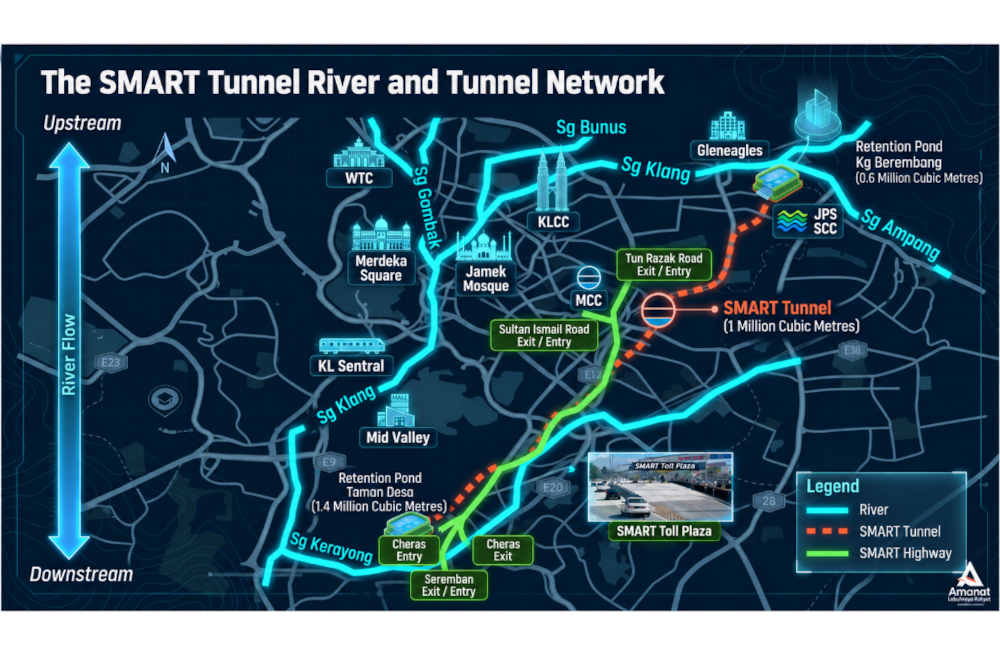
The SMART Tunnel forms part of an integrated system that diverts excess water from the Klang and Ampang rivers towards downstream storage facilities.
According to ALR, the system has a combined capacity of three million cubic metres, equivalent to about 1,200 Olympic-sized swimming pools. This comprises:
Kampung Berembang holding pond: 600,000 cubic metres
SMART Tunnel: one million cubic metres
Taman Desa holding pond: 1.4 million cubic metres
During heavy rain, excess water is diverted into the system near Kampung Berembang and channelled towards Taman Desa for temporary storage before being released into Sungai Kerayong.
Two control centres oversee different aspects of the operation:
SMART Control Centre: Under DID, it monitors rainfall and river flows, issues flood warnings and directs water into the system.
Motorway Control Centre: Operated by ALR, it manages traffic diversion and clearing, as well as cleaning and restoring the road before reopening.
Safety features include 220 CCTV cameras monitored around the clock, variable-message traffic signs, 42 emergency telephones, 16 radio units, watertight doors and 10 emergency exits and escape routes.
There are four tunnel modes
Mode 1: Normal operation
During ordinary weather, traffic uses the motorway as usual, with no floodwater diverted through the tunnel.
When water levels rise, excess water is diverted through the lower channel beneath the motorway, allowing traffic to continue. ALR’s operating matrix identifies a flow range of 70 to 150 cubic metres per second for this mode.
Mode 3: Motorway closure
When the flood model forecasts a flow rate of 150 cubic metres per second or more, the motorway is closed and cleared of vehicles in preparation for possible floodwater diversion.
The motorway compartments may not need to be flooded if conditions change.
Mode 4: Prolonged severe storm
If the storm persists, the motorway compartments are used to carry floodwater after all vehicles have been evacuated.
The motorway remains closed until the water has been drained and the road cleaned and inspected.
The distinction is important: a motorway closure does not necessarily mean the tunnel will be flooded.
Mode 3 prepares it for possible use as a floodwater channel, while Mode 4 involves diverting water through the motorway tunnel.
Closure of the SMART tunnel also meant that no tolls are collected throughout the flooding of the tunnel and recovery stages.
The numbers are an illustration only, not verified current losses.
Actual foregone revenue would depend on current toll revenue, traffic patterns, timing of closure, and whether traffic would otherwise have paid the toll.
What happens after the tunnel floods?
The tunnel cannot immediately reopen once a floodwater diversion operation ends. According to ALR, recovery involves six stages:
Stage1: Notification — DID issues a notification and monitors river flows and water levels.
Stage 2: Pumping — Floodwater is pumped out and the main flow checked.
Stage 3: Safety inspection — The tunnel is checked for gas and other potential hazards.
Stage 4: Cleaning — Machinery removes debris and sediment, with operations running around the clock.
Stage 5: System restoration — The tunnel’s systems are restored and checked.
Stage 6: Final inspection — Safety checks are completed before the motorway reopens.
This is a four-day reopening target, with an average recovery period of two days. The actual duration depends on the work needed to restore safe operating conditions.
Major maintenance may also be required after Mode 4, including replacing tunnel fixtures or repairing structural damage caused by floodwater.
How much flood damage has the tunnel prevented?
ALR reported 685 flood-mode incidents and estimated that the system had avoided RM4.94 billion in potential flood damage.
The incidents comprised 556 Mode 2 operations, 118 Mode 3 operations and 11 Mode 4 operations.
The estimates also cover areas and populations ALR said were protected during these operations. They represent potential damage avoided, rather than a direct accounting of losses that would certainly have occurred without the tunnel.
While the SMART Tunnel’s primary purpose remains flood mitigation, its motorway component also operates under a toll concession. Its financing and management arrangements have since changed as the government sought to reduce compensation payments, avoid toll increases and bring forward the return of the concessions to the government.
Why was the concession restructured?
The restructuring covered four Klang Valley highway concessions: SMART, KESAS, LDP and SPRINT.
Under the original agreements, the government faced compensation payments when tolls were kept below the rates concessionaires were contractually entitled to charge.
For SMART, ALR previously cited a contractual toll of RM5 for a Class 1 vehicle, compared with the prevailing rate of RM3 at the time. The contractual rate was scheduled to rise further.
The restructuring aimed to address three issues:
Reduce government compensation: The government had been paying concessionaires the difference between the tolls motorists paid and the rates stipulated in their agreements.
Avoid toll hikes: Without restructuring, the government would have had to continue paying compensation or allow toll rates to rise.
Shorten the concessions: Revenue would go towards debt repayment instead of shareholder dividends, allowing the highways to return to the government earlier.
ALR was established as a private, not-for-profit holding company to acquire the four concessionaires.
In October 2022, it issued RM5.5 billion in sukuk to finance the acquisition and refinance existing debt.
The SMART concessionaire, Syarikat Mengurus Air Banjir dan Terowong Sdn Bhd, became an ALR subsidiary.
ALR said it would not distribute dividends to shareholders, with revenue instead used to cover operating and maintenance costs and repay financing obligations.
The model was designed to maintain existing toll rates without government compensation under the restructured concessions, while directing funds towards debt repayment and an earlier return of the highways to the government.
The restructuring changed the financial and concession arrangements, not the tunnel’s flood-control function.
Who operates the tunnel now, and what happens next?
The SMART Tunnel concession is held by Syarikat Mengurus Air Banjir dan Terowong Sdn Bhd, which is wholly owned by ALR.
ALR aims to return all four highway concessions to the government by 2033, five years before the sukuk programme’s final maturity in 2038.
The return would not automatically make the highways toll-free. The government would decide on future toll arrangements, including whether to remove tolls or retain nominal charges to cover maintenance.
FMM report: Haze cost some Malaysian firms about RM280,000 in masks, medical expenses
Malaysia’s latest haze cost RM8b in welfare losses, may have led to 1,700 deaths, report finds
Inside KL’s SMART Tunnel: The hidden work behind its flood-fighting operation
吉隆坡的SMART隧道具有双重用途:缓解交通拥堵,并通过引导巴生-安邦流域的多余水量来减轻洪水风险。
该项目由金务大集团及其合作伙伴开发,以公私合营模式将防洪系统与高速公路相结合。
该隧道大大减少了潜在的洪水灾害,自建成以来估计已避免了 685 起洪水灾害事件。
隧道管理部门已进行重组,以缩短特许经营期限、维持通行费标准并减少政府补偿,计划到 2033 年将其交还政府控制。
吉隆坡,10月29日讯——对大多数驾车者来说,SMART隧道是绕过吉隆坡市中心南部交通拥堵的一条途径。然而,它的主要用途远不止于此。
这条 9.7 公里长的雨水管理和公路隧道将一条 3 公里长的双层高速公路与一个防洪系统结合起来,旨在暴雨期间将多余的水从市中心引走。
它将巴生-安邦流域的水引流到下游,以减少洪水风险,包括巴生河和鹅唛河在占美清真寺附近交汇处周围的洪水风险。
据SMART隧道特许经营公司及其他三家高速公路特许经营公司的控股公司Amanat Lebuhraya Rakyat (ALR)称,该系统的总蓄水能力为300万立方米,并记录了685起洪水模式事件。
项目文件显示,总成本约为19.3亿令吉。
为什么要修建智能隧道?
吉隆坡有着悠久的洪水历史,1926 年和 1971 年都发生过重大洪水事件。
2001年4月,洪水淹没了怡保路、甘巴克路和蒙希阿卜杜拉路。
2002年6月和2003年6月发生的更多事件影响了巴生河、Jalan Gombak和Dataran Merdeka周围的地区。
SMART隧道构想于2001年出现,当时政府寻求私营部门的方案来解决反复发生的洪水问题,同时缓解通往市中心南部的交通拥堵。
双用途车型是如何开发的?
Gamuda Berhad 与工程顾问 Sepakat Setia Perunding Sdn Bhd 和 Mott MacDonald 合作,制定了一项分洪隧道方案,然后于 2002 年与 MMC Corporation Berhad 合作建设高速公路。
该项目涉及政府和私营部门,其中包括灌溉和排水局 (DID) 和马来西亚公路管理局等机构。
政府委托建造了雨水管理设施,将巴生-安邦集水区的洪水通过隧道引流到下游蓄水池。
与此同时,这条高速公路是根据建设-运营-移交(BOT)模式的私有化安排开发的。
这家私营部门合资企业成立了Syarikat Mengurus Air Banjir dan Terowong Sdn Bhd,以实施该项目并运营高速公路特许权。
隧道于 2003 年开始建设,并于 2007 年通车。
隧道是如何运作的?
SMART隧道是综合系统的一部分,该系统将巴生河和安邦河的多余水量引流至下游蓄水设施。
据ALR公司称,该系统的总容量为300万立方米,相当于约1200个奥运标准游泳池。这包括:
Kampung Berembang 蓄水池:60万立方米
智能隧道:一百万立方米
Taman Desa 蓄水池:140万立方米
暴雨期间,多余的水会被引流到 Kampung Berembang 附近的水利系统,并被引导至 Taman Desa 进行临时储存,然后再排放到 Sungai Kerayong。
两个控制中心分别负责监督运营的不同方面:
智能控制中心:在 DID 系统下,它监测降雨量和河流流量,发布洪水预警,并将水引导至系统中。
高速公路控制中心:由ALR运营,负责管理交通改道和清理,以及在重新开放道路之前进行道路的清洁和恢复。
安全设施包括 220 个全天候监控的闭路电视摄像头、可变信息交通标志、42 部紧急电话、16 个无线电装置、水密门和 10 个紧急出口和逃生路线。
隧道模式有四种。
模式 1:正常运行
正常天气下,交通照常使用高速公路,洪水不会通过隧道改道。
当水位上升时,多余的水会通过高速公路下方的下部通道排出,从而保证交通畅通。ALR 的运行矩阵规定,此模式下的流量范围为每秒 70 至 150 立方米。
模式 3:高速公路封闭
当洪水模型预测流量达到每秒 150 立方米或以上时,高速公路将被封闭,车辆将被清空,以便进行可能的洪水改道。
如果情况发生变化,高速公路路段可能不需要注水。
模式 4:持续时间较长的强风暴
如果暴雨持续,在所有车辆疏散后,将利用高速公路的封闭路段来排放洪水。
高速公路将继续封闭,直至积水排干、道路清理和检查完毕。
这一点很重要:高速公路封闭并不一定意味着隧道会被淹没。
模式 3 使其可用作防洪通道,而模式 4 则涉及将水引流至高速公路隧道。
SMART隧道关闭也意味着在隧道被淹和恢复阶段期间不收取通行费。
这些数字仅供参考,并非经核实的当前损失。
实际损失的收入将取决于当前的通行费收入、交通模式、封闭时间以及交通是否原本会支付通行费。
隧道被淹后会发生什么?
洪水分流作业结束后,隧道无法立即重新开放。根据ALR的说法,恢复工作分为六个阶段:
第一阶段:通知——DID发布通知并监测河流流量和水位。
第二阶段:抽水——将洪水抽出并检查主要水流。
第三阶段:安全检查——检查隧道是否存在气体和其他潜在危险。
第四阶段:清理——机械设备清除碎屑和沉淀物,作业昼夜不停。
第五阶段:系统恢复——隧道系统恢复并进行检查。
第六阶段:最终检查——高速公路重新开放前完成安全检查。
这是四天内重新开放的目标,平均恢复期为两天。实际持续时间取决于恢复安全运营条件所需的工作量。
模式 4 之后可能还需要进行重大维护,包括更换隧道装置或修复洪水造成的结构损坏。
隧道防止了多少洪水损失?
ALR报告了685起洪水模式事件,并估计该系统避免了49.4亿令吉的潜在洪水损失。
这些事件包括 556 次 2 类模式操作、118 次 3 类模式操作和 11 次 4 类模式操作。
这些估算还涵盖了ALR公司称在这些行动中受到保护的区域和人口。它们代表的是避免的潜在损失,而不是如果没有隧道肯定会发生的直接损失。
虽然SMART隧道的主要目的仍然是防洪,但其高速公路部分也采用收费特许经营模式运营。此后,由于政府寻求减少补偿支出、避免提高通行费并提前将特许经营权归还政府,该隧道的融资和管理安排发生了变化。
特许经营权为何要进行重组?
此次重组涵盖了巴生谷的四条高速公路特许经营权:SMART、KESAS、LDP 和 SPRINT。
根据原协议,当通行费低于特许经营商按合同规定有权收取的费率时,政府将面临赔偿支付。
对于SMART项目,ALR此前曾表示,1类车辆的合同通行费为5令吉,而当时的现行通行费为3令吉。合同费率原计划进一步上涨。
此次重组旨在解决三个问题:
减少政府补偿:政府一直在向特许经营商支付司机实际支付的通行费与协议中规定的费率之间的差额。
避免通行费上涨:如果不进行重组,政府将不得不继续支付补偿金或允许通行费上涨。
缩短特许经营期限:收入将用于偿还债务而不是股东分红,从而使高速公路能够更早地归还政府。
ALR 是一家私营的非营利控股公司,其成立目的是收购这四家特许经营商。
2022 年 10 月,该公司发行了 55 亿令吉的伊斯兰债券,用于收购和现有债务的再融资。
SMART 特许经营商 Syarikat Mengurus Air Banjir dan Terowong Sdn Bhd 成为 ALR 子公司。
ALR表示不会向股东派发股息,而是将收入用于支付运营和维护成本以及偿还融资义务。
该模式旨在维持现有通行费率,而无需政府在重组特许经营权下进行补偿,同时将资金用于偿还债务和尽早将高速公路归还政府。
重组改变了财务和特许经营安排,但并没有改变隧道的防洪功能。
现在谁在运营这条隧道?接下来会发生什么?
SMART Tunnel 特许权由 ALR 全资拥有的 Syarikat Mengurus Air Banjir dan Terowong Sdn Bhd 持有。
ALR 的目标是在 2033 年前将所有四条高速公路的特许经营权归还给政府,比伊斯兰债券计划在 2038 年最终到期提前五年。
这项补偿措施并不意味着高速公路将自动免费通行。政府将决定未来的收费安排,包括是否取消通行费或保留象征性费用以支付维护费用。
FMM报告:雾霾导致部分马来西亚公司在口罩和医疗费用方面损失约28万令吉。
报告显示,马来西亚最近一次雾霾造成80亿令吉的福利损失,并可能导致1700人死亡。
吉隆坡智慧隧道内部:防洪行动背后的秘密