Google to partner NHG Health on AI-powered health coach谷歌将与NHG Health合作开发人工智能健康教练
Google and NHG Health to launch an AI health coach for personalised preventive care in Singapore, starting with select users in 2027. Read more at straitstimes.com.
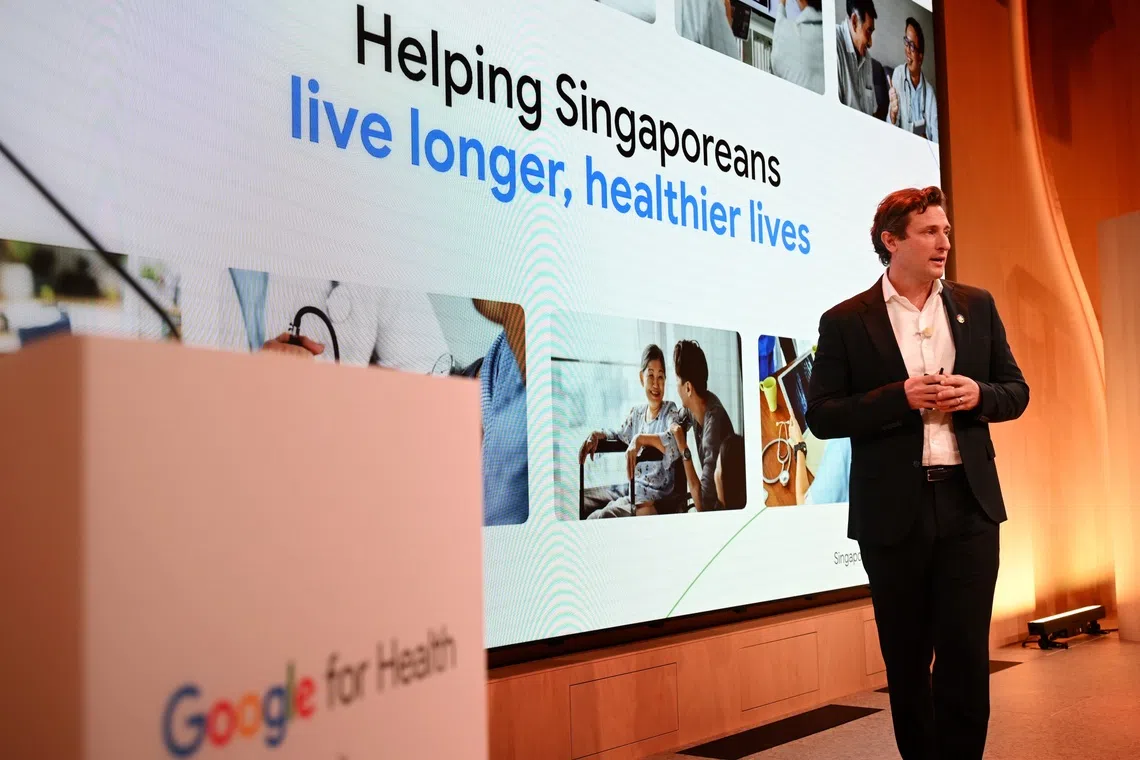
Google Singapore country managing director Ben King said the true power of AI lies in “solving complex societal challenges”, including healthcare.
ST PHOTO: KUA CHEE SIONG
Published Oct 29, 2026, 04:45 PM
Updated Oct 29, 2026, 04:45 PM
Google and NHG Health will test an AI health coach in Singapore from the first quarter of 2027. It will give personal lifestyle tips and screening reminders.
The nine-month study will target Healthier SG users who missed screenings and seniors. It will use Google Maps, voice messages and four national languages.
If successful, NHG Health wants to expand the service nationally through HealthHub. Google also announced new AI health research, training and US$7 million in regional health funding.
SINGAPORE - Tech giant Google is partnering NHG Health on an artificial intelligence-enabled health coach that will provide users with personalised lifestyle guidance and preventative care reminders, as part of an initiative to use AI to advance preventative healthcare here.
To be available via the NHG Healthbot – the health cluster’s chatbot on messaging platform WhatsApp – users may soon able to use the coach to suggest healthier meals or places to exercise near them, for example, drawing on the tech giant’s services such as Google Maps.
This was announced at the inaugural Google for Health Summit, held at the tech giant’s office at Mapletree Business City on Oct 29.
The service will first be available to a select group of users in the first quarter of 2027 as part of a nine-month long proof-of-concept study, said NHG Health population health chief operating officer Ong Jing Fang.
This group will include those who are eligible for Healthier SG but have not yet gone for screenings under the nationa l preventive health initiative , she said.
This is to encourage them to go for these screenings and better understand their reasons for not doing so.
Ong noted the group will also include seniors, with the health coach able to provide virtual frailty assessments as well as guidance on diet and exercise, as part of frailty prevention efforts.
The service will be available in all four national languages, with users also able to tap on the health coach using voice messages.
This initial group could include as many as a few thousand users, who will be brought onboard neighbourhood by neighbourhood, she said.
Should the health coach prove successful, the aim is eventually make it available beyond NHG Health’s ambit in northern and central Singapore, Ong added.
“We do want to go national if possible, to extend it to everybody in Singapore,” she said, noting this could be done by including it as part of national digital healthcare platform HealthHub.
The health coach will draw on insights from a predictive model which combines NHG Health’s population health database with data from Google on areas such as environmental and behavioural patterns.
This model aims to forecast health risks such as chronic diseases and frailty, at a population level, to enhance Singapore’s preventive health efforts using artificial intelligence.
Senior Minister of State for Digital Development and Information Tan Kiat How, who spoke at the event, said the collaboration between NHG Health and Google could potentially help create a health system that can reach out to people “before problems become crises”.
“It will explore whether predictive insights can identify health risks earlier, and whether an AI-enabled health coach can provide more personalised preventive guidance while directing clinically sensitive or urgent issues towards appropriate care channels,” said Tan, who is also Senior Minister of State for Health.
NHG Health group chief executive Joe Sim said the initiative would help drive preventive health efforts here.
“By bringing data and intelligence together, we can better understand the individual residents behind the data, reach them earlier, and turn every interaction into a personalised and targeted opportunity to help residents in central and north Singapore take charge of their health with good outcomes,” he said.
“With Singapore’s rapidly ageing population, we see tremendous potential for this technology to accelerate medical breakthroughs and support clinicians on the frontline to help citizens live longer, healthier lives,” he said.
A slew of other initiatives was also announced at the summit, which followed the announcement of the National AI Partnership between Google and the Government in May .
Google Research, the tech giant’s research arm, will launch a new research hub here, with a team of research scientists and software engineers focused on advancing foundational AI efficiency.
The hub will also work with local academic institutions such as the National University of Singapore and Nanyang Technological University to cultivate local scientific talent and provide targeted research support.
Google Research will also scale up its existing health research initiatives, such as bringing MedGemma – a medical-focused AI model – to frontline care settings here to enable the development of secure, customised AI solutions.
As part of its global AI co-clinician research initiative, Google DeepMind, the tech giant’s AI subsidiary, is working with National University Health System (NUHS) to explore how AI can augment clinicians’ capabilities and enable new models of care in the longer term.
The AI tool will assist doctors with clinical queries, drawing on existing clinical guidelines and medical literature.
The study will assess the accuracy, safety and usefulness of the tool’s responses, with clinicians independently evaluating these responses against established clinical criteria.
And as part of broader workforce skilling efforts, Google is also introducing its Google AI for Healthcare Professionals Certificate, an online programme which seeks to equip healthcare workers to use the technology for administrative tasks and continuous learning.
Google is also contributing US$7 million ($8.9 million) to the Philanthropy Asia Alliance’s Health for Human Potential Coalition, which aims to tackle infectious diseases and preventable deaths across South-east Asia.
Of this amount, US$1 million will go towards supporting PathGen, an AI powered platform that aims to more rapidly detect emerging disease threats across the region.
Zhaki Abdullah is a correspondent at The Straits Times. He is on the health beat, in addition to occasionally covering science, environmental, tech and Muslim affairs issues.
AI/artificial intelligence
谷歌新加坡国家总经理 Ben King 表示,人工智能的真正力量在于“解决复杂的社会挑战”,包括医疗保健。
《海峡时报》摄影:郭志雄
发布于 2026 年 10 月 29 日下午 4:45
更新于2026年10月29日下午4:45
谷歌和NHG Health将于2027年第一季度在新加坡测试一款人工智能健康教练。该教练将提供个人生活方式建议和体检提醒。
这项为期九个月的研究将以错过筛查的“健康新加坡”用户和老年人为目标人群。研究将使用谷歌地图、语音留言和四种新加坡官方语言。
如果成功,NHG Health希望通过HealthHub将这项服务推广到全国。谷歌也宣布了新的AI健康研究、培训项目,并投入700万美元用于区域健康领域的资金。
新加坡——科技巨头谷歌正与NHG Health合作开发一款人工智能健康教练,该教练将为用户提供个性化的生活方式指导和预防保健提醒,这是利用人工智能推进新加坡预防性医疗保健计划的一部分。
用户很快就能通过 NHG Healthbot(该健康集群在即时通讯平台 WhatsApp 上的聊天机器人)使用该健康教练,例如,利用这家科技巨头的 Google 地图等服务,来推荐更健康的膳食或附近的锻炼场所。
该消息是在10月29日于谷歌位于丰树商业城的办公室举行的首届谷歌健康峰会上宣布的。
NHG Health 人口健康首席运营官 Ong Jing Fang 表示,作为一项为期九个月的概念验证研究的一部分,该服务将于 2027 年第一季度首先向部分用户开放。
她表示,该群体将包括符合“健康新加坡”计划资格但尚未根据国家预防性健康计划接受筛查的人员。
这是为了鼓励他们参加这些筛查,并更好地了解他们不参加筛查的原因。
Ong指出,该小组还将包括老年人,健康教练能够提供虚拟的衰弱评估以及饮食和运动方面的指导,作为预防衰弱工作的一部分。
该服务将提供四种国家语言版本,用户还可以通过语音留言与健康教练联系。
她表示,首批用户可能多达数千人,他们将按社区逐个加入。
Ong补充说,如果健康教练被证明是成功的,最终目标是将其推广到新加坡北部和中部地区,而不是NHG Health的管辖范围之内。
“如果可能的话,我们希望将其推广到全国,惠及新加坡的每一个人,”她说道,并指出这可以通过将其纳入国家数字医疗平台 HealthHub 来实现。
健康教练将利用预测模型的见解,该模型结合了 NHG Health 的人口健康数据库和来自 Google 的环境和行为模式等领域的数据。
该模型旨在利用人工智能,在人口层面预测慢性病和体弱等健康风险,以加强新加坡的预防性健康工作。
出席活动的数码发展及新闻部高级政务部长陈杰豪表示,NHG Health 与谷歌的合作有可能帮助创建一个能够在问题演变成危机之前就接触到人们的医疗系统。
“这项研究将探索预测性见解能否更早地识别健康风险,以及人工智能赋能的健康教练能否提供更个性化的预防指导,同时将临床敏感或紧急问题引导至适当的护理渠道,”陈先生说道,他同时也是卫生部高级政务部长。
NHG Health集团首席执行官Joe Sim表示,这项举措将有助于推动本地的预防性健康工作。
他说:“通过将数据和情报结合起来,我们可以更好地了解数据背后的居民个体,更早地接触到他们,并将每一次互动都变成个性化和有针对性的机会,帮助新加坡中部和北部居民掌控自己的健康,并取得良好的结果。”
他说:“新加坡人口老龄化速度很快,我们看到这项技术具有巨大的潜力,可以加速医学突破,并支持一线临床医生,帮助公民活得更长久、更健康。”
在峰会上还宣布了一系列其他举措,此前谷歌和政府于 5 月份宣布了国家人工智能合作伙伴关系。
谷歌研究院(Google Research,这家科技巨头的研究部门)将在这里设立一个新的研究中心,该中心将由一支研究科学家和软件工程师团队组成,致力于提高基础人工智能的效率。
该中心还将与新加坡国立大学和南洋理工大学等本地学术机构合作,培养本地科学人才并提供有针对性的研究支持。
谷歌研究院还将扩大其现有的健康研究计划,例如将 MedGemma(一种专注于医疗的 AI 模型)引入一线护理环境,以开发安全、定制的 AI 解决方案。
作为其全球人工智能联合临床医生研究计划的一部分,科技巨头谷歌旗下的人工智能子公司谷歌DeepMind正与新加坡国立大学医疗系统(NUHS)合作,探索人工智能如何增强临床医生的能力,并在长期内实现新的护理模式。
该人工智能工具将参考现有的临床指南和医学文献,协助医生解答临床问题。
该研究将评估该工具反应的准确性、安全性和实用性,临床医生将根据既定的临床标准独立评估这些反应。
作为更广泛的劳动力技能提升计划的一部分,谷歌还推出了面向医疗保健专业人员的谷歌人工智能证书,这是一个在线课程,旨在帮助医疗保健工作者利用该技术完成行政任务和持续学习。
谷歌还向亚洲慈善联盟的“人类潜能健康联盟”捐赠了 700 万美元(890 万美元),该联盟旨在解决东南亚的传染病和可预防的死亡问题。
其中 100 万美元将用于支持 PathGen,这是一个人工智能平台,旨在更快地检测该地区新出现的疾病威胁。
扎基·阿卜杜拉是《海峡时报》的记者。他主要负责健康新闻报道,偶尔也报道科学、环境、科技和穆斯林事务等议题。
人工智能