Teachers learn to better use AI in their classrooms at ST’s interactive AI workshop在ST的互动式人工智能研讨会上,教师们学习如何在课堂上更好地使用人工智能。
Teachers learn to use AI tools for their classrooms at Straits Times workshop, focusing on accurate, responsible content creation Read more at straitstimes.com.
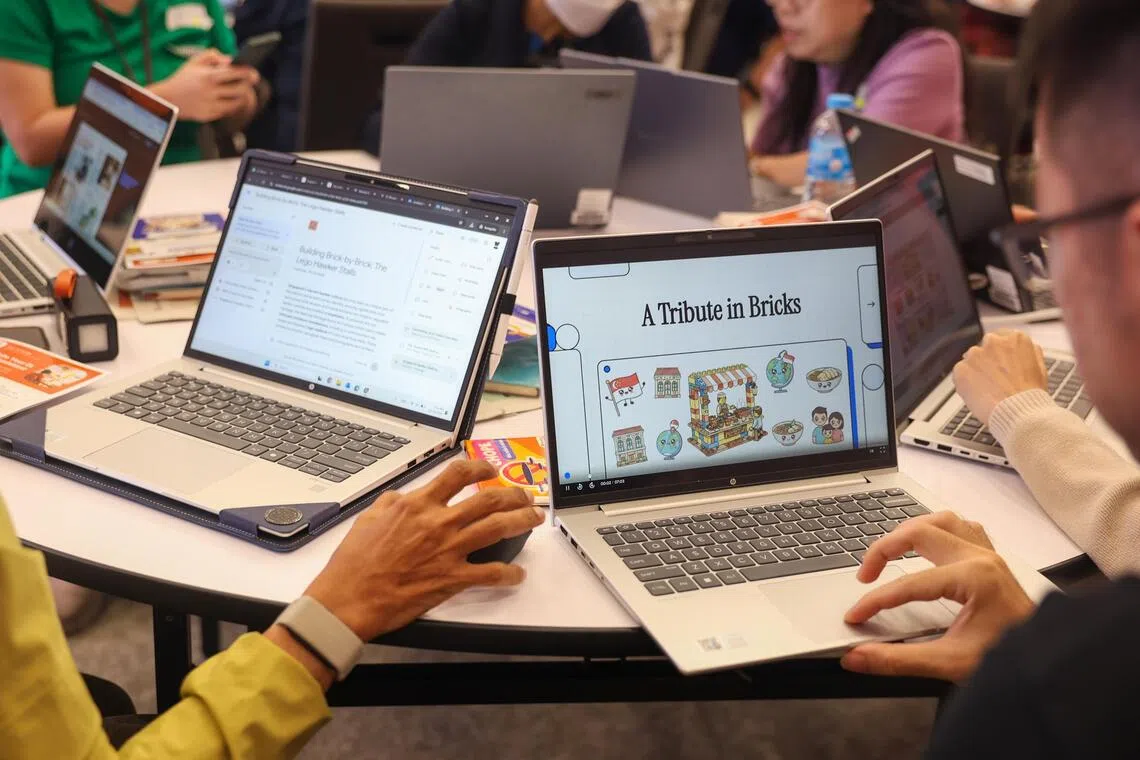
Primary and secondary school teachers looking through their creations in an interactive AI workshop organised by ST on Oct 29.
Published Oct 29, 2026, 06:56 PM
Updated Oct 29, 2026, 06:56 PM
More than 80 teachers from 45 schools joined a Straits Times workshop in Singapore to learn how Gen AI can create classroom content using news articles.
Teachers used tools like Gemini Notebook and ChatGPT to make worksheets, videos and infographics, while checking that the content was accurate and used proper sources.
The workshop stressed AI literacy and responsible use, with teachers saying AI can save time and help them adapt resources for different student levels.
SINGAPORE – Teachers tried their hand at using generative AI (Gen AI) to create classroom content from news articles, while learning to ensure that the content is accurate and backed by trusted sources at a Straits Times’ workshop on Oct 29.
Held at SPH Media News Centre in Toa Payoh North, the interactive session was attended by over 80 primary and secondary school teachers from 45 schools.
This year’s teacher’s engagement workshop, facilitated by trainers from StoryLab Academy, guided teachers on how to tailor AI-generated content to their classroom’s specific contexts and students’ level of learning ability. It built on last year’s session which focused on using AI to generate visual content for the classroom .
During the workshop, teachers harnessed AI tools such as Gemini Notebook and ChatGPT to create lesson resources for learners of varying abilities. They used articles published in Little Red Dot and IN – weekly student publications produced by The Straits Times’ Schools department for primary and secondary schools respectively.
With Gen AI increasingly being adopted in Singaporean schools , one key component covered was AI literacy and responsible AI use.
ST editor Jaime Ho said: “AI literacy has much in common with media literacy. It could be distinguishing between real and false or synthesised content; it could be identifying bias, or it could be appreciating the humanity and authenticity behind our words and journalism.
“We’re doing exactly this, among many other things, to help build a healthier media and content ecosystem and experience for the young amongst us.”
During the workshop, teachers harnessed AI tools such as Gemini Notebook and ChatGPT to create lesson resources for learners of varying abilities. ST PHOTO: JASEL POH
During the workshop, teachers harnessed AI tools such as Gemini Notebook and ChatGPT to create lesson resources for learners of varying abilities.
As part of the session’s activities, teachers created videos, infographics and other resources, while verifying that they were factually accurate and free of hallucinations – unsubstantiated information not from sources added by AIs.
Faizal Mohamad, an English and literature teacher at Whitley Secondary School, said: “Given the time constraints I have as a teacher, AI can really help me in gathering the facts, details and products that I want for my classroom.”
He added that he wanted to use what he learnt from the workshop to “create catchy videos and link it to global affairs for my students to understand”.
Desirene Teng, an English teacher at River Valley Primary School, said: “Having to adapt a particular resource to higher- or lower- ability students can be time-consuming, so having AI generate differentiated resources tailored to my students will be very helpful.”
Meridian Secondary School English teacher Rosalind Lee said: “In the classroom, I already use AI for a multitude of tasks, from brainstorming to creating classroom resources to feedback.”
“I don’t rely on AI too much, but I think it can help expedite our processes and lay the groundwork for the work I do in the classroom.”
AI/artificial intelligence
Education and schools
ST Schools programme
10月29日,中小学教师在《海峡时报》组织的互动式人工智能工作坊中浏览他们的作品。
发布于 2026 年 10 月 29 日下午 6:56
更新于2026年10月29日下午6:56
来自 45 所学校的 80 多名教师参加了新加坡《海峡时报》举办的研讨会,学习如何利用新闻文章创建课堂内容。
教师们使用 Gemini Notebook 和 ChatGPT 等工具制作工作表、视频和信息图表,同时检查内容是否准确以及是否使用了正确的来源。
研讨会强调了人工智能素养和负责任的使用,教师们表示人工智能可以节省时间,并帮助他们根据不同学生的水平调整资源。
新加坡——10 月 29 日,《海峡时报》举办了一场研讨会,教师们尝试使用生成式人工智能 (Gen AI) 从新闻文章中创建课堂内容,同时学习如何确保内容的准确性并得到可信来源的支持。
本次互动交流会在大巴窑北的新加坡报业控股媒体新闻中心举行,来自 45 所中小学的 80 多名教师参加了此次交流会。
今年的教师互动工作坊由StoryLab Academy的培训师主持,指导教师如何根据课堂的具体情况和学生的学习能力来定制人工智能生成的内容。本次工作坊以去年的课程为基础,去年的课程重点在于利用人工智能为课堂生成视觉内容。
在工作坊期间,教师们利用Gemini Notebook和ChatGPT等人工智能工具,为不同能力水平的学习者创建了教学资源。他们使用了《小红点》(Little Red Dot)和《IN》上发表的文章——这两份周刊分别是《海峡时报》学校部门为小学和中学学生制作的刊物。
随着新加坡学校越来越多地采用人工智能,人工智能素养和负责任的人工智能使用成为其中一个关键组成部分。
《海峡时报》编辑何杰明表示:“人工智能素养与媒体素养有很多共同之处。它可以是区分真实内容和虚假或合成内容;它可以是识别偏见;也可以是欣赏我们文字和新闻报道背后的人性和真实性。”
“我们正在做很多事情,其中就包括这件事,目的就是为了帮助我们当中的年轻人构建一个更健康的媒体和内容生态系统及体验。”
在工作坊期间,教师们利用 Gemini Notebook 和 ChatGPT 等人工智能工具,为不同能力水平的学习者创建了教学资源。(海峡时报照片:JASEL POH)
在研讨会期间,教师们利用 Gemini Notebook 和 ChatGPT 等人工智能工具,为不同能力的学习者创建课程资源。
作为课程活动的一部分,教师们制作了视频、信息图表和其他资源,同时验证它们在事实上是否准确,并且不包含任何虚构内容——即未经证实的信息,而非人工智能添加的信息。
惠特利中学英语和文学教师费萨尔·穆罕默德说:“鉴于我作为教师的时间限制,人工智能真的可以帮助我收集我课堂上需要的各种事实、细节和产品。”
他还表示,他想利用从研讨会中学到的知识,“制作引人入胜的视频,并将其与全球事务联系起来,以便我的学生能够理解”。
河谷小学英语教师邓德西琳表示:“根据学生能力的高低调整教学资源可能很耗时,因此人工智能能够生成适合学生的差异化教学资源将非常有帮助。”
子午线中学英语老师罗莎琳德·李说:“在课堂上,我已经使用人工智能来完成许多任务,从头脑风暴到创建课堂资源再到反馈。”
“我并不太依赖人工智能,但我认为它可以帮助加快我们的工作流程,并为我在课堂上所做的工作奠定基础。”
人工智能
教育和学校
ST 学校计划