Self-taught tailor is first Singaporean to win Italian contest自学成才的裁缝成为首位赢得意大利大赛的新加坡人
Singapore tailor Javin Tan becomes first non-Italian to win prestigious Italian tailoring prize in Naples Read more at straitstimes.com.
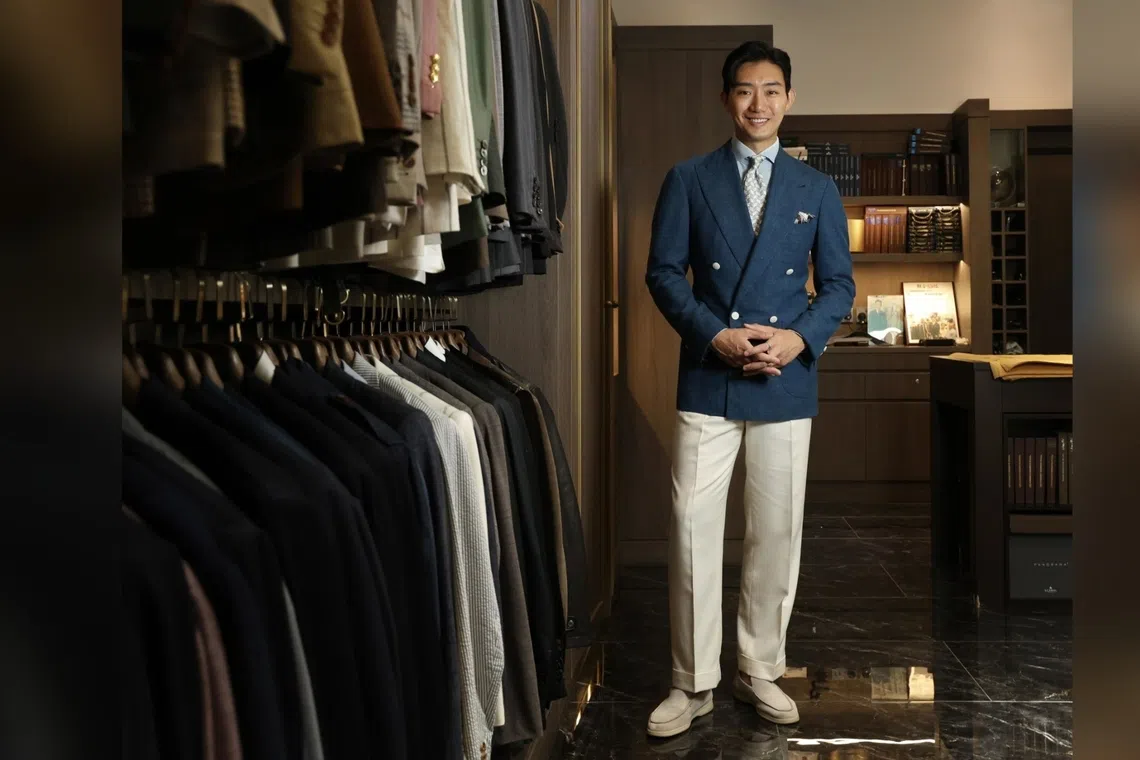
Javin Tan, founder of Singapore bespoke tailor Common Suits, has won Milano su Misura – Trofeo Arbiter 2026 in Naples. He wears his winning sailing suit at his atelier.
ST PHOTO: HESTER TAN
Published Oct 29, 2026, 10:05 AM
Updated Oct 29, 2026, 05:23 PM
Javin Tan, founder of Common Suits, became the first non-Italian to win Milano su Misura - Trofeo Arbiter after beating 24 tailors, including Savile Row names, with a tropical sailing-inspired suit.
Tan started in 2014 with a $25-a-day NUS canteen booth and grew the brand through hard work, mistakes, and support from his mother, who backed his dream.
Common Suits now has ateliers across Asia, and Tan’s breathable design adapts Neapolitan tailoring for Singapore’s heat, showing local craft can win on the world stage.
SINGAPORE – As a university student, business major Javin Tan fell in love with the feeling of wearing a well-cut suit. Fresh out of school, he decided to make them for a living.
In 2014, just two weeks after his final exam at the National University of Singapore (NUS), he rented a booth outside a campus canteen for $25 a day to sell his first suits. That humble pop-up grew into bespoke tailoring house Common Suits .
Twelve years on, the 37-year-old director and founder has become the first non-Italian to win Milano su Misura – Trofeo Arbiter, an international tailoring competition organised by Italian menswear magazine Arbiter with luxury fabric house Loro Piana.
On Oct 17 in Naples, Tan beat 23 tailors from around the world, including heritage houses from London’s Savile Row.
His winning look, created for the theme Style on Board and Dockside, was an ocean-blue double-breasted jacket in Loro Piana wool, silk and linen, paired with ivory trousers.
The prestigious competition traces its roots to 1952, when Italy held the Festival della Moda Maschile, the world’s first event dedicated to men’s fashion and tailoring. After a long hiatus, it was revived as Milano su Misura – Trofeo Arbiter in 2020.
It was initially open only to Italian master tailors, before welcoming international entrants in 2024.
Tailor Javin Tan bested 23 tailors worldwide at the Milano su Misura – Trofeo Arbiter 2026 competition with his ocean-blue jacket (right). PHOTOS: MILANO SU MISURA - TROFEO ARBITER, HESTER TAN
Tailor Javin Tan bested 23 tailors worldwide at the Milano su Misura – Trofeo Arbiter 2026 competition with his ocean-blue jacket (right).
PHOTOS: MILANO SU MISURA - TROFEO ARBITER, HESTER TAN
Clinching the title in Naples, a city regarded as home to some of the world’s finest tailors, made the victory extra meaningful for Tan.
“Winning it in Naples is like winning a tech award in Silicon Valley,” he tells The Straits Times. “The win is not just for myself and my team. It’s also for the whole of Asia. We do have good craftsmen.”
The 2026 edition was not Tan’s first time at the competition.
He was first invited in 20 25.
The theme then, Winter Elegance , was a tough brief for a tailor from the tropics. But his debut went w ell.
The experience taught him the importance of staying true to his identity. “I saw that all 24 tailors had their own way of doing things, and I think that’s beautiful,” he says. “It gave me more conviction to be proud of where I’m from.”
Javin Tan, founder of Singapore bespoke tailor Common Suits, chalk-marking at his atelier at 122 Telok Ayer Street. ST PHOTO: HESTER TAN
Javin Tan, founder of Singapore bespoke tailor Common Suits, chalk-marking at his atelier at 122 Telok Ayer Street.
Encouraged, he returned in 2026 to build on what he had learnt , both about his identity and about designing pieces that are as functional as they are elegant . The nautical theme of 2026 , which played to his strengths in tropical tailoring, made it an easy decision to participate.
Naples, like Singapore, is a warm port city, which suited the light, breathable construction for which Common Suits is known.
Visibly passionate about his prized ocean-blue jacket, Tan says he drew inspiration for the competition from a boating day. In May, he had been invited as a guest of Loro Piana to sail at the Tre Golfi Sailing Week in Sorrento, Italy. Much of his winning suit was shaped by what he noticed on the boat.
“My shades were constantly wet because of the sea spray, and I didn’t want to wipe them on my jacket,” he says. “That led me to think, how can I put a microfibre cloth in my jacket?”
Tan also noticed ribbons on the sails called telltales, which show sailors the wind direction – and recreated them in green and red details beneath the jacket’s sleeve cuff.
Ivory rubber buttons are a nod to the rubber-soled shoes worn on deck, and a sign of respect for the boat and the sport.
The built-in microfibre patch that can clean sunglasses in Tan’s winning suit. ST PHOTO: HESTER TAN
The built-in microfibre patch that can clean sunglasses in Tan’s winning suit.
In Naples, the jury for the two-day competition included generational tailors Massimiliano Attolini and Luca Rubinacci, whose family workshops were founded in the 1930s.
On the first day, the judges examined each creation on a mannequin. The next day, the tailors walked a runway in their own designs so the judges could assess the fit.
It was a nerve-racking two days for Tan, who had long looked up to many of the judges. So, when his name was called as the winner that evening, it came as a surprise.
“I was very shocked,” he says. “The first thing I said was that I’m from Singapore. I really want to show the world what Singapore can do.”
A close-up of the hidden wind-direction strip under the sleeve of the suit. ST PHOTO: HESTER TAN
A close-up of the hidden wind-direction strip under the sleeve of the suit.
Tan traces his love for the suit back to his days at NUS. Studying finance and marketing meant he often had to wear a suit for presentations and interviews, and he found himself enjoying dressing up more than the subject itself.
“When I put on my first made-to-measure suit, it was very empowering,” Tan says. “I felt like I had to stand up straighter, taller, and behave more like a gentleman.”
When he told his family that he wanted to become a tailor, his mother, a former beautician and clinic assistant, backed him. “My mum has always been quite supportive of whatever I’ve chosen in life,” he says. “She encouraged me to go for it.”
The mostly self-taught tailor learnt much of the craft from YouTube, from taking measurements to drafting patterns.
“But the execution is not quite the same as the theory,” says Tan, who later hired a few master tailors and learnt alongside them. “I found that out only through making a lot of mistakes.”
Over three days, suited up, the fresh graduate set up shop at a canteen booth outdoors with no air-conditioning. He dressed second-hand mannequins purchased from Carousell and laid out fabric swatches he had cut by hand on a canteen bench, hoping to catch classmates who needed suits for job interviews.
It was good timing and after the pop-up, he marketed his business online. Whenever inquiries came in, he took the bus to customers’ homes with his luggage.
Money was tight. “In the early days, I would be lucky if I could even draw $1,000 a month,” Tan recalls.
“I didn’t think of giving up, but I did question whether life would be better if I were on the other side. Whenever times got really tough, I would go back to why we named the brand Common Suits.”
“Common” implies a common denominator, Tan says. “It’s the common denominator of the shared values of all good men.”
“ Coming from a single-parent family, I’ve always looked up to leaders and inspiring role models,” he adds, citing as examples Lee Kuan Yew, Hong Kong tycoon Li Ka-shing and American businessman John D. Rockefeller.
“I realised there’s a common set of values that they all have – integrity, respect, diligence, taking up responsibilities even when it’s hard, and perseverance.”
“Whenever I face a hard decision, I ask myself, how would these people solve this? Would they give up, or would they persevere?”
“I came from a humble family, so I wanted the name to serve as a reminder of where my roots are,” says Tan, who is married and has a daughter. “And if we do succeed one day, we can show the next generation that you don’t have to come from money to build something from scratch.”
Built for the tropics
Javin Tan with his team in the workroom of his atelier. ST PHOTO: HESTER TAN
Javin Tan with his team in the workroom of his atelier.
Today, Common Suits has ateliers in Singapore, Manila, Jakarta and Bangkok, and a team of close to 20 who make the suits by hand here. Its clients are mostly entrepreneurs, professionals, expatriates and grooms.
Prices start at $2,100 for a bespoke suit, and customers spend an average of $3,000 to $3,500 on a suit. Each one takes 50 to 60 hours to make and, after four to five fittings, is usually ready in about eight weeks.
Despite the city’s tropical heat, Tan says there is demand for bespoke suiting.
“Singapore is a financial hub and a melting pot that attracts a lot of people from overseas,” he says. “Many of them are here for business, and even if they don’t wear a suit every day, they need one when they travel for work.”
The evolution of suits displayed at Common Suits. ST PHOTO: HESTER TAN
The evolution of suits displayed at Common Suits.
According to Tan, Singapore suits traditionally follow the English style of tailoring, which is structured with strong shoulders.
“But I realised it’s just not comfortable or practical to be wearing a heavy, structured suit all year long,” Tan says.
Neapolitan tailoring, a soft, lighter style developed for Naples, offered a better starting point. To account for Singapore’s added humidity, Tan worked with his canvas manufacturer to create a fabric of his own that lets sweat evaporate quickly.
Common Suits has since become known for blending the sharp lines of English tailoring with the soft, light construction of Neapolitan tailoring. The result is a masculine silhouette with a defined shoulder-to-waist ratio, in a suit light enough for the tropical heat.
“On the outside, it looks formal, elegant and sharp,” he says. “When customers look at our jacket, they can’t tell that it’s actually that comfortable.”
When asked who he would make a suit for if he could choose anyone, Tan was quick to reply. “I want to make one for my mum. She should really experience what her son has created.”
新加坡高级定制裁缝店 Common Suits 的创始人 Javin Tan 赢得了在意大利那不勒斯举办的 2026 年 Milano su Misura – Trofeo Arbiter 大赛。他在自己的工作室里穿着获奖的航海服。
圣路易斯邮报照片:海丝特·谭
发布于 2026 年 10 月 29 日上午 10:05
更新于2026年10月29日下午5:23
Common Suits 的创始人 Javin Tan 凭借一套热带航海风格的西装,击败了包括萨维尔街知名裁缝在内的 24 位裁缝,成为首位赢得 Milano su Misura - Trofeo Arbiter 大奖的非意大利人。
Tan 于 2014 年在新加坡国立大学食堂以每天 25 美元的价格起家,通过辛勤工作、不断犯错以及母亲的支持,逐步发展壮大了这个品牌,他的母亲一直支持他的梦想。
Common Suits 目前在亚洲各地设有工作室,Tan 的透气设计将那不勒斯剪裁工艺应用于新加坡的炎热气候,表明本土工艺也能在世界舞台上取得成功。
新加坡——大学商科专业学生贾文·谭(Javin Tan)爱上了穿着剪裁合身的西装的感觉。毕业后,他决定以制作西装为生。
2014年,在新加坡国立大学(NUS)期末考试结束后仅仅两周,他就以每天25新元的价格在校园食堂外租了一个摊位,开始出售他的第一批西装。这个简陋的临时摊位发展成了高级定制西装店Common Suits。
十二年后,这位 37 岁的总监兼创始人成为首位赢得 Milano su Misura – Trofeo Arbiter 的非意大利人,这是一项由意大利男装杂志 Arbiter 与奢侈面料公司 Loro Piana 联合举办的国际裁缝比赛。
10 月 17 日,在意大利那不勒斯,谭击败了来自世界各地的 23 位裁缝,其中包括伦敦萨维尔街的知名老字号裁缝店。
他为“船上和码头上的时尚”这一主题设计的获奖造型,是一件由 Loro Piana 羊毛、丝绸和亚麻制成的海蓝色双排扣夹克,搭配象牙色长裤。
这项享有盛誉的赛事起源于1952年,当时意大利举办了Festival della Moda Maschile(男装时尚节),这是世界上第一个专注于男装时尚和剪裁的盛会。经过多年的中断,该赛事于2020年以Milano su Misura – Trofeo Arbiter(米兰裁缝大赛)的名义重新举办。
最初只对意大利高级裁缝开放,2024 年才开始接受国际参赛者。
裁缝 Javin Tan 凭借其海蓝色夹克(右图)在 2026 年米兰裁缝大赛(Milano su Misura – Trofeo Arbiter 2026)中击败了来自世界各地的 23 位裁缝。图片:米兰裁缝大赛 - 仲裁者奖,Hester Tan
裁缝 Javin Tan 凭借其海洋蓝色的夹克(右图)在 2026 年米兰裁缝大赛(Milano su Misura – Trofeo Arbiter 2026)中击败了来自世界各地的 23 位裁缝。
照片:MILANO SU MISURA - TROFEO 仲裁员,HESTER TAN
在被誉为世界顶级裁缝之都的那不勒斯夺得冠军,对谭来说,这场胜利意义非凡。
“在那不勒斯赢得比赛就像在硅谷赢得科技奖一样,”他告诉《海峡时报》。“这场胜利不仅属于我和我的团队,也属于整个亚洲。我们确实拥有优秀的工匠。”
2026 年的比赛并非 Tan 第一次参加该项赛事。
他于 2025 年首次受邀。
当时的主题是“冬日优雅”,这对一位来自热带地区的裁缝来说是个不小的挑战。但他的首秀非常成功。
这段经历让他明白了坚守自我身份的重要性。“我发现24位裁缝都有自己独特的做事方式,我觉得这很美妙,”他说。“这让我更加坚定地为我的家乡感到自豪。”
新加坡高级定制裁缝店 Common Suits 的创始人 Javin Tan 正在位于直落亚逸街 122 号的工作室里用粉笔画线。(海峡时报摄影:HESTER TAN)
新加坡高级定制裁缝店 Common Suits 的创始人 Javin Tan 正在位于直落亚逸街 122 号的工作室里用粉笔做标记。
受到鼓舞,他于2026年重返赛场,继续深化他所学到的知识,包括对自身风格的探索以及对兼具功能性和优雅感的服装设计。2026年的主题是航海风,这与他擅长的热带剪裁相得益彰,因此他毫不犹豫地决定参与其中。
那不勒斯和新加坡一样,都是气候温暖的港口城市,这很适合 Common Suits 品牌以轻便透气的服装结构而闻名。
谭先生对他的那件心爱的海蓝色夹克衫显然充满热情,他说他的参赛灵感来源于一次航海经历。五月份,他受邀作为罗洛·皮亚纳 (Loro Piana) 的嘉宾,前往意大利索伦托参加特雷·戈尔菲帆船周 (Tre Golfi Sailing Week)。他那套获奖西装的设计灵感很大程度上来源于他在船上的所见所闻。
“我的墨镜总是被海浪打湿,我不想用外套擦拭,”他说。“这让我想到,怎样才能把一块超细纤维布放在外套里呢?”
谭还注意到船帆上的丝带被称为风向标,它向水手们指示风向——并在夹克袖口下方用绿色和红色细节重新制作了这些丝带。
象牙色橡胶纽扣是对甲板上穿着的橡胶底鞋的致敬,也是对船只和这项运动的尊重。
谭女士获奖套装中内置的超细纤维布片可以用来清洁太阳镜。(图片来源:ST PHOTO,摄影:HESTER TAN)
Tan的获奖西装里内置了一块超细纤维布,可以用来清洁太阳镜。
在那不勒斯,为期两天的比赛的评委包括世代从事裁缝行业的 Massimiliano Attolini 和 Luca Rubinacci,他们的家族作坊创立于 20 世纪 30 年代。
第一天,评委们在人体模型上仔细查看了每件作品。第二天,裁缝们穿着自己设计的服装走上T台,以便评委们评估服装的合身度。
对于一直很敬仰众多评委的谭来说,这两天真是令人紧张不安。所以,当当晚宣布他获胜时,他感到非常意外。
“我当时非常震惊,”他说。“我说的第一句话就是我来自新加坡。我真的很想向世界展示新加坡的实力。”
特写镜头展现了西装袖子下隐藏的风向标条。ST 摄影:HESTER TAN
特写镜头展示了西装袖子下隐藏的风向标条。
谭先生对西装的喜爱可以追溯到他在新加坡国立大学求学时期。由于他学习的是金融和市场营销,这意味着他经常需要在演讲和面试时穿西装,他发现自己更享受穿衣打扮的过程,而不是学习课程本身。
“当我第一次穿上定制西装时,我感觉自己充满了力量,”谭说道。“我觉得自己必须站得更直、更挺拔,举止更像个绅士。”
当他告诉家人他想成为一名裁缝时,他的母亲——一位曾经的美容师和诊所助理——非常支持他。“我妈妈一直都很支持我人生中的任何选择,”他说。“她鼓励我放手一搏。”
这位主要靠自学的裁缝从 YouTube 上学习了很多技艺,从量尺寸到绘制纸样。
“但实际操作与理论并不完全一致,”谭说道。他后来聘请了几位裁缝师傅,并向他们学习。“我犯了很多错误才明白这一点。”
三天时间里,这位刚毕业的大学生全副武装,在没有空调的食堂露天摊位上摆起了摊位。他给从二手交易平台Carousell上买来的模特穿上衣服,并将自己手工裁剪的布料样品铺在食堂的长凳上,希望能吸引到需要西装去面试的同学。
时机把握得很好,快闪店活动结束后,他开始在网上推广自己的生意。每当有客户咨询,他就带着行李坐公交车去客户家。
当时经济拮据。“早些年,我一个月能挣到1000美元就不错了,”谭回忆道。
“我从未想过放弃,但我确实质疑过,如果我身处另一边,生活是否会更好。每当遇到真正艰难的时刻,我都会想起我们当初为什么把品牌命名为‘Common Suits’。”
谭说,“共同”意味着一个共同点。“它是所有优秀男人的共同价值观。”
“我来自单亲家庭,所以我一直仰慕领导者和鼓舞人心的榜样,”他补充道,并列举了李光耀、香港富豪李嘉诚和美国商人约翰·D·洛克菲勒作为例子。
“我意识到他们都拥有一些共同的价值观——正直、尊重、勤奋、勇于承担责任(即使遇到困难)以及坚持不懈。”
“每当我面临艰难的抉择时,我都会问自己,这些人会如何解决这个问题?他们会放弃,还是会坚持下去?”
“我出身寒微,所以我希望公司的名字能够时刻提醒我我的根在哪里,”已婚并育有一女的谭说道。“如果我们有一天成功了,我们就能向下一代证明,你不必出身富裕也能白手起家。”
专为热带地区而建
Javin Tan和他的团队在他的工作室里。ST摄影:HESTER TAN
Javin Tan 和他的团队在他的工作室里。
如今,Common Suits在新加坡、马尼拉、雅加达和曼谷均设有工作室,拥有近20人的团队,全部由工匠手工制作西装。其客户主要包括企业家、专业人士、外籍人士和新郎。
定制西装的起价为2100美元,顾客平均花费在3000美元到3500美元之间。每套西装需要50到60个小时制作,经过四到五次试穿后,通常需要大约八周时间才能完成。
尽管这座城市气候炎热,但谭先生表示,定制西装的需求依然存在。
他说:“新加坡是金融中心,也是文化熔炉,吸引了大量海外人士。他们中许多人来这里是为了经商,即使他们并非每天都穿西装,但出差时也需要一套西装。”
Common Suits 展出的西装演变历程。ST 摄影:HESTER TAN
Common Suits 展示了西装的演变历程。
据 Tan 介绍,新加坡的西装传统上遵循英式剪裁风格,其特点是结构感强,肩部线条硬朗。
“但我意识到,一年四季都穿着厚重、挺括的西装既不舒服也不实用,”谭说道。
那不勒斯剪裁风格轻盈柔软,起源于那不勒斯,为新加坡的服装设计提供了更好的起点。为了应对新加坡潮湿的气候,谭与帆布制造商合作,研发了一种能够快速排汗的面料。
Common Suits 因将英式剪裁的利落线条与那不勒斯剪裁的柔软轻盈完美融合而闻名。最终呈现出线条分明、肩腰比例协调的男士西装,轻盈透气,即使在热带气候下也能穿着舒适。
“从外观上看,它正式、优雅、干练,”他说。“顾客看到我们的夹克时,根本感觉不到它实际上非常舒适。”
当被问及如果可以自由选择,他会为谁制作一套西装时,谭先生毫不犹豫地回答:“我想为我妈妈做一套。她应该真正体验一下她儿子的作品。”