Bangladesh scrambling as Ganges water treaty with India nears expiry, putting millions of livelihoods at risk孟加拉国与印度之间的恒河水条约即将到期,数百万人的生计面临风险,孟加拉国正为此焦头烂额。
RAJSHAHI (Bangladesh), Oct 29 — In Bangladesh’s parched Barind region, 72-year-old Bikash Soren remembers when the Ganges river flowing in from neighbouring India carried large...
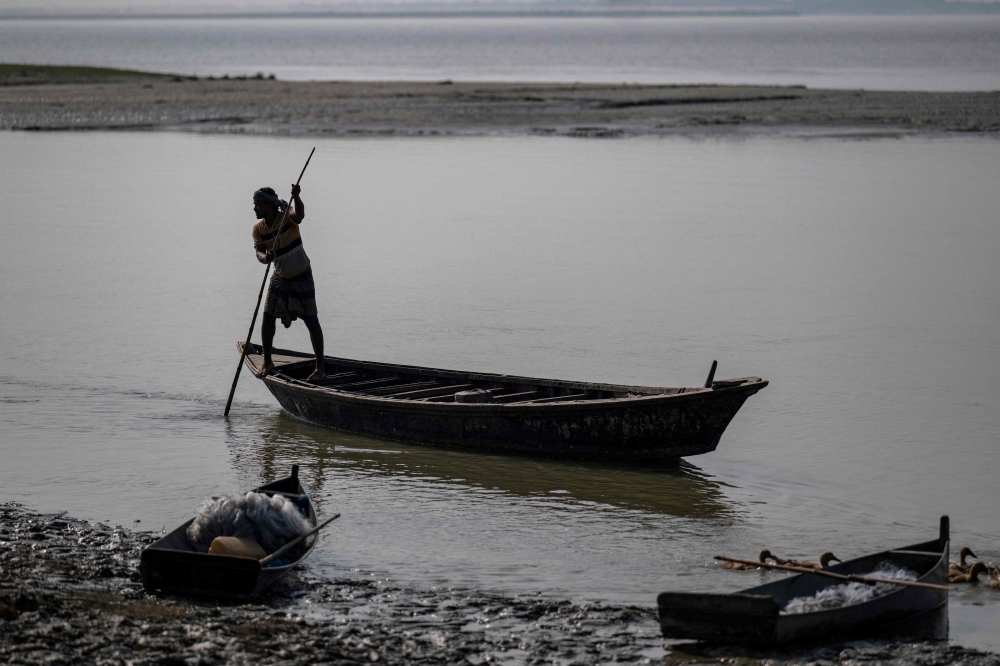
RAJSHAHI (Bangladesh), Oct 29 — In Bangladesh’s parched Barind region, 72-year-old Bikash Soren remembers when the Ganges river flowing in from neighbouring India carried large boats past his village year-round.
But the South Asian country is now blighted by persistent water shortages — and the expiration of a long-term water-sharing deal with Delhi in just a few weeks’ time threatens tens of millions of livelihoods.
“For almost three months a year, you hardly see the river flowing,” the Protestant priest said.
Two farmers killed themselves last season, he added, after dwindling water levels left their rice and wheat crops in tatters.
Shrinking flows in the Ganges have also slashed fish catches in the river, known in Bangladesh as the Padma.
“Where will we find fish now?” said Abu Bakar Siddique, 55, who has switched to fish farming in ponds.
“I used to catch many kinds.”
The 2,525-kilometre Ganges flows through the world’s most populous river basin, home to 655 million people including more than 50 million in Bangladesh, according to the World Bank.
The 1996 treaty, which expires on December 12, governs dry-season water sharing at India’s Farakka Barrage, 20 kilometres upstream of Bangladesh.
But Bangladesh needs a new deal based on “mutual benefit and respect”, Rashed Al Mahmud Titumir, a prime ministerial adviser who heads a technical committee on water-sharing, told AFP.
Water arguments over 54 cross-border rivers between India and Bangladesh stretch back decades, and the Ganges is among the most important.
Malik Fida A. Khan, a former Bangladeshi member of the Joint Rivers Commission (JRC), the body overseeing water-sharing, said India had built “additional dams” upstream.
“This time, the agreement must include provisions on climate change — and take the entire river basin into account,” he said.
Bangladesh said India had not responded to its request to negotiate a treaty renewal.
New Delhi’s foreign ministry said that “discussions regarding river-related matters” are a matter for the JRC commission, which held its last technical talks back in May.
The last officially confirmed ministerial-level JRC meeting was in 2022 — after a 12-year gap.
And a proposed water-sharing deal for the cross-border Teesta river has been stalled since 2011.
Relations between New Delhi and Dhaka have soured since Bangladesh’s ex-leader Sheikh Hasina fled to old ally India, where she remains, following a 2024 uprising.
Hasina, sentenced to death in absentia for crimes against humanity, has vowed to return to Bangladesh from India in December, the month the treaty she signed expires.
Bangladesh’s Prime Minister Tarique Rahman may also reportedly visit India before the treaty expires, but no visit has been confirmed.
Arguments over water-sharing date back to 1975, when India opened the 2.2-kilometre Farakka Barrage — which Bangladesh accuses Delhi of using to divert most of the water.
The United Nations intervened in the dispute and a deal was agreed in 1977.
But water-sharing arrangements lapsed a decade later, bringing severe consequences, said Sheikh Rokon of Dhaka-based environmental group Riverine People.
“The Ganges suffered during the years without a treaty, and at least three rivers almost dried up,” Rokon said.
One was the Gorai, which carries freshwater into the Sundarbans, the world’s largest mangrove forest and a World Heritage site, helping limit saltwater intrusion as sea levels rise.
Bangladesh’s Ganges-Kobadak Irrigation Project, designed to water a vast area of farmland bigger than the size of Berlin, “became inoperative because of water scarcity”, Rokon said.
In May, Dhaka approved the Padma Barrage, a US$2.8-billion (RM11.3 billion) project intended to ease shortages and include a 113-megawatt hydropower plant.
The 1996 treaty has no automatic extension clause.
“If we fail to reach a deal, I fear the situation will be worse than what we experienced during the years without a treaty,” Rokon added.
“Demand for freshwater on both sides has increased significantly.”
Even with the treaty in place, the Ganges-Kobadak project has shrunk to 550 square kilometres, according to Bangladeshi state news agency BSS.
“If the river does not carry enough water, the consequences could be disastrous,” said Chowdhury Sarwar Jahan, a geology professor at Bangladesh’s University of Rajshahi.
Bangladesh’s agriculture-dependent economy is already reeling from the impact of climate change, which compounds shifting river flows, alternating dry-season shortages and intense monsoon floods washing away farmland and villages.
In Chapainawabganj district, the river has widened by three kilometres in recent years — nearly doubling its size — according to Bangladesh’s Water Development Board.
Rehana Khatun, 50, described the “howling sound” as floods destroyed her home in Fielder Bazar village.
“The river turned wild and started swallowing everything along the bank,” said Khatun, who now lives in a bamboo shelter.
“And the trauma stays with children long after the waters recede.” — AFP
‘Are we going to be the next one?’: Rural US hospitals fear Trump health cuts
Deal still eludes nations on final day of UN nature summit
Four tankers ablaze in Strait of Hormuz as Iran disputes US claim that sea lanes are mine-free
Flood-prone gravel road in Baram serving 3,000 residents needs urgent upgrade, say locals
Beeping leads woman to find dashcam hidden under sink in Bau food court toilet; police probe privacy intrusion
Housewife allegedly cheated of RM554,525 by ‘bomoh’ over son’s health, land problems (VIDEO)
拉杰沙希(孟加拉国),10 月 29 日——在孟加拉国干旱的巴林德地区,72 岁的比卡什·索伦还记得,从邻国印度流入的恒河曾经一年四季都有大船从他的村庄经过。
但这个南亚国家现在饱受持续缺水之苦——而且与德里的长期水资源共享协议将在几周后到期,这将威胁到数千万人的生计。
“一年中将近三个月的时间,你几乎看不到河水流动,”这位新教牧师说道。
他还补充说,上个种植季有两名农民因水位下降导致水稻和小麦作物歉收而自杀。
恒河水量减少也导致这条在孟加拉国被称为帕德玛河的河流的鱼类捕捞量锐减。
“我们现在去哪里找鱼呢?” 55岁的阿布·巴卡尔·西迪克说道,他已经转行在池塘里养鱼了。
“我以前抓过很多种鸟。”
据世界银行统计,全长 2525 公里的恒河流经世界上人口最稠密的流域,该流域居住着 6.55 亿人口,其中包括 5000 多万孟加拉国人口。
1996 年的条约将于 12 月 12 日到期,该条约规定了印度法拉卡拦河坝(位于孟加拉国上游 20 公里处)旱季的用水分配。
但孟加拉国总理顾问、水资源共享技术委员会主席拉希德·阿尔·马哈茂德·蒂图米尔告诉法新社,孟加拉国需要一项基于“互利共赢和相互尊重”的新协议。
印度和孟加拉国之间围绕 54 条跨境河流的水资源争端由来已久,其中恒河是最重要的河流之一。
孟加拉国前联合河流委员会 (JRC) 成员马利克·菲达·A·汗 (Malik Fida A. Khan) 表示,印度在上游修建了“额外的水坝”。联合河流委员会是负责监督水资源分配的机构。
“这一次,协议必须包含有关气候变化的条款,并且要考虑到整个流域,”他说。
孟加拉国表示,印度没有回应其提出的续签条约谈判请求。
新德里外交部表示,“有关河流相关事宜的讨论”属于联合研究中心委员会的职责范围,该委员会上次技术会谈是在5月份。
上一次正式确认的部长级联合研究中心会议是在 2022 年——时隔 12 年。
一项关于跨境蒂斯塔河水资源共享的提议自 2011 年以来一直处于停滞状态。
自2024年孟加拉国爆发起义后,孟加拉国前领导人谢赫·哈西娜逃往昔盟友印度,并一直留在印度,新德里和达卡之间的关系就此恶化。
哈西娜因反人类罪被缺席判处死刑,她誓言将于12月从印度返回孟加拉国,届时她签署的条约将到期。
据报道,孟加拉国总理塔里克·拉赫曼也可能在条约到期前访问印度,但目前尚未证实此事。
关于水资源分配的争论可以追溯到 1975 年,当时印度启用了 2.2 公里长的法拉卡拦河坝——孟加拉国指责德里利用该拦河坝截流了大部分水资源。
联合国介入了这场争端,并于 1977 年达成了一项协议。
但十年后,水资源共享协议失效,带来了严重的后果,总部位于达卡的环保组织“河流人民”的谢赫·罗孔说道。
罗孔说:“在没有条约的那些年里,恒河遭受了苦难,至少有三条河流几乎干涸。”
其中之一是戈莱河,它将淡水输送到世界上最大的红树林——孙德尔本斯红树林,这是一处世界遗产,有助于限制海水入侵,因为海平面正在上升。
罗孔表示,孟加拉国的恒河-科巴达克灌溉工程旨在灌溉比柏林面积还大的广大农田,“由于缺水而停止运作”。
今年 5 月,达卡批准了帕德玛拦河坝项目,这是一个耗资 28 亿美元(113 亿令吉)的项目,旨在缓解电力短缺,其中包括一座 113 兆瓦的水力发电厂。
1996 年的条约没有自动延期条款。
罗孔补充说:“如果我们未能达成协议,我担心情况会比没有条约的那些年还要糟糕。”
“双方对淡水的需求都显著增加。”
据孟加拉国国家通讯社BSS报道,即使有了条约,恒河-科巴达克水利工程的面积也缩减至550平方公里。
“如果河流水量不足,后果不堪设想,”孟加拉国拉杰沙希大学地质学教授乔杜里·萨尔瓦尔·贾汉说。
孟加拉国依赖农业的经济已经受到气候变化的影响,气候变化加剧了河流流量的变化、旱季交替短缺以及强烈的季风洪水冲毁农田和村庄。
据孟加拉国水利发展委员会称,近年来,恰帕伊纳瓦布甘杰地区的河流宽度增加了三公里,几乎翻了一番。
50 岁的雷哈娜·卡顿 (Rehana Khatun) 将洪水摧毁她在菲尔德巴扎尔村的家时发出的“呼啸声”描述为“凄厉的嚎叫声”。
“河水变得狂暴,开始吞噬河岸边的一切,”现在住在竹棚里的卡顿说道。
“即使洪水退去,孩子们仍会长期遭受创伤。”——法新社
“我们会是下一个吗?”:美国农村医院担忧特朗普削减医疗预算
在联合国自然峰会的最后一天,各国仍未能达成协议。
四艘油轮在霍尔木兹海峡起火,伊朗对美国关于该海域无雷的说法提出异议。
巴拉姆镇一条易受洪水侵袭的砂石路亟需升级改造,当地居民表示,这条路服务于3000名居民。
蜂鸣声引出女子,发现宝湖美食广场洗手间水槽下藏有行车记录仪;警方调查这起侵犯隐私事件。
据称,一名家庭主妇因儿子健康和土地问题被“巫医”骗走554,525令吉(视频)