The challenges facing Singapore’s haze law — and where it can gain more teeth新加坡雾霾法面临的挑战——以及它如何才能加强效力
With no company prosecuted yet under the Transboundary Haze Pollution Act, legal experts map out the possible ways to enhance the law and other regulations in order to proactively manage risks of future haze incidents.
With no company prosecuted yet under the Transboundary Haze Pollution Act, legal experts map out the possible ways to enhance the law and other regulations in order to proactively manage risks of future haze incidents.
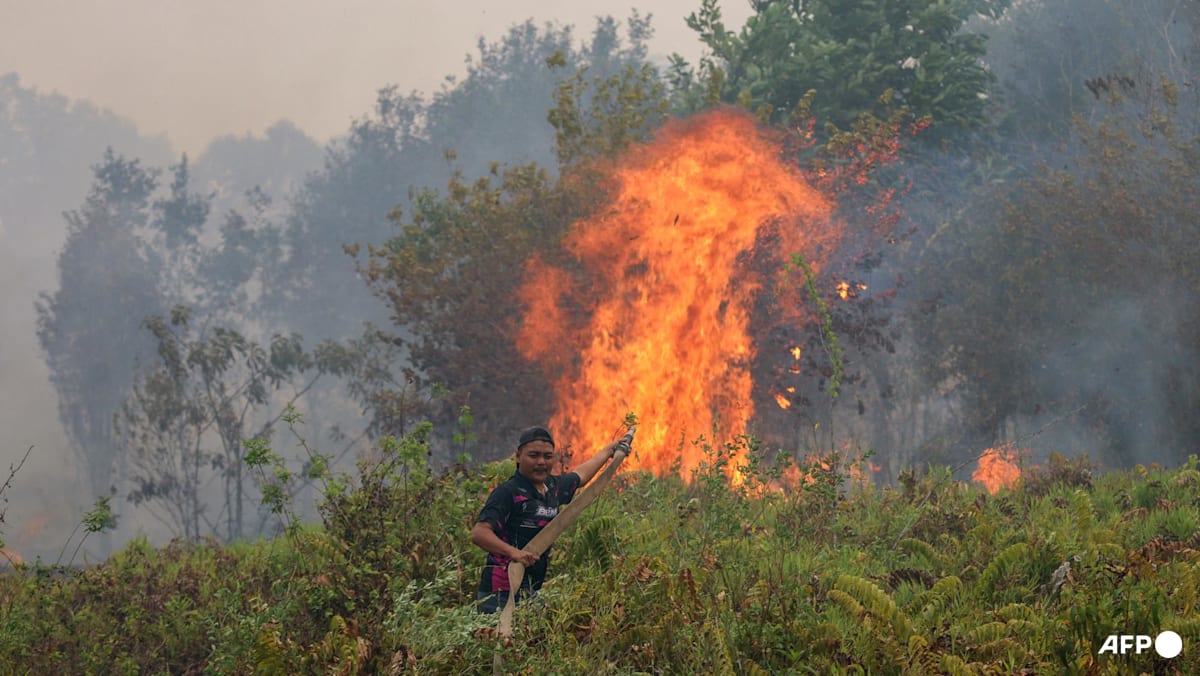
A firefighter extinguishes a fire in Sungai Tabuk village in Banjar Regency, South Kalimantan province, on Oct 16, 2026. (File photo: AFP/Muda Sagala)
This audio is generated by an AI tool.
SINGAPORE: More than a decade after Singapore enacted its anti-haze law, not a single company or director has ever been prosecuted under the statute.
With haze originating from Indonesian forest and peatland fires once again cloaking the region in recent weeks, the absence of convictions has spurred scrutiny over the legislation’s teeth.
Singapore has since said that it will strengthen the law in the next parliamentary sitting in November.
Speaking to CNA, legal experts said the lack of legal conclusions over the past decade risks casting the 2014 law as a “paper tiger”, though the Transboundary Haze Pollution Act (THPA) already possesses extra-territorial reach and has exerted commercial pressure in other ways.
Since the Act took effect, 26 notices have been issued: six in 2015, and 20 this year, including notices served on Oct 23 to 1 0 Singapore-based firms for the first time .
Four of the six earlier cases from 2015 remain open. The following year, a director of one such Indonesian firm was served a legal notice for an interview with the authorities while he was in Singapore, but he did not turn up and left the country.
The primary bottleneck, analysts told CNA, was the evidential and practical hurdles of securing cross-border cooperation, obtaining relevant information from overseas jurisdictions, and compelling foreign witnesses to appear in court.
Mr Tan Chong Huat, senior partner at RHT Law Asia and chairman of RHT Group of Companies, said critical evidence, such as operational records, land documentation, pertinent fires, and key witnesses, is typically situated outside Singapore.
"Obtaining admissible evidence and securing cooperation from overseas entities or witnesses may also be difficult," he said.
The Ministry of Law said as much on Oct 23 as it announced a new specialist panel to probe firms linked to haze .
“Government agencies, including the Attorney-General’s Chambers, may face legal and practical limitations in carrying out such work in other jurisdictions. This is because there are generally limitations imposed by countries on what work can be done in their territories by overseas government agencies,” said a spokesperson.
CNA Games Guess Word Crack the word, one row at a time Buzzword Create words using the given letters Mini Sudoku Tiny puzzle, mighty brain teaser Mini Crossword Small grid, big challenge Word Search Spot as many words as you can Show More Show Less
Amid heightened state action towards haze-linked firms, the government will be tabling legislative amendments on an urgent basis to sharpen the THPA’s legal teeth and give the specialist assessment framework legal force. If passed, the amendments would make it an offence for companies to refuse to appoint assessors or fail to cooperate fully with their investigations.
The panel, comprising experts with experience in cross-border inquiries and investigations , will be advised by law firm Davinder Singh Chambers.
Companies identified by the government may be directed to appoint, at their own expense, assessors from the panel to examine their operations, corporate relationships and supply chains.
Coordinating Minister for National Security K Shanmugam on Oct 19 said Singapore "will use every legal and regulatory lever at our disposal to exert pressure where it matters" on companies suspected of causing the haze yet refuse to cooperate.
Mr Tan said of the move: "The desired outcome is not necessarily prosecution success.
“The overarching objective is to demonstrate to the region that our government has the will and means to enforce the desired behaviour to prevent haze and pollution in Singapore."
Ahead of the tabling of the amendment Bill, CNA spoke to legal experts about what has stalled prosecutions for over the years, what legal changes are needed to overcome existing barriers, and how Singapore can bring every lever it has to bear so errant firms are held accountable.
EXISTING LAW ALREADY ESTABLISHES LIABILITY
Noting that the THPA in its current form is already broad in scope, legal experts said the law is not limited to the holders of Indonesian concessions behind the haze-causing fires and other companies that directly cause the fire.
"An entity that condones another’s fire-causing conduct, for instance by permitting it to occur, is also caught (under Section 2(3))," said Mr Mark Mangan, partner at law firm Lindsay Francis & Mangan.
This means that the law can also apply to parent entities participating in the management of a firm that occupies the plot of affected land, said Mr Kenneth Pereire, managing director of KGP Legal LLC.
That said, however, liability for a company does not arise simply out of a corporate relationship, said Mr Tan of RHT Law.
"Liability of a parent or other related entity is not automatic merely because of its corporate relationship and would depend on the statutory requirements being established," he said.
In other words, a company's liability must be proven under the law, and not be assumed automatically based on its corporate link to an entity responsible fora haze-related act.
People row a canoe along the Kallang river as the haze eases in Singapore on Oct 23, 2026. (File photo: AFP/Roslan Rahman)
EVIDENTIAL CHALLENGES OF PRESENT LAW
Experts noted that although the THPA possesses extraterritorial reach – enabling it to target overseas companies whose haze-producing actions impact Singapore – the primary hurdles stem from practical and evidential difficulties.
To assist in determining responsibility and identifying the origin of haze, Section 8 of the THPA establishes "rebuttable presumptions", noted Mr Kenneth Pereire of KGP Legal.
The presumptions spelled out under the Act essentially shift the burden of proof – if authorities prove certain baseline facts, the law automatically assumes a conclusion until the accused party can prove otherwise.
For example, once certain facts linking a fire to haze in Singapore and an entity to the affected land are established, the Act can presume that the entity engaged in or condoned conduct that caused or contributed to the haze, unless the entity proves otherwise.
Nevertheless, Mr Pereire highlighted that proving the underlying facts required to trigger these presumptions, along with other statutory requirements, remains a challenge.
He also noted that THPA provides the NEA with information gathering and investigative powers.
"However, those powers do not remove the practical challenges of obtaining overseas evidence and witnesses, securing compliance with a notice to a person abroad to provide specified information, prosecuting that person for non-compliance, and enforcing any resulting penalty," he added.
That said, Indonesia and Singapore have pledged to establish a joint task force that could cross these evidential hurdles, experts noted.
Indonesia Foreign Minister Arrmanatha Nasir said the task force will link information sharing, financial intelligence, cross-border evidence gathering, as well as asset recovery.
“No border should shield those who profit from burning our forests,” he said on Tuesday in a joint press conference with Singapore Foreign Minister Vivian Balakrishnan.
Singapore Foreign Minister Vivian Balakrishnan (left) and Indonesia Foreign Minister Arrmanatha Nasir at a joint press conference in Jakarta, Indonesia, on Oct 27. (Photo: Instagram/arrmanathanasir)
NEW SPECIALIST PANEL
To this end, companies with haze links identified by the government will be required to engage a team of investigation firms and legal advisors from the new specialist panel to conduct thorough inquiries into their operations, corporate relationships and supply chains.
The assessors will submit an evaluation report to NEA, which will take the findings into account in determining whether further action is warranted, said the Law Ministry and the NEA on Friday.
Asked about this new panel, experts said its existence will discourage businesses from taking part in haze-causing activities or being associated with entities that carry out such acts.
Mr Tan described the panel as the Singapore government "closing out the enforcement levers by tightening the disclosure and reporting processes".
The panel, he said, can be effective as long as the entities have some nexus to Singapore.
Mr Mangan added that this type of probe by a specialist panel is often undertaken in instances of money-laundering, breach of sanctions regime or other alleged corporate misconduct.
"This is the first time that such a technique has been applied to determine whether companies are complicit in environmental damage, shifting the onus on them to demonstrate that they have a clean bill of health as it were," he said.
"Among other benefits, this should discourage companies in the future that wish to do business in Singapore from being connected in any way with the burning."
(File photo: Jeremy Long)
As for how the THPA can be strengthened further beyond what has been announced, legal experts suggested a range of tweaks ranging from facilitating information gathering to stiffer penalties for companies and their directors.
Mr Tan of RHT Law suggested targeted evidential presumptions where objective satellite, meteorological and land-control criteria are established.
He added, however, that a meaningful opportunity for entities to rebut such presumptions must be preserved.
Mr Pereire noted that the present law imposes a fine of up to S$5,000 (US$3,900) or up to three months’ jail, or both, if a person within Singapore alters, suppresses or destroys information that the authorities seek.
The same penalties also apply if the person provides false or reckless information to the authorities.
To strengthen the government’s ability to gather evidence from those served with THPA notices, he suggested that this clause in the Act be extended to persons outside Singapore as well.
The law currently already covers persons within or outside Singapore who fail to do or refrain from doing anything required of them without a reasonable excuse.
Presently, those guilty of this offence shall be liable to a fine not exceeding S$5,000 or jailed for a maximum of one month, or both.
Some of the experts also suggested stiffer fines for liable entities, beyond the aggregate maximum S$2 million provided for under the existing law.
"Given that the revenues of major agribusiness groups run into the billions, S$2 million maximum fine is but a mere slap on the wrist," said Associate Professor Eugene Tan, law don at the Singapore Management University (SMU).
He also suggested that culpable key officers of an entity found liable should be jailed and "not be allowed to hide behind the corporate veil".
"As a company cannot be jailed, holding key officers personally liable for haze-causing actions can reduce the potential moral hazard that arises when the consequences of corporate decision-making are borne by the company but not by the key decision-makers or shareholders," he said.
The experts, however, stressed that any form of liability or conviction against individuals needs to be based on their role in the haze-related activities, and not automatically be based on their title or position in a related company.
As for whether the law can target the entire supply chain, experts said such a change could be considered in principle, but with sufficient safeguards against overreach.
Mr Tan of RHT Law said that commercial associations should not automatically amount to criminal liability.
"Any new liability should clearly identify the required nexus, such as knowledge, control, material assistance, failure to carry out prescribed due diligence, or continued dealing after specified warning signs," said Mr Tan.
"Proof becomes more difficult as the chain becomes longer and may require traceability records, beneficial-ownership information, procurement documents, financing arrangements and evidence of knowledge or control."
GOING BEYOND PROSECUTION
Beyond making prosecution easier, legal experts said Singapore could consider measures aimed at preventing haze-linked risks before fires occur.
To this, Mr Mangan said that there are laws in other jurisdictions which Singapore could examine, such as the European Union.
The grouping’s legislation on deforestation, for instance, requires companies to exercise some level of due diligence to examine the origin of certain high-risk commodities before trading in or using them, he said.
Mr Pereire suggested a law imposing due diligence duties on companies that source, process or finance specified commodities such as palm oil, timber and pulp and paper.
"The duties should be tailored to each company’s role – for example, traceability requirements for companies handling commodities and risk-screening requirements for financiers," he said.
He added that companies could be required, where reasonably practicable, to identify suppliers and the suppliers' fire prevention measures and history of fire incidents, and keep records of such checks.
"Where a serious risk is identified, companies could be required to seek corrective action and, if it remains unaddressed, suspend or terminate the relevant sourcing or business relationship," he said.
Agreeing, Mr Tan of RHT Law said that an approach of due diligence and disclosure is "more legally defensible" than a broad extension of liability across the entire supply chain.
Apart from the THPA, he suggested considering complementary regulatory and disclosure-based measures, noting that there are already sustainability reporting requirements for listed companies here.
"Any haze-specific disclosure requirement could therefore be considered in the context of this existing framework, subject to appropriate materiality criteria and reporting standards," he said.
Get our pick of top stories and thought-provoking articles in your inbox
Stay updated with notifications for breaking news and our best stories
Join our channel for the top reads for the day on your preferred chat app
由于目前还没有公司因违反《跨境烟霾污染法》而被起诉,法律专家正在研究如何加强该法律和其他法规,以便主动管理未来烟霾事件的风险。
2026 年 10 月 16 日,一名消防员在南加里曼丹省 Banjar 县的 Sungai Tabuk 村扑灭火灾。(资料图片:法新社/Muda Sagala)
这段音频是由人工智能工具生成的。
新加坡:新加坡颁布反雾霾法十多年后,没有一家公司或董事因违反该法而被起诉。
最近几周,源自印度尼西亚森林和泥炭地火灾的烟雾再次笼罩该地区,而没有定罪引发了人们对该立法效力的审查。
新加坡方面表示,将在11月举行的下届国会会议上加强该法律。
法律专家在接受亚洲新闻台采访时表示,过去十年缺乏法律结论,可能会使 2014 年的法律沦为“纸老虎”,尽管《跨境烟霾污染法》(THPA)已经具有域外效力,并在其他方面施加了商业压力。
自该法生效以来,已发出 26 份通知:2015 年 6 份,今年 20 份,其中包括 10 月 23 日首次向 10 家新加坡公司送达的通知。
2015年发生的六起案件中,有四起仍未结案。次年,一家印尼公司的董事在新加坡期间收到当局的问询通知,但他并未到场,而是离开了新加坡。
分析人士告诉中央社,主要瓶颈在于跨境合作的证据和实际障碍,以及从海外司法管辖区获取相关信息和强制外国证人出庭作证的困难。
RHT Law Asia 高级合伙人兼 RHT 集团公司董事长陈崇发先生表示,关键证据,如运营记录、土地文件、相关火灾和关键证人,通常位于新加坡境外。
“获取可采纳的证据以及获得海外实体或证人的合作也可能很困难,”他说。
10月23日,律政部宣布成立一个新的专家小组,调查与雾霾有关的公司,并表示了这一点。
一位发言人表示:“包括总检察署在内的政府机构在其他司法管辖区开展此类工作时,可能会面临法律和实际操作上的限制。这是因为各国通常会对海外政府机构在其境内可以开展的工作范围有所限制。”
CNA游戏 猜词游戏 逐行破解单词 流行词游戏 用给定的字母组成单词 迷你数独 小小谜题,挑战你的大脑 迷你填字游戏 小方格,大挑战 单词搜索 尽可能多地找出单词 显示更多 显示更少
鉴于政府加大了对涉雾霾企业的打击力度,政府将紧急提交立法修正案,以强化《雾霾污染防治法》(THPA)的法律效力,并赋予专业评估框架法律效力。如果修正案获得通过,企业拒绝委任评估人员或不全力配合调查将构成违法行为。
该小组由具有跨境调查经验的专家组成,并将由 Davinder Singh Chambers 律师事务所提供法律咨询。
政府可能会指示被认定的公司自费聘请专家组成员对其运营、公司关系和供应链进行审查。
新加坡国家安全统筹部长尚穆根于10月19日表示,新加坡“将动用一切法律和监管手段,在关键之处施加压力”,以制约那些涉嫌造成雾霾却拒绝合作的公司。
谭先生就此举表示:“我们期望的结果不一定是起诉成功。”
“我们的总体目标是向该地区表明,我国政府有决心和能力强制推行必要的行为规范,以防止新加坡出现雾霾和污染。”
在修正案草案提交之前,CNA采访了法律专家,探讨了多年来导致起诉停滞不前的原因、需要进行哪些法律改革才能克服现有障碍,以及新加坡如何才能动用一切手段追究违规公司的责任。
现行法律已明确规定责任
法律专家指出,《烟霾污染防治法》目前的形式已经涵盖范围很广,该法不仅限于造成烟霾火灾的印尼特许经营权持有者和其他直接造成火灾的公司。
“纵容他人纵火行为(例如允许纵火行为发生)的实体也属于(第 2(3) 条)的管辖范围,”林赛·弗朗西斯·曼根律师事务所的合伙人马克·曼根先生说。
KGP Legal LLC 的总经理 Kenneth Pereire 先生表示,这意味着该法律也可以适用于参与管理占用受影响土地的公司的母公司实体。
不过,RHT 律师事务所的 Tan 先生表示,公司的责任并非仅仅源于公司关系。
他说:“母公司或其他关联实体的责任并非仅仅因为其公司关系而自动产生,而是取决于已确立的法律要求。”
换句话说,公司的责任必须依法证明,而不能仅仅因为其与造成雾霾相关行为的实体存在公司联系就自动认定其负有责任。
2026年10月23日,新加坡雾霾逐渐消散,人们在加冷河上划独木舟。(资料照片:法新社/罗斯兰·拉赫曼)
现行法律的证据挑战
专家指出,尽管《烟雾污染防治法》具有域外效力——使其能够针对那些造成烟雾污染并影响新加坡的海外公司——但主要障碍源于实际操作和证据方面的困难。
KGP Legal 的 Kenneth Pereire 先生指出,为了帮助确定责任和识别雾霾的来源,《THPA》第 8 条规定了“可反驳的推定”。
该法案规定的推定实质上转移了举证责任——如果当局证明了某些基本事实,法律会自动推定结论,直到被告方能够证明相反的情况为止。
例如,一旦确定了某些事实将新加坡的火灾与烟霾联系起来,并将某个实体与受影响的土地联系起来,该法案就可以推定该实体参与或纵容了造成或促成烟霾的行为,除非该实体证明并非如此。
然而,佩雷尔先生强调,要证明触发这些推定所需的基本事实以及其他法定要求,仍然是一个挑战。
他还指出,《住房和城市规划法》赋予了国家环境局信息收集和调查权力。
“然而,这些权力并不能消除获取海外证据和证人、确保向境外人员发出提供特定信息的通知得到遵守、对不遵守通知的人员提起诉讼以及执行由此产生的任何处罚等方面的实际挑战,”他补充道。
专家指出,尽管如此,印度尼西亚和新加坡已承诺成立联合工作组,以克服这些证据障碍。
印尼外交部长阿尔马纳塔·纳西尔表示,该工作组将把信息共享、金融情报、跨境证据收集以及资产追回联系起来。
“任何边界都不应该保护那些从焚烧我们的森林中获利的人,”他周二在与新加坡外交部长维文·巴拉克里希南举行的联合新闻发布会上说。
10 月 27 日,新加坡外交部长维文·巴拉克里希南(左)和印度尼西亚外交部长阿玛纳塔·纳西尔在印度尼西亚雅加达举行联合新闻发布会。(照片:Instagram/arrmanathanasir)
新专家小组
为此,政府认定与雾霾有关联的公司将被要求聘请来自新成立的专家小组的调查公司和法律顾问团队,对其运营、公司关系和供应链进行彻底调查。
律政部和国家环境局周五表示,评估人员将向国家环境局提交一份评估报告,国家环境局将考虑评估结果,以决定是否需要采取进一步行动。
当被问及这个新小组时,专家表示,它的存在将阻止企业参与造成雾霾的活动或与实施此类行为的实体有关联。
陈先生将该小组描述为新加坡政府“通过收紧信息披露和报告程序来关闭执法手段”。
他说,只要这些实体与新加坡有某种联系,该小组就能发挥有效作用。
曼根先生补充说,这种由专家小组进行的调查通常发生在洗钱、违反制裁制度或其他涉嫌公司不当行为的案件中。
他说:“这是首次将这种技术应用于确定公司是否对环境造成破坏,从而将举证责任转移到公司身上,要求它们证明自己完全没有问题。”
“除其他好处外,这应该会阻止未来想在新加坡开展业务的公司以任何方式与这场焚烧事件产生关联。”
(资料照片:杰里米·朗)
至于如何进一步加强《THPA》,法律专家建议进行一系列调整,包括促进信息收集和对公司及其董事处以更严厉的处罚。
RHT 律师事务所的 Tan 先生建议,在确定客观的卫星、气象和土地控制标准后,可以采取有针对性的证据推定。
但他补充说,必须保留实体反驳此类推定的有意义的机会。
佩雷尔先生指出,现行法律规定,如果新加坡境内的任何人更改、隐瞒或销毁当局寻求的信息,将被处以最高 5000 新元(3900 美元)的罚款或最高三个月的监禁,或两者并罚。
如果该人向当局提供虚假或鲁莽的信息,也将受到同样的处罚。
为了加强政府从收到《防止虐待和侵犯人权法案》通知的人那里收集证据的能力,他建议将该法案中的这一条款也扩展到新加坡境外的人。
现行法律已经涵盖了新加坡境内外的任何人,如果他们没有合理的理由而未能履行或不履行其被要求履行的任何义务。
目前,犯有此罪行者将被处以不超过 5,000 新元的罚款或监禁最多一个月,或两者并罚。
一些专家还建议对负有责任的实体处以更严厉的罚款,超过现行法律规定的最高 200 万新元的罚款总额。
“鉴于大型农业企业集团的收入高达数十亿新元,200万新元的最高罚款只不过是轻描淡写地惩罚一下而已,”新加坡管理大学 (SMU) 法学教授陈永健副教授说道。
他还建议,对于被认定负有责任的实体,应将负有责任的关键人员监禁,“不允许他们躲在公司面纱后面”。
他说:“由于公司不能被监禁,让关键管理人员对造成雾霾的行为承担个人责任,可以减少潜在的道德风险,因为当公司决策的后果由公司承担,而不是由关键决策者或股东承担时,就会出现这种风险。”
然而,专家们强调,对个人的任何形式的责任或定罪都需要基于他们在与雾霾相关的活动中的角色,而不是自动基于他们在相关公司中的头衔或职位。
至于该法律是否可以针对整个供应链,专家表示,原则上可以考虑这种改变,但要有足够的保障措施来防止权力过度扩张。
RHT律师事务所的陈先生表示,商业合作不应自动构成刑事责任。
“任何新的责任都应明确指出所需的关联性,例如知情、控制、实质性协助、未能履行规定的尽职调查,或在出现特定警告信号后继续交易,”谭先生说。
“随着链条变长,举证变得更加困难,可能需要追溯记录、受益所有权信息、采购文件、融资安排以及知情或控制的证据。”
超越起诉
除了简化起诉程序外,法律专家表示,新加坡还可以考虑采取措施,在火灾发生前预防与烟霾相关的风险。
对此,曼根先生表示,新加坡可以借鉴其他司法管辖区的法律,例如欧盟的法律。
他表示,例如,该组织关于森林砍伐的立法要求公司在交易或使用某些高风险商品之前,必须进行一定程度的尽职调查,以审查其来源。
佩雷尔先生建议制定一项法律,对采购、加工或融资特定商品(如棕榈油、木材、纸浆和纸张)的公司施加尽职调查义务。
“职责应该根据每家公司的角色量身定制——例如,处理商品的公司有可追溯性要求,而金融机构有风险筛查要求,”他说。
他还补充说,在合理可行的情况下,可以要求公司查明供应商及其防火措施和火灾事故历史,并保留此类检查的记录。
他说:“如果发现严重风险,公司可能会被要求采取纠正措施;如果风险仍然没有得到解决,则会被暂停或终止相关的采购或业务关系。”
RHT 律师事务所的 Tan 先生对此表示赞同,并指出尽职调查和披露的做法“在法律上更站得住脚”,而不是将责任范围扩大到整个供应链。
除了THPA之外,他还建议考虑采取补充性的监管和信息披露措施,并指出新加坡上市公司已经有可持续发展报告的要求。
“因此,任何针对雾霾的特定披露要求都可以在现有框架内考虑,但须符合适当的重要性标准和报告标准,”他说道。
订阅我们的邮件,即可获取精选热点新闻和引人深思的文章。
订阅通知,第一时间获取突发新闻和精彩报道。
加入我们的频道,即可在您常用的聊天应用上获取当日热门文章。