Think flipping meat twice makes it juicier? Korean pork expert says the opposite你以为把肉翻两次面会让肉更鲜嫩多汁?韩国猪肉专家却说恰恰相反。
"Is it really true that meat tastes better if you flip it exactly twice? That might work for very thinly sliced pork belly. But with meat of ordina...
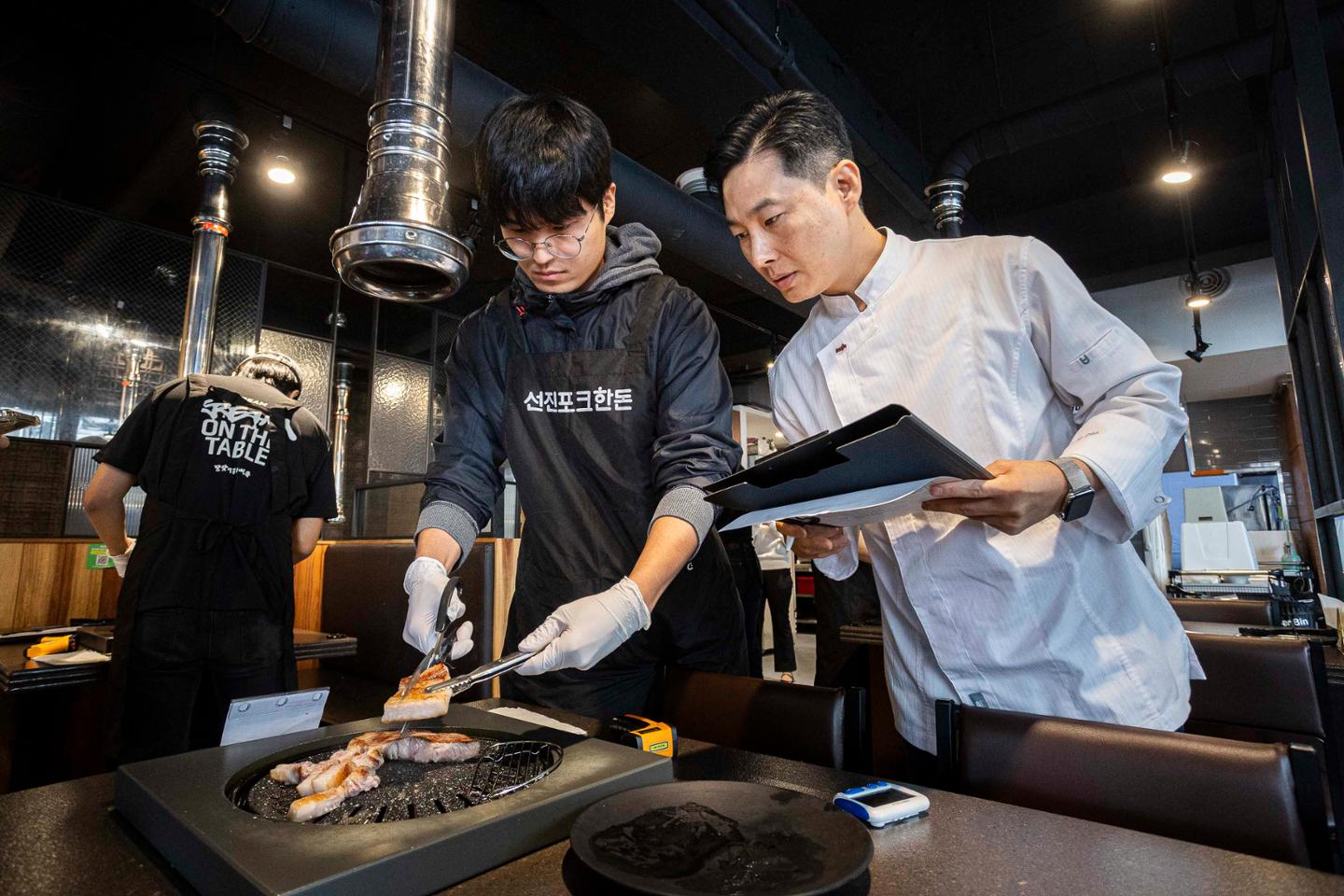
Cha Ho-myung, a former chef who leads Sunjin Technology Research Institute’s Meat&Food Food Solution Team, taught pork-grilling techniques at Yaksan Dwaeji in Seoul on Oct. 14. He recommends flipping meat frequently rather than only twice, and keeping the grill between 150 and 180 degrees Celsius. Sunjin’s Grilling Meister program combines a written test with practical training and assessment to teach professional knowledge about pork and cooking science.
Sunjin introduced the private Grilling Meister certification program in 2021.
Candidates are assessed on more than 20 criteria, including hand cleanliness, grill temperature, browning and juice retention.
The average pass rate exceeds 90 percent, and more than 400 people have taken the exam.
Cha recommends storing pork at between 0 and 2 degrees Celsius.
For 2-centimeter-thick samgyeopsal, Cha’s 2-1-4 method calls for grilling each broad side for two minutes, then grilling each remaining side for one minute after cutting the pork into bite-sized pieces.
Published Oct 30, 2026 4:17 pm KST
Cha Ho-myung, right, head of the Food Solution Team at Sunjin Technology Research Institute's Meat&Food Innovation Center, evaluates a participant's grilling technique during the 19th Grilling Meister certification exam at Yaksan Dwaeji in Yeongdeungpo District, Seoul, Oct. 14. Courtesy of Sunjin
"Is it really true that meat tastes better if you flip it exactly twice? That might work for very thinly sliced pork belly. But with meat of ordinary thickness, juices move in the direction the heat is applied. If you want to keep the juices toward the center and make the meat moist, it's better to flip it frequently."
Cha Ho-myung, a former chef with 26 years of experience who now leads the Meat&Food Food Solution Team at Sunjin Technology Research Institute, challenged a widely held belief about grilling meat as he taught the science behind cooking pork at Yaksan Dwaeji, a restaurant in Yeongdeungpo District, Seoul, on Oct. 14.
The lesson was part of the practical training for "Grilling Meister," a private certification program introduced in 2021 by Sunjin, the agricultural and food company behind Sunjin Pork, Korea's first branded pork product.
Candidates first take an online written test covering pork production, processing and nutrition. Then comes the centerpiece of the certification process: a practical exam for participants to demonstrate their skill in grilling "samgyeopsal", or pork belly, and "moksal," the meat from the neck.
Evaluators scrutinize more than 20 criteria ranging from the cleanliness of the cook's hands and the temperature of the grill to whether the meat has developed a proper Maillard reaction — the browning process that produces distinctive flavors and aromas — and retained enough of its juices.
Cha Ho-myung, right, head of the Food Solution Team at Sunjin Technology Research Institute's M&F Innovation Center, gives a lecture ahead of Sunjin's 19th Grilling Meister practical exam on Oct. 14. The hourlong session covers pork food culture, pork production, nutritional aspects of pork and grilling techniques. Courtesy of Sunjin
The average pass rate exceeds 90 percent, largely because most candidates already work in the restaurant industry or are preparing to open their own businesses.
But the program focuses less on passing or failing than on using the roughly two-hour training and testing process to teach professional knowledge about pork and the science of cooking it. More than 400 people have taken the certification exam so far.
Cha, who led research and development of the Grilling Meister program, said he realized the need for a scientific and standardized manual for grilling meat after meeting restaurant owners.
Some, he said, believed misconceptions such as the idea that meat should be seared over extremely high heat to "seal in" its juices. Others blamed the quality of raw meat when problems appeared during cooking, only to discover that the pork had not been stored at the proper temperature — between 0 and 2 degrees Celsius.
Sunjin set out to establish methods that would allow virtually anyone to grill pork consistently and well.
One restaurant owner taking the certification exam said he planned to teach the techniques to his employees.
Cha demonstrated the process himself, beginning with a surprisingly simple step: wiping off moisture on the surface of the meat with a paper towel.
Water interferes with the Maillard reaction.
Cha Ho-myung demonstrates how to grill samgyeopsal, or pork belly, according to Sunjin's grilling manual during the 19th Grilling Meister certification exam on Oct. 14. Cha says factors including the temperature of the grill and meat, the thickness of the pork, cooking time and even the color of the rendered fat should be checked. Courtesy of Sunjin
The grill should be kept between 150 and 180 degrees Celsius, the range in which the browning reaction is most active.
"The standard method is to leave chilled meat at room temperature for about an hour before grilling it, but that's not easy in real life," Cha said. "If you heat the grill to 210 degrees and then put meat straight from the refrigerator on it, the temperature will fall to the appropriate level."
For those without a thermometer, smoke can serve as a clue.
"Because the smoke point of pork fat is 189 degrees, there shouldn't be smoke if you're grilling it at the proper temperature," he said.
Then comes the flipping: Cha recommends what he calls the "2-1-4" rule.
For a 2-centimeter-thick piece of samgyeopsal, grill each of the two broad sides for two minutes. Cut the pork into bite-sized pieces, then rotate the pieces and grill each remaining side for one minute.
The result, he said, is properly grilled pork belly with a browned exterior and juicy center.
Beyond grilling techniques, Sunjin's Meat Culture Research Institute studies hygienic meat storage, develops specialized grills and explores pre-grilling methods that can reduce cooking time. It also develops recipes for side dishes that pair well with pork and shares its findings with the restaurant industry.
"Our goal is to train experts in grilling Korean pork so that more people can enjoy a healthy and satisfying grilling culture," Cha said.
This article from the Hankook Ilbo, the sister publication of The Korea Times, was translated by a generative AI system and edited by The Korea Times.
曾任厨师、现任顺进技术研究院肉类食品解决方案团队负责人的车浩明(音译)于10月14日在首尔药山烤肉店教授猪肉烧烤技巧。他建议频繁翻面,而非仅翻面两次,并将烤架温度保持在150至180摄氏度之间。顺进的“烧烤大师”项目结合笔试、实践培训和考核,旨在教授有关猪肉和烹饪科学的专业知识。
Sunjin于2021年推出了私人烧烤大师认证项目。
候选人需接受 20 多项标准评估,包括手部清洁度、烤架温度、褐变程度和汁液保留情况。
平均通过率超过 90%,已有 400 多人参加了考试。
Cha建议将猪肉储存在0至2摄氏度的环境中。
对于 2 厘米厚的五花肉,Cha 的 2-1-4 方法是先将每面烤两分钟,然后将猪肉切成一口大小的块,再将剩余的每面烤一分钟。
发布于2026年10月30日下午4:17(韩国标准时间)
10月14日,在首尔永登浦区药山烧烤店举行的第19届烧烤大师认证考试上,顺进技术研究院肉类食品创新中心食品解决方案团队负责人车浩明(右)正在评估一位考生的烧烤技巧。(图片由顺进技术研究院提供)
“肉翻两次面真的更好吃吗?这或许对切得很薄的五花肉有效。但对于普通厚度的肉来说,肉汁会朝着受热的方向流动。如果你想让肉汁留在中心,保持肉质鲜嫩多汁,最好经常翻面。”
拥有 26 年经验的前厨师车浩明(Cha Ho-myung)现任顺进技术研究院肉类食品解决方案团队负责人,10 月 14 日,他在首尔永登浦区的药山烤肉店讲解了烹饪猪肉背后的科学原理,挑战了人们对烤肉的普遍看法。
这堂课是“烧烤大师”实践培训的一部分,这是韩国首个品牌猪肉产品 Sunjin Pork 背后的农业食品公司 Sunjin 于 2021 年推出的一项私人认证计划。
考生首先要参加一项在线笔试,内容涵盖猪肉的生产、加工和营养。接下来是认证过程的核心环节:一项实操考试,考生需要展示他们烤制“五花肉”(samgyeopsal)和“猪颈肉”(moksal)的技能。
评估人员会仔细审查 20 多项标准,从厨师手的清洁程度和烤架的温度,到肉是否发生了适当的美拉德反应(产生独特风味和香气的褐变过程),以及是否保留了足够的汁液。
图为孙进技术研究院M&F创新中心食品解决方案团队负责人车浩明(右)在10月14日孙进第19届烧烤大师实操考试前进行讲座。这场时长一小时的讲座涵盖了猪肉饮食文化、猪肉生产、猪肉营养成分以及烧烤技巧。图片由孙进提供
平均通过率超过 90%,这主要是因为大多数考生已经在餐饮业工作,或者正准备开办自己的企业。
但该项目并非着重于考试的通过与否,而是利用大约两小时的培训和测试过程,教授有关猪肉及其烹饪科学的专业知识。迄今为止,已有超过400人参加了认证考试。
领导 Grilling Meister 项目研发的 Cha 表示,在与餐馆老板会面后,他意识到需要一本科学、标准化的肉类烧烤手册。
他说,有些人信奉一些错误观念,比如认为肉应该用极高的温度煎烤才能“锁住”肉汁。还有一些人在烹饪过程中出现问题时,会把责任归咎于生肉的质量,结果却发现猪肉的储存温度不合适——应该在0到2摄氏度之间。
Sunjin致力于建立一种能够让几乎任何人都能持续、出色地烤制猪肉的方法。
一位参加认证考试的餐馆老板表示,他计划将这些技术教给他的员工。
Cha亲自演示了整个过程,首先是一个非常简单的步骤:用纸巾擦去肉表面的水分。
水会干扰美拉德反应。
10月14日,在第19届烧烤大师认证考试上,车浩明(Cha Ho-myung)根据Sunjin烧烤手册演示了如何烤制五花肉(samgyeopsal)。车浩明表示,烤制五花肉需要考虑诸多因素,包括烤架和肉的温度、猪肉的厚度、烹饪时间,甚至油脂的颜色。图片由Sunjin提供。
烤架温度应保持在 150 至 180 摄氏度之间,这是褐变反应最活跃的温度范围。
“通常的做法是将冷藏的肉在室温下放置约一小时后再进行烧烤,但这在实际操作中并不容易做到,”查说道。“如果你将烤架预热至210度,然后直接将刚从冰箱里取出的肉放在上面,温度就会降到合适的水平。”
对于没有温度计的人来说,烟雾可以作为一种线索。
他说:“因为猪油的烟点是189度,所以如果你用合适的温度烧烤,就不会冒烟。”
接下来是翻转:Cha 推荐他所谓的“2-1-4”规则。
对于一块2厘米厚的五花肉,先将两面各烤两分钟。然后将五花肉切成一口大小的块,再翻面,将剩余的两面各烤一分钟。
他说,这样烤出来的五花肉外皮焦香,内里鲜嫩多汁。
除了烧烤技法,顺进肉类文化研究所还研究肉类卫生储存方法,开发专用烧烤炉,并探索能够缩短烹饪时间的预烤方法。此外,该研究所还开发与猪肉搭配的配菜食谱,并与餐饮业分享研究成果。
“我们的目标是培养烤制韩国猪肉的专家,让更多的人能够享受到健康、令人满足的烧烤文化,”车先生说。
本文来自《韩国日报》(《韩国时报》的姊妹报),由人工智能生成系统翻译,并由《韩国时报》编辑。