‘Better late than never,’ says Balakrishnan on first Pakistan visit by S’pore leader in two decades“迟到总比不到好,”巴拉克里希南就新加坡领导人二十年来首次访问巴基斯坦表示。
Singapore and Pakistan renew ties with talks on trade, investment, disaster preparedness and wider regional cooperation. Read more at straitstimes.com.
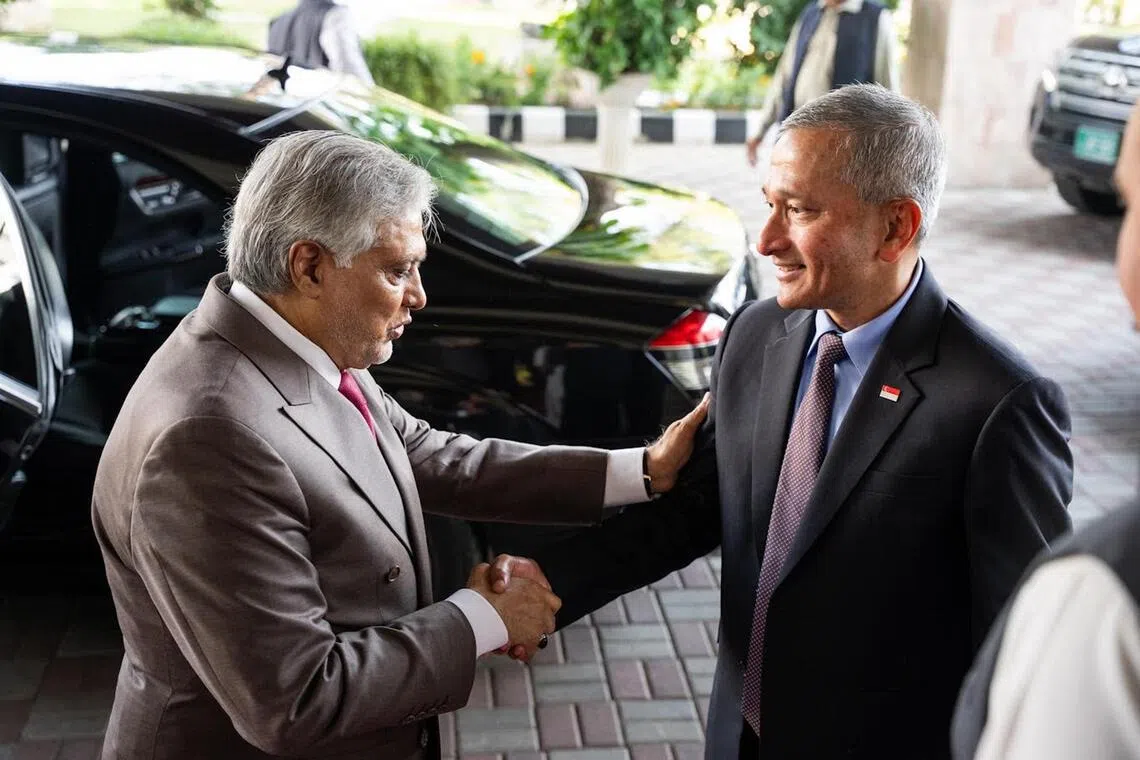
Foreign Minister Vivian Balakrishnan (right) with Pakistan's Deputy Prime Minister and Minister of Foreign Affairs Mohammad Ishaq Dar (left) in Islamabad, Pakistan on Oct 30, 2026.
PHOTO: MINISTRY OF FOREIGN AFFAIRS
Kalicharan Veera Singam
Published Oct 30, 2026, 10:15 PM
Updated Oct 30, 2026, 10:15 PM
Singapore and Pakistan renewed ties during Vivian Balakrishnan’s visit to Islamabad for 60 years of diplomatic relations.
Both sides want more trade, investment and business links, as current trade is only US$1.19 billion, far below Singapore’s trade with India and Bangladesh.
They also signed an MOU on disaster response, and plan to work on early warning, rescue training and wider ASEAN-SCO cooperation.
SINGAPORE – Greater bilateral trade, investment flows and technological upskilling were among the topics discussed during Foreign Minister Vivian Balakrishnan’s official visit to Islamabad, Pakistan, on Oct 30.
He was in Pakistan at the invitation of the country’s Deputy Prime Minister and Minister for Foreign Affairs, Mohammad Ishaq Dar, to mark Singapore and Pakistan’s 60th year of diplomatic relations .
“Over the years, there have been high-level exchanges at the leadership level, sometimes all over the world; not often enough in our own home countries,” Balakrishnan remarked on the very rare direct high-level visits between leaders of the two countries during a joint press conference with Dar in Islamabad.
“I was checking the records. My former prime minister Goh Chok Tong was here in 2004. So this is belated, but better late than never.”
The minister affirmed that the two governments have remained in constant communication “far more than people realise,” and that they have a “very effective partnership”.
Balakrishnan noted that the first order of business in Singapore’s relations with Pakistan would be to work on improving trade, economic cooperation and areas like carbon markets.
“Our trade relations – looking at the numbers and the data – ought to be much higher,” Balakrishnan said.
He noted that businesses, particularly small and medium-sized enterprises, need to engage directly to understand commercial opportunities and risks across South-east Asia and South Asia. He added that governments must facilitate these interactions and identify new avenues for mutually beneficial cooperation.
Trade ties between Singapore and Pakistan are currently valued at around US$1.19 billion (S$1.5 billion). For comparison, Singapore’s trade with India and Bangladesh are valued at around US$35 billion and US$3 billion respectively.
Balakrishnan said that the second area of cooperation between the two countries would be on disaster preparedness and response. Singapore Civil Defence Force and Pakistan’s National Disaster Management Authority exchanged a memorandum of understanding (MOU) during Balakrishnan’s visit.
“Pakistan, unfortunately, has extensive experience in responding to large-scale natural disasters, including floods and other extreme weather events, and so there is much that Singapore can learn from Pakistan in how to cope and how to be more resilient for the future,” Balakrishnan said.
“Through this MOU, we hope to explore cooperation in areas including early warning systems, the sharing of best practices, strengthening search and rescue capabilities, as well as hopefully, conducting joint training and exercises. It’s worth remembering that disasters do not respect boundaries, do not have passports, and the more we can work together, the better,” he added.
Balakrishnan also expressed appreciation for Pakistan’s “unique, but very constructive and valuable role” in the current crisis in the Gulf region. He also reaffirmed both countries’ commitment to International law and the United Nations Convention on the Law of the Sea 1982, which sets out the right of transit passage in Straits Used for International Navigation.
With Singapore chairing ASEAN next year and Pakistan leading the Shanghai Cooperation Organisation, Balakrishnan said that this will create opportunities for the two diverse regional blocs to do more together. He also noted that Pakistan is already a sectoral dialogue partner of ASEAN.
“In an increasingly uncertain global environment, including on the business side of it, it is even all the more important for our two countries to remain open, connected, and constructively engaged with each other,” he added.
Kalicharan Veera Singam is Assistant Foreign Editor at The Straits Times.
Singapore foreign policy
2026年10月30日,印度外交部长维维安·巴拉克里希南(右)与巴基斯坦副总理兼外交部长穆罕默德·伊沙克·达尔(左)在巴基斯坦伊斯兰堡会面。
图片来源:外交部
卡利查兰·维拉·辛格姆
发布于 2026 年 10 月 30 日晚上 10:15
更新于2026年10月30日晚上10:15
在维文·巴拉克里希南访问伊斯兰堡庆祝建交60周年之际,新加坡和巴基斯坦恢复了外交关系。
双方都希望加强贸易、投资和商业联系,因为目前的贸易额仅为 11.9 亿美元,远低于新加坡与印度和孟加拉国的贸易额。
他们还签署了灾害应对谅解备忘录,并计划在预警、救援培训和更广泛的东盟-上海合作方面开展工作。
新加坡——10月30日,外交部长维文·巴拉克里希南对巴基斯坦伊斯兰堡进行正式访问,期间双方讨论了扩大双边贸易、投资流动和技术技能提升等议题。
他应巴基斯坦副总理兼外交部长穆罕默德·伊沙克·达尔的邀请访问巴基斯坦,以纪念新加坡和巴基斯坦建交60周年。
“多年来,两国领导人之间有过多次高层交流,有时遍及世界各地;但在我们自己的国家,交流却不够频繁。”巴拉克里希南在伊斯兰堡与达尔举行的联合新闻发布会上,就两国领导人之间极其罕见的直接高层互访发表了上述评论。
“我查阅了记录。我的前总理吴作栋2004年曾来过这里。所以这次来访有点晚了,但总比不来好。”
部长强调,两国政府一直保持着密切沟通,“远超人们的想象”,并且两国建立了“非常有效的伙伴关系”。
巴拉克里希南指出,新加坡与巴基斯坦关系的首要任务是努力改善贸易、经济合作以及碳市场等领域。
巴拉克里希南说:“从数字和数据来看,我们的贸易关系应该更高。”
他指出,企业,特别是中小企业,需要直接参与互动,以了解东南亚和南亚的商业机遇和风险。他还补充说,各国政府必须促进这些互动,并寻找互利合作的新途径。
目前新加坡与巴基斯坦的贸易额约为11.9亿美元(15亿新元)。相比之下,新加坡与印度和孟加拉国的贸易额分别约为350亿美元和30亿美元。
巴拉克里希南表示,两国合作的第二个领域是灾害防备和应对。巴拉克里希南访问期间,新加坡民防部队和巴基斯坦国家灾害管理局交换了谅解备忘录。
巴拉克里希南说:“不幸的是,巴基斯坦在应对大规模自然灾害(包括洪水和其他极端天气事件)方面拥有丰富的经验,因此新加坡可以从巴基斯坦学习很多东西,了解如何应对灾害以及如何增强未来的韧性。”
“我们希望通过这份谅解备忘录,探索在预警系统、最佳实践分享、加强搜救能力等领域的合作,并希望能够开展联合培训和演习。值得注意的是,灾害不分国界,不分国界,我们越能携手合作,就越能战胜灾害。”他补充道。
巴拉克里希南还对巴基斯坦在当前海湾地区危机中发挥的“独特但极具建设性和价值的作用”表示赞赏。他还重申了两国对国际法和1982年《联合国海洋法公约》的承诺,该公约规定了国际航行海峡的过境通行权。
巴拉克里希南表示,新加坡明年将担任东盟轮值主席国,巴基斯坦将担任上海合作组织主席国,这将为这两个不同的区域集团创造更多合作机会。他还指出,巴基斯坦已经是东盟的部门对话伙伴。
他补充说:“在全球环境日益不确定(包括商业环境)的情况下,我们两国保持开放、联系和建设性互动就显得尤为重要。”
卡利查兰·维拉·辛格姆是《海峡时报》的助理外事编辑。
新加坡外交政策