Amnesty boss says Cambodian state or officials complicit in the country’s still existing scam industry国际特赦组织负责人称,柬埔寨政府或官员与该国仍然存在的诈骗产业有牵连。
Scam empire exposed. Amnesty links five security firms and more than 20 Cambodian officers to compounds rife with rape, torture and forced fraud. Chief Agnès… Read More ›
新闻视频
October 31, 2026 at 12:45 pm
by James Morris and Son Nguyen
in Crime , Living , Media , Politics , Thailand
Amnesty International chief Agnès Callamard has accused the Cambodian state of probable complicity in a vast criminal scam industry built on slavery, rape and torture. Speaking in Bangkok on Thursday, she unveiled an explosive investigation identifying 86 compounds, five security companies and links to more than 20 military and police personnel. Meanwhile, Phnom Penh claims to have closed 605 locations and referred 4,147 suspects for prosecution. Yet Amnesty says powerful security operators remain untouched. Survivors describe brutal beatings, electric shocks, sexual violence and forced online fraud. The findings expose connections reaching Cambodia’s security establishment and raise the prospect of international prosecutions and arrest warrants.
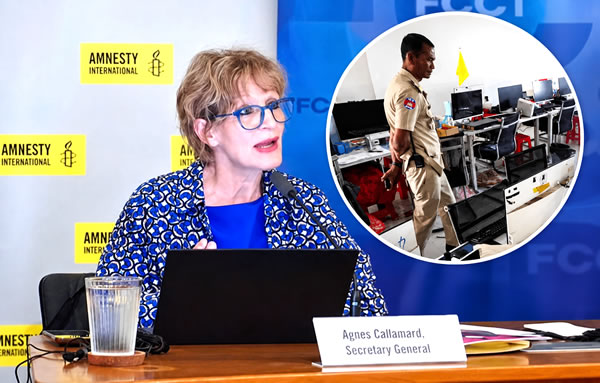
Amnesty chief Agnès Callamard accuses Cambodia of probable complicity in scam centres linked to rape, torture and slavery, exposing security firms and military-police links. ( Source: Khaosod )
Amnesty International Secretary-General Agnès Callamard has accused the Cambodian state of probable complicity in its vast scam centre industry. Speaking in Bangkok on Thursday, October 29, she challenged Phnom Penh’s claims of a successful crackdown.
Her accusations followed an investigation linking private security companies, military officers and senior police personnel to criminal compounds. Researchers identified 86 compounds and five security companies connected to facilities involving trafficking, torture, rape and slavery.
Meanwhile, Cambodian authorities claim to have closed 605 locations and referred 4,147 suspects for prosecution. However, Amnesty says the businesses and security networks behind the industry have escaped meaningful investigation. The findings also expose the treatment of thousands of foreign workers, including victims forced into online fraud.
Amnesty chief accuses Cambodian state of probable complicity as security firms escape prosecution
Callamard delivered her accusations at the Foreign Correspondents Club of Thailand (FCCT) on Thursday afternoon. She had travelled from London to launch a 160-page investigation into Cambodia’s criminal scam compounds.
Her findings challenged months of government announcements concerning raids, arrests, compound closures and mass deportations. Notably, she described the Cambodian state as either “acquiescent” or “probably complicit” in the industry. “The footprint of the Cambodian state is everywhere,” she told journalists.
The accusations followed an investigation identifying links between private security companies and serving Cambodian military and police officers. Researchers also uncovered business relationships involving politically influential figures and property developments containing suspected criminal operations.
“Cambodia has failed to protect the victims. The security companies have not been touched,” Callamard said. She described the government’s response as “clearly, woefully insufficient”. Her criticism centred on the companies and individuals connected to the compounds rather than the number of police raids.
Cambodia claims major crackdown but Amnesty links five security firms and officers to scam compounds
Cambodian authorities maintain that their campaign has dismantled hundreds of suspected criminal locations. They also report thousands of suspects referred for prosecution and extensive deportation operations.
However, Amnesty’s latest findings identify five private security companies linked to facilities where investigators documented serious abuses. Separately, the investigation identified more than 20 Cambodian military and police personnel connected to compounds. These included serving officers, senior police figures and individuals linked to commercial property developments.
Amnesty did not establish that the Cambodian government had formally authorised the criminal operations. Instead, investigators documented connections between state personnel, private businesses and locations used for trafficking and forced labour.
The findings appeared in Thursday’s report, Official Business: Security Companies and Authorities at Scamming Compounds in Cambodia. The investigation covered January 2023 to September 2026 and examined 86 scam compounds across Cambodia. Researchers interviewed 151 survivors and reviewed records involving more than 400 additional victims.
Investigators trace guards across 82 compounds and identify a military officer linked to security firm
Investigators visited 82 of the 86 identified compounds and found security guards at every location. In parallel, Amnesty analysed footage from more than 200 TikTok accounts belonging to security guards.
Researchers connected videos from those accounts to 23 compounds. The footage provided additional evidence of security arrangements inside the facilities. According to Amnesty, guards controlled access, restricted movement and prevented trafficked workers from escaping. They also enforced instructions imposed by the criminal organisations operating inside.
Callamard said the industry could not function on such a scale without these security arrangements. “These are enormous [compounds]. You can’t hide from everyone to see,” she told the Bangkok press conference.
The report identified Leap Somnang as one of the principal companies providing security at suspected scam compounds. Amnesty linked the business to at least 15 locations across eight Cambodian provinces. Furthermore, investigators identified Colonel Ban Sophat, an officer in the Royal Cambodian Armed Forces, in connection with the company.
Five security companies face scrutiny over scam compounds and links to senior Cambodian officers
Ban Sophat had publicly appeared as chairman of Leap Somnang. However, he denied owning or managing the business. He maintained that his involvement had been limited to an advisory role.
The company’s presence across eight provinces placed it among the most extensively documented security operators in Amnesty’s investigation. Its operations also illustrated the connections researchers examined between private security businesses and serving military personnel.
Another company, Security Response, was linked to five scam compounds. Investigators identified connections involving Panda Bank and the Huione network. Meanwhile, ZD Security, previously known as BIC Security, was connected to two compounds in Botum Sakor.
Dara Security was linked to another two compounds in Sihanoukville. Best Security was identified in connection with a compound in Bavet, where Amnesty documented trafficking, forced labour and child labour. The report examined these companies alongside the businesses and officials associated with their operations.
The Bavet findings included a connection involving Deputy Police Chief Lay Channy. His telephone number appeared in advertising associated with Best Security. In addition, Lay Channy had participated in a crackdown in Bavet, where the company guarded a compound.
Best Security denied that the police officer controlled the business. The investigation also identified Brigadier General Tek Bunthoeun in connection with another property development. Researchers found he held a direct, potentially controlling interest in a development containing a scam compound.
Amnesty traces influential business links as Cambodia claims thousands of arrests and deportations
Other business connections involved a former bank chief executive and a property developer. Investigators also identified a relationship involving the son of a former Cambodian deputy prime minister. However, Amnesty did not establish that these individuals were personally responsible for abuses inside the compounds.
Instead, the report called for investigations into company ownership, management arrangements and connections involving state personnel. Its evidence included corporate relationships, property interests, security arrangements and material obtained from social media accounts.
The findings emerged against a series of Cambodian government announcements claiming substantial progress against scam centres. In February 2026, senior minister Chhay Sinarith reported that authorities had closed approximately 190 suspected locations.
Chhay Sinarith chairs Cambodia’s Commission for Combating Online Scams. He told Reuters that the crackdown had resulted in the arrest of 173 senior criminal figures. Additionally, Cambodian authorities reported deporting 11,000 workers during the enforcement campaign.
By August, the government was reporting much larger figures covering July 2025 to July 2026. According to those figures, authorities had targeted 751 suspected scam locations and closed 605. The government also reported referring 4,147 suspects for prosecution. On another front, 49 casino licences had been revoked or suspended.
Cambodia reports police discipline and mass closures but Amnesty finds major gaps in enforcement
These figures represented official Cambodian government claims rather than independently verified totals. Nevertheless, Phnom Penh presented the operations as evidence of its campaign against organised international cybercrime.
The Cambodian government maintains that the country must not become a safe haven for international cybercriminals. It has also acknowledged disciplinary proceedings involving police officers connected to scam compounds.
In correspondence dated October 15, Cambodian authorities told Amnesty that 77 police officers had been disciplined. Despite these measures, Amnesty questioned whether enforcement had reached the companies and individuals responsible for protecting the operations. Its investigation distinguished between shutting down compounds and prosecuting those responsible for running them.
That distinction had already emerged in an earlier Amnesty investigation published on June 8. Researchers examined government interventions at 86 identified scam compounds. They found evidence of state intervention at only 24 locations.
Seven additional compounds showed evidence of mass releases or escapes. Consequently, more than 70% of the identified compounds had shown no evidence of state intervention at that stage. The findings contrasted with the Cambodian government’s announcements concerning its campaign.
Survivors describe failed police interventions and trafficking victims denied recognition in Cambodia
Survivors described being moved between locations before police operations. Others reported officers entering or visiting compounds without securing the release of captive workers. One Kenyan survivor described police collecting a woman’s body from a compound.
According to the account, other captive workers remained imprisoned inside the facility. Separately, Amnesty interviewed survivors who reported suffering further abuse after police had already intervened at their compounds. The testimony formed part of its examination of enforcement practices.
The June investigation also examined how Cambodian authorities treated people removed from criminal facilities. None of the 73 survivors interviewed for that investigation had been formally recognised as trafficking victims.
Amnesty said their experiences met the relevant international criteria for such recognition. Callamard returned to this issue during Thursday’s Bangkok press conference. “We are demanding that the Cambodian government treat the victims as victims and not criminals,” she said.
Many foreign nationals had entered Cambodia after responding to fraudulent employment advertisements. The promised positions frequently involved technology, customer service or financial businesses. Instead, recruits arriving at the compounds discovered that they were not free to leave.
Captive workers face beatings, electric shocks and rape inside Cambodia’s guarded scam compounds
They were confined inside guarded facilities and ordered to participate in online fraud. Their captors imposed financial targets and monitored their performance. Workers who failed to generate the required income faced punishment.
The investigation documented beatings, electric shocks, confinement and threats with firearms. Some workers were assaulted after refusing instructions or attempting to escape.
Moreover, investigators recorded serious sexual violence against women held inside the compounds. At a facility identified as Park 8, a Cameroonian woman named Maia described being restrained and raped by managers. According to her testimony, security guards were stationed outside during the abuse.
Another survivor, a Ugandan man identified as Gabe, described being chained and beaten. He also reported being subjected to electric shocks. Callamard told journalists that some captive workers had been bought and sold between compounds.
In one case, a woman was raped three times after failing to generate the income demanded by her captors. The accounts formed part of Amnesty’s evidence concerning trafficking, forced labour, torture, rape and slavery.
Security firms controlled captive workers as Amnesty questions whether Cambodia dismantled the networks
The report identified security companies as important participants in maintaining the system of confinement. Guards prevented workers from leaving and helped enforce instructions issued by criminal organisations.
Crucially, Amnesty linked these arrangements to businesses with connections involving Cambodian state personnel. Its investigation therefore examined the companies responsible for guarding compounds alongside the criminal activities occurring inside them. The findings also documented the role of security personnel in maintaining control over trafficked workers.
The October report acknowledged changes following the Cambodian government’s enforcement campaign. Amnesty assessed that large-scale scam compound operations currently appeared to be dormant.
That finding marked a change from conditions documented during earlier investigations. Even so, the organisation maintained that underlying business and security networks had not faced adequate investigation. Its latest report concentrated on accountability for abuses already documented and the individuals connected to the compounds.
Callamard said the security companies identified by Amnesty had not been prosecuted. She called for investigations into their activities and the roles played by individuals associated with them.
Foreign trafficking victims face deportation as Amnesty demands scrutiny of scam centre financiers
The report also examined the international dimensions of the criminal industry. Foreign workers were recruited through fraudulent employment arrangements and transported into guarded facilities. Once inside, many were forced to participate in online financial fraud targeting victims elsewhere. Some were subsequently transferred or sold between compounds.
Others escaped, were released or were removed during police operations. Meanwhile, Cambodia’s enforcement campaign resulted in the deportation of thousands of workers. Amnesty’s earlier findings showed that trafficking victims were not always formally recognised as such.
The organisation raised concerns about treating coerced workers as criminal suspects. Its October investigation also examined those responsible for financing, managing and protecting the compounds. The report identified company owners, directors, managers and financiers as potential subjects for further investigation.
Amnesty’s recommendations extended beyond Cambodia to foreign governments and international law enforcement authorities. The organisation urged prompt, impartial and independent investigations into companies, corporate leadership and state officials.
It also questioned the use of raids, arrests and deportations as the principal measures of enforcement progress. Instead, the report focused on identifying those responsible for criminal operations and documented abuses. Its recommendations included scrutiny of companies providing security at the compounds.
Amnesty urges international prosecutions and arrest warrants over crimes in Cambodian scam compounds
The report proposed reviewing law enforcement, military, financial and security cooperation involving Cambodian institutions. Such reviews would concern institutions or individuals credibly implicated in enabling or protecting scam compounds.
Beyond Cambodia, Amnesty called for consideration of prosecutions in foreign jurisdictions. These could involve universal jurisdiction or other extraterritorial powers where national legislation permits their use. The organisation also recommended arrest warrants where investigators obtain sufficient admissible evidence.
Such proceedings would concern individuals, companies or groups suspected of responsibility for crimes under international law. The report additionally called for compensation and protection for victims. Its recommendations included people deported after being removed from the compounds.
The proposals placed international legal mechanisms alongside domestic Cambodian investigations. They also addressed the responsibilities of company leadership and state personnel connected to the industry.
Callamard’s appearance in Bangkok provided a regional platform for the investigation’s publication. She personally presented the findings and answered questions concerning the Cambodian government’s conduct.
Amnesty explained that its regional office was based in Bangkok. The organisation also said it could not organise the report’s launch in Phnom Penh. Importantly, it stressed that the decision to hold the event in Thailand was unrelated to the Thai-Cambodian conflict.
Report launch puts Cambodian state connections and cross-border criminal operations in focus
The press conference took place amid continuing regional concern about organised criminal networks operating across borders. Cambodia’s scam centre industry has involved foreign recruitment, trafficking and financial fraud targeting international victims.
Amnesty’s investigation concentrated on the companies and security structures supporting those operations inside Cambodia. Its findings identified specific businesses and connections involving serving military and police officers. The report also examined the treatment of foreign workers subjected to coercion and abuse.
For its part, the Cambodian government continues to point to hundreds of compound closures and thousands of suspects referred for prosecution. Those figures remain central to Phnom Penh’s account of its campaign against the industry.
However, Amnesty’s latest report examined whether the businesses and individuals behind the compounds had faced criminal investigation. It identified five private security companies connected to facilities where serious abuses had been documented. The investigation also uncovered links involving serving officers, senior police personnel and politically connected commercial interests.
Survivor evidence and company records fuel Amnesty’s accusation of probable Cambodian state complicity
The evidence included survivor testimony, corporate relationships, property interests and social media material. In particular, investigators documented the role of security guards in maintaining confinement and enforcing criminal operations. Callamard’s accusations therefore extended beyond criticism of Cambodia’s enforcement record.
She publicly raised the possibility of state complicity while presenting evidence of connections between officials and the industry. Amnesty did not establish that the Cambodian government had formally authorised the criminal operations.
Instead, its findings identified relationships involving state personnel and private businesses requiring further investigation. The Cambodian authorities have reported closing 605 locations and referring 4,147 suspects for prosecution.
They have also reported disciplinary action against 77 police officers. At the same time, Amnesty acknowledges that large-scale compound operations currently appear dormant following the crackdown. Nevertheless, its October investigation identified five security companies and numerous connections involving Cambodian state personnel.
Amnesty says connected security firms remain unprosecuted despite Cambodia’s extensive crackdown claims
Callamard said those companies had escaped prosecution despite their documented links to scam compounds. “The footprint of the Cambodian state is everywhere,” she told journalists. Her remarks placed the Cambodian authorities’ connections with private security businesses at the centre of the investigation.
The report also set out possible international legal action, including prosecutions and arrest warrants where sufficient evidence exists. These proposals concern individuals and companies suspected of responsibility for crimes under international law.
The latest findings stand alongside Cambodia’s official record of raids, arrests, deportations and compound closures. Amnesty identified businesses, security arrangements and state connections involving facilities where trafficking, torture, rape and slavery occurred. Its Secretary-General publicly accused the Cambodian state of being either acquiescent or probably complicit.
Meanwhile, Phnom Penh’s own figures document an extensive enforcement campaign against the industry. The central unresolved issue identified by Amnesty is whether the companies and individuals responsible for the compounds will face prosecution.
Former minister in Anutin’s first government appears on Congress list for sanctions over scam industry
Police hunt DJ in Nakhon Si Thammarat after body is found with baffling evidence as to cause of death
Thailand horrified by savage daylight public murder of 61-year-old out walking in southern Trat province
59 year old man murdered his drinking buddy fearing he was a ‘Phi Pop ghost’ in Khon Kaen on Thursday
Alcohol and property disputes were key factors in stepmother’s murder. Suspect confesses to police before charges
Angry mob, tense scenes in Nong Bua Lamphu after horrific murder of 13 year old girl by her stepfather
New Zealand man who was stabbed by father-in-law forgives the older man and helps post bail for him
Road rage caused a marijuana dealer to fatally stab a Burmese painter in Bangkok on Sunday night
Marijuana use is linked to a tragic murder-suicide case in Nakhon Si Thammarat on Monday morning
Marijuana industry faces disaster as Health Minister unveils law to outlaw recreational pot use in Thailand
Cannabis law emerges as a big political threat to the coalition judging by what happened in 2022 revolt
James Morris is a pename for an international writer based in Bangkok who works on various international news media. He is a sub editor with the Thai Examiner news website since it began in 2015. Son Nguyen is an international writer and news commentator specialising in Thai news and current affairs. He commenced working with the Thai Examiner News Desk in May 2018.
All posts by James Morris and Son Nguyen
Restaurant YouTube reviewer is a fraudster with an arrest warrant. Police complaint filed in Nonthaburi October 27, 2026 A food influencer’s demand for prawns, drinks or
Israeli arrested on drug and sex charges threatens police and well known detective Inspector Jae October 27, 2026 A Bangkok sex-and-drugs raid nets Israeli Tomer
Knock on the door coming for 10k visa overstayers now in Thailand as police launch new crackdown October 26, 2026 Thailand launches a nationwide hunt for over 10,000
19 year old hothead lands in jail after punching female driver who honked her car horn at him in Bangkok October 26, 2026 Terrifying scenes in Bangkok as a motorcyclist, 19,
Thailand falls behind Southeast Asian peers in race to build more flight connections as tourism fades October 24, 2026 High-season alarm for Thailand as direct international
Israeli woman on Koh Phangan faces deportation after her visa was revoked. Rising diplomatic tensions October 24, 2026 Israeli woman, 33, faces visa cancellation on Koh
American YouTuber brutally attacked robbed and beaten outside a Pattaya bar by two ‘foreign’ assailants October 22, 2026 American YouTuber Chris Barnes exposes a grim Pattaya
Prime Minister Anutin pushes a hard line on narcotics suppression which will jail even more yaba users October 22, 2026 Thailand’s drug crisis sees Anutin act with new
Departures tax to be axed as Thailand’s hotel sector reels from a debt crisis linked with the Covid era October 22, 2026 Revolt puts Thailand’s ฿1,000 departure tax in
12 properties raided, 85 people charged after Pattaya police raids linked to the illegal foreign ownership crackdown October 21, 2026 Police target ฿800 million in Pattaya property
Controversy on two wheels rages in Pattaya as city’s mototaxi drivers switch to blue vests from orange October 21, 2026 Blue replaces orange for 5,281 Pattaya motorcycle taxi
Queen Suthida meets the Emperor and Empress of Japan on a visit promoting international women’s ice hockey October 21, 2026 Queen Suthida meets Japan’s Emperor Naruhito and
Men accused of murdering Russian siblings in July plead guilty to all counts in Pattaya including rape October 20, 2026 Death penalty looms for two Thai men after guilty
Tourism industry shaken by the latest Chinese warning coming from its diplomatic missions in Thailand October 20, 2026 China warns its citizens of abductions and trafficking
PM orders hands off land and property by foreigners as enforcement to be moved ahead by December October 20, 2026 Anutin puts thousands of suspected foreign land
Chinese and Vietnamese links probed in police open files on nightlife activities in Bangkok and Rayong October 19, 2026 Police storm a karaoke bar at 4 am, arresting 13
Nigerian cocaine gang arrested after strict crackdown orders from the Immigration Bureau chief Big Nop October 18, 2026 Bangkok cocaine sting leads police from a dealer to a
Thousands of fake Thai citizens of Chinese origin identified in one case going back over two decades October 27, 2026
New police chief wants officers who show their faces to the public and issue warnings instead of fines October 27, 2026
Special Branch and cyber police move against the ‘Godd Dam’ Facebook page after PM ‘tea money’ fake October 26, 2026
Government spokesman’s rebuke to the World Health Organisation (WHO). Keep out of Thai internal affairs October 26, 2026
Mystery of Dutch TV star deepens as police confirm he left Thailand and lawyer claims he wants privacy October 25, 2026
Prime Minister in a spot as no confidence debate looks like it’s being stalled or postponed in parliament October 24, 2026
PM calls police chief and orders preparations to make sure Thailand is not subject to French like rioting October 22, 2026
Pledges on investment are up but Foreign Direct Investment for the first six months is down nearly 5% October 22, 2026
Frenchman arrested by Immigration. Officer spotted him on Interpol wanted list for drug trafficking October 22, 2026
Drunk woman stripped naked on a Pattaya public street Tuesday night hurling abuse. Arrested by police October 21, 2026
Former top Democrat Party aide and MP met DSI over Bhumjaithai MP’s husband’s links to online gambling October 21, 2026
Row over handling of two online gambling cases related to MPs. Questions of jurisdiction and fair play October 21, 2026
German family members injured in Phuket after app based taxi driver lost control of car looking at GPS October 20, 2026
Bhumjaithai MP and her husband answer questions of the elite DSI police over links to online gambling October 20, 2026
Hellish battle with UK Home Office for Brit seeking to bring Burmese fiancée and son home for Christmas October 20, 2026
7kg heroin in drink sachets bound for Australia found in a Samut Prakan premises after police tip off October 19, 2026
Much loved Robocop, a popular figure in Nonthaburi near Bangkok dies in a tragic road traffic accident October 19, 2026
Thai star Nene Royal faces trademark headaches in Thailand and South Korea as she secures her fortune October 18, 2026
Six dead in deadly clashes in Southern Thailand including a policeman killed on National Police Day October 17, 2026
Underfire southern MP says Prime Minister Anutin telephoned her and urged her to post a selfie online October 17, 2026
Prime Minister cock a hoop as IMF World Bank meet ends in Bangkok. Insists Thailand’s standing has risen October 17, 2026
Departures tax pushed by the Ministry of Finance is the death kiss for the tourist sector say top execs October 16, 2026
© 2026 Thai Examiner. All rights reserved.
2026年10月31日下午12:45
作者:詹姆斯·莫里斯和孙阮
在“犯罪”、“生活”、“媒体”、“政治”、“泰国”等类别中
国际特赦组织负责人阿涅斯·卡拉马尔指控柬埔寨政府可能参与了一个庞大的犯罪诈骗产业,该产业建立在奴役、强奸和酷刑之上。周四在曼谷,她公布了一项爆炸性调查结果,该调查发现了86个犯罪窝点、5家安保公司,并与20多名军警人员有关联。与此同时,金边方面声称已关闭605个犯罪窝点,并将4147名嫌疑人移交起诉。然而,国际特赦组织表示,一些势力强大的安保人员仍然逍遥法外。幸存者描述了他们遭受的残酷殴打、电击、性暴力和被迫进行的网络诈骗。调查结果揭露了该犯罪集团与柬埔寨安全机构的联系,并引发了国际社会提起诉讼和发出逮捕令的可能性。
国际特赦组织负责人阿涅斯·卡拉马尔指控柬埔寨可能与强奸、酷刑和奴役相关的诈骗中心有牵连,并曝光了安保公司和军警之间的联系。(来源:考索德报)
国际特赦组织秘书长阿涅斯·卡拉马尔指责柬埔寨政府可能与其庞大的诈骗中心产业存在共谋关系。10月29日星期四,她在曼谷发表讲话,质疑金边方面声称已成功打击诈骗活动。
她的指控源于一项调查,该调查将私人保安公司、军官和高级警官与犯罪窝点联系起来。研究人员发现了86个窝点和5家保安公司,这些窝点与人口贩运、酷刑、强奸和奴役等犯罪活动有关。
与此同时,柬埔寨当局声称已关闭605个网点,并将4147名嫌疑人移交起诉。然而,大赦国际表示,该行业背后的企业和安全网络却逃脱了有效的调查。调查结果还揭露了数千名外籍劳工的遭遇,其中包括被迫参与网络诈骗的受害者。
国际特赦组织负责人指责柬埔寨政府可能参与其中,而安保公司却逃脱了起诉。
卡拉马尔德周四下午在泰国外国记者俱乐部(FCCT)发表了她的指控。她从伦敦来到这里,启动了一项长达160页的关于柬埔寨犯罪团伙诈骗的调查。
她的调查结果对政府数月来发布的有关突袭、逮捕、关闭营地和大规模驱逐出境的声明提出了质疑。值得注意的是,她将柬埔寨政府描述为对该行业“默许”或“可能同流合污”。她告诉记者:“柬埔寨政府的足迹无处不在。”
这些指控源于一项调查,该调查发现私人保安公司与柬埔寨现役军警人员之间存在关联。研究人员还揭露了涉及有影响力人士的政治商业关系,以及涉嫌犯罪活动的房地产开发项目。
卡拉马尔表示:“柬埔寨未能保护受害者。安保公司却未受到任何追究。”她形容政府的应对措施“显然远远不够”。她的批评主要集中在与这些建筑群有关的公司和个人身上,而非警方突袭的次数。
柬埔寨声称进行了大规模打击,但大赦国际将五家安保公司和人员与诈骗窝点联系起来。
柬埔寨当局坚称,他们的行动已捣毁数百个涉嫌犯罪场所。他们还报告称,已将数千名嫌疑人移交起诉,并开展了大规模的遣返行动。
然而,大赦国际的最新调查结果显示,有五家私人保安公司与调查人员记录到严重虐待事件的场所存在关联。此外,调查还发现有20多名柬埔寨军警人员与这些场所相关,其中包括现役军官、高级警官以及与商业地产开发有关的人员。
大赦国际并未证实柬埔寨政府正式授权了这些犯罪活动。相反,调查人员记录了国家人员、私营企业以及用于人口贩运和强迫劳动的场所之间的联系。
调查结果发表在周四发布的报告《官方事务:柬埔寨诈骗窝点的安保公司和当局》中。该调查涵盖2023年1月至2026年9月,并对柬埔寨境内的86个诈骗窝点进行了调查。研究人员采访了151名受害者,并查阅了涉及400多名其他受害者的记录。
调查人员追踪了82个院落的保安人员,并确认了一名与安保公司有关联的军官。
调查人员走访了已确认的86处院落中的82处,发现每处都有保安人员。与此同时,大赦国际分析了200多个属于这些保安人员的TikTok账户上的视频。
研究人员将这些账户中的视频与23个营地联系起来。这些视频提供了营地内部安保措施的更多证据。据大赦国际称,警卫控制着人员进出,限制他们的行动,并阻止被贩卖的劳工逃跑。他们还执行营地内犯罪组织下达的指令。
卡拉马尔表示,如果没有这些安保措施,这个行业不可能如此大规模地运作。“这些都是规模庞大的(建筑群)。你不可能躲过所有人的视线,”她在曼谷的新闻发布会上说道。
报告指出,Leap Somnang是为涉嫌诈骗场所提供安保服务的主要公司之一。大赦国际将该公司与柬埔寨八个省份的至少15个地点联系起来。此外,调查人员还发现柬埔寨皇家武装部队军官班索帕特上校与该公司有关联。
五家安保公司因涉嫌诈骗和与柬埔寨高级官员有关联而受到审查。
班索帕曾公开以Leap Somnang董事长的身份露面,但他否认拥有或管理该公司,并坚称自己仅担任顾问角色。
该公司业务遍及八个省份,使其成为大赦国际调查中记录最详尽的安保公司之一。其运营情况也印证了研究人员所调查的私人安保公司与现役军人之间的联系。
另一家名为 Security Response 的公司与五个诈骗窝点有关联。调查人员发现这些窝点涉及熊猫银行和 Huione 犯罪网络。与此同时,ZD Security(前身为 BIC Security)与博图姆萨科尔的两个窝点有关联。
Dara Security与西哈努克城的另外两处院落有关联。Best Security则与巴维特的一处院落有关,大赦国际在该院落记录了人口贩运、强迫劳动和童工现象。该报告对这些公司及其相关企业和官员进行了调查。
巴维特调查结果显示,副警长莱·钱尼与此案有关联。他的电话号码出现在与“最佳安保公司”相关的广告中。此外,莱·钱尼还参与了巴维特的一次打击行动,而该公司当时负责守卫该地区的一个院落。
Best Security否认该警官控制着这家公司。调查还发现,准将Tek Bunthoeun与另一处房地产开发项目有关。调查人员发现,他直接持有可能控制该项目的股份,而该项目中包含一个诈骗场所。
国际特赦组织追踪与柬埔寨有影响力的商业关系,此前柬埔寨声称逮捕和驱逐了数千人。
其他商业关系涉及一名前银行首席执行官和一名房地产开发商。调查人员还发现,一名柬埔寨前副首相的儿子也牵涉其中。然而,大赦国际并未证实这些人对营地内的虐待行为负有直接责任。
相反,该报告呼吁对公司所有权、管理安排以及涉及国家人员的关系展开调查。其证据包括公司关系、财产权益、安保安排以及从社交媒体账户获取的材料。
调查结果与柬埔寨政府此前一系列声称打击诈骗中心取得实质性进展的声明相悖。2026年2月,高级部长蔡西纳里特报告称,当局已关闭约190个涉嫌诈骗场所。
柬埔寨打击网络诈骗委员会主席蔡西纳里特告诉路透社,此次打击行动已逮捕了173名高级犯罪分子。此外,柬埔寨当局报告称,在执法行动期间遣返了11000名劳工。
到8月份,政府公布的数据大幅增加,涵盖了2025年7月至2026年7月期间。根据这些数据,当局已查处751个涉嫌诈骗场所,并关闭了605个。政府还报告称,已将4147名嫌疑人移交检控。此外,49家赌场的营业执照已被吊销或暂停。
柬埔寨方面报告称警方纪律严明并进行了大规模停工,但大赦国际发现执法方面存在重大漏洞。
这些数据代表的是柬埔寨政府的官方说法,而非独立核实的总数。尽管如此,金边方面仍将这些行动作为其打击有组织国际网络犯罪行动的证据。
柬埔寨政府坚持认为,该国绝不能成为国际网络犯罪分子的避风港。政府也承认已对涉嫌参与诈骗团伙的警官提起纪律处分。
在10月15日的信函中,柬埔寨当局告知大赦国际,已有77名警官受到纪律处分。尽管采取了这些措施,大赦国际仍质疑执法是否触及到负责保护这些非法活动的公司和个人。其调查区分了关闭非法活动场所和起诉运营这些场所的责任人。
这一区别在大赦国际6月8日发布的一项早期调查中就已经显现。研究人员调查了86个已确认的诈骗窝点,发现政府干预的证据仅存在于其中24个地点。
另有七种化合物显示出大规模释放或泄漏的迹象。因此,超过70%的已识别化合物在当时阶段没有显示出国家干预的迹象。这一发现与柬埔寨政府关于其行动的声明截然相反。
幸存者描述了柬埔寨警方干预失败以及人口贩运受害者被剥夺身份的情况。
幸存者描述了在警方行动前被转移不同地点的情况。另一些人则报告说,警察在没有确保被俘工人获释的情况下进入或走访了营地。一名肯尼亚幸存者描述了警方从一个营地带走一名女性尸体的情景。
据报道,其他被囚禁的工人仍被关押在该设施内。此外,大赦国际采访了一些幸存者,他们表示在警方介入其住所后,他们仍然遭受了进一步的虐待。这些证词构成了大赦国际对执法实践调查的一部分。
6月份的调查还审查了柬埔寨当局如何对待从犯罪场所转移出来的人员。接受调查采访的73名幸存者中,没有一人被正式认定为人口贩运受害者。
国际特赦组织表示,他们的遭遇符合相关国际标准,可以获得此类认可。卡拉马尔在周四曼谷举行的新闻发布会上再次谈到这个问题。她说:“我们要求柬埔寨政府将受害者视为受害者,而不是罪犯。”
许多外国人因轻信虚假招聘广告而进入柬埔寨。这些广告承诺的职位通常涉及技术、客户服务或金融行业。然而,新员工抵达营地后才发现,他们根本无法离开。
在柬埔寨戒备森严的非法劳工集中营里,被奴役的劳工面临殴打、电击和强奸的威胁。
他们被限制在戒备森严的场所内,并被命令参与网络诈骗。绑架者设定了财务目标,并监控他们的完成情况。未能达到收入要求的工人将受到惩罚。
调查记录了殴打、电击、非法拘禁和枪支威胁等暴行。一些工人在拒绝服从指令或试图逃跑后遭到殴打。
此外,调查人员还记录了关押在营地内的女性遭受的严重性暴力。在被命名为“8号营地”的设施中,一名名叫玛雅的喀麦隆女子描述了她被管理人员捆绑并强奸的经过。据她作证,虐待发生时,保安人员就驻守在营地外。
另一名幸存者,一名名叫加布的乌干达男子,描述了自己被铁链锁住并遭到殴打的经历。他还报告说曾遭受电击。卡拉马尔告诉记者,一些被囚禁的劳工在不同的营地之间被买卖。
其中一起案件中,一名妇女因未能挣到绑架者要求的收入而被强奸三次。这些案例构成了国际特赦组织关于人口贩运、强迫劳动、酷刑、强奸和奴役的证据的一部分。
安保公司控制着被奴役的劳工,而大赦国际则质疑柬埔寨是否已瓦解了这些网络。
报告指出,保安公司是维持监禁体系的重要参与者。保安人员阻止工人离开,并协助执行犯罪组织下达的指令。
至关重要的是,大赦国际将这些安排与涉及柬埔寨政府人员的企业联系起来。因此,其调查不仅审查了负责安保工作的企业,还调查了这些企业内部发生的犯罪活动。调查结果还记录了安保人员在控制被贩运劳工方面所扮演的角色。
10月份的报告承认,柬埔寨政府的执法行动带来了一些变化。大赦国际评估认为,目前大规模诈骗窝点似乎已经停止运作。
这一发现与之前调查中记录的情况有所不同。即便如此,该组织仍然坚持认为,相关的业务和安全网络尚未得到充分调查。其最新报告重点关注已记录在案的滥用行为的责任追究以及与这些场所相关的个人。
卡拉马尔表示,大赦国际指认的那些安保公司尚未受到起诉。她呼吁对这些公司的活动以及与其相关的个人所扮演的角色展开调查。
人口贩运受害者面临遣返,大赦国际要求审查诈骗中心资助者
该报告还考察了犯罪产业的国际层面。外国劳工通过欺诈性雇佣安排被招募,并被运送到戒备森严的场所。进入这些场所后,许多人被迫参与针对其他地方受害者的网络金融诈骗。一些人随后在不同的场所之间被转移或贩卖。
其他人则逃脱、获释或在警方行动中被带走。与此同时,柬埔寨的执法行动导致数千名劳工被驱逐出境。大赦国际此前的调查结果显示,人口贩运受害者并非总能得到正式认定。
该组织对将受胁迫劳工视为犯罪嫌疑人的做法表示担忧。其10月份的调查还审查了负责为这些营地提供资金、管理和保护的人员。报告指出,公司所有者、董事、经理和投资人可能是进一步调查的对象。
大赦国际的建议不仅限于柬埔寨,还延伸至外国政府和国际执法机构。该组织敦促对相关公司、企业领导人和政府官员展开迅速、公正和独立的调查。
报告还质疑将突袭、逮捕和驱逐作为衡量执法进展的主要手段。相反,报告重点在于查明犯罪活动和已记录在案的滥用职权行为的责任人。报告建议对为这些营地提供安保服务的公司进行审查。
国际特赦组织敦促国际社会对柬埔寨诈骗窝点内的犯罪行为提起诉讼并发出逮捕令。
该报告建议审查涉及柬埔寨机构的执法、军事、金融和安全合作。此类审查将针对那些被证实参与协助或保护诈骗窝点的机构或个人。
除了柬埔寨之外,大赦国际还呼吁考虑在外国司法管辖区提起诉讼。这可能涉及普遍管辖权或其他域外管辖权,前提是国家法律允许使用这些权力。该组织还建议,如果调查人员获得充分可采纳的证据,则应签发逮捕令。
此类诉讼将涉及涉嫌违反国际法罪行的个人、公司或团体。报告还呼吁对受害者进行赔偿和保护,并建议将那些被驱逐出营地的人员送回营地。
这些提案将国际法律机制与柬埔寨国内调查相结合,并明确了与该行业相关的公司领导层和政府人员的责任。
卡拉马尔在曼谷的露面为该调查报告的发布提供了一个区域性平台。她亲自介绍了调查结果,并回答了有关柬埔寨政府行为的问题。
国际特赦组织解释说,其区域办事处设在曼谷。该组织还表示,无法在金边组织这份报告的发布会。重要的是,该组织强调,在泰国举办此次活动的决定与泰柬冲突无关。
报告发布将柬埔寨政府与跨境犯罪活动的关系置于聚光灯下
此次新闻发布会召开之际,区域内对跨境有组织犯罪网络的持续关注依然存在。柬埔寨的诈骗中心产业涉及招募外国人、人口贩运和针对国际受害者的金融诈骗。
大赦国际的调查重点关注了支持柬埔寨境内行动的公司和安全机构。调查结果指出了一些具体企业及其与现役军警人员的关系。该报告还调查了遭受胁迫和虐待的外籍劳工的待遇。
柬埔寨政府方面则继续强调,已查封数百个非法场所,并将数千名嫌疑人移交起诉。这些数字仍然是金边方面打击非法采油行业行动的核心依据。
然而,大赦国际的最新报告调查了这些营地背后的企业和个人是否曾面临刑事调查。报告指出,有五家私人保安公司与一些曾记录严重虐待事件的营地有关联。调查还揭露了其中涉及现役警官、高级警务人员以及与政界关系密切的商业利益集团。
幸存者提供的证据和公司记录进一步证实了国际特赦组织对柬埔寨政府可能参与其中的指控。
证据包括幸存者的证词、公司关系、财产权益和社交媒体资料。调查人员尤其记录了保安人员在维持监禁和执行犯罪活动中所扮演的角色。因此,卡拉马尔的指控不仅限于对柬埔寨执法记录的批评。
她公开提出国家可能参与其中,并提供了官员与该行业存在关联的证据。但大赦国际并未证实柬埔寨政府曾正式授权这些犯罪活动。
相反,调查结果发现,一些涉及政府人员和私营企业的关系需要进一步调查。柬埔寨当局已报告关闭了605个场所,并将4147名嫌疑人移交起诉。
他们还报告称,已有77名警官受到纪律处分。与此同时,大赦国际承认,在打击行动之后,大规模的非法营地行动目前似乎已经停止。然而,该组织10月份的调查发现,有五家安保公司与柬埔寨政府人员存在诸多关联。
国际特赦组织表示,尽管柬埔寨声称已进行大规模打击,但涉事安保公司仍未受到起诉。
卡拉马尔表示,尽管这些公司因与诈骗团伙有确凿的联系而受到起诉,但它们仍然逃脱了法律制裁。“柬埔寨政府的足迹无处不在,”她对记者说。她的这番话将柬埔寨当局与私人保安公司的联系置于调查的核心位置。
该报告还列出了可能的国际法律行动,包括在证据确凿的情况下提起诉讼和发出逮捕令。这些提议涉及涉嫌违反国际法的个人和公司。
最新调查结果与柬埔寨官方公布的突袭、逮捕、驱逐和关闭营地的记录相符。大赦国际查明了涉及人口贩运、酷刑、强奸和奴役的场所、相关企业、安保安排以及政府机构之间的联系。其秘书长公开指责柬埔寨政府要么默许,要么很可能是同谋。
与此同时,金边市政府自身的数据显示,当局已针对该行业开展了广泛的执法行动。大赦国际指出,目前尚未解决的核心问题是,那些对合成化合物负有责任的公司和个人是否会受到起诉。
阿努廷第一届政府的前部长因涉嫌诈骗行业被列入国会制裁名单。
警方在洛坤府发现一具尸体,死因不明,随后展开对一名DJ的追捕。
泰国南部达叻府发生一起骇人听闻的事件,一名61岁男子在光天化日之下被残忍杀害,举国震惊。
周四,在孔敬府,一名59岁男子因害怕酒友是“Phi Pop鬼魂”而将其杀害。
继母被谋杀与酒精和财产纠纷密切相关。嫌疑人在被起诉前向警方认罪。
继父残忍杀害一名13岁女孩后,农布阿兰普村爆发愤怒的民众抗议,现场气氛紧张。
新西兰男子被岳父刺伤后,原谅了岳父并帮助他缴纳保释金。
周日晚间,曼谷一名因路怒症引发的毒贩刺死了一名缅甸画家。
周一上午,那空是贪玛叻府发生的一起悲惨的谋杀-自杀案与吸食大麻有关。
泰国卫生部长公布法律,拟禁止娱乐性大麻使用,大麻产业面临灾难性后果。
从2022年大选的起义来看,大麻合法化似乎对执政联盟构成了巨大的政治威胁。
詹姆斯·莫里斯(James Morris)是一位常驻曼谷的国际作家,笔名,他为多家国际新闻媒体撰稿。自2015年泰国新闻网站Thai Examiner成立以来,他一直是该网站的副编辑。孙阮(Son Nguyen)是一位国际作家和新闻评论员,专长于泰国新闻和时事。他于2018年5月加入Thai Examiner新闻编辑部。
James Morris 和 Son Nguyen 的所有帖子
一名餐厅YouTube点评博主涉嫌诈骗,已被警方通缉。警方于2026年10月27日在暖武里府立案调查。该美食博主要求提供虾、饮料或其他食品。
2026年10月27日,一名以色列男子因涉嫌毒品和性犯罪被捕,他威胁警方和知名侦探杰伊警督。曼谷警方突袭毒品和性犯罪案件,逮捕了以色列人托默。
泰国警方发起新一轮打击行动,追捕1万名签证逾期滞留者(2026年10月26日) 泰国在全国范围内展开搜捕行动,追捕超过1万名签证逾期滞留者
2026年10月26日,曼谷一名19岁摩托车手因殴打鸣笛女司机而被捕入狱。事发时曼谷上演了令人震惊的一幕。
随着旅游业的衰退,泰国在建设更多航线连接方面落后于东南亚其他国家(2026年10月24日) 泰国旅游旺季警报:直航国际航线减少
一名以色列女子在帕岸岛面临签证被吊销后被驱逐出境。外交紧张局势加剧 2026年10月24日 一名33岁的以色列女子在帕岸岛面临签证被取消的困境
2026年10月22日,美国YouTube博主克里斯·巴恩斯在芭堤雅一家酒吧外遭到两名“外国”袭击者残忍袭击、抢劫和殴打。巴恩斯揭露了芭堤雅的黑暗面。
泰国总理阿努廷对毒品问题采取强硬立场,将有更多吸食冰毒者入狱 2026年10月22日 泰国毒品危机促使阿努廷采取新举措
泰国酒店业因新冠疫情引发的债务危机而遭受重创,离境税或将取消 2026年10月22日 民众抗议泰国1000泰铢的离境税
芭堤雅警方突击搜查12处房产,85人被控,此次行动与打击非法外资房产有关(2026年10月21日)。警方目标是芭堤雅价值8亿泰铢的房产。
芭堤雅两轮车争议:摩托出租车司机将背心颜色由橙色改为蓝色 2026年10月21日 芭堤雅5281辆摩托出租车司机将背心颜色由橙色改为蓝色
2026年10月21日,苏提达王后访问日本,旨在推广国际女子冰球运动,并会见了日本天皇和皇后。苏提达王后会见了日本天皇德仁。
两名被控于7月在芭堤雅谋杀俄罗斯兄妹的男子,于2026年10月20日认罪,承认所有指控,包括强奸罪。两名泰国男子因罪名成立,面临死刑。
泰国旅游业受到中国驻外使领馆最新警告的震动 2026年10月20日 中国警告其公民提防绑架和人口贩运
总理下令禁止外国人侵占土地和房产,执法行动将于2026年10月20日前推进。阿努廷将数千块疑似外国土地划为非法占地。
2026年10月19日,警方公开调查曼谷和罗勇府夜生活活动,并调查其中是否涉及中国和越南的联系。凌晨4点,警方突袭一家卡拉OK酒吧,逮捕13人。
2026年10月18日,在移民局局长“大诺普”(Big Nop)的严厉打击下,一个尼日利亚可卡因团伙在曼谷落网。此次缉毒行动将警方从一名毒贩引向了最终的犯罪团伙。
2026年10月27日,一项调查发现数千名冒充泰国公民的华裔人士,该案可追溯至二十多年前。
新任警察局长希望警员们公开露面,并以警告代替罚款。2026年10月27日
2026年10月26日,在总理“茶钱”造假事件曝光后,特别部门和网络警察对“Godd Dam”脸书页面采取行动
政府发言人驳斥世界卫生组织(世卫组织):不要干涉泰国内政 2026年10月26日
荷兰电视明星的神秘行踪愈发扑朔迷离,警方证实他已离开泰国,律师则声称他希望保持隐私。2026年10月25日
首相处境艰难,不信任投票似乎将在议会陷入停滞或推迟(2026年10月24日)
总理召见警察局长,命令做好准备,确保泰国不会像法国那样在2026年10月22日发生骚乱。
投资承诺有所增加,但前六个月的外国直接投资下降了近5%(2026年10月22日)
一名法国男子因涉嫌贩毒被移民局逮捕。官员于2026年10月22日在国际刑警组织的通缉名单上发现了他的踪迹。
周二晚间,一名醉酒女子在芭堤雅街头被扒光衣服并辱骂他人。她于2026年10月21日被警方逮捕。
前民主党高级助手兼国会议员于2026年10月21日会见了泰国特别调查局(DSI),讨论泰自豪党议员的丈夫与网络赌博的关联。
围绕两起与议员有关的网络赌博案件处理方式的争议。管辖权和公平性问题 2026年10月21日
2026年10月20日,普吉岛发生一起车祸,一家德国人在乘坐网约车时因司机看GPS导航而失控受伤。
2026年10月20日,泰自豪党议员及其丈夫就网络赌博案接受泰国特警队(DSI)的质询。
一名英国男子试图将缅甸未婚妻和儿子带回家过圣诞节,却与英国内政部展开了一场艰苦卓绝的斗争(2026年10月20日)
2026年10月19日,警方根据线报在北榄府一处房屋内查获7公斤海洛因,这些海洛因藏在饮料袋中,原计划运往澳大利亚。
深受喜爱的“机械战警”(Robocop)是曼谷附近暖武里府的知名人物,于2026年10月19日因一场悲惨的交通事故去世。
泰国明星妮妮·罗亚尔(Nene Royal)在泰国和韩国面临商标纠纷,她正努力保住自己的财富。2026年10月18日
泰国南部发生致命冲突,造成六人死亡,其中包括一名在2026年10月17日国家警察日当天殉职的警察。
备受争议的南方议员称,总理阿努廷于2026年10月17日致电她,敦促她在网上发布一张自拍照。
泰国总理在曼谷举行的国际货币基金组织和世界银行会议闭幕之际沾沾自喜,坚称泰国的地位已经提升。(2026年10月17日)
财政部力推的离境税是旅游业的致命一击,高管们如是说 2026年10月16日
© 2026 Thai Examiner。版权所有。