More step forward to donate bone marrow in Singapore新加坡骨髓捐献活动再接再厉
More people in Singapore are donating bone marrow as BMDP records 71 donations in 2026, driven by rising transplant needs. Read more at straitstimes.com.
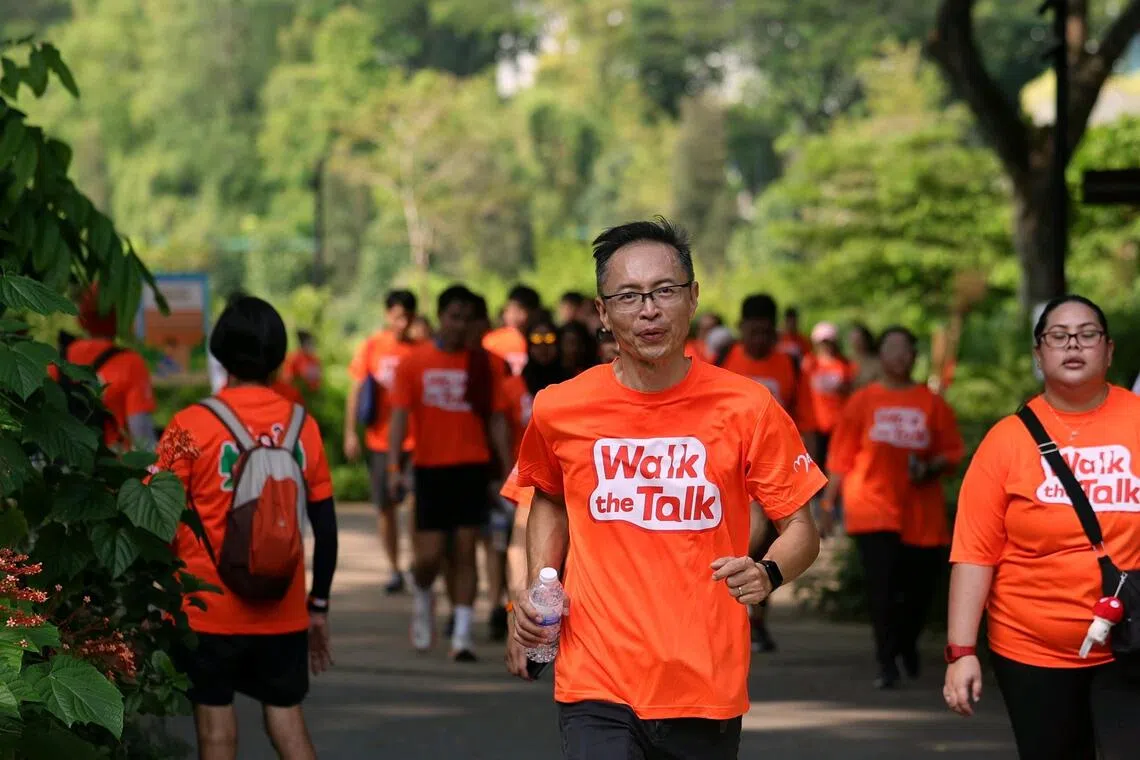
Psychiatrist and recovered transplant recipient Daniel Kwek taking part in the 2.5km Walk the Talk walkathon organised by Bone Marrow Donor Programme (BMDP) at Bidadari Park on Oct 31.
Published Oct 31, 2026, 02:40 PM
Updated Oct 31, 2026, 02:40 PM
BMDP said 71 bone marrow donations were done in Singapore in 2026, already above the 57 from the whole of 2025.
Minister Tan See Leng said only about 20% of 500 yearly hospital requests lead to a transplant. He urged a bigger, more varied donor register because many cases fail for health or match reasons.
The donor network is growing, with 130,000 registered donors and 48 corporate partners.
SINGAPORE – More people here are donating their bone marrow, with the Bone Marrow Donor Programme (BMDP) facilitating 71 such donations here so far in 2026.
This is more than the 57 recorded for the whole of 2025.
This was announced by BMDP chief executive Charles Loh on Oct 31 at Match for Life 2026, a walkathon organised by the programme at Bidadari Park.
The increase reflects growing transplant needs, greater use of local donors and BMDP’s efforts to make transplants more accessible to patients, the programme said.
BMDP is a non-profit organisation that builds and manages Singapore’s only register of volunteer marrow donors.
Once a match is found, these donors can be asked to donate to patients with leukaemia or other blood diseases.
While BMDP now has more than 130,000 registered donors on its registry , donor dropout is still the programme’s greatest challenge, said Loh.
Minister for Energy, Trade and Industry (Energy and Industry) Tan See Leng, who is BMDP’s patron, noted that while the programme receives about 500 search requests annually from hospitals for matching marrow donors, only about 20% eventually lead to a transplant.
“There are many reasons why a transplant may not proceed – a patient’s condition may change, a donor may not be able to proceed, or a suitable match may not be found,” Tan said at the event on Oct 31.
“We must therefore continue to grow and diversify our donor registry, to improve the chances of finding a suitable match for patients who need one,” he added.
As at end-September, 247 potential donors had agreed to proceed when contacted, moving patients a step closer to a life-saving transplant.
The number of organisations under BMDP’s corporate partner programme has also grown from 26 when it was launched in 2025 to 48 in 2026.
Under the programme, organisations support employees who wish to donate their bone marrow, such as by offering them time off or volunteer leave to do so.
About 800 people took part in the walkathon, including 262 registered marrow donors, 12 of whom have already donated marrow or stem cells to patients in need.
Among those taking part was psychiatrist Daniel Kwek, 60, who in October 2018 discovered a red patch on his knee.
He initially thought it was cellulitis, a common bacterial skin infection.
It was actually a sign of acute myeloid leukaemia – a rare, aggressive blood cancer that develops in the bone marrow, whose symptoms can include bruising or spots on the skin.
Married with a son, he said: “One of the first things I did when I was diagnosed was to call a lawyer friend to help me draft a will, because you never know what might happen.”
Kwek added that he was unprepared for how difficult the process of chemotherapy would be.
He said: “After a few months, when the treatment got a bit tougher, I broke down.”
His oncologist suggested getting a bone marrow transplant, which would be more effective in treating leukaemia, and he agreed.
After signing up for the BMDP, a match was found and he went through a successful transplant in January 2019.
After having to take oral chemo meds for several months and monthly follow-ups for six years, he now has to go for check-ups only every four to six months.
Kwek said that while he had previously avoided BMDP volunteers canvassing for donors, he now volunteers, sharing his own story to encourage more to step forward.
The greatest gift of getting a transplant was seeing his son get married in 2023, Kwek said.
“It was like getting another lease on life,” he said.
Zhaki Abdullah is a correspondent at The Straits Times. He is on the health beat, in addition to occasionally covering science, environmental, tech and Muslim affairs issues.
Organ donation/Transplants
精神科医生兼移植康复者丹尼尔·郭于 10 月 31 日在比达达里公园参加了由骨髓捐献者计划 (BMDP) 组织的 2.5 公里“边走边谈”步行马拉松活动。
发布于2026年10月31日下午2:40
更新于2026年10月31日下午2:40
BMDP表示,2026年新加坡共进行了71例骨髓捐献,已经超过了2025年全年的57例。
陈思龙部长表示,医院每年提出的500例器官移植申请中,只有约20%最终成功移植。他呼吁建立更大规模、更多样化的捐献者登记库,因为许多病例因健康或配型问题而失败。
捐赠者网络正在不断壮大,目前拥有 13 万名注册捐赠者和 48 家企业合作伙伴。
新加坡——越来越多的人在这里捐献骨髓,截至目前,骨髓捐献者计划(BMDP)在2026年已促成71例此类捐献。
这比 2025 年全年记录的 57 个还要多。
10 月 31 日,BMDP 首席执行官 Charles Loh 在 Bidadari 公园举行的 Match for Life 2026 步行马拉松活动上宣布了这一消息。
该项目表示,这一增长反映了移植需求的增加、对当地捐赠者的更多利用以及 BMDP 为使患者更容易获得移植服务所做的努力。
BMDP 是一个非营利组织,负责建立和管理新加坡唯一的志愿骨髓捐献者登记册。
一旦找到匹配的供体,就可以请这些供体向患有白血病或其他血液疾病的患者捐献血液。
罗表示,虽然BMDP目前在其登记册上已有超过13万名注册捐献者,但捐献者退出仍然是该计划面临的最大挑战。
能源、贸易及工业部长(能源及工业)陈世龙是骨髓捐献者计划的赞助人,他指出,虽然该计划每年收到医院约 500 份寻找匹配骨髓捐献者的请求,但最终只有约 20% 的请求促成了移植手术。
“移植手术可能无法进行的原因有很多——患者的病情可能会发生变化,捐赠者可能无法进行手术,或者可能找不到合适的配型,”谭在10月31日的活动上说。
“因此,我们必须继续发展和丰富我们的捐献者登记库,以提高为需要捐献器官的患者找到合适配型的机会,”他补充道。
截至 9 月底,已有 247 名潜在捐赠者同意在接到联系后进行捐赠,这使得患者离挽救生命的移植手术更近了一步。
BMDP企业合作伙伴计划下的组织数量也从2025年启动时的26个增加到2026年的48个。
根据该计划,各组织会为希望捐献骨髓的员工提供支持,例如提供休假或志愿服务假。
约有 800 人参加了此次步行活动,其中包括 262 名已登记的骨髓捐献者,其中 12 人已经向有需要的患者捐献了骨髓或干细胞。
参与者中包括 60 岁的精神科医生丹尼尔·奎克,他在 2018 年 10 月发现自己的膝盖上有一块红色的斑块。
他最初以为是蜂窝织炎,一种常见的细菌性皮肤感染。
这实际上是急性髓系白血病的征兆——这是一种罕见的、侵袭性强的血液癌症,起源于骨髓,其症状可能包括皮肤瘀伤或斑点。
他已婚并育有一子,他说:“确诊后我做的第一件事就是打电话给一位律师朋友,请他帮我起草一份遗嘱,因为你永远不知道会发生什么。”
郭先生补充说,他没有预料到化疗过程会如此艰难。
他说:“几个月后,治疗变得更加艰难,我崩溃了。”
他的肿瘤科医生建议他进行骨髓移植,认为这样治疗白血病会更有效,他同意了。
在注册 BMDP 后,他找到了匹配的供体,并于 2019 年 1 月成功接受了移植手术。
在经历了数月的口服化疗药物治疗和长达六年的每月随访后,他现在只需每四到六个月进行一次检查。
郭先生表示,虽然他以前一直避免与BMDP志愿者一起挨家挨户募捐,但现在他却成了志愿者,分享自己的故事,以鼓励更多的人站出来。
郭先生说,接受移植手术最大的礼物就是看到儿子在 2023 年结婚。
“这就像是获得了第二次生命,”他说。
扎基·阿卜杜拉是《海峡时报》的记者。他主要负责健康新闻报道,偶尔也报道科学、环境、科技和穆斯林事务等议题。
器官捐献/移植