How Instagram microgardener Airene Tan harvests edibles from her 2 sq m HDB balconyInstagram上的微型园艺达人Airene Tan是如何在她2平方米的组屋阳台上收获可食用植物的呢?
How Airene Tan grows edibles on a 2 sq m HDB balcony with vertical gardening, compost and climate-adapted planting. Read more at straitstimes.com.
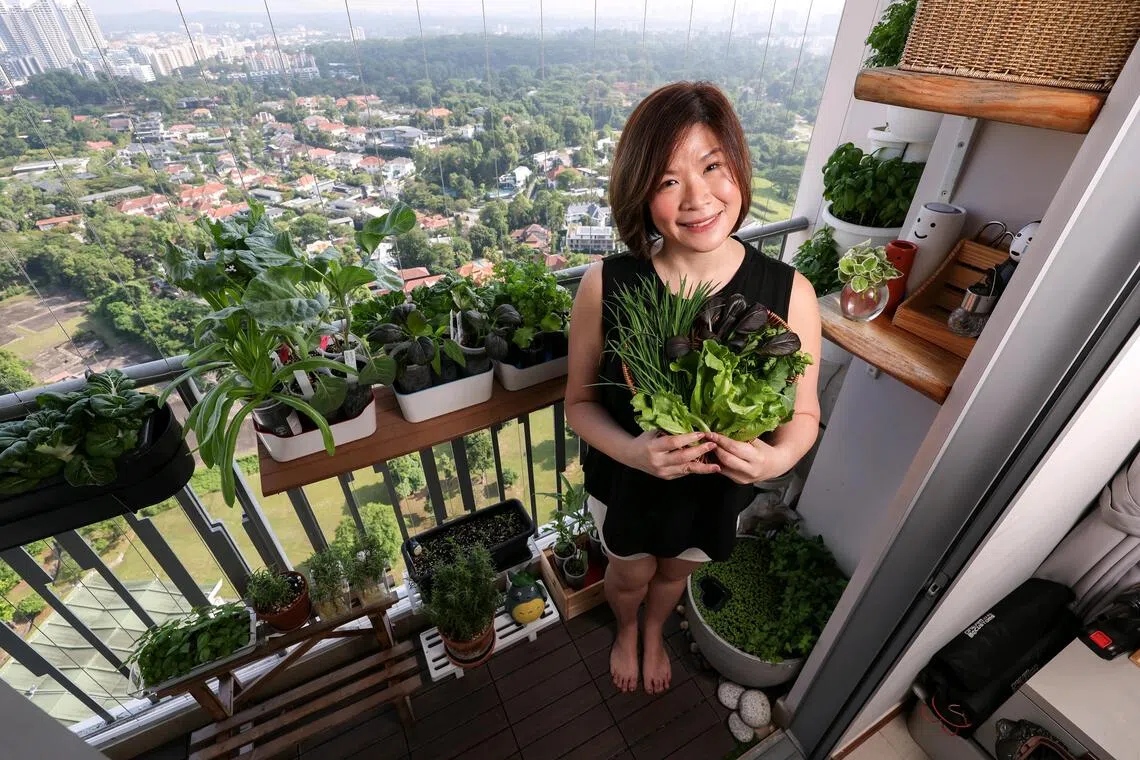
Singapore microgardener Airene Tan with a platter of produce harvested from her balcony edible garden, including Chinese chives, local lettuce, purple king bak choy, Siberian kale and coriander, on Oct 30.
Published Oct 31, 2026, 12:45 PM
Updated Oct 31, 2026, 12:45 PM
Airene Tan grows more than 12 herbs and vegetables on a 2 sq m HDB balcony in Queenstown. She started gardening during the 2020 circuit breaker and now shares tips with 24,000 Instagram followers.
Her success comes from growing upwards, using loose soil, and checking moisture before watering. She uses compost, worm castings, banana peel tea, and a chunky mix for rosemary and other Mediterranean herbs.
Tan says the balcony garden does not replace groceries, but it shapes her meals. She recommends basil, mint, and Indian borage for beginners, and gardens around Singapore’s heat, rain, and wind.
After more than four months (I’m still keeping my fingers crossed), my 2m-long herb patch on the rooftop terrace is still going strong.
I recently plucked my second batch of six eggplants from two pots, after harvesting five fruits two weeks earlier. The chilli padi, which I harvested around the same time as the eggplants, is due for a second round too. The Indian borage is so happy it is practically throwing itself out of its pot, and the laksa and curry leaves, the basil, the mint, the saw-toothed coriander - all of them are growing happily, seemingly unfazed even by the haze .
What is more exhilarating for me is that the Red Rubin basil, winged bean, okra and luffa seeds have all germinated and grown into seedlings within a month. To cater to the luffas, I installed two large arches for them to climb in the past two weeks. Both now have vines winding their way to the top, their fine tendrils reaching for the light, with a few sunny yellow flowers peeking from the leaves.
My little edible stretch is, by any measure, thriving. And yet, I’m still holding my breath for three other herbs that I’ve abysmally failed to grow all these long years.
They are the silver-leaved, grey-green herbs - rosemary, thyme, oregano - which continue to defeat me. Despite my best efforts, I cannot seem to keep them happy for long. They arrive looking plump and promising from the nursery, and within weeks they begin that slow decline: yellowing, dropping, browning at the tips, until one morning I find them limp and resigned, as if they had simply given up on me. In three months, I lost three rosemary plants, two thyme plants, and one oregano.
So what am I doing wrong? Is it simply our tropical climate - the relentless heat, the humidity that hangs in the air like a wet blanket - or is there a secret to growing these Mediterranean herbs successfully in Singapore?
There’s nothing more inviting than cooking with fresh herbs - and better yet, from your own garden. When we extended our kitchen into the backyard of the old Min’s Garden, we deliberately pushed it close to the back slope, bricking it off at the edge to form a planter. I wanted to grow an array of herbs there as I could just reach out from the kitchen window and pluck a handful of whatever I need for the dish I’m cooking. Or so I hoped.
I planted rosemary, thyme, oregano, basil, mint, laksa and curry leaves - all bought from a nursery. A few weeks on, the basils and green leafy herbs thrived. I remember having so much basil that I gave most of it away to my office colleagues.
But not the silver-leafed Mediterranean rosemary, thyme, oregano, tarragon and sage.
These failures taught me that these herbs were not suited for that spot. I tried growing them in full sun and watered them daily, and when they still gave up the ghost on me, I didn’t give up. But success continued to elude me. I lost count of how many rosemary plants I have killed.
Then we moved from our bungalow to a condominium more than a year ago. On my must-do list: I was adamant to start growing rosemary again - on my full-sun rooftop terrace. In six months, I have lost three pots.
Then I asked Airene Tan (@woomaamee on Instagram), a microgardener who shares her urban gardening journey on her 2 sq m balcony from her 45-storey HDB flat in Queenstown.
Singapore microgardener Airene Tan tending to her edible garden on her balcony on Oct 30. ST PHOTO: BRIAN TEO
Singapore microgardener Airene Tan tending to her edible garden on her balcony on Oct 30.
She is known for demonstrating sustainable home gardening techniques adapted to Singapore’s climate. Her reels of leafy herbs, greens, luscious melons, tomatoes and cucumbers make you green with envy. Her approach emphasises accessibility for beginners with minimal outdoor space.
Inspired by her success, I’m hoping she holds the key to finally growing these elusive herbs. Fingers crossed - this time, they’ll take off.
Coaxing bountiful harvests from compact HDB balcony
In a compact balcony, Tan has cultivated something remarkable: a thriving edible garden that yields more than 12 different herbs and vegetables in a good week.
The 43-year-old design consultant has spent six years mastering the art of growing food in a space smaller than a parking lot. Her secret? Growing upward, feeding the soil, and letting her harvests dictate the week’s menu.
From circuit breaker to cultivator
Tan’s gardening journey began in 2020, during the pandemic-era circuit breaker. Bored and seeking something to tend, she picked up free seeds from NParks and planted them along her HDB corridor.
“My very first success was kangkong, which grows so fast that it convinced me I could do this,” she recalls. “The first herb I grew well was basil. It thrives in our heat and rewards you quickly.”
That initial success sparked a passion that has since grown into a flourishing balcony garden – and an Instagram community of 24,000 followers eager for her practical advice.
Her north-facing balcony receives direct sun from March to September, soaking up roughly eight hours of sunlight daily. The planting area is about 2 sq m, with around 25 to 28 containers in rotation at any given time. During her “Crop Cups” experiments – using small plastic containers to demonstrate space-efficient growing – that number multiplies dramatically.
“I grow upward,” Tan explains. “My invisible grilles support the climbers, which frees up floor space and improves airflow, while hanging pots on my pipe allow me to grow multiple small pots of leafy greens vertically.”
She favours canvas grow bags over ceramic pots: they’re lighter, breathable, and fold away during the rainy season. Rollable saucers let her reposition plants as the sun shifts. Climbing plants like bitter gourds occupy the sunniest spots from May to July – doubling as natural shade against the harshest heat.
Lessons learned the hard way
A close-up of produce harvested from Singapore microgardener Airene Tan’s balcony garden, including Chinese chives, local lettuce, purple king bak choy, Siberian kale and coriander, on Oct 30. ST PHOTO: BRIAN TEO
A close-up of produce harvested from Singapore microgardener Airene Tan’s balcony garden, including Chinese chives, local lettuce, purple king bak choy, Siberian kale and coriander, on Oct 30.
Like many beginners, Tan made the biggest mistake: overwatering. “I watered on a schedule instead of checking the soil, and the soil compacted into a dense mass. I had fungus gnats in every planter,” she remembers.
The turning point came through community support. “Urban Farmers on Facebook was my go-to whenever I had questions. From there, I learned to stop watering by habit and started checking that the top few centimetres were dry before watering again.”
She loosened compacted soil, learned to amend her own mix for better drainage, and deployed yellow sticky traps for adult gnats while letting the soil dry out.
Tan’s approach to soil health is holistic. She runs a worm composter and uses vermicompost alongside banana peel tea and organic chicken manure during active growing seasons. Crushed eggshells and neem powder round out her soil mix.
“One of my key successes to growing edibles is keeping the soil loose and airy, since compacted soil is where problems start,” she says.
Between crops, she tops up with compost rather than replacing everything. This philosophy extends to her prized rosemary. Her gritty mix – built on leca (lightweight expanded clay pebbles), pumice, perlite, and rice husk with only a small share of compost – prioritises drainage above all.
“Singapore’s humidity and heat make it hard to acclimatise rosemary and other Mediterranean plants, so I keep the mix mostly chunky.”
A muse, not a grocery replacement
Singapore microgardener Airene Tan making a platter of produce harvested from her balcony edible garden, including Chinese chives, local lettuce, purple king bak choy, Siberian kale and coriander, on Oct 30. ST PHOTO: BRIAN TEO
Singapore microgardener Airene Tan making a platter of produce harvested from her balcony edible garden, including Chinese chives, local lettuce, purple king bak choy, Siberian kale and coriander, on Oct 30.
In a good week, Tan - who is married with a nine-year-old son - harvests enough herbs and vegetables to feature in at least six different dishes. But she’s realistic about the yield.
“I would not say it feeds my family sustainably. The yield from a balcony this size does not replace the weekly grocery run. What it does is act as a muse. Seeing what is ready to pick tells me what to cook for the week ahead, so the garden shapes the menu instead of the other way around. The variety matters more to me than the volume.”
Her fridge, she notes, does get a helping hand. “I use tap water, and reuse the fish tank’s waste water to water my plants. I froze my tomatoes this year because there were simply too many to consume, but usually I harvest what I will cook for the week.”
The beginner’s shortlist
For those looking to start, Tan recommends three forgiving options:
Italian basil: “Hardy and forgiving. Fast growing, thrives in our heat and rewards you quickly.”
Mint: “Nearly impossible to kill, but give it its own pot because it spreads.” She now grows it primarily in her low-tech fish tank, where it roots quickly and thrives on the ammonia and nitrates in fish waste. “My fish benefit from the mint cleaning the water by removing harmful nitrites.”
Indian borage: “Requires little care and water. Grows like a succulent and thrives on neglect.”
Tan’s harvesting philosophy is simple: cut often, and cut strategically.
“Always cut just above a leaf node - the point where a pair of leaves meets the stem. The plant then branches from that spot, so each cut becomes two stems. With basil, pinch the growing tips before it flowers, and remove flower buds early so the plant keeps producing leaves. Never strip a plant bare. Leave enough foliage for it to recover.”
Her strategies for climate adaptation are practical and tested.
Heatwaves: Move leafy vegetables out of harsh afternoon sun. Fill ollas or self-watering pots to support plants during extreme heat. “Only water in the morning while it’s cool and not when the plant is experiencing heat stress.”
Heavy rain: Small containers and seedlings move indoors. Leca balls at the bottom of pots prevent waterlogging, and drainage holes stay clear.
Strong winds: Larger plants are staked or tied to the grilles with plant ties.
She also gardens with the seasons: March to September for fruiting crops, October to February for herbs and leafy greens. During the wettest months, “my garden takes a break, and my soil rests”.
Tan’s Instagram account began modestly, with around 300 followers. Then a tomato harvest video took it to 10,000 in three months, and past 20,000 the following month.
“I started sharing tips to pay forward the help I got from the local gardening community when I began,” she says. “My account was actually a cooking channel first before it evolved into a gardening channel.”
She remains an active participant in that community, swopping seeds and blessing fellow gardeners with extra seedlings.
With a full-time job, Tan’s gardening routine is efficient: about 20 minutes daily for watering and feeding the fish, with more time on weekends for sowing or soil maintenance. Her husband isn’t much of a plant lover, she notes, “but is very supportive of my gardening endeavours”.
Looking back at her journey, she reflects on what a small space can teach.
“Plastic cups are a low barrier of entry to gardening,” she says, acknowledging that she uses them for fast-growing crops and seedlings while being mindful of microplastic concerns for edibles. “I use these cups to demonstrate how small spaces can also be utilised to grow crops.”
At its heart, her garden is proof that constraint breeds creativity – and that even a 2 sq m balcony can shape how a family eats, one harvest at a time.
Mad About Gardening is a new monthly series celebrating gardens, gardeners and the irresistible joys, quirks and rewards of growing things.
Got an interesting story to tell about your home garden? E-mail your gardening adventures and photographs of your patch of green to stlife@sph.com.sg
10 月 30 日,新加坡微型园丁 Airene Tan 展示了一盘从她阳台可食用花园中采摘的农产品,其中包括韭菜、本地生菜、紫白菜、羽衣甘蓝和香菜。
发布于 2026 年 10 月 31 日下午 12:45
更新于2026年10月31日下午12:45
艾琳·谭在女皇镇一套组屋2平方米的阳台上种植了超过12种香草和蔬菜。她于2020年阻断措施期间开始园艺,现在在Instagram上与24000名粉丝分享园艺技巧。
她的成功秘诀在于向上生长,使用疏松的土壤,并在浇水前检查土壤湿度。她使用堆肥、蚯蚓粪、香蕉皮茶,以及一种用于迷迭香和其他地中海香草的粗粒混合土。
谭女士说,阳台花园并不能取代食材,但它会影响她的膳食。她建议初学者种植罗勒、薄荷和琉璃苣,并建议在新加坡炎热、多雨、多风的气候条件下种植。
四个多月过去了(我仍然抱有希望),我在屋顶露台上种植的2米长的香草园依然长势良好。
最近,我从两个花盆里摘了第二批茄子,一共六个。两周前,我刚收获了五个。和茄子差不多同时收获的小米椒也该轮作了。琉璃苣长得特别旺盛,都快要从花盆里蹦出来了。叻沙叶、咖喱叶、罗勒、薄荷、芫荽——所有这些植物都长势喜人,似乎连雾霾都丝毫没有影响。
更令我兴奋的是,红罗勒、翼豆、秋葵和丝瓜的种子都在一个月内发芽长成了幼苗。为了方便丝瓜攀爬,过去两周我搭建了两个大拱架。现在,两个拱架上都长满了藤蔓,细长的卷须伸向阳光,几朵明亮的黄色小花从叶片间探出头来。
我的那小块可食用植物地,无论从哪个角度来看,都长势喜人。然而,我还在为另外三种香草的生长而焦头烂额,这么多年来,我种它们都失败得一塌糊涂。
它们是那些银叶灰绿的香草——迷迭香、百里香、牛至——总是让我束手无策。尽管我竭尽全力,却始终无法让它们长久健康生长。它们从苗圃运来时,看起来饱满而充满生机,但几周之内就开始缓慢衰败:叶片泛黄、下垂、叶尖变褐,直到某天早晨,我发现它们无力地垂着,仿佛已经放弃了我。三个月内,我损失了三株迷迭香、两株百里香和一株牛至。
那我到底做错了什么?难道仅仅是因为我们这里是热带气候——持续的高温,空气中弥漫着像湿毯子一样的潮湿——还是说在新加坡成功种植这些地中海香草有什么秘诀?
没有什么比用新鲜香草烹饪更诱人的了——尤其是用自家花园里的香草。当我们把厨房扩建到老敏家花园的后院时,我们特意把它推到后坡附近,并在边缘用砖砌成一个种植区。我当时想在那里种各种各样的香草,这样我就可以从厨房窗户伸手摘一把做菜需要的香草。至少我是这么想的。
我种了迷迭香、百里香、牛至、罗勒、薄荷、叻沙叶和咖喱叶——都是从苗圃买的。几周后,罗勒和绿叶香草长势喜人。我记得罗勒长得特别好,大部分都送给了办公室的同事。
但不包括银叶地中海迷迭香、百里香、牛至、龙蒿和鼠尾草。
这些失败让我明白,这些香草不适合种在那里。我试着把它们种在阳光充足的地方,每天浇水,但它们还是死了,但我没有放弃。然而,成功始终与我无缘。我已经数不清自己养死了多少株迷迭香了。
一年多前,我们从平房搬到了公寓。我的待办事项清单上有一项:我决心要在阳光充足的屋顶露台上重新种植迷迭香。结果六个月过去了,我已经死了三盆。
然后我采访了 Airene Tan(Instagram 账号:@woomaamee),她是一位微型园艺爱好者,在她位于女皇镇 45 层组屋的 2 平方米阳台上分享她的城市园艺之旅。
10月30日,新加坡微型园艺爱好者艾琳·谭(Airene Tan)在阳台上照料她的食用花园。(海峡时报摄影:布莱恩·张)
10月30日,新加坡微型园艺爱好者艾琳·谭在阳台上照料她的食用花园。
她以展示适合新加坡气候的可持续家庭园艺技术而闻名。她展示的绿叶香草、蔬菜、鲜嫩多汁的甜瓜、西红柿和黄瓜,令人羡慕不已。她的方法强调即使是户外空间有限的初学者也能轻松上手。
受她成功的鼓舞,我希望她能掌握培育这些难种香草的秘诀。但愿这次它们能成功。
如何从狭小的组屋阳台上收获丰硕果实
在狭小的阳台上,谭先生培育出了一个非凡的成果:一个生机勃勃的食用花园,在丰收的一周内可以产出 12 种以上的不同香草和蔬菜。
这位43岁的设计顾问花了六年时间,精通在比停车场还小的空间里种植食物的艺术。她的秘诀是什么?向上生长,滋养土壤,并让收成决定一周的菜单。
从断路器到耕耘机
谭女士的园艺之旅始于2020年疫情期间的阻断措施。当时她感到无聊,又想找点事做,于是从国家公园局领取了免费种子,并将它们种在了她居住的组屋走廊沿线。
“我第一次成功种植的是空心菜,它长得非常快,让我相信自己也能做到,”她回忆道。“我种得最好的第一种香草是罗勒。它在我们这里很耐热,而且很快就能收获。”
最初的成功激发了她的热情,如今她已将阳台花园打造成一个欣欣向荣的花园,并在 Instagram 上拥有 24,000 名粉丝,他们都渴望获得她的实用建议。
她朝北的阳台从三月到九月都能沐浴在阳光直射下,每天大约能晒到八小时的太阳。种植面积大约两平方米,任何时候都有大约25到28个盆栽轮流摆放。在她进行“作物杯”实验期间——使用小型塑料容器来展示高效利用空间的种植方法——这个数字会大幅增加。
“我的种植方式是向上发展,”谭解释说。“我的隐形格栅支撑着攀援植物,这样既节省了地面空间,又改善了空气流通,而悬挂在管道上的花盆则让我可以垂直种植多盆绿叶蔬菜。”
她更喜欢帆布种植袋而不是陶瓷花盆:帆布袋更轻便透气,雨季还能折叠收纳。可滚动的托盘让她可以根据阳光角度调整植物的位置。苦瓜等攀援植物在五月到七月间占据阳光最充足的地方——它们还能在酷暑中起到天然遮荫的作用。
惨痛的教训
10月30日,新加坡微型园艺爱好者艾琳·谭(Airene Tan)在自家阳台花园采摘了多种蔬菜,包括韭菜、本地生菜、紫白菜、羽衣甘蓝和香菜。(海峡时报摄影:布莱恩·张)
10 月 30 日,新加坡微型园丁 Airene Tan 在阳台花园里收获了农产品,近距离拍摄了照片,其中包括韭菜、本地生菜、紫白菜、羽衣甘蓝和香菜。
和许多新手一样,谭犯了最大的错误:浇水过多。“我按时浇水,而不是检查土壤,结果土壤板结成了密实的土块。每个花盆里都滋生了真菌蚋,”她回忆道。
转折点来自于社区的支持。“每当我遇到问题时,Facebook上的‘城市农夫’小组都是我的首选。在那里,我学会了不再凭习惯浇水,而是开始检查表层几厘米的土壤是否干燥后再浇水。”
她松动了板结的土壤,学会了改良自己的混合土以改善排水,并在土壤干燥的同时放置了黄色粘虫板来捕捉成虫小黑蚊。
谭女士采用整体方法来改善土壤健康。她使用蚯蚓堆肥机,并在作物生长旺季将蚯蚓粪与香蕉皮茶和有机鸡粪混合使用。碎蛋壳和印楝粉则完善了她的土壤混合物。
“我种植食用植物成功的关键之一是保持土壤疏松透气,因为土壤板结是问题的根源,”她说。
作物轮作间隙,她会添加一些堆肥,而不是全部更换。这种理念也体现在她珍爱的迷迭香上。她使用的粗颗粒混合土——以陶粒(轻质膨胀粘土卵石)、浮石、珍珠岩和稻壳为主,只添加少量堆肥——将排水性放在首位。
“新加坡的湿度和炎热使得迷迭香和其他地中海植物很难适应当地环境,所以我尽量保持混合物中颗粒较大。”
缪斯,而非杂货替代品
10月30日,新加坡微型园艺爱好者艾琳·谭(Airene Tan)正在制作一盘从她阳台可食用花园采摘的蔬菜,包括韭菜、本地生菜、紫白菜、羽衣甘蓝和香菜。(海峡时报摄影:布莱恩·张)
10 月 30 日,新加坡微型园丁 Airene Tan 制作了一盘从她阳台可食用花园中采摘的农产品,其中包括韭菜、本地生菜、紫白菜、羽衣甘蓝和香菜。
谭女士已婚,育有一名九岁的儿子。如果收成好的话,她一周能收获足够的香草和蔬菜,至少可以用于六道不同的菜肴。但她对产量也有着清醒的认识。
“我不会说它能可持续地养活我的家人。这么小的阳台上的收成不足以取代每周去超市采购。但它却能激发我的灵感。看看哪些蔬菜可以采摘,就能知道接下来一周该做什么菜,所以是花园决定了菜单,而不是我决定了菜单。对我来说,品种比产量更重要。”
她提到,她的冰箱也得到了一些帮助。“我用的是自来水,还会把鱼缸里的废水用来浇花。今年我把西红柿都冷冻起来了,因为实在吃不完,但通常情况下,我只会采摘一周要用的量。”
初学者精选清单
对于想要入门的人,谭推荐了三种比较容易上手的选择:
意大利罗勒:“生命力顽强,适应性强。生长迅速,在炎热的气候下茁壮成长,很快就能收获果实。”
薄荷:“几乎养不死,但最好单独种一盆,因为它会蔓延。”她现在主要在简易鱼缸里种植薄荷,薄荷在那里生根很快,而且能吸收鱼粪中的氨和硝酸盐。“薄荷能净化水质,去除有害的亚硝酸盐,我的鱼也因此受益。”
印度琉璃苣:“需水量少,生长习性像多肉植物,即使疏于照料也能茁壮成长。”
谭的收割理念很简单:经常收割,并且要有策略地收割。
“修剪时,务必在叶节点上方——也就是两片叶子与茎连接的地方——进行。这样植株就会从该点分枝,所以每次修剪都会长出两根茎。对于罗勒,在开花前掐掉生长点,并尽早去除花蕾,这样植株才能持续长叶。切勿将植株修剪得光秃秃的,要留出足够的叶子让它恢复生长。”
她的气候适应策略切实可行,并且经过了检验。
热浪来袭:将绿叶蔬菜移出午后烈日暴晒区。用陶罐或自动浇水花盆盛水,帮助植物度过酷暑。“只在清晨凉爽时浇水,不要在植物遭受高温胁迫时浇水。”
暴雨:将小型盆栽和幼苗移至室内。花盆底部的陶粒可防止积水,排水孔也要保持畅通。
强风:较大的植物用支架或植物绑带固定在格栅上。
她也顺应季节种植:三月到九月种植果树,十月到次年二月种植香草和绿叶蔬菜。在最潮湿的月份,“我的花园会休息,土壤也会休养生息”。
Tan的Instagram账号起步很普通,只有大约300名粉丝。后来,一段番茄采摘的视频让粉丝在三个月内达到了1万,并在接下来的一个月突破了2万。
“我开始分享园艺技巧,是为了回报我当初从当地园艺爱好者那里得到的帮助,”她说。“我的账号最初其实是一个烹饪频道,后来才发展成园艺频道。”
她仍然是该社区的积极参与者,与他人交换种子,并向其他园丁赠送多余的幼苗。
谭女士有一份全职工作,但她的园艺安排却很高效:每天大约花20分钟浇水喂鱼,周末则会抽出更多时间播种或进行土壤维护。她提到,她的丈夫不太喜欢植物,“但他非常支持我的园艺爱好”。
回顾自己的经历,她反思了一个狭小的空间能教会她什么。
“塑料杯降低了园艺的入门门槛,”她说道,并承认自己用它们来种植生长迅速的作物和幼苗,同时也考虑到食用植物中微塑料的问题。“我用这些杯子来展示如何利用狭小的空间种植作物。”
从本质上讲,她的花园证明了限制可以激发创造力——即使是 2 平方米的阳台也可以通过一次次的收获来塑造一个家庭的饮食方式。
《园艺狂热》是一档全新的月度系列节目,旨在赞美花园、园丁以及种植植物带来的无法抗拒的乐趣、奇特之处和回报。
想分享您自家花园的精彩故事吗?欢迎将您的园艺趣事和照片发送至 stlife@sph.com.sg