Beyond war, key maritime nations grope for solutions to keep waterways open战争之外,主要沿海国家正努力寻求保持航道畅通的解决方案。
"We must not allow insecurity to become the new normal," Zaqy Mohamad said at the Manama Dialogue. Read more at straitstimes.com.
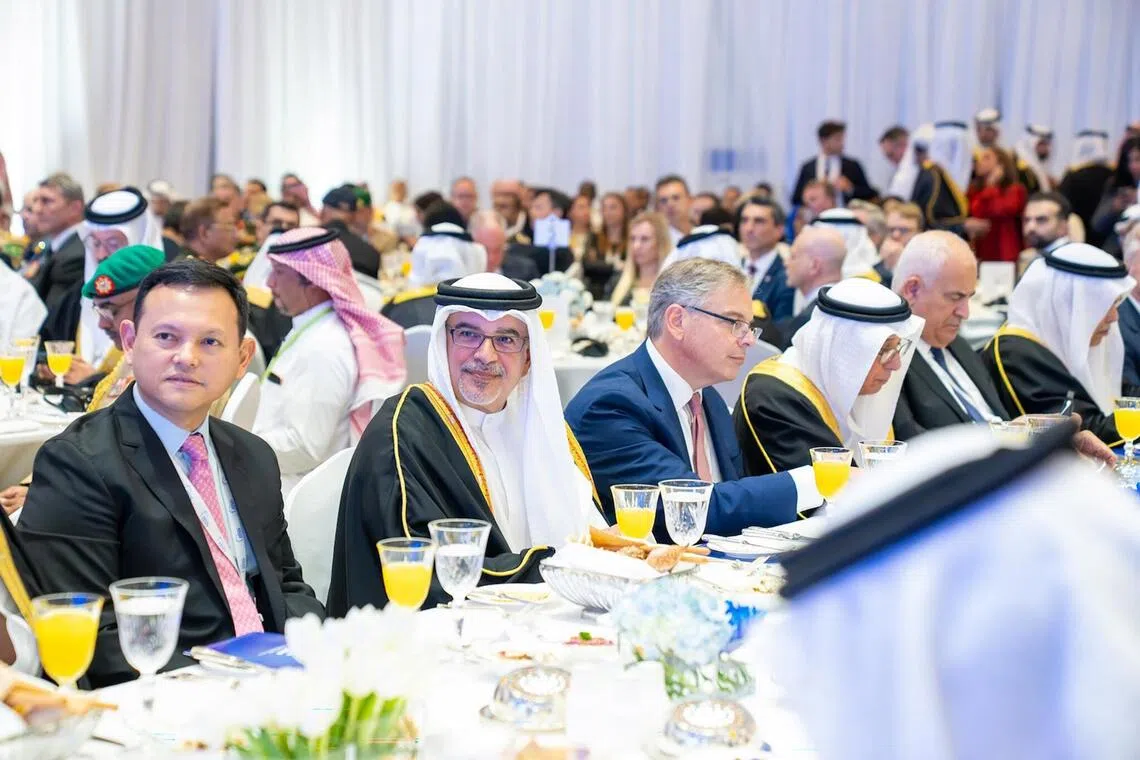
(From left) Acting Minister for Muslim Affairs and Senior Minister of State for Defence Zaqy Mohamad and Crown Prince and Prime Minister of Bahrain Salman bin Hamad Al Khalifa at the opening dinner for the Manama Dialogue in Bahrain.
PHOTO: OFFICE OF HIS ROYAL HIGHNESS THE CROWN PRINCE AND PRIME MINISTER, KINGDOM OF BAHRAIN
Published Nov 01, 2026, 10:25 PM
Updated Nov 01, 2026, 10:25 PM
Maritime nations at the Manama Dialogue said the Strait of Hormuz crisis shows security cooperation has not kept pace with global trade, and waterways must not be held hostage.
Singapore’s Zaqy Mohamad called for states to share threat data, act together and protect undersea infrastructure, while backing patrols in the Malacca Straits, Gulf of Aden and Red Sea.
Leaders warned that Iran-linked threats, Red Sea and Black Sea disruption, and high oil prices are raising conflict and trade risks.
MANAMA – With the war on Iran possibly approaching its denouement one way or the other, maritime nations have started to look over the horizon.
A common sentiment, arising out of the crisis in the Strait of Hormuz where a tense standoff between the US and Iran has disrupted shipping for months, is this: While globalisation and shared economic interests have failed to reduce risk of conflict, never again should economies and livelihoods be held hostage to maritime chokepoints.
That’s one of the key takeaways from this year’s Manama Dialogue, organised by the International Institute of Strategic Studies. It is a point that Singapore and a host of nations articulated at the West Asian region’s premier security conference.
“The lesson from Hormuz is not that our world has become too interconnected. It is that our security cooperation has not always kept pace with our interdependence,” Acting Minister for Muslim Affairs and Senior Minister of State for Defence Zaqy Mohamad said on Sunday as he shared a panel on maritime security.
“We must not allow insecurity to be come the new normal.”
Noting that no single nation can secure the maritime commons individually, Zaqy called for littoral and user-states of waterways to take the initiative, supplemented by other users of the maritime passages.
If countries accept higher risks, longer shipping routes and rising costs as simply the price of doing business, he warned, maritime insecurity would become a permanent feature of international trade. That’s unacceptable.
He suggested three areas for cooperation: sharing information about threats in a timely manner , being prepared to act together, and “securing what we cannot always see”.
“Maritime security is no longer just about the things we see, protecting the ships that we see. It is also about safeguarding the infrastructure beneath the seas on which our connected world depends on .
“As technology advances, defence establishments must work together to understand emerging risks and develop collective responses.”
While Singapore works with neighbours Indonesia, Malaysia and Thailand on the Malacca Straits Patrol, it also has contributed to Combined Task Force (CTF) 151 in the Gulf of Aden and CTF 153 in the Red Sea, he said, adding that participating in these multi-state naval partnerships underscored the Republic’s dedication to safeguard maritime security beyond its region.
The urgency to find durable solutions to maintaining maritime security has been gaining ground for a while. When Bahrain, host of the Manama Dialogue, presided over the UN Security Council in April it made maritime security and freedom of navigation a priority, bringing attention to the danger of eroding norms of navigation.
Greece, a nation with a long maritime history, is doing likewise as current president of the Security Council.
Greek Prime Minister Kyriakos Mitsotakis, in an opening address to the Dialogue, spoke of a broad consensus within the Security Council that “this topic should be treated as an issue of utmost urgency.”
The sense of urgency, he said, was driven not only by actions of states, but also non-state actors who are able to use cheap technologies to disrupt navigation and threaten undersea cables.
This issue was not relevant to the Middle East alone, he said, noting that the world now had two “problematic theatres of operation” -- the other being the Black Sea which has been heavily affected by the Russia-Ukraine war.
Just days ago, he noted, a Greek-owned container ship was sunk in the western Black Sea. And so much of grain remains unsold in Ukraine’s warehouses because of the disrupted shipping, while markets elsewhere wait for those shipments to arrive.
Even so, Mitsotakis called for European attention to “shift more aggressively” to West Asia.
Greece, as a leading maritime nation, has “a lot of skin in the game when we talk about the freedom of navigation”.
A senior Asian diplomat attending the Dialogue said he expected Singapore’s call for littoral states and users of waterways to take the initiative, to find resonance in the region.
“Where Hormuz and the Black Sea are concerned, the world is looking for credible powers to lead the collective effort to ensure freedom of navigation,” he said.
Recalling that during the Iraq War Singapore had joined the ‘coalition of the willing’ by sending a landing ship tank he said, strong powers stepping forth to lead the effort would bolster the confidence of smaller powers to sign on to such efforts.
“Even token behaviour helps make the larger point,” the diplomat added.
This year’s Manama Dialogue concluded amidst widespread apprehension that another US-Israeli attack on Iran is imminent after the US mid-term elections.
Iran has threatened to rain retaliation on Gulf states and other US-friendly regimes across the West Asian region. Led by Qatar, frantic diplomatic efforts were continuing over the weekend to stave off yet another round of conflict.
Thanks to Iranian threats, the Strait of Hormuz through which much of the energy supplies headed for Asia used to pass, remains all but closed. October saw the highest number of strikes on shipping in a single month since war began in late February.
Tehran also has a significant measure of influence over traffic in the Bab el-Mandeb strait and the Red Sea through irregular forces in Yemen allied or sympathetic to it.
Meanwhile, oil prices remain significantly elevated, stoking global inflation. Iran has a 2,000-km shoreline along the strategic waters of the Persian Gulf and the Gulf of Oman from which it can interdict the flow of commerce in the Strait of Hormuz . It also has a small footprint on the Caspian Sea through which it trades with Russia and Central Asia.
West Asia expert Vali Nasr told an RSIS conference in Singapore in October that control over the Strait of Hormuz has emerged as strategically more important for Tehran than retaining its nuclear programme.
Indeed, in negotiations to end the war, Iran has demanded that it be given privileges over the Strait rather like what was accorded Turkey under the 1936 Treaty of Montreux which left Ankara as a sort of supervisor of the Bosporus Strait.
Such Iranian demands sit uneasily with most countries in Asia .
For Southeast Asian states like Singapore, open and secure sea lanes are economic lifelines, Zaqy said at the Dialogue. While security circumstances differ, the principles governing maritime passage must be consistent.
“What happens in Hormuz or in the Bab el- Mandeb matters far beyond the Gulf. We must not allow attempts to restrict transit passage there to undermine navigational rights in the Straits of Malacca and Singapore, or any other strategic waterway,” he said.
At the same panel, Indian foreign secretary Vikram Misri scathingly noted that Indian seafarers using the Strait of Hormuz had been attacked “not just by Iranian actors… and we have not minced words” about it.
Misri was referring to US strikes on merchant mariners to enforce a naval blockade meant to prevent Iranian exports. The most serious of those incidents occured on June 10th when three Indian seafarers were killed in a US missile attack.
Ravi Velloor is senior columnist at The Straits Times.
Maritime and shipping
(从左至右)穆斯林事务代理大臣兼国防国务高级大臣扎基·穆罕默德和巴林王储兼首相萨勒曼·本·哈马德·阿勒哈利法在巴林举行的麦纳麦对话开幕晚宴上。
照片:巴林王国王储兼首相办公室
发布于 2026 年 11 月 1 日晚上 10:25
更新于2026年11月1日晚上10:25
在麦纳麦对话中,海洋国家表示,霍尔木兹海峡危机表明安全合作没有跟上全球贸易的步伐,水道绝不能成为人质。
新加坡的扎基·穆罕默德呼吁各国共享威胁数据,共同行动,保护海底基础设施,同时支持在马六甲海峡、亚丁湾和红海的巡逻行动。
各国领导人警告称,与伊朗有关的威胁、红海和黑海的混乱以及高油价正在加剧冲突和贸易风险。
马纳马——随着对伊朗的战争可能即将以某种方式结束,海上国家已经开始放眼未来。
在霍尔木兹海峡危机中,美国和伊朗之间的紧张对峙已经扰乱航运数月之久,由此产生了一种普遍的看法:虽然全球化和共同的经济利益未能降低冲突的风险,但绝不能再让经济和生计成为海上咽喉要道的挟持物。
这是由国际战略研究所主办的今年麦纳麦对话的主要结论之一。新加坡和许多其他国家在西亚地区最重要的安全会议上也阐述了这一点。
“霍尔木兹海峡事件的教训并非在于我们的世界联系过于紧密,而在于我们的安全合作并未始终跟上相互依存的步伐,”代理穆斯林事务部长兼国防部高级国务部长扎基·穆罕默德周日在参加一个海上安全小组讨论时表示。
“我们绝不能让不安全感成为新的常态。”
扎基指出,没有哪个国家能够单独保障海洋公域的安全,他呼吁沿岸国家和航道使用者主动采取行动,并辅以其他海上通道使用者。
他警告说,如果各国将更高的风险、更长的航程和不断上涨的成本视为开展业务的必然代价,那么海上不安全将成为国际贸易的永久特征。这是不可接受的。
他建议在三个方面进行合作:及时分享有关威胁的信息,做好共同行动的准备,以及“确保我们看不见的东西的安全”。
“海上安全不再仅仅关乎我们肉眼所见的东西,比如保护我们看到的船只。它还关乎保护我们互联世界赖以生存的海底基础设施。”
“随着科技进步,国防机构必须携手合作,了解新出现的风险,并制定集体应对措施。”
他表示,新加坡在与邻国印度尼西亚、马来西亚和泰国合作开展马六甲海峡巡逻的同时,也为亚丁湾的联合特遣部队(CTF)151和红海的联合特遣部队(CTF)153做出了贡献。他还补充说,参与这些多国海军伙伴关系凸显了新加坡致力于维护其区域以外海上安全的决心。
寻求维护海上安全的持久解决方案的紧迫性已日益凸显。巴林作为麦纳麦对话的东道国,于4月担任联合国安理会轮值主席国期间,将海上安全和航行自由列为优先事项,并强调了航行规范遭到破坏的危险。
希腊是一个拥有悠久航海历史的国家,作为现任安理会轮值主席国,它也在做着同样的事情。
希腊总理基里亚科斯·米佐塔基斯在对话开幕致辞中表示,安理会内部已达成广泛共识,“这一议题应被视为极其紧迫的问题”。
他表示,这种紧迫感不仅是由国家行为体的行为所驱动的,也是由非国家行为体所驱动的,这些非国家行为体能够利用廉价技术扰乱航行并威胁海底电缆。
他表示,这个问题不仅仅与中东有关,并指出世界现在有两个“棘手的战区”——另一个是黑海,黑海受到了俄罗斯-乌克兰战争的严重影响。
他指出,就在几天前,一艘希腊所有的集装箱船在黑海西部沉没。由于航运中断,大量粮食滞留在乌克兰的仓库中,而其他地区的市场则在等待这些货物的到来。
即便如此,米佐塔基斯仍呼吁欧洲将注意力“更加积极地转向”西亚。
希腊作为海洋强国,“在谈到航行自由时,希腊有着切身利益”。
一位出席对话的亚洲高级外交官表示,他预计新加坡呼吁沿岸国家和水道使用者采取主动行动的提议将在该地区引起共鸣。
他说:“就霍尔木兹海峡和黑海而言,世界正在寻找可信的大国来领导集体努力,以确保航行自由。”
他回忆起伊拉克战争期间新加坡曾派遣登陆舰坦克加入“自愿联盟”,并表示,强国挺身而出领导这项行动将增强小国参与此类行动的信心。
这位外交官补充说:“即使是象征性的行为也有助于表达更大的观点。”
今年的麦纳麦对话在普遍担忧美国中期选举后美国和以色列可能再次对伊朗发动袭击的背景下结束。
伊朗威胁要对海湾国家和西亚地区其他亲美政权进行报复。在卡塔尔的领导下,各方周末仍在进行紧急外交斡旋,以避免新一轮冲突爆发。
由于伊朗的威胁,曾经运往亚洲的大部分能源供应都要经过的霍尔木兹海峡几乎完全关闭。10月份发生的航运袭击事件数量是自2月底战争爆发以来单月最高的。
德黑兰还通过也门境内与其结盟或同情的非正规军,对曼德海峡和红海的交通拥有相当大的影响力。
与此同时,油价居高不下,加剧了全球通胀。伊朗拥有长达2000公里的波斯湾和阿曼湾沿岸战略要地,可据此拦截霍尔木兹海峡的贸易往来。此外,伊朗在里海也拥有少量领土,并通过里海与俄罗斯和中亚进行贸易。
西亚问题专家瓦利·纳斯尔 (Vali Nasr) 10 月份在新加坡举行的 RSIS 会议上表示,对德黑兰而言,控制霍尔木兹海峡的战略重要性已经超过了保留其核计划。
事实上,在结束战争的谈判中,伊朗要求获得对博斯普鲁斯海峡的特权,就像1936年《蒙特勒条约》赋予土耳其的特权一样,该条约使安卡拉成为博斯普鲁斯海峡的某种监管者。
伊朗的这些要求令亚洲大多数国家感到不安。
扎基在对话中表示,对于新加坡等东南亚国家而言,开放安全的海上航道是经济生命线。尽管安全形势各不相同,但海上通行原则必须保持一致。
他说:“霍尔木兹海峡或曼德海峡发生的事情,其影响远远超出海湾范围。我们绝不能允许任何限制那里过境通行的行为,以损害马六甲海峡、新加坡海峡或任何其他战略水道的航行权。”
在同一小组讨论会上,印度外交秘书维克拉姆·米斯里严厉指出,使用霍尔木兹海峡的印度海员不仅遭到伊朗方面的袭击……对此我们毫不含糊。
米斯里指的是美国为执行旨在阻止伊朗出口的海上封锁而对商船海员发动的袭击。其中最严重的事件发生在6月10日,当时三名印度海员在美军导弹袭击中丧生。
拉维·韦洛尔是《海峡时报》的资深专栏作家。
海事和航运