NATO nations size up an interceptor-drone bazaar where low price is everything北约国家正在评估拦截无人机市场的行情,低价至上。
A price point advantage is no longer measured in millions of dollars below the competition, but in mere thousands.
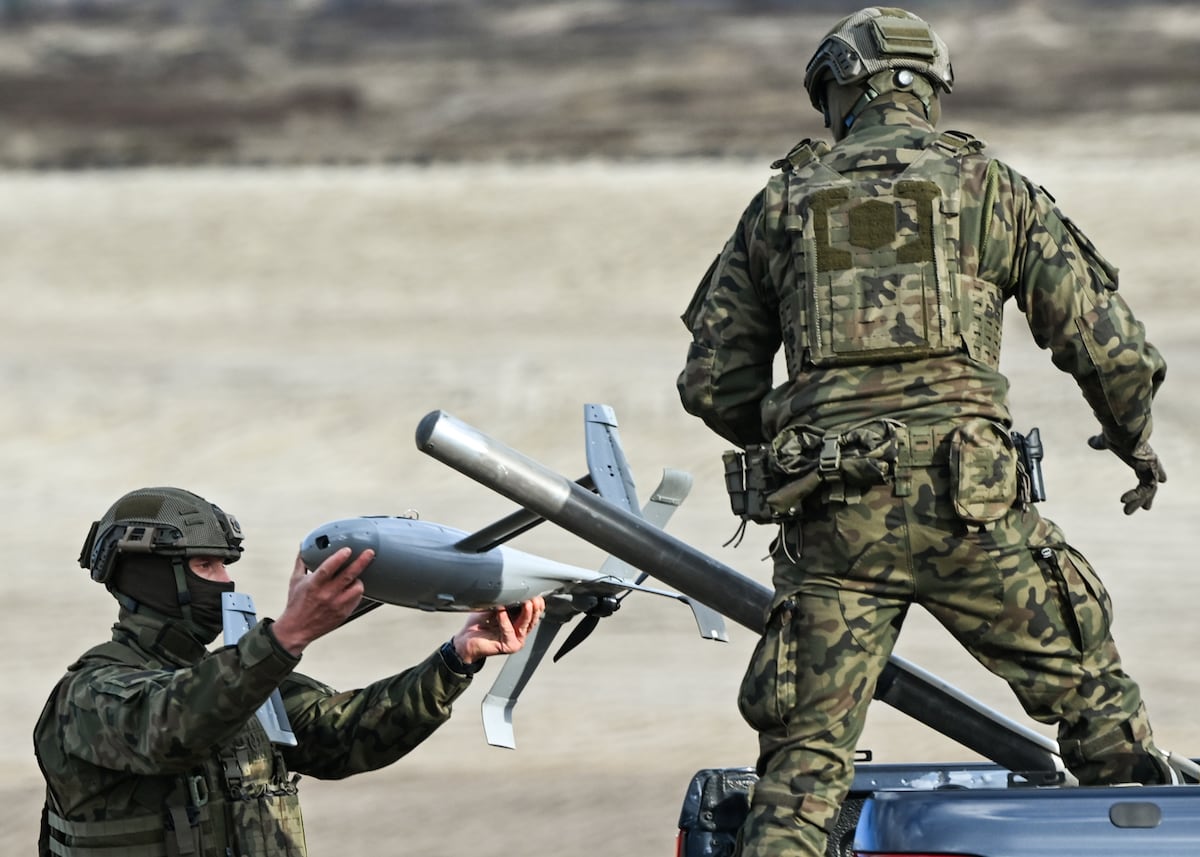
KYIV, Ukraine — Lithuania, a NATO state bordering Russia and Belarus, bought 48 Merops interceptors from American manufacturer Perennial Autonomy on April 22, becoming the latest NATO country to buy into the $15,000 per-shot counter-drone system.
The pilot purchase, made without competitive bidding, follows earlier Merops deployments and training with Polish and Romanian forces along NATO’s eastern flank.
The system is an example of a new crop of drone countermeasures marketed under an ultra-low-cost mantra that promises to even out a longstanding imbalance in air defense: Intercepting aerial threats like drones is exponentially more expensive than launching them.
It’s a brave new world for arms vendors, especially in the West, nursed on lavish defense budgets over decades. A price point advantage is no longer measured in millions of dollars below the competition, but in mere thousands.
Merops is “capable of intercepting Shahed, Gerbera, and other similar targets,” Lithuanian Defense Minister Robertas Kaunas said, according to national broadcaster LRT – a claim the manufacturer, Perennial Autonomy, confirmed to Military Times, saying Merops has already successfully engaged both target types in combat.
The American-made system saw its first official combat confirmation last month, when Army Secretary Dan Driscoll told Congress that Merops had been used to down Iranian Shaheds aimed at U.S. troops in the Middle East.
The Army bought 13,000 Merops interceptors in eight days after Iran began launching drones at U.S. positions in late February, Driscoll said in April 16 testimony.
The Pentagon turned to Merops after burning through hundreds of Patriot missiles defending against Iranian Shaheds – each Patriot costing more than $3 million, drawing down stockpiles Ukraine has long depended on for its own air defense.
“They protected U.S. troops,” Driscoll told lawmakers, defending the $15,000 unit cost as a fraction of what a Shahed costs to produce. “We will make that trade all day long.”
Merops is built by Perennial Autonomy, the secretive defense startup former Google chief executive Eric Schmidt launched in 2023 as White Stork, according to Forbes .
The company rebranded to Project Eagle in February 2024, and again to Perennial Autonomy, and pulled in former Pentagon innovation chief Will Roper alongside engineers from Apple, SpaceX and Google.
Merops’s closest peers are Ukrainian drones – which are cheaper, have been in combat longer, and are already winning NATO buyers of their own.
Schmidt set out to build attack drones, but was soon convinced by his Ukrainian hosts that defensive interceptor drones – built to take out incoming drones mid-air, minimizing ground damage – were the best investment. Ukrainian forces first deployed Merops as a Shahed interceptor in June 2024, and Poland and Romania have since fielded it along NATO’s eastern flank.
Ukrainian air defense, which averaged roughly 90% interception rates of incoming Russian drones and 80% of cruise missiles in March, has taken the spotlight worldwide as Iranian Shaheds and other unmanned air and ground vessels have caused hundreds of American casualties and billions in damage to US military assets since the war in the Middle East kicked off over two months ago.
A Bullet interceptor drone from General Cherry is on display at Xponential Europe in Düsseldorf, Germany, March 24, 2026. (Henning Kaiser/picture alliance via Getty Images)
Typical Ukrainian-built interceptors run $1,000 to $3,000 a unit and have downed thousands of Russian Shaheds since 2024, with kills logged through Ukraine’s Mission Control battlefield system .
Merops has logged more than 1,000 Shahed-type intercepts in Ukraine since combat testing began in mid-2024, Militarnyi reported. The Pentagon has yet to disclose a Middle East engagement count or per-target success rate.
No interceptor system holds a clear edge, said Stanislav Gryshyn, co-founder of Ukrainian interceptor maker General Cherry.
Their drones ranked first among Ukrainian producers in enemy kills in March, with units logging 11,473 confirmed hits – 5,800 more than the previous month – the highest absolute growth in effectiveness of any tracked system in the period, according to Militarnyi .
The company’s jet-powered Bullet interceptor recorded 3,296 visually confirmed kills in February alone, verified through Ukraine’s Delta battle-management system, Gryshyn told Military Times.
“Anyone claiming one product is better in all respects is either lying or misunderstanding the market,” Gryshyn said.
Four Ukrainian-built interceptors dominate the Shahed-killing fleet: SkyFall’s P1-SUN, Wild Hornets’ Sting, the Ukrainian-British Octopus, and General Cherry’s Bullet.
The Army has deployed roughly 20 Merops complexes to one Middle East site staffed by more than 100 soldiers, about 10 complexes to a second site, and 1,000 armed and unarmed interceptors across the two locations, according to Business Insider . The Surveyor interceptor is flown with an Xbox controller, the publication reported.
Perennial Autonomy also makes the Bumblebee V2, a multirotor FPV interceptor already deployed in Ukraine, on a separate $5.2 million Pentagon contract, according to Calibre Defence .
Bullet works differently. The jet-powered interceptor tops 300 kilometers per hour, climbs to 6,000 meters, and runs on a four-person crew – driver, operator, navigator, communications – Gryshyn told Military Times.
“The guidance system predicts the target and reacts at high speed,” Gryshyn said. “The operator confirms via FPV goggles, and the system completes the intercept.”
Production is the bottleneck. Ukraine has scaled interceptor manufacturing through three parallel channels, with output in the first four months of 2026 already surpassing all of 2025, Defense Minister Mykhailo Fedorov said April 27.
“Our task is to ensure a stable supply of interceptors to the military and to protect Ukrainians from Shahed attacks,” Fedorov said.
A video published by drone maker General Cherry claims to show an interceptor drone bringing down multiple Russian Shahed drones.
General Cherry can currently scale to 100,000 drones a month and is still expanding its manufacturing capabilities, Gryshyn told Military Times.
The company signed production deals in March and April with New Hampshire-based Wilcox Industries and Croatia’s Orqa, seeding distributed NATO production lines.
The Pentagon has committed more than $600 million to counter-drone procurement since the Iran war opened, including $350 million for CENTCOM in the first 30 days, DefenseScoop reported.
Drone spending will run “conservatively, $54 billion” in fiscal 2027 – “closer to $74 billion” once counter-drone programs are added, Defense Secretary Pete Hegseth told the House Armed Services Committee on Wednesday in his first congressional appearance since the Iran war began.
Competition for those dollars is fierce – and Ukrainian manufacturers are already strong players.
SkyFall’s Shrike 10 Fiber, submitted through U.K. partner Skycutter, took first place in the opening round of the Pentagon’s $1.1 billion Drone Dominance program – a four-round competition of strike drones between 25 companies at Fort Benning, Georgia, aiming to field more than 300,000 low-cost drones for U.S. forces – with two of the top six finishers Ukrainian-designed.
No equivalent open competition exists for interceptor drones like Bullet. Merops side-stepped the traditionally slow procurement process by getting fast-tracked through the Army’s G-TEAD program, which aims to provide troops with “combat‑credible capabilities at the speed of war,” the U.S. Army said last month.
Now, Merops has been flagged as a transition candidate for a program of record under Project Manager Close Combat Systems, the step from prototype to sustained acquisition.
Even at scale, the Pentagon’s floor is Ukraine’s ceiling.
Merops could drop to $10,000 a piece at scale, Driscoll said. Ukrainian-built interceptors are already well below that price point.
The directive from Kyiv, Fedorov said in an April Telegram post, is to defeat Russia by “degrading its economic capacity” – and price asymmetry is the lever. Russia launched a record 6,663 drones at Ukraine in April, averaging 222 a night, according to the air force.
A defense engineered for that volume cannot run on $15,000 systems, a lesson Ukraine has learned and is now beginning to sell abroad.
“When you need to shoot down 60 Shaheds at once, you need $2,000 systems, not $15,000 complexes,” Gryshyn told Military Times.
Ukraine asked the Pentagon last August to help scale interceptor manufacturing. Washington declined.
Kyiv is opening the market on its own.
Zelenskyy unveiled an arms-export framework April 27, citing up to 50% surplus capacity in parts of the defense industry and naming the Middle East and Persian Gulf, Europe and the Caucasus as target markets. Ukrainian forces get first claim on production; surplus goes abroad.
“The export of Ukrainian weapons will become a reality,” Zelenskyy said last week.
乌克兰基辅——北约成员国立陶宛与俄罗斯和白俄罗斯接壤,于 4 月 22 日从美国制造商 Perennial Autonomy 购买了 48 架 Merops 拦截器,成为最新一个购买这种单价 15,000 美元的反无人机系统的北约国家。
此次试点采购并未经过公开招标,此前 Merops 已在北约东翼与波兰和罗马尼亚部队进行了部署和训练。
该系统是新一代无人机对抗措施的典型例子,这些措施以超低成本为卖点,旨在平衡防空领域长期存在的不平衡:拦截无人机等空中威胁的成本比发射它们的成本要高得多。
对于武器供应商而言,这是一个全新的世界,尤其是在西方国家,这些国家几十年来一直依靠巨额国防预算维持运营。价格优势不再是以比竞争对手低数百万美元来衡量,而仅仅是几千美元。
据立陶宛国家广播公司 LRT 报道,立陶宛国防部长罗伯塔斯·考纳斯表示,“Merops 能够拦截 Shahed、Gerbera 和其他类似目标”。制造商 Perennial Autonomy 向《军事时报》证实了这一说法,称“Merops”已经在战斗中成功打击了这两种类型的目标。
美国制造的这套系统上个月首次得到正式实战验证,当时陆军部长丹·德里斯科尔告诉国会,美军的Merops系统曾被用来击落伊朗向中东美军发射的“烈士”火箭。
德里斯科尔在 4 月 16 日的证词中表示,伊朗在 2 月下旬开始向美国阵地发射无人机后,美国陆军在八天内购买了 13000 架 Merops 拦截机。
在消耗了数百枚爱国者导弹防御伊朗“烈士”导弹后,五角大楼转而使用梅罗普斯导弹防御系统——每枚爱国者导弹的成本超过 300 万美元,这消耗了乌克兰长期以来赖以进行自身防空的库存。
德里斯科尔告诉议员们:“它们保护了美军。”他辩称,每辆1.5万美元的成本只是“沙赫德”装甲车生产成本的一小部分。“我们随时都愿意做这样的交易。”
据《福布斯》报道,Merops 由 Perennial Autonomy 打造,这是一家神秘的国防初创公司,由前谷歌首席执行官埃里克·施密特于 2023 年创立,当时名为 White Stork。
该公司于 2024 年 2 月更名为 Project Eagle,之后又更名为 Perennial Autonomy,并吸纳了前五角大楼创新主管威尔·罗珀以及来自苹果、SpaceX 和谷歌的工程师。
Merops 最接近的竞争对手是乌克兰无人机——乌克兰无人机价格更低,作战经验更丰富,并且已经赢得了北约买家的青睐。
施密特最初的目标是研发攻击型无人机,但很快被乌克兰方面说服,认为防御型拦截无人机——旨在空中拦截来袭无人机,最大限度减少地面损失——才是最佳投资。乌克兰军队于2024年6月首次部署了“梅罗普斯”(Merops)无人机作为“沙赫德”(Shahed)拦截机,此后波兰和罗马尼亚也在北约东翼部署了该型无人机。
乌克兰防空部队在3月份对来袭的俄罗斯无人机平均拦截率约为90%,对巡航导弹的平均拦截率约为80%。自两个多月前中东战争爆发以来,伊朗的“烈士”无人机和其他无人空中和地面飞行器已造成数百名美国人伤亡,并对美国军事资产造成数十亿美元的损失,乌克兰防空部队因此成为全世界关注的焦点。
2026年3月24日,在德国杜塞尔多夫举行的欧洲Xponential展会上,General Cherry公司的“子弹”拦截无人机正在展出。(Henning Kaiser/picture alliance via Getty Images)
典型的乌克兰制造的拦截机每架售价为 1000 至 3000 美元,自 2024 年以来已击落数千架俄罗斯“沙赫德”战斗机,击落记录是通过乌克兰的“任务控制”战场系统进行的。
据米利塔尼报道,自2024年中期开始实战测试以来,Merops已在乌克兰完成了1000多次“沙赫德”型拦截任务。五角大楼尚未公布在中东地区的交战次数或单目标成功率。
乌克兰拦截器制造商 General Cherry 的联合创始人斯坦尼斯拉夫·格里申表示,目前没有任何拦截器系统具有明显的优势。
据米利塔尼称,他们的无人机在3月份乌克兰生产商中击杀敌方目标的次数排名第一,其部队记录了11473次确认命中——比上个月增加了5800次——是该时期任何履带式系统有效性绝对增长幅度最大的。
格里申告诉《军事时报》,该公司喷气式“子弹”拦截机仅在 2 月份就取得了 3296 次目视确认的击落战果,并通过乌克兰的 Delta 作战管理系统进行了验证。
格里申说:“任何声称某个产品在所有方面都更好的人,要么是在撒谎,要么是对市场缺乏了解。”
乌克兰制造的四架拦截机主导了击杀沙赫德的舰队:SkyFall 的 P1-SUN、Wild Hornets 的 Sting、乌克兰-英国的 Octopus 和 General Cherry 的 Bullet。
据《商业内幕》报道,美国陆军已在中东一处地点部署了约20套“梅罗普斯”(Merops)拦截系统,每套系统配备100多名士兵;在另一处地点部署了约10套系统;并在两处地点共部署了1000架武装和非武装拦截机。该媒体还报道称,“勘测者”(Surveyor)拦截机使用Xbox游戏手柄进行操控。
据 Calibre Defence 报道,Perennial Autonomy 还生产 Bumblebee V2,这是一款多旋翼 FPV 拦截器,已在乌克兰部署,这是五角大楼单独签订的价值 520 万美元的合同。
“子弹”的工作原理不同。格里申告诉《军事时报》,这种喷气式拦截机的最高时速可达300公里,爬升高度可达6000米,由四名机组人员操作——驾驶员、操作员、导航员和通信员。
格里申说:“制导系统能够预测目标并高速做出反应。操作员通过FPV眼镜确认后,系统完成拦截。”
生产是瓶颈。乌克兰国防部长米哈伊洛·费多罗夫4月27日表示,乌克兰已通过三个并行渠道扩大拦截器生产规模,2026年前四个月的产量已经超过2025年全年的产量。
费多罗夫说:“我们的任务是确保向军方稳定供应拦截器,并保护乌克兰人民免受沙赫德袭击。”
无人机制造商 General Cherry 发布的一段视频声称显示,一架拦截无人机击落了多架俄罗斯 Shahed 无人机。
格里申告诉《军事时报》,General Cherry 目前每月可生产 10 万架无人机,并且仍在扩大其制造能力。
该公司于 3 月和 4 月与位于新罕布什尔州的 Wilcox Industries 和克罗地亚的 Orqa 签署了生产协议,为北约分布式生产线奠定了基础。
据DefenseScoop报道,自伊朗战争爆发以来,五角大楼已投入超过6亿美元用于反无人机采购,其中包括在战争爆发后的前30天内向中央司令部投入的3.5亿美元。
国防部长皮特·赫格塞斯周三在伊朗战争爆发后首次出席国会听证会时告诉众议院军事委员会,2027 财年无人机支出“保守估计为 540 亿美元”,一旦加上反无人机项目,“将接近 740 亿美元”。
对这些美元的争夺非常激烈——而乌克兰制造商已经是实力强劲的参与者。
SkyFall 公司通过其英国合作伙伴 Skycutter 提交的 Shrike 10 Fiber 无人机,在五角大楼价值 11 亿美元的“无人机优势”计划首轮比赛中获得第一名。该计划是 25 家公司在佐治亚州本宁堡举行的四轮攻击无人机竞赛,旨在为美军部署超过 30 万架低成本无人机。在前六名选手中,有两款是乌克兰设计的。
目前尚无针对类似“子弹”拦截无人机的公开竞标机制。美国陆军上个月表示,Merops公司绕过了传统的缓慢采购流程,通过陆军的G-TEAD项目获得了快速审批。该项目旨在“以战争速度为部队提供作战可信能力”。
现在,Merops 已被列为近战系统项目经理领导下的正式项目过渡候选者,这是从原型到持续采购的过渡阶段。
即使从规模上看,五角大楼的底线也只能是乌克兰的上限。
德里斯科尔表示,Merops导弹批量生产后,单价可能会降至1万美元。乌克兰制造的拦截导弹价格已经远低于这个价位。
费多罗夫在4月份的一篇Telegram帖子中表示,基辅方面的指示是通过“削弱俄罗斯的经济能力”来击败俄罗斯——而价格不对称正是实现这一目标的手段。据俄罗斯空军统计,4月份俄罗斯向乌克兰发射了创纪录的6663架无人机,平均每晚222架。
为这种规模设计的防御系统无法在 15,000 美元的系统上运行,乌克兰已经吸取了这一教训,现在开始向国外出售此类系统。
“当你需要一次性击落 60 架 Shahed 飞机时,你需要的是价值 2000 美元的系统,而不是价值 15000 美元的综合系统,”格里申告诉《军事时报》。
去年8月,乌克兰请求五角大楼帮助扩大拦截导弹的生产规模,但遭到华盛顿的拒绝。
基辅正在自行开放市场。
泽连斯基4月27日公布了一项武器出口框架,指出乌克兰国防工业部分领域产能过剩高达50%,并将中东和波斯湾、欧洲和高加索地区列为目标市场。乌克兰军队享有优先使用权;剩余产能则出口海外。
“乌克兰武器出口将成为现实,”泽连斯基上周表示。