Majority back proposed COE 'feebate' scheme, most favour five-band system多数人支持拥车证“费用返还”方案,大多数人赞成五级制度。
The government is also studying the option of a transport grant for large families, says Minister for Transport Jeffrey Siow.
The government is also studying the option of a transport grant for large families, says Minister for Transport Jeffrey Siow.
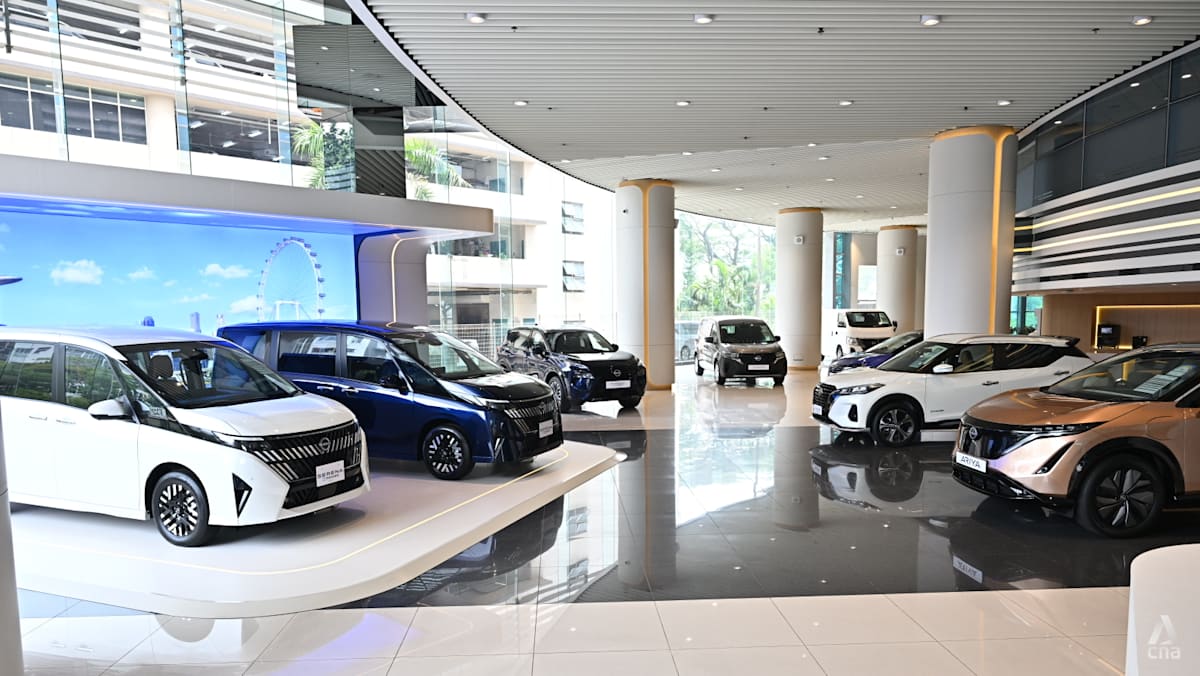
Premium and mass market cars in the car showrooms along Ubi on Oct 9, 2026. (Photo: CNA/Raydza Rahman)
This audio is generated by an AI tool.
SINGAPORE: A proposed scheme to introduce rebates and surcharges on Certificate Of Entitlement (COE) premiums has received majority support in a public consultation, with most respondents favouring a five-band system to distinguish between mass-market and luxury cars.
Transport Minister Jeffrey Siow said in parliament on Tuesday (Nov 3) that the Land Transport Authority (LTA) was still studying the submissions after the consultation closed on Monday and had not decided on the final changes.
"The majority of respondents expressed support for such a scheme. Most people preferred a 'feebate' with five-bands, to reduce cliff effects," said Mr Siow.
Several Members of Parliament (MPs) had asked about proposed changes to the Certificate of Entitlement (COE) system, including whether they would keep mass-market cars within reach, affect electric vehicle (EV) adoption and result in higher prices for cheaper cars.
In response, Mr Siow said that the proposed fee-and-rebate, or "feebate", system was intended to restore a "permanent price distinction in COE premiums between mass-market and luxury cars", after the gap between Category A and B COE premiums narrowed with EVs' growing popularity.
Manufacturers and workshops can adjust the power output of EVs using software, allowing the same car to qualify for different COE categories, he said.
As a result, Category A premiums have exceeded Category B premiums on several occasions this year.
"This trend will continue as electric vehicles become more popular," he added.
Under the LTA's proposal, the existing Category A and B COEs would be merged into a single category for cars.
Categories A and B currently divide cars broadly according to engine capacity and power, with Category A traditionally covering smaller and less powerful models.
LTA has said advances in vehicle technology, particularly EVs, have made these criteria less effective. Manufacturers have increasingly been able to adjust vehicle specifications to fit within Category A limits, resulting in more buyers competing for Category A COEs and a narrowing price gap with Category B.
To continue distinguishing between mass-market and higher-value cars, LTA proposed introducing a feebate system based on a car model's open market value (OMV).
A car in a lower-value band would receive a rebate on its COE price, while higher-value models would face a surcharge. Depending on how the bands are structured, the difference between the highest surcharge and largest rebate could be as much as S$30,000.
LTA has proposed either a three-band or five-band system, with the largest rebate and surcharge set at S$15,000 in both options.
The agency said the aim is to better distinguish between mass-market and higher-value cars while allowing COE premiums themselves to continue to be determined by market forces.
LTA has said it expects to complete its review by the end of the year and publish its findings and recommendations in the first half of 2027.
FIVE BANDS PREFERRED
MP Edward Chia Bing Hui (PAP-Holland-Bukit Timah), who had earlier proposed the feebate system, asked whether the rebate and surcharge could be set as a percentage of the COE price instead of as fixed amounts.
Mr Siow said this could reduce the "cliff effects" between bands further, but would also mean buyers would not know the exact rebate or surcharge before the COE bidding exercise begins.
LTA will also study whether to further reduce COE bidding fees for individuals and whether motor dealers should be required to publish car prices without COE.
Some buyers still prefer dealers to bid for COEs on their behalf as a one-stop service, Mr Siow said, adding that the government should not make this more difficult.
"But we can make it easier for individual buyers to bid for COEs on their own," he said.
LTA is also still reviewing how taxis would be treated under the proposed feebate system, Mr Siow said.
EV SUPPORT TO REMAIN SEPARATE
MP Choo Pei Ling (PAP-Chua Chu Kang) asked how the proposed system would avoid discouraging the adoption of high-performance EVs, which can have higher OMVs, and ensure mass-market buyers were not crowded out by luxury car buyers.
Mr Siow said a separate feebate structure for EVs had been proposed, but this would make the system too complicated.
The government will instead continue to support EV adoption separately through the Vehicle Emissions Scheme rather than through COE policies, he said.
SUPPORT FOR FAMILIES
MP Tin Pei Ling (PAP-MacPherson) asked whether the proposed feebate could increase demand for lower-value vehicles and inadvertently push up prices of mass-market cars.
She also asked what more could be done to help large families that need a car.
Mr Siow said he recognised that larger families, particularly those with young children, may find it difficult to travel together on public transport.
But any support would also have to consider families that do not intend to buy a car and instead rely on public transport, taxis, private-hire cars or car-sharing services, he said.
The government is studying the option of a transport grant, with more details to be provided later.
CNA Games Guess Word Crack the word, one row at a time Buzzword Create words using the given letters Mini Sudoku Tiny puzzle, mighty brain teaser Mini Crossword Small grid, big challenge Word Search Spot as many words as you can Show More Show Less
Get our pick of top stories and thought-provoking articles in your inbox
Stay updated with notifications for breaking news and our best stories
Join our channel for the top reads for the day on your preferred chat app
交通部长萧正树表示,政府也在研究向大家庭发放交通补助金的方案。
2026年10月9日,乌美路沿线汽车展厅内陈列着高端和大众市场车型。(图片:CNA/Raydza Rahman)
这段音频由人工智能工具生成。
新加坡:一项关于对拥车证(COE)保费引入回扣和附加费的提案在公众咨询中获得了多数支持,大多数受访者倾向于采用五级制度来区分大众市场汽车和豪华汽车。
交通部长萧敬腾周二(11月3日)在国会表示,陆路交通管理局(LTA)在周一咨询结束后仍在研究各方提交的意见,尚未决定最终的修改方案。
“大多数受访者表示支持这样的方案。大多数人更倾向于五级收费的‘费用返还制’,以减少断崖式上涨的影响,”萧先生说。
一些国会议员询问了有关拥车证(COE)制度拟议变更的问题,包括这些变更是否会使大众市场汽车保持在可承受范围内、是否会影响电动汽车(EV)的普及以及是否会导致价格较低的汽车价格上涨。
对此,萧先生表示,拟议的费用和回扣制度,或称“费回扣制度”,旨在恢复“大众市场汽车和豪华汽车在拥车证溢价方面的永久价格差异”,此前随着电动汽车越来越受欢迎,A类和B类拥车证溢价之间的差距已经缩小。
他表示,制造商和维修厂可以通过软件调整电动汽车的功率输出,使同一辆车能够符合不同的拥车证类别。
因此,今年A类保费多次超过B类保费。
他补充说:“随着电动汽车越来越受欢迎,这种趋势还会继续下去。”
根据陆路交通管理局的提议,现有的 A 类和 B 类拥车证将合并为单一的汽车拥车证类别。
目前,汽车主要根据发动机排量和功率分为 A 类和 B 类,A 类传统上涵盖较小、功率较低的车型。
陆路交通管理局表示,车辆技术的进步,尤其是电动汽车的普及,使得这些标准效力降低。制造商越来越能够调整车辆规格以符合A类拥车证的限制,导致更多买家竞相购买A类拥车证,并缩小了与B类拥车证的价格差距。
为了继续区分大众市场汽车和高价值汽车,陆路交通管理局提议引入基于汽车型号公开市场价值(OMV)的收费返还制度。
价格较低的车辆可获得拥车证价格折扣,而价格较高的车型则需缴纳附加费。根据价格区间划分方式的不同,最高附加费与最高折扣之间的差额可能高达3万新元。
陆路交通管理局提出了三级或五级收费制度,两种方案中最大的回扣和附加费均为 15,000 新元。
该机构表示,此举旨在更好地区分大众市场汽车和高价值汽车,同时让拥车证溢价本身继续由市场力量决定。
陆路交通管理局表示,预计将于今年年底完成审查,并于 2027 年上半年公布审查结果和建议。
五支乐队优先
此前提出退税制度的国会议员谢炳辉(人民行动党-荷兰-武吉知马选区)询问,退税和附加费是否可以按拥车证价格的百分比设定,而不是设定为固定金额。
萧先生表示,这可能会进一步减少不同等级之间的“断崖效应”,但也意味着买家在拥车证竞标开始前无法知道确切的折扣或附加费。
陆路交通管理局还将研究是否进一步降低个人拥车证竞标费用,以及是否应要求汽车经销商公布不含拥车证的汽车价格。
萧先生表示,一些买家仍然更喜欢经销商代表他们竞标拥车证,以获得一站式服务,并补充说政府不应该让这件事变得更加困难。
“但我们可以让个人买家更容易自行竞标拥车证,”他说。
萧先生表示,陆路交通管理局仍在审查拟议的费用返还制度下出租车将如何受到对待。
电动汽车支持将继续独立运作
国会议员朱佩玲(人民行动党-蔡厝港)询问,拟议的系统将如何避免阻碍高性能电动汽车的普及(高性能电动汽车的OMV更高),并确保大众市场买家不会被豪华车买家挤出市场。
萧先生表示,有人提议对电动汽车实行单独的补贴机制,但这会使系统过于复杂。
他表示,政府将继续通过车辆排放计划单独支持电动汽车的普及,而不是通过拥车证政策。
对家庭的支持
国会议员陈佩玲(人民行动党-麦波申)质问,拟议的退税措施是否会增加对低价车辆的需求,并无意中推高大众市场汽车的价格。
她还询问还能做些什么来帮助需要汽车的大家庭。
萧先生表示,他意识到大家庭,特别是那些有幼儿的家庭,可能很难一起乘坐公共交通工具出行。
但他表示,任何支持措施都必须考虑到那些不打算买车,而是依赖公共交通、出租车、私人租车或汽车共享服务的家庭。
政府正在研究发放交通补贴的方案,更多细节稍后公布。
CNA游戏 猜词游戏 逐行破解单词 流行词游戏 用给定的字母组成单词 迷你数独 小小谜题,挑战你的大脑 迷你填字游戏 小方格,大挑战 单词搜索 尽可能多地找出单词 显示更多 显示更少
订阅我们的邮件,即可获取精选热点新闻和引人深思的文章。
订阅通知,第一时间获取突发新闻和精彩报道。
加入我们的频道,即可在您常用的聊天应用上获取当日热门文章。