New GovTech-Google DeepMind app flags potential scams by analysing incoming messagesGovTech 与 Google DeepMind 联合开发的新应用通过分析收到的信息来识别潜在的诈骗行为。
Read more at straitstimes.com.
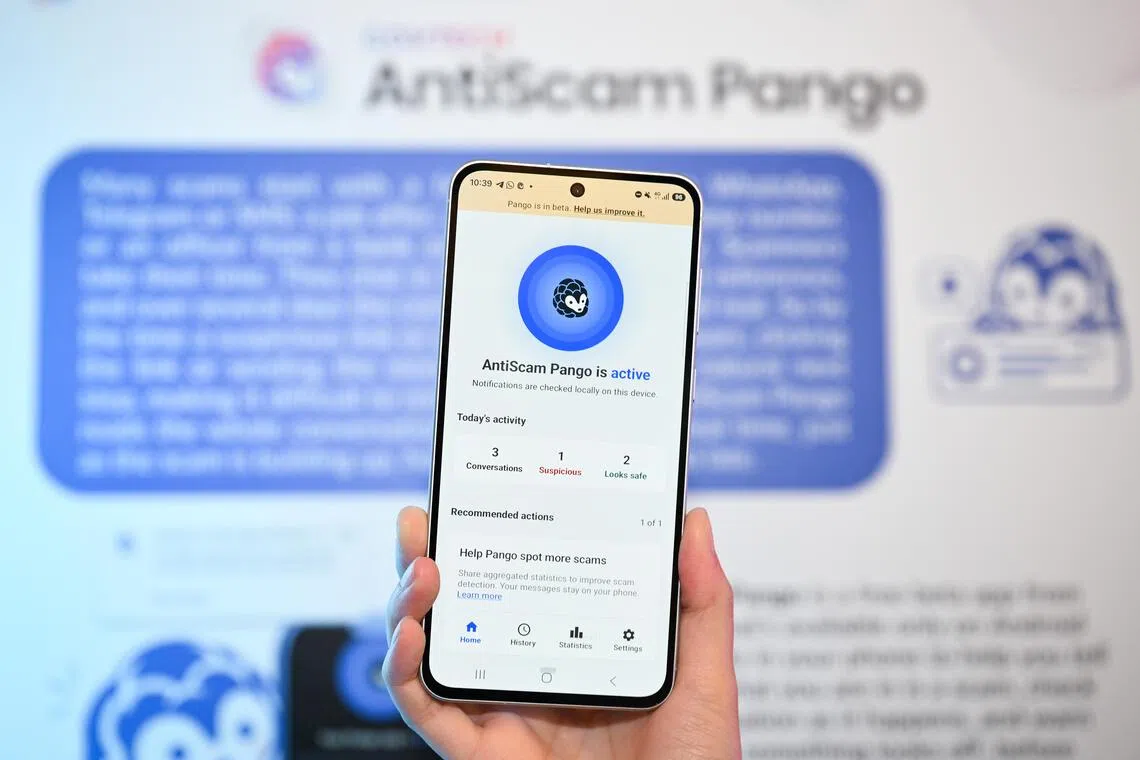
AntiScam Pango uses artificial intelligence to analyse all messages to flag suspicious conversations as they unfold.
ST PHOTO: LIM YAO HUI
Published Nov 04, 2026, 12:00 PM
Updated Nov 04, 2026, 12:19 PM
SINGAPORE – A new app has launched to help users spot potential scams by analysing and flagging suspicious conversations, including those from numbers that have not previously been reported.
Called AntiScam Pango, the app uses artificial intelligence to analyse all messages to flag suspicious conversations as they unfold.
Developed by the Government Technology Agency (GovTech) and Google DeepMind, the app was unveiled on Nov 4 by Acting Minister for Manpower Jasmin Lau at GovTech’s biennial conference STACK Conference 2026.
News of the development of this on-device scam detection model was first announced in October on the sidelines of the Singapore International Cyber Week.
“It checks messages on WhatsApp, Telegram and SMS, flags the ones that look suspicious, and warns you in real time, before you take further actions,” said Lau, who is also Senior Minister of State for Digital Development and Information and Minister-in-charge of GovTech.
“The analysis happens on your phone itself, so your messages stay private,” Lau said.
For a start, Android users can download the beta app from the Google Play Store. Once users grant the necessary permissions, AntiScam Pango runs in the background.
When AntiScam Pango flags a potentially suspicious conversation, it explains the indicators that suggest it could be a scam.
This approach aims to help users recognise social engineering tactics, in which scammers manipulate people into trusting them and taking actions that may put their money or personal information at risk.
The user can then decide whether to continue the exchange, report it or take precautions, such as independently verifying the sender’s identity. The app does not automatically block or delete messages.
Message content is not sent to external servers unless the user chooses to report it, GovTech said. Neither the agency nor its partners can access users’ personal information or private messages through the app, it added.
AntiScam Pango’s AI model from Google DeepMind was trained on scam patterns and scenarios to recognise manipulation tactics and characteristics commonly found in scams targeting people here.
Training data comes from ScamShield, developed by GovTech’s Open Government Products unit, the police and the National Crime Prevention Council.
ScamShield blocks calls from blacklisted numbers reported by users. ScamShield also uses AI to assess whether phone numbers, messages or links submitted by users are likely linked to scams. Its enhanced app has recorded 1.61 million installations since August 2024.
Training data also comes from an in-house AI-powered classifier tool that evaluates suspicious web links.
“With AntiScam Pango, we want to show people that they do not have to choose between protection from scams and keeping their personal messages private,” said GovTech’s director of trust and safety Mark Chen.
“Our collaboration with Google DeepMind is pushing the boundaries of what small AI models can do to deliver both,” he added.
AntiScam Pango adds to existing protection offered by ScamShield, which helps users block scam calls, filter suspicious SMS messages, and check or report potentially fraudulent messages, phone numbers and links.
Unlike ScamShield, AntiScam Pango proactively assesses conversations as messages arrive across supported messaging platforms, rather than rely on users to submit them for checking. It can also flag suspicious exchanges involving numbers that have not previously been identified as risky.
GovTech said it is exploring integrating AntiScam Pango into ScamShield, but no timeline has been provided.
The agency is also assessing other messaging platforms to expand Pango’s coverage beyond WhatsApp, Telegram and SMS.
For now, AntiScam Pango is available only on Android because the operating system allows apps to request access to incoming notifications from messaging services.
GovTech is exploring ways to offer similar protection on other operating systems, including Apple’s iOS, while retaining on-device analysis and the same privacy and security standards.
Li Ying is a technology correspondent covering online safety, cybersecurity and the impact of artificial intelligence.
AI/artificial intelligence
Artificial Intelligence
AntiScam Pango 利用人工智能分析所有信息,并在对话进行过程中标记可疑对话。
《海峡时报》照片:林耀辉
发布于2026年11月4日下午12:00
更新于2026年11月4日下午12:19
新加坡——一款新的应用程序已经上线,旨在通过分析和标记可疑对话(包括来自以前未被举报的号码的对话)来帮助用户发现潜在的诈骗行为。
这款名为 AntiScam Pango 的应用程序利用人工智能分析所有消息,并在对话进行过程中标记可疑对话。
该应用程序由政府科技局 (GovTech) 和 Google DeepMind 共同开发,并于 11 月 4 日由人力部代部长刘嘉敏在政府科技局两年一度的 STACK 大会 2026 上正式发布。
该设备端诈骗检测模型的研发消息最早于 10 月份在新加坡国际网络安全周期间公布。
“它会检查 WhatsApp、Telegram 和短信上的消息,标记出可疑的消息,并在你采取进一步行动之前实时发出警告,”刘先生说。他同时也是数码发展及新闻部高级政务部长兼政府科技局主管部长。
“分析过程直接在你的手机上进行,所以你的信息是私密的,”刘说。
首先,Android 用户可以从 Google Play 商店下载测试版应用。用户授予必要权限后,AntiScam Pango 将在后台运行。
当反诈骗软件 Pango 标记出可能可疑的对话时,它会解释表明该对话可能是诈骗的迹象。
这种方法旨在帮助用户识别社会工程策略,诈骗者通过这些策略操纵人们,让他们信任自己并采取可能危及自身金钱或个人信息的行动。
用户随后可以决定是否继续交流、举报或采取预防措施,例如自行验证发件人的身份。该应用不会自动屏蔽或删除消息。
政府科技局表示,除非用户选择举报,否则消息内容不会发送到外部服务器。该机构还补充说,无论是政府科技局还是其合作伙伴,都无法通过该应用程序访问用户的个人信息或私人消息。
AntiScam Pango 的 AI 模型来自 Google DeepMind,它经过诈骗模式和场景的训练,可以识别针对本地用户的诈骗中常见的操纵策略和特征。
训练数据来自 ScamShield,该系统由 GovTech 的开放政府产品部门、警方和国家预防犯罪委员会共同开发。
ScamShield 会拦截用户举报的黑名单号码拨打的电话。ScamShield 还利用人工智能技术评估用户提交的电话号码、短信或链接是否可能与诈骗有关。自 2024 年 8 月以来,其增强版应用程序的安装量已达 161 万次。
训练数据还来自公司内部开发的AI驱动分类器工具,该工具用于评估可疑的网络链接。
“我们希望通过 AntiScam Pango 向人们表明,他们不必在防范诈骗和保护个人信息隐私之间做出选择,”GovTech 信任与安全主管 Mark Chen 表示。
他补充说:“我们与谷歌DeepMind的合作正在突破小型人工智能模型的功能极限,以实现这两个目标。”
AntiScam Pango 增强了 ScamShield 提供的现有保护,ScamShield 可帮助用户阻止诈骗电话、过滤可疑短信,并检查或举报潜在的欺诈信息、电话号码和链接。
与 ScamShield 不同,AntiScam Pango 会在消息通过支持的即时通讯平台到达时主动评估对话内容,而不是依赖用户提交消息进行检查。它还可以标记涉及之前未被识别为风险号码的可疑交流。
GovTech表示正在探索将AntiScam Pango整合到ScamShield中,但尚未给出具体时间表。
该机构还在评估其他即时通讯平台,以扩大 Pango 的覆盖范围,使其超越 WhatsApp、Telegram 和短信。
目前,AntiScam Pango 仅适用于 Android 系统,因为该操作系统允许应用程序请求访问来自即时通讯服务的传入通知。
GovTech 正在探索如何在其他操作系统(包括苹果的 iOS)上提供类似的保护,同时保留设备上的分析以及相同的隐私和安全标准。
李颖是一名科技记者,报道网络安全、网络安全保护以及人工智能的影响。
人工智能
人工智能