UOB’s Q3 net profit jumps 182% to $1.25b but misses estimates, shares fall over 5%大华银行第三季度净利润飙升182%至12.5亿美元,但仍低于预期,股价下跌逾5%。
UOB Q3 net profit jumps 182% to $1.25b but misses estimates as shares fall over 5% after earnings Read more at straitstimes.com.
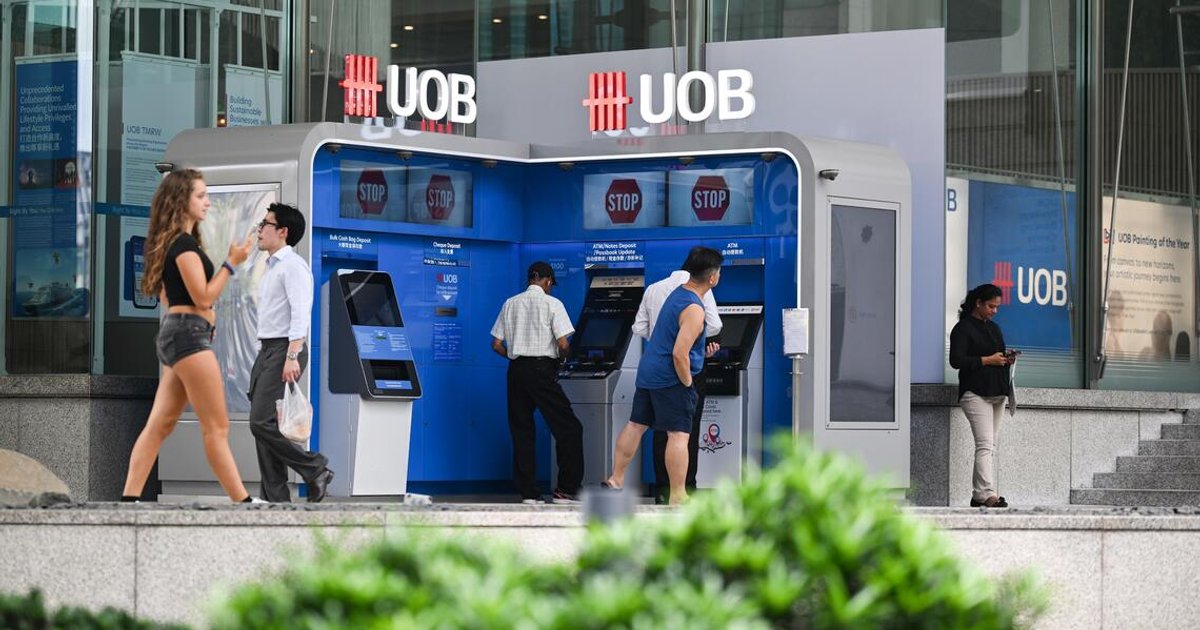
UOB is the first bank to report its third quarter earnings on Nov 4, after all three banks saw shares fall on Nov 2.
ST PHOTO: LIM YAOHUI
Published Nov 04, 2026, 08:06 AM
Updated Nov 04, 2026, 12:18 PM
UOB’s third-quarter net profit jumped 182% to $1.25 billion, helped by an 81% drop in credit loss provisions, but it still missed Bloomberg’s $1.38 billion estimate.
Shares fell over 5% after the results, as investors focused on the earnings miss, slower quarter-on-quarter profit, and pressure from higher deposit rates and Greater China asset quality issues.
UOB said it is pushing wealth, transaction banking and selective growth in digital infrastructure and energy, while aiming to double wealth income by 2030 and keep loan growth steady in 2027.
SINGAPORE - UOB’s third-quarter net profit jumped 182% to $1.25 billion from $443 million a year earlier, largely due to a sharp drop in provisions for potential loan losses.
But compared with the previous quarter, its net profit fell 15% from $1.48 billion. It also missed the $1.38 billion forecast among six analysts polled by Bloomberg.
Shares tumbled over 5% in response to the earnings performance, sliding down to $38.36, from its previous close of $40.46, during the early trading hours on Nov 4. They fell over 6% before the noon trading break.
The jump in UOB’s net profit was a result of several factors. For one thing, UOB set aside $258 million for credit and other losses in the three months ended Sept 30, a sharp reduction of 81% from $1.36 billion a year earlier.
Net interest income, which measures the difference between what a bank earns from lending and pays on deposits, rose 1% year on year to $2.28 billion.
Net fee income in the third quarter hit a record $733 million, a 19% increase from the same period a year ago. It also marked a 10% increase over the previous quarter.
This rise came on the back of strong growth in wealth, cards and loan-related activities, UOB noted. Customer-related treasury income also reached a new high, reflecting robust client engagement and demand for hedging solutions, it added.
Meanwhile, assets under management grew by 3% over the same quarter last year to reach $204 billion.
UOB chief executive officer and deputy chairman Wee Ee Cheong said: “The group continued to see healthy customer activity across our businesses this quarter, with strong growth in wealth management, healthy loan growth and record fees and customer-related treasury income.”
For the first nine months of 2026, wealth income rose 13 % from a year ago, while card income was up 25% year on year.
Wee said at a media briefing that the bank has also been reshaping its wholesale banking business, by investing in its transaction banking capabilities, strengthening the regional network and deepening sector coverage.
Wholesale banking loans grew 9% year on year, with trade loans recording a robust 31% growth.
Transaction banking also remained an important driver of the franchise’s performance, UOB said.
Total expenses fell to $1.6 billion, a 4% decrease over the previous quarter, in line with income moderation.
Wee said this financial performance reflects the strength of the bank’s diversified franchise and customer relationships, with over 8 million customers in the region.
“As connectivity across ASEAN strengthens, customers increasingly value banking partners that can support them across their business, personal and wealth needs,” he said.
Non-performing loan ratio also fell to 1.5%, although non-performing assets rose slightly, especially in Greater China.
Responding to media queries, group chief financial officer Leong Yung Chee said: “You do see recovery in Greater China asset quality issues, but they are recovering slower than what we have seen in the US portfolio.
“We intend to manage that very actively, and we will see that gradually decline in terms of non-performing loan numbers.”
When asked about the portfolio exposure to real estate and hospitality, Leong said that it has declined.
“We are growing in some of the other non-real estate sectors such as digital infrastructure, energy sectors. These are higher-growth areas. So some of our loan growth that you are seeing in these markets are from these areas,” he said.
When it comes to artificial intelligence-related financing, Leong said the amount currently constitutes less than 5% of the loan book. These short- and long-term loans are evaluated under the bank’s credit processes and borrower profile assessments .
“(AI) is one of the areas where it’s exhibiting the strongest growth across industries. But we also we’re not immune to, or ignorant about what’s happening across the AI-related financing space,” he said, referring to credit default swaps that have risen.
“We have to be very selective about which ones we do, but we cannot ignore that this is a very exciting and high-growth area right now.”
He also commented on the high interest rate environment.
“Deposit rates have all been creeping up lately, which is very good for consumers, but from a funding cost and net interest margin, it applies pressure and compression,” he said, although he noted that these will adjust when benchmark rates firm up, which takes one to two quarters before it shows up in financial results.
Wee said at the media briefing that the bank is sharpening its strategic focus, investing in capital-like businesses that broaden sources of revenue, and plans to strategically reinvest gains from recent divestments to accelerate growth.
He also said wealth is one of the bank’s key initiatives, and it is confident of achieving its ambition to double its wealth income by 2030.
“We have significant scope to deepen customer relationships across banking, investment, and wealth. Many of our customers have become more affluent with more sophisticated wealth,” he said.
He noted that UOB has increased its team of relationship managers, sharpened its focus on liability-led wealth acquisition, and added capabilities in North Asia, particularly Hong Kong.
“We are also strengthening our private banking service platform. We have established a dedicated strategic client coverage team and added three regional market heads to accelerate our transformation and strengthen regional coverage,” he said.
For 2027, UOB projected mid single-digit growth for loans, while estimating higher net interest income than in 2026, supported by balance sheet growth.
It also expects mid to high single-digit growth for the fee income segment.
When asked about raising the bank’s share price, Wee said his focus is not on a single ratio, but about growing the bank in the long term in a highly competitive market.
He added that UOB is disciplined in monetising non-core assets to boost the core business, and is building its people, platforms and products.
“These are all geared towards a long-term strategy. We are not selling for the sake of selling.”
For returns to rise in the long term, the bank also needs to invest, he said. The strategy is not to cut off technology investments, for instance, just to chase short-term returns.
“We have to hire people ... we have to invest. So it’s a process. It’s not just one single point in time.”
Local bank shares fall
UOB was the first bank to report third quarter earnings. All three local banks’ shares extended their losses on Nov 4.
DBS and OCBC shares both fell around 2% before the trading break at noon.
Earlier in the week, shares of all three banks fell as analysts projected that wealth management fees at Singapore banks could ease in the third quarter.
Analysts also said that investors are expected to scrutinise the banks’ exposure to AI -related financing. They are also looking out for the impact of rising bond yields on investment portfolios and capital positions.
Another issue that has come under the spotlight is the banks’ role in financing firms related to the haze that blanketed Singapore and the region in October.
On Oct 28, the Monetary Authority of Singapore (MAS) said that banks should review their financing relationships with customers who are linked to activities contributing to transboundary haze. This includes limiting their exposure or cutting ties with those found to have clearly breached environmental laws.
Sue-Ann Tan is a business correspondent at The Straits Times, covering capital markets and sustainable finance.
Banks and financial institutions
11 月 2 日,三家银行的股价均出现下跌,大华银行是第一家于 11 月 4 日公布第三季度业绩的银行。
ST 照片:林耀辉
发布于 2026 年 11 月 4 日上午 8:06
更新于2026年11月4日下午12:18
大华银行第三季度净利润增长182%至12.5亿美元,这得益于信贷损失拨备下降81%,但仍低于彭博社13.8亿美元的预期。
财报公布后,股价下跌超过 5%,投资者关注的焦点是盈利未达预期、季度利润增速放缓以及存款利率上升和大中华区资产质量问题带来的压力。
大华银行表示,公司正在大力发展财富管理、交易银行业务以及数字基础设施和能源领域的选择性增长,目标是到 2030 年将财富收入翻一番,并在 2027 年保持贷款增长稳定。
新加坡——大华银行第三季度净利润同比增长 182%,从去年同期的 4.43 亿美元增至 12.5 亿美元,这主要是由于潜在贷款损失准备金大幅下降。
但与上一季度相比,其净利润下降了15%,至14.8亿美元。彭博社调查的六位分析师此前预测的13.8亿美元也低于预期。
受盈利表现影响,股价在11月4日早盘交易中暴跌超过5%,从前一日收盘价40.46美元跌至38.36美元。午间交易休市前,股价下跌超过6%。
大华银行净利润大幅增长是多种因素共同作用的结果。首先,截至9月30日的三个月内,大华银行拨备了2.58亿新元用于信贷及其他损失,较上年同期的13.6亿新元大幅下降81%。
净利息收入(衡量银行贷款收入与存款利息支出之间的差额)同比增长 1%,达到 22.8 亿美元。
第三季度净手续费收入达到创纪录的7.33亿美元,比去年同期增长19%,比上一季度增长10%。
大华银行指出,财富管理、信用卡和贷款相关业务的强劲增长推动了这一增长。此外,客户相关的资金业务收入也创下新高,反映出客户参与度高以及对冲解决方案的需求旺盛。
与此同时,管理资产规模较去年同期增长3%,达到2040亿美元。
大华银行首席执行官兼副主席魏义昌表示:“本季度,集团各项业务的客户活跃度持续保持良好,财富管理业务强劲增长,贷款业务健康增长,手续费和客户相关资金收入均创历史新高。”
2026 年前九个月,财富收入比上年同期增长 13%,而信用卡收入同比增长 25%。
魏家祥在媒体简报会上表示,该银行也一直在重塑其批发银行业务,投资于其交易银行能力,加强区域网络,并深化行业覆盖。
批发银行贷款同比增长 9%,其中贸易贷款实现了强劲增长 31%。
大华银行表示,交易银行业务仍然是推动该特许经营业务业绩的重要因素。
总支出降至 16 亿美元,比上一季度下降 4%,与收入放缓相符。
Wee表示,这一财务业绩反映了该银行多元化业务和客户关系的实力,该银行在该地区拥有超过800万客户。
“随着东盟内部联系的日益紧密,客户越来越重视能够满足其业务、个人和财富需求的银行合作伙伴,”他表示。
不良贷款率也降至 1.5%,尽管不良资产略有上升,尤其是在大中华区。
针对媒体的询问,集团首席财务官梁永志表示:“大中华区的资产质量问题确实有所复苏,但复苏速度比我们在美国投资组合中看到的要慢。”
“我们将积极应对这一问题,并会看到不良贷款数量逐步下降。”
当被问及投资组合中房地产和酒店业的占比时,梁先生表示,这一比例已经下降。
“我们在其他一些非房地产领域也在增长,例如数字基础设施和能源领域。这些都是高增长领域。因此,您在这些市场看到的贷款增长部分就来自这些领域,”他说道。
梁先生表示,就人工智能相关融资而言,目前该类贷款金额占贷款总额的比例不到5%。这些短期和长期贷款均按照银行的信贷流程和借款人资质评估进行审批。
“人工智能是各行业中增长最强劲的领域之一。但我们也并非对人工智能相关融资领域正在发生的事情视而不见,或者置身事外,”他说道,指的是不断上涨的信用违约互换。
“我们必须非常谨慎地选择要做的事情,但我们不能忽视这目前是一个非常令人兴奋且高增长的领域。”
他还对高利率环境发表了评论。
“最近存款利率一直在缓慢上升,这对消费者来说当然是好事,但从融资成本和净息差来看,这会造成压力和压缩,”他说道,不过他也指出,当基准利率走强时,这些因素会进行调整,而基准利率的走强需要一到两个季度才能反映在财务业绩中。
魏家祥在媒体简报会上表示,该银行正在加强战略重点,投资于类似资本的业务,以拓宽收入来源,并计划将近期资产剥离所得收益进行战略性再投资,以加速增长。
他还表示,财富管理是该银行的关键举措之一,并有信心实现到 2030 年财富收入翻一番的目标。
“我们在银行、投资和财富管理领域拥有巨大的发展空间,可以进一步深化与客户的关系。我们的许多客户都变得更加富裕,拥有更加复杂的财富,”他说道。
他指出,大华银行增加了客户经理团队,更加专注于负债驱动型财富获取,并增强了在北亚,特别是香港的业务能力。
“我们也在加强私人银行服务平台。我们成立了专门的战略客户服务团队,并增设了三位区域市场负责人,以加速转型并加强区域覆盖,”他说道。
大华银行预计 2027 年贷款将实现中等个位数增长,同时预计净利息收入将高于 2026 年,这得益于资产负债表的增长。
该公司还预计手续费收入部分将实现中高个位数增长。
当被问及提高银行股价的问题时,魏家祥表示,他的关注点不是单一的比率,而是在竞争激烈的市场中实现银行的长期增长。
他还补充说,大华银行在将非核心资产变现以促进核心业务方面非常有纪律,并且正在建设其人才、平台和产品。
“这些都是为了实现长期战略目标。我们不是为了销售而销售。”
他表示,要想实现长期收益增长,银行也需要进行投资。例如,其策略并非为了追求短期回报而削减技术投资。
“我们需要招聘人员……我们需要投资。所以这是一个过程,而不是一蹴而就的事情。”
本地银行股下跌
大华银行是首家公布第三季度业绩的银行。11月4日,三家本地银行的股价均延续跌势。
星展银行和华侨银行的股价在中午休市前均下跌了约 2%。
本周早些时候,由于分析师预测新加坡银行业财富管理费用可能在第三季度有所下降,这三家银行的股价均出现下跌。
分析师还表示,投资者预计将仔细审查各银行在人工智能相关融资方面的风险敞口。他们也在关注债券收益率上升对投资组合和资本状况的影响。
另一个受到关注的问题是,银行在为与10月份笼罩新加坡和该地区的雾霾相关的公司提供融资方面扮演的角色。
10月28日,新加坡金融管理局(MAS)表示,各银行应审查与那些参与造成跨境雾霾活动的客户的融资关系。这包括限制其风险敞口,或切断与那些被认定明显违反环境法律的客户的联系。
Sue-Ann Tan 是《海峡时报》的商业记者,负责报道资本市场和可持续金融。
银行和金融机构