Fadli’s questions aim to cast Govt as soft on Israel, says Shanmugam; WP MP rejects characterisation尚穆根表示,法德利的提问意在将政府描绘成对以色列态度软弱;工人党议员驳斥了这种说法。
The minister said raising all international law issues at meetings with foreign counterparts would be an "absurd and novel" approach. Read more at straitstimes.com.
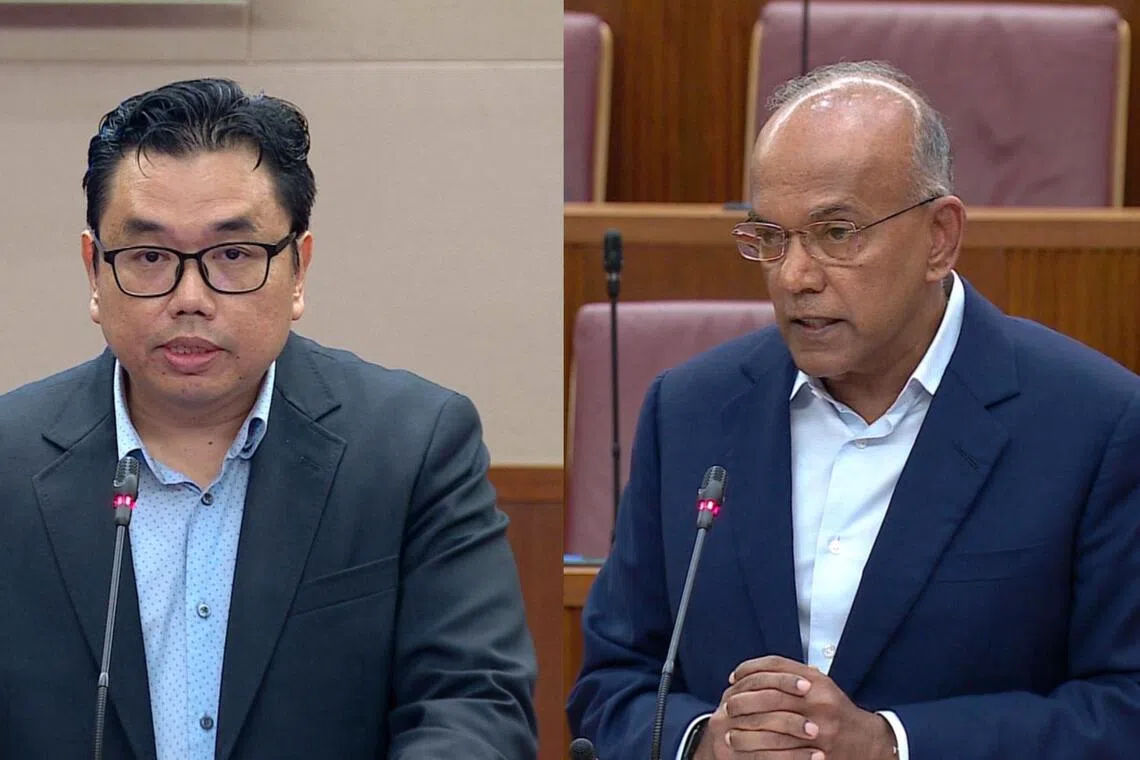
WP’s Fadli Fawzi (Aljunied GRC) and Senior Minister and Coordinating Minister for National Security K. Shanmugam clashed in Parliament on Nov 4, 2026.
Published Nov 04, 2026, 05:34 PM
Updated Nov 04, 2026, 05:34 PM
SINGAPORE – Fadli Fawzi’s questions on a meeting between Singapore and Israeli officials seek to present a picture to the Malay/Muslim community that the Government is unprincipled and soft on Israel, said Senior Minister K. Shanmugam.
The Workers’ Party MP made “absurd suggestions” on how the Government should engage with its foreign counterparts , Shanmugam said in the House on Nov 4.
“That’s what this question and this subsequent explanation is all about: getting people to view our international relationships through the prism of race and religion. That is just wrong,” he said.
Fadli, in response, rejected Shanmugam’s characterisation, and said his questions were not motivated by race and religion. “This is primarily an issue about how Singapore can uphold its commitments to international law consistently,” he added.
The pair were discussing questions that Fadli, who represents Aljunied GRC, had filed for Parliament’s October sitting about an Israeli delegation’s meeting with Ministry of Home Affairs (MHA) officials in Singapore.
Shanmugam took issue with Fadli’s intentions in asking the questions, and said Fadli was sending two messages to two different audiences: One to the general public to present that the WP is focused on national interests, and another to the Malay/Muslim community that the Government is soft on Israel.
Fadli had asked in October if Singapore had discussed with Israeli officials how to address illegal settlements and settler violence in the West Bank.
Singapore’s position, reiterated in August 2026, is that Israeli settlements in the West Bank are illegal under international law. It has also urged the Israeli government to halt settlement expansion plans.
Fadli had filed them following an article published on Sept 7 by Israeli daily Haaretz that said officials discussed the death penalty at the May meeting.
Shanmugam, who is also Coordinating Minister for National Security and Home Affairs Minister, said in a written reply to Fadli in October that this was false, and that the discussion focused on operational and security-related issues.
It did not extend to broader foreign policy matters, he added.
Shanmugam, in his response then, asked Fadli in return if he believed the MHA should use such engagements to raise broader concerns about the policies or conduct of foreign counterparts.
He also asked Fadli to clarify if this principle should apply only to Israel, or consistently to all countries that engage with MHA.
“If that is the Member’s position, the Government would be interested to understand how he proposes that such an approach would serve Singapore’s overall interests,” he said then.
Approach international law with ‘enlightened self interest’
Most of the back-and-forth focused on the WP MP’s position on Singapore’s bilateral relationships, and whether the opposition party’s stance was that the city-state should raise all issues at all meetings.
Responding to Shanmugam’s October questions in a personal explanation at the end of question time, Fadli said MHA should raise concerns about policies or conduct that relate to security and law enforcement “as and when relevant” when engaging foreign counterparts that may be implicated in such issues.
Settler activity and illegal territorial expansion in the West Bank, especially settler violence, are grave violations of international law and threats to international security, he said.
Singapore’s operational and technical cooperation in law enforcement and security matters must be conducted in the context of its overall national interests and fundamental principles, which includes its commitment to international law, he added.
“Given this context, I believe that it would have been relevant to clearly reiterate at this meeting Singapore’s principled position that Israeli settlements in the West Bank are illegal under international law, and our deep concerns about settler violence against Palestinian civilians in the West Bank.”
Fadli added that Singapore should address issues that are relevant to its concerns, commitment and interests, and these should be applied consistently to all countries with which MHA engages.
“It is also my belief that when engaging with foreign counterparts, Singapore should maintain a whole-of-government approach in upholding our commitment to international law and a rules-based international order,” he said.
Shanmugam, in response, said Fadli had not answered questions on whether his approach extended to all bilateral issues.
This suggestion – that every ministry must raise “all possible issues of international law” when meeting Israel or any other country, and all possible bilateral issues – “would certainly be novel”, Shanmugam said.
He raised the example of Singaporean diplomat Rena Lee’s election as a judge of the International Court of Justice in the early hours of Nov 4. Lee had secured the highest number of votes – 151 of 191 – in the UN General Assembly, and the joint-highest in the Security Council with 13 of 15 votes.
Shanmugam said the Government worked very hard to lobby other countries on her nomination.
“Imagine you start a meeting with UK, France, US, and your objective is to ask for their vote in support, and you start out by… referring to the wars in the Middle East, Syria and Yemen – together, millions displaced, hundreds of thousands of children and women killed.”
Shanmugam said: “You start out by listing this category of international law issues, and then you say, ‘By the way, can you please support us?’”
MPs and Singaporeans can see how “absurd and novel” such a position is, Shanmugam said.
Fadli said in response that it is not the WP’s position to raise every bilateral issue at every bilateral meeting.
He said he believes in raising concerns only when they are relevant, and in the meeting with Israeli officials, the illegal settlements were relevant.
Responding, Shanmugam asked how Fadli knew the issue of settler violence was relevant to the meeting, if he did not know the contents of the discussion.
Singapore’s approach to international law “has got to be enlightened self-interest,” he added.
“We are elected as MPs and ministers to safeguard Singaporeans’ interests primarily, not just principles of international law.
“Principles of international law (must be) seen through the prism of Singapore’s national interest, which is fundamental, and because we are a small country, it is important for us that international law be upheld,” he said.
This does not necessarily mean repeating it at every meeting, he added.
“These things are dealt with with common sense and skill, and if the member believes that (in) meetings with Israel, on the West Bank settler issue, every meeting should raise those issues – put down an adjournment motion, and we can debate it.”
2026年11月4日,工人党议员法德利·法兹(阿裕尼集选区)与高级部长兼国家安全统筹部长尚穆根在国会发生冲突。
发布于 2026 年 11 月 4 日下午 5:34
更新于2026年11月4日下午5:34
新加坡——高级部长尚穆根表示,法德利·法齐就新加坡与以色列官员会面提出的问题,意在向马来/穆斯林社群展现政府对以色列缺乏原则和软弱的形象。
尚穆根在11月4日的国会会议上表示,工人党议员就政府应如何与外国同行打交道提出了“荒谬的建议”。
“这个问题以及随后的解释,其目的就在于此:让人们透过种族和宗教的棱镜来看待我们的国际关系。这完全是错误的,”他说。
法德利回应称,他驳斥了尚穆根的说法,并表示他的提问并非出于种族或宗教动机。“这主要关乎新加坡如何才能始终如一地履行其对国际法的承诺,”他补充道。
两人正在讨论法德利(代表阿裕尼集选区)向国会提交的关于以色列代表团与新加坡内政部官员会面的问题,这些问题将在10月份的国会会议上提出。
尚穆根对法德利提出这些问题的动机表示不满,并称法德利向两个不同的受众传递了两个信息:一个是向公众表明工人党关注国家利益,另一个是向马来/穆斯林社区表明政府对以色列态度软弱。
法德利曾在10月份询问新加坡是否与以色列官员讨论过如何解决西岸的非法定居点和定居者暴力问题。
新加坡在2026年8月重申,以色列在西岸的定居点违反国际法,属于非法行为。新加坡还敦促以色列政府停止定居点扩张计划。
法德利提交这些文件之前,以色列《国土报》9月7日发表了一篇文章,称官员们在5月份的会议上讨论了死刑问题。
尚穆根同时也是国家安全统筹部长和内政部长,他在10月份给法德利的书面答复中表示,这是不实的,讨论的重点是行动和安全相关问题。
他补充说,这并不包括更广泛的外交政策问题。
当时,尚穆根反问法德利,他是否认为内政部应该利用此类交流来提出对外国同行政策或行为的更广泛关切。
他还要求法德利澄清这一原则是否只适用于以色列,还是应一视同仁地适用于所有与内政部有联系的国家。
“如果这是该议员的立场,政府很想了解他如何认为这种做法符合新加坡的整体利益,”他当时说道。
以“开明的利己主义”视角看待国际法
双方的大部分辩论都集中在工人党议员对新加坡双边关系的立场上,以及反对党的立场是否是新加坡应该在所有会议上提出所有问题。
在质询时间的最后,法德利以个人解释回应了尚穆根10月份提出的问题,他表示,内政部在与可能卷入此类问题的外国同行接触时,应“在相关情况下”提出有关安全和执法政策或行为的关切。
他表示,定居者在西岸的活动和非法领土扩张,特别是定居者的暴力行为,严重违反了国际法,并对国际安全构成威胁。
他补充说,新加坡在执法和安全事务方面的行动和技术合作必须在其整体国家利益和基本原则的框架内进行,其中包括其对国际法的承诺。
“鉴于此,我认为在本次会议上明确重申新加坡的原则立场是,以色列在西岸的定居点违反国际法,并且我们对定居者在西岸对巴勒斯坦平民的暴力行为深表关切,是十分必要的。”
法德利补充说,新加坡应该解决与其关切、承诺和利益相关的问题,并且这些原则应该始终如一地适用于内政部与其接触的所有国家。
“我也认为,新加坡在与外国同行交往时,应坚持全政府方针,维护我们对国际法和基于规则的国际秩序的承诺,”他说。
对此,尚穆根表示,法德利没有回答他的做法是否适用于所有双边问题。
尚穆根表示,这项建议——即每个部委在与以色列或任何其他国家会面时,都必须提出“所有可能的国际法问题”以及所有可能的双边问题——“肯定是新颖的”。
他举了新加坡外交官雷娜·李于11月4日凌晨当选为国际法院法官的例子。李在联合国大会上获得了191票中的151票,是该届选举中获得的最高票数;在安全理事会上,她也获得了15票中的13票,是该届选举中获得的最高票数之一。
尚穆根表示,政府为争取她的提名付出了巨大的努力,游说其他国家。
“想象一下,你与英国、法国、美国举行会议,你的目标是争取他们的投票支持,而你一开始就……提到中东、叙利亚和也门的战争——这些战争造成数百万人流离失所,数十万儿童和妇女丧生。”
尚穆根说:“你先列出这一类国际法问题,然后说,‘顺便问一下,你们能不能支持我们?’”
尚穆根表示,国会议员和新加坡民众都能看出这种立场是多么“荒谬和新奇”。
法德利回应说,工人党的立场并非在每次双边会议上提出每一个双边问题。
他说,他认为只有在问题相关时才应该提出关切,而在与以色列官员的会面中,非法定居点问题正是相关的。
对此,尚穆根问道,如果法德利不知道讨论的内容,他怎么知道定居者暴力问题与会议相关呢?
他补充说,新加坡对待国际法的态度“必须是开明的利己主义”。
“我们当选为国会议员和部长,主要是为了维护新加坡人的利益,而不仅仅是维护国际法原则。
他说:“国际法原则必须从新加坡的国家利益角度来看待,这是根本性的,而且因为我们是一个小国,维护国际法对我们来说非常重要。”
他补充说,这并不一定意味着每次会议都要重复这一点。
“这些事情需要用常识和技巧来处理。如果议员认为在与以色列就西岸定居者问题举行的会议上,每次会议都应该提出这些问题,那么就提出休会动议,我们可以进行辩论。”