54% of S’pore residents pursued a publicly funded university degree over their lifetime: 2025 data2025年数据显示,54%的新加坡居民在其一生中都曾获得公立大学学位。
54% of Singapore residents secured a publicly funded university degree place in 2025, with 44% fresh school leavers and 10% adult learners. Read more at straitstimes.com.
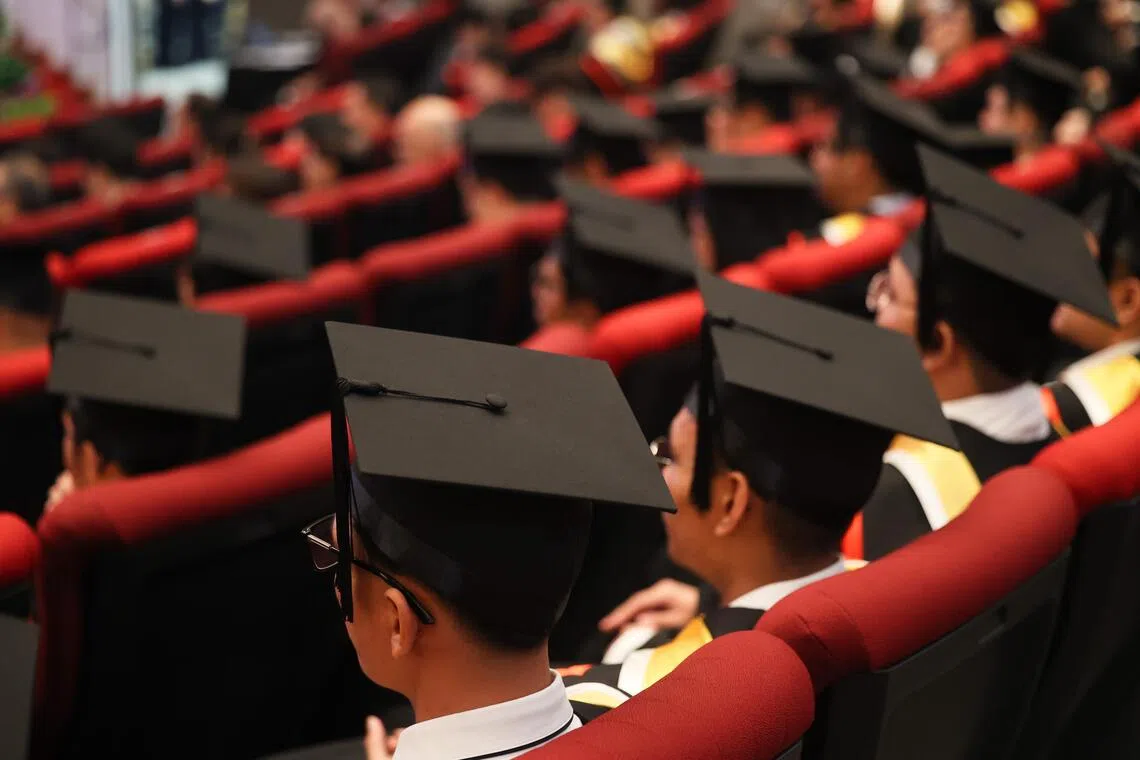
About 44% were fresh school leavers who entered full-time degree programmes. Around 10% were adult learners, who mostly enrolled in part-time undergraduate programmes.
PHOTO: LIANHE ZAOBAO
Published Nov 04, 2026, 03:55 PM
Updated Nov 04, 2026, 09:31 PM
The lifetime cohort participation rate for publicly funded university degrees is estimated at 54% in 2025. Capacity stands at 60%.
About 44% are fresh school leavers and 10% are adult learners. The 60% capacity includes 45% for school leavers and 15% for adult learners.
Education Minister Desmond Lee said adult learner routes help Singaporeans study later in life, while universities and employers must support flexible learning and skills upgrading.
SINGAPORE – About 54% of Singapore residents secured a place in a publicly funded university degree programme over their lifetimes, 2025 data shows.
Of these, about 44% were fresh school leavers who entered full-time degree programmes, while another 10% were adult learners, who mostly enrolled in part-time undergraduate programmes.
Education Minister Desmond Lee gave these figures for the academic year 2025 in a written parliamentary reply on Nov 3, in response to Denise Phua (Jalan Besar GRC) who had asked how the latest participation rate compared with the earlier announced 60% allowance.
She had also asked how the Ministry of Education (MOE) was ensuring continued university access for both fresh school leavers and adult learners.
The lifetime cohort participation rate of 54% measures the share of a cohort who get a place in a publicly funded degree programme over their lifetime, including those who pursue a degree later in life.
Lee said the participation rate for fresh school leavers is expected to be revised upwards as more of the cohort progress to university in the coming years, including men currently serving national service.
MOE had announced in 2023 that this figure would go up from 50% to 60% by 2025 . This meant up to 2,300 more publicly funded university places in 2025.
The capacity of 60% comprises 45% for fresh school leavers and 15% for adult learners.
“The 60% lifetime cohort participation rate is the planned capacity of publicly funded degree places. It is not an intake target,” Lee said in his Nov 3 reply.
Adopting a “lifetime” rate marks a shift from the prevailing practice of “front-loading” education and using the traditional cohort participation rate that refers to the proportion of students in a yearly cohort that progresses to university.
Announcing the increased capacity in 2023, then Education Minister Chan Chun Sing had said the rise in places would be weighted towards enabling adult learners from the workforce to access a university upgrading pathway. Chan said more subsidised places would support upgrading later in life, reducing the need to ‘front-load’ education.
MOE later told The Straits Times it would provide an update on the participation rate by late 2026, as some of the academic year 2025 intake would take place only in early 2026.
Lee said the separate provision for adult learners allows Singaporeans to enter the workforce first and pursue a degree later to support their career plans and aspirations. It also recognises that earlier cohorts had fewer opportunities to attend university when they were younger.
Adult learners can face challenges when returning to education, he added. A survey of students who withdrew from their courses found that work commitments were the top reason.
MOE has been working with the autonomous universities to make their programmes more accessible to working adults, said Lee. These include part-time work-study degree programmes and micro-credentials that can be stacked up to a degree.
Employers also have a role in helping employees make time for training and supporting continual skills upgrading, Lee said.
“Ultimately, a degree is one of many ways to continue learning.”
Correction note: This story has been edited for clarity over how the lifetime cohort participation rate is calculated.
Shermaine Ang is a journalist at The Straits Times, covering social issues in Singapore.
Singapore Parliament
Universities - Singapore
Ministry of Education
约44%是应届毕业生,他们进入了全日制学位课程。约10%是成年学习者,他们大多就读于非全日制本科课程。
图片来源:联合早报
发布于 2026 年 11 月 4 日下午 3:55
更新于2026年11月4日晚上9:31
预计到 2025 年,公立大学学位终身参与率将达到 54%。招生能力为 60%。
其中约44%为应届毕业生,10%为成人学习者。60%的招生容量中,45%用于应届毕业生,15%用于成人学习者。
教育部长李智陞表示,成人学习途径可以帮助新加坡人在人生后期继续深造,同时大学和雇主必须支持灵活的学习方式和技能提升。
新加坡——2025年的数据显示,约有54%的新加坡居民在其一生中获得过公立大学学位课程的入学资格。
其中约 44% 是应届毕业生,他们进入了全日制学位课程;另有 10% 是成年学习者,他们大多参加了非全日制本科课程。
教育部长李智陞在11月3日以书面答复国会时给出了2025学年的这些数据,以回应惹兰勿刹集选区议员潘丽诗的提问。潘丽诗询问最新的入学参与率与之前宣布的60%的入学津贴相比如何。
她还询问教育部如何确保应届毕业生和成年学习者能够继续接受大学教育。
54% 的终身队列参与率衡量的是一个队列在其一生中获得公立资助学位课程名额的比例,包括那些在人生后期攻读学位的人。
李表示,随着未来几年更多应届毕业生升入大学,包括目前正在服兵役的男性,预计应届毕业生的大学入学率将会上调。
教育部在2023年宣布,到2025年,这一比例将从50%提高到60%。这意味着到2025年,公立大学将增加多达2300个学位名额。
60%的招生名额中,45%面向应届毕业生,15%面向成年学习者。
李在11月3日的答复中表示:“60%的终身入学率是公立学位课程的计划容量,而不是招生目标。”
采用“终身”比率标志着教育的“前期投入”做法发生了转变,不再使用传统的同届学生参与率,后者指的是每年同届学生中升入大学的学生比例。
时任教育部长陈振声在宣布2023年扩招计划时表示,新增名额将主要用于帮助在职成年学习者获得大学进修机会。陈振声指出,更多资助名额将支持人们在人生后期提升学历,从而减少“前期教育”的需求。
教育部后来告诉《海峡时报》,将在 2026 年底前提供参与率的最新信息,因为 2025 学年的部分入学要到 2026 年初才会进行。
李显龙表示,为成人学习者设立的单独课程可以让新加坡人先进入职场,之后再攻读学位,以支持他们的职业规划和抱负。此举也考虑到早期群体在年轻时接受高等教育的机会较少。
他还补充说,成年学习者重返校园可能会面临挑战。一项针对退学学生的调查发现,工作繁忙是他们退学的主要原因。
李表示,教育部一直与各自治大学合作,使在职人士更容易获得相关课程。这些课程包括兼职工作学习学位课程和可累积成学位的微证书课程。
李表示,雇主也有责任帮助员工抽出时间进行培训,并支持员工不断提升技能。
“归根结底,学位只是继续学习的众多途径之一。”
更正说明:本文已进行编辑,以更清晰地说明终身队列参与率的计算方法。
Shermaine Ang是《海峡时报》的记者,负责报道新加坡的社会问题。
新加坡国会
新加坡大学
教育部