Postal service here to stay, but has to continually reinvent itself: SingPost CEO新加坡邮政首席执行官表示,邮政服务将继续存在,但必须不断自我革新。
SingPost CEO says postal service must reinvent itself as mail volumes fall and the company pivots to parcels, digital stamps and rental income. Read more at straitstimes.com.
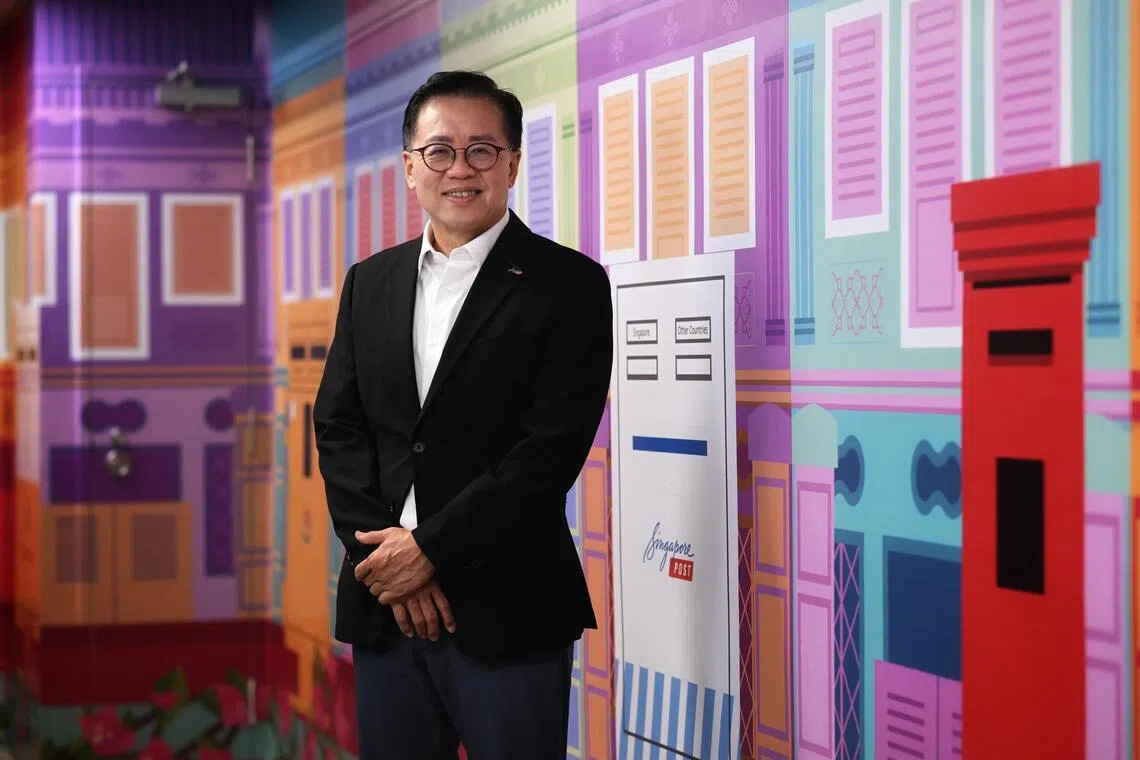
Digitalisation and the shrinking of post office spaces may displace staff, but SingPost has no plans for retrenchment, says CEO Mark Chong.
ST PHOTO: CHONG JUN LIANG
Published Nov 05, 2026, 07:00 AM
Updated Nov 05, 2026, 11:53 AM
SingPost says postal services will stay, but the company must keep changing as letter volumes fall and e-commerce parcel work becomes more important.
The company will keep SingPost Centre and use post offices for rental income, while cutting space, using kiosks, and redeploying staff instead of retrenching.
SingPost is also upgrading postboxes and digital stamps, and plans to focus on higher-value parcel deliveries as costs, competition, and tariff risks rise.
SINGAPORE – Letter volumes are shrinking as digital communication takes over, but the postal service remains necessary in Singapore – though it must reinvent itself, said Singapore Post chief executive Mark Chong.
“The rise of e-commerce actually gave postal agencies hope that they could play a role in the servicing of parcels, and that’s what SingPost had done,” noted Chong, who took over the role about a year ago.
“But of course, the decline of postal volumes also means that it impacts things like our network of post offices,” he told The Straits Times, in his first full interview since his appointment. He added that mail volumes declined some 40% from the Covid-19 pandemic period to 2024.
He believes the post offices and the main building, the SingPost Centre in Paya Lebar, can continue to be leveraged for revenue.
The sale of SingPost Centre was hotly tipped in recent years to unlock value for the company, but in May 2026, Chong firmly said that the building is not for sale.
Chong explained that he discussed the issue with the new SingPost board and scanned the surrounding environment.
One consideration was Paya Lebar Air Base’s eventual relocation from 2030 to make way for more homes in a mixed-use district.
Chong said: “There’s going to be upside. If we were to sell the building, how do you know what upsides you leave on the table?”
Upcoming developments in Paya Lebar could also increase the building’s value. “So it’s impossible to affix a value to the SingPost Centre at this moment, and we like the revenue streams that it gives us. Therefore, we decided to keep it,” he said.
Most of the building is now leased to other tenants, with SingPost occupying two floors for mail processing and office use, and the General Post Office taking a space on the ground floor.
Parcels are sorted in Tampines, at the Regional eCommerce Logistics Hub. The $30 million automated sortation facility was unveiled in June, with technology that has sped up the processing and sorting of parcels, while reducing costs, Chong said.
This approach to generating rental income while keeping its physical footprint also applies to SingPost’s network of post offices.
Generating income from post offices
At its peak, SingPost had around 60 post offices. Now, it has around 40 manned and unmanned touchpoints, SingPost said.
In May, SingPost said that it was working with the Government to come up with an operating model that is profitable and sustainable, especially for the post office network, and ruled out nationalisation.
Chong said the approach is to reduce the footprint of service counters and free up space that can be leased out to generate rental income.
In some cases where the post office is unmanned, SingPost services are provided through self-service kiosks, so the rest of the space can be completely leased out.
One early example of this was the Killiney Post Office, which first leased out its second level t o KPO Cafe & Bar in 2010.
Digitalisation and the shrinking of post office spaces may displace staff, but SingPost has no plans to retrench employees and has taken a “conscious decision” to redeploy them to post offices with high traffic or to train others, Chong said.
But most post offices are still manned by staff. He noted that post offices in places like Raffles Place, Ion Orchard and Woodlands see very high traffic, so more workers are deployed there.
The post offices can also deliver services for other government agencies and organisations, Chong said.
He referred to the sale of Singtel’s Special Discounted Shares, where shareholders could speak to staff at post offices to get help in selling their shares. This was especially helpful for older shareholders, who found it challenging to navigate the task online.
Singtel said more than 117,000 walk-in inquiries and transactions were processed at 36 SingPost branches by Aug 31.
Transforming postboxes for parcel deliveries
While Chong believes that the postal service, which has been around for the past 168 years, will not become obsolete as long as people need physical deliveries, things need to change.
To make itself more relevant, SingPost is transforming its postboxes, including some 750 street-side letter boxes.
Instead of separate slots for local and overseas letters, the postboxes will have a slot for all letters and a second, larger slot for parcels. This is meant to make it more convenient for people who want to return goods, for instance.
In October, SingPost also became the first in Asia to introduce digital stamps. Users get a unique code when they buy a digital stamp on the SingPost app, which they write at the top-right corner of a letter or postcard, allowing them to send mail without physical stamps or postage labels.
Combined with SingPost@MyBlock – an islandwide mail and small parcel pick-up service from designated HDB and condo letterboxes, the digital stamps “close the loop of convenience”, as Chong puts it.
This also reduces the need for users to go to the post office, which means post offices can be downsized and the space used for something else.
“It’s a virtuous loop,” Chong added.
“This demonstrates where SingPost is heading. We are led by convenience for the consumer and the public. Secondly, we have to go digital – for convenience, for relevance, and also because it reduces our cost to serve.”
Separately, SingPost told ST: “SingPost is currently in discussion with the Infocomm Media Development Authority to explore relaxing the regulatory requirements in order to have more flexibility to manage the costs of operating the regulated business. We will share more when these are finalised.”
In the parcel delivery space, competition is intense, and some large e-commerce players are even able to offer shoppers free delivery through their own logistics arms.
Chong said: “We need to be able to compete. We need to have the right economics ... We need the necessary volumes, but we will not chase volumes at the expense of profit.”
He added: “I just don’t think that the price can get lower and lower because the cost of delivering has not gone down.”
In fact, delivery costs have risen because of supply chain disruptions due to the conflict in the Middle East, and SingPost also faces the challenge of navigating tariff uncertainty.
SingPost’s strategy is to pivot towards delivering higher-value goods, such as medical devices and healthcare products.
“(Such services) will be for customers who appreciate quality, reliability, trust, and that’s why we are investing in all the digital technology to give customers the parcel tracking information they want,” he said.
Chong also expects the postal service to exist for years to come.
“Digitalisation can do lots of things, but the delivery of physical goods is still necessary. The Government still sends you certain bills and big corporate institutions are still governed by hard-copy letters, reminders and contracts. So there is still a service to be rendered,” he said.
Sue-Ann Tan is a business correspondent at The Straits Times, covering capital markets and sustainable finance.
Postal and delivery services
新加坡邮政首席执行官马克·张表示,数字化和邮局空间的缩小可能会导致员工失业,但新加坡邮政没有裁员计划。
《海峡时报》照片:梁崇俊
发布于2026年11月5日上午7:00
更新于2026年11月5日上午11:53
新加坡邮政表示,邮政服务将继续存在,但随着信件数量的下降和电子商务包裹业务变得越来越重要,公司必须不断做出改变。
该公司将保留新加坡邮政中心,并利用邮局收取租金收入,同时削减办公空间,使用自助服务亭,并重新部署员工,而不是裁员。
随着成本、竞争和关税风险的上升,新加坡邮政也在升级邮筒和电子邮票,并计划专注于更高价值的包裹递送。
新加坡——随着数字通信的普及,信件数量正在减少,但邮政服务在新加坡仍然是必要的——尽管它必须进行自我革新,新加坡邮政首席执行官马克·张表示。
“电子商务的兴起实际上让邮政机构看到了希望,他们可以在包裹服务中发挥作用,而新加坡邮政正是这样做的,”大约一年前接任该职位的钟先生指出。
“当然,邮件量的下降也意味着它会对我们的邮局网络等设施产生影响,”他在上任后的首次全面采访中告诉《海峡时报》。他还补充说,从新冠疫情期间到2024年,邮件量下降了约40%。
他认为邮局和位于巴耶利峇的新加坡邮政中心主楼可以继续用于创收。
近年来,出售新加坡邮政中心被广泛认为可以释放公司的价值,但2026年5月,庄先生明确表示该大楼不出售。
Chong解释说,他与新加坡邮政新董事会讨论了这个问题,并考察了周围环境。
其中一个考虑因素是巴耶利峇空军基地最终将于 2030 年搬迁,以便在混合用途区建造更多住宅。
钟先生说:“肯定会有上涨空间。如果我们卖掉这栋楼,你怎么知道会损失哪些潜在收益呢?”
巴耶利峇地区即将开展的开发项目也可能提升该建筑的价值。“因此,目前无法给新加坡邮政中心估价,而且我们很看好它带来的收益。所以,我们决定保留它。”他说道。
该建筑的大部分现在都已出租给其他租户,其中新加坡邮政占用两层楼用于邮件处理和办公用途,而邮政总局则占用一楼的一个空间。
包裹在淡滨尼的区域电子商务物流中心进行分拣。张先生表示,这座耗资3000万美元的自动化分拣设施于6月启用,其采用的技术提高了包裹的处理和分拣速度,同时降低了成本。
这种在保持实体存在的同时创造租金收入的方法也适用于新加坡邮政的邮局网络。
通过邮局创收
新加坡邮政表示,鼎盛时期,其邮局数量约为60家。如今,它拥有约40个有人值守和无人值守的服务点。
5 月,新加坡邮政表示,正在与政府合作,制定一个盈利且可持续的运营模式,特别是针对邮局网络,并排除了国有化的可能性。
Chong表示,此举旨在减少服务柜台的占地面积,腾出空间出租以产生租金收入。
在一些邮局无人值守的情况下,新加坡邮政会通过自助服务亭提供服务,以便将剩余空间完全出租出去。
早期的一个例子是基利尼邮局,它于 2010 年首次将其二楼出租给了 KPO 咖啡酒吧。
钟先生表示,数字化和邮局空间的缩小可能会导致员工失业,但新加坡邮政没有裁员计划,并已“有意识地决定”将他们重新部署到客流量大的邮局或培训其他人。
但大多数邮局仍然有工作人员值守。他指出,像莱佛士坊、ION Orchard 和兀兰等地的邮局客流量非常大,因此会增派人手。
钟先生表示,邮局还可以为其他政府机构和组织提供服务。
他提到了新加坡电信的特价股票出售计划,股东可以前往邮局与工作人员洽谈,获得出售股票的帮助。这对年纪较大的股东尤其方便,因为他们觉得在线操作比较困难。
新加坡电信表示,截至 8 月 31 日,新加坡邮政 36 家分行共处理了超过 117,000 笔到店咨询和交易。
改造邮筒以用于包裹递送
尽管钟认为,拥有 168 年历史的邮政服务只要人们还需要实物递送,就不会过时,但情况需要改变。
为了提升自身竞争力,新加坡邮政正在对其邮筒进行改造,其中包括约750个街边信箱。
邮筒不再区分本地信件和国际信件,而是设置一个所有信件的投递口和一个更大的包裹投递口。这样做是为了方便人们退货等。
10月,新加坡邮政成为亚洲首家推出电子邮票的邮政公司。用户在新加坡邮政应用程序上购买电子邮票后,会获得一个唯一的代码,只需将该代码写在信件或明信片的右上角,即可无需实体邮票或邮资标签寄送邮件。
结合 SingPost@MyBlock(一项覆盖全岛的邮件和小包裹领取服务,可从指定的组屋和公寓信箱领取),数字邮票“完善了便利的闭环”,正如 Chong 所说。
这也减少了用户前往邮局的需求,这意味着邮局可以缩小规模,腾出的空间可以用于其他用途。
“这是一个良性循环,”钟补充道。
“这表明了新加坡邮政的发展方向。我们始终以消费者和公众的便利为首要目标。其次,我们必须走向数字化——为了便利,为了与时俱进,也因为数字化能够降低我们的服务成本。”
此外,新加坡邮政告诉《海峡时报》:“新加坡邮政目前正与资讯通信媒体发展局商讨放宽监管要求,以便更灵活地管理受监管业务的运营成本。待最终结果确定后,我们将分享更多信息。”
在包裹递送领域,竞争非常激烈,一些大型电子商务企业甚至能够通过自己的物流部门为购物者提供免费送货服务。
钟先生说:“我们需要具备竞争力。我们需要合理的经济效益……我们需要达到必要的销量,但我们不会为了追求销量而牺牲利润。”
他补充道:“我认为价格不可能再降了,因为运输成本并没有下降。”
事实上,由于中东冲突导致供应链中断,配送成本有所上升,新加坡邮政还面临着应对关税不确定性的挑战。
新加坡邮政的战略是转向递送更高价值的商品,例如医疗器械和保健产品。
“(此类服务)将面向重视质量、可靠性和信任的客户,因此我们正在投资所有数字技术,以便为客户提供他们想要的包裹跟踪信息,”他说。
钟先生也预计邮政服务将在未来很多年里继续存在。
“数字化可以做很多事情,但实物交付仍然是必要的。政府仍然会寄送某些账单,大型企业机构仍然依赖纸质信函、提醒函和合同。所以,仍然有服务需要提供,”他说道。
Sue-Ann Tan 是《海峡时报》的商业记者,负责报道资本市场和可持续金融。
邮政和递送服务