SIA's ability to serve Singaporeans not affected by Air India investment: Jeffrey Siow to WP's Kenneth Tiong萧杰伟就新加坡航空服务不受印度航空投资影响的新加坡人的能力向工人党记者张建宗表示
The Workers' Party MP asked if the government would rule out direct support through Temasek if "Air India goes wrong", but Mr Siow said Air India’s losses do not automatically become SIA’s liabilities.
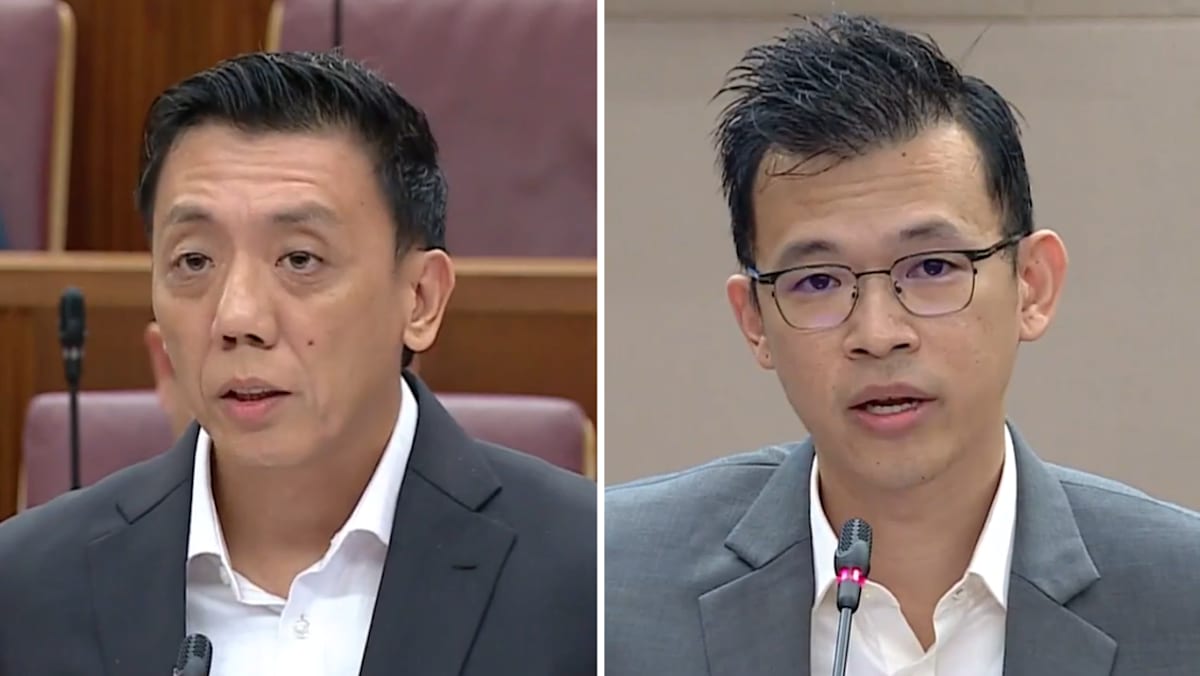
The Workers' Party MP asked if the government would rule out direct support through Temasek if "Air India goes wrong", but Mr Siow said Air India’s losses do not automatically become SIA’s liabilities.
Minister for Transport Jeffrey Siow (left) and Workers' Party MP Kenneth Tiong in parliament on Sep 8, 2026.
This audio is generated by an AI tool.
SINGAPORE: Singapore Airlines’ (SIA) ability to serve Singaporeans is not affected by the company’s investment in Air India , Transport Minister Jeffrey Siow told parliament on Tuesday (Sep 8).
Mr Siow was responding to MP Kenneth Tiong (WP-Aljunied), who asked whether losses from SIA’s foreign associates have been assessed against its capacity to provide essential transport services, given that the airline is a designated operating entity under the Civil Aviation Authority of Singapore Act.
Mr Tiong also asked whether such losses, or a continuing pattern of them, would trigger the Act's requirement to notify the Civil Aviation Authority of Singapore (CAAS) of any event that could materially impede its ability to provide an essential transport service.
Mr Siow said SIA is required to report any events or irregularities that may materially impede or impair such services, but losses in a foreign associate do not necessarily meet that test on their own.
CNA Games Guess Word Crack the word, one row at a time Buzzword Create words using the given letters Mini Sudoku Tiny puzzle, mighty brain teaser Mini Crossword Small grid, big challenge Word Search Spot as many words as you can Show More Show Less “The relevant question is whether such losses or anything else reach the point of materially constraining the resources available for SIA's fleet maintenance or network operations here," he said. “That is a judgment based on facts. We are nowhere close to this scenario. At present, there is no reason for us to doubt SIA's ability to deliver air services in Singapore.” Mr Siow noted SIA’s core business had one of its strongest years, with record revenue, high operating profit margins and a record number of passengers carried. SIA has been open about the Air India investment, he said, discussing it with shareholders at its annual general meeting in July and setting out its considerations in a letter to the Business Times on Aug 29. “Through Air India, SIA gains deeper access to one of the largest aviation markets in the world by passenger traffic and a strategic location or onward connections to Europe and the Middle East,” said Mr Siow. “Many overseas investment returns will not necessarily emerge immediately. Whether a specific investment in Air India proves valuable is for SIA and its shareholders to answer.” SIA owns 25.1 per cent of Air India. Scrutiny over the investment has grown since a Reuters report last month cited sources as saying that Air India is seeking a further US$1.5 billion in support from owners Tata Sons and SIA, just months after it posted a record annual loss.
“The relevant question is whether such losses or anything else reach the point of materially constraining the resources available for SIA's fleet maintenance or network operations here," he said.
“That is a judgment based on facts. We are nowhere close to this scenario. At present, there is no reason for us to doubt SIA's ability to deliver air services in Singapore.”
Mr Siow noted SIA’s core business had one of its strongest years, with record revenue, high operating profit margins and a record number of passengers carried.
SIA has been open about the Air India investment, he said, discussing it with shareholders at its annual general meeting in July and setting out its considerations in a letter to the Business Times on Aug 29.
“Through Air India, SIA gains deeper access to one of the largest aviation markets in the world by passenger traffic and a strategic location or onward connections to Europe and the Middle East,” said Mr Siow.
“Many overseas investment returns will not necessarily emerge immediately. Whether a specific investment in Air India proves valuable is for SIA and its shareholders to answer.”
SIA owns 25.1 per cent of Air India. Scrutiny over the investment has grown since a Reuters report last month cited sources as saying that Air India is seeking a further US$1.5 billion in support from owners Tata Sons and SIA, just months after it posted a record annual loss.
At present, there is no reason to doubt Singapore Airlines’ (SIA) ability to deliver air services in Singapore, said Transport Minister Jeffrey Siow. As for its investment in Air India, SIA has been open about it, he said in reply to MP Kenneth Tiong’s question in parliament on Tuesday (Sep 8). Addressing Mr Tiong’s suggestion that Singaporeans are somehow paying for the Air India investment, he said SIA is a listed company that funds its investments from its own balance sheet and earnings. He stressed that the Civil Aviation Authority of Singapore’s assessment remains that SIA’s ability to serve Singaporeans is not adversely affected. Mr Siow also noted that Mr Tiong had stated online that he strongly rejects the racist and xenophobic comments that have arisen in the public discussion on Air India. But he pointed out that his public rhetoric goes beyond the question that he put before the House - he has posed a narrowly framed technical query on SIA’s capacity to provide essential transport services and insinuated that through SIA's investments, Singaporeans somehow "owe Air India a living". This does not contribute to a healthy climate for companies to make commercial decisions which serve the best interests of Singapore and Singaporeans, said Mr Siow.
Mr Siow said Mr Tiong had “drawn an imaginary link” between SIA's overseas investment and its ability to maintain air services in Singapore.
He pointed to Mr Tiong’s Facebook posts in which the MP asked what would happen "if this deal goes bad", whether Temasek would be "their backstop" and what it would mean for Singaporeans' taxes and quality of life.
In his Facebook post, Mr Tiong also said it was "unfortunate" that questions about the Air India deal have become entangled with racist comments, which he condemned.
Mr Siow said he was glad Mr Tiong agreed that no one should "seek to exploit racial divisions for political purposes", but said his public rhetoric "goes beyond the question that he puts before this house".
“He has drawn these multiple tenuous linkages, dressed them up in emotive terms, insinuated that through SIA's investments, Singaporeans somehow owe Air India a living, and suggested that SIA is not making its investment decisions on a commercial basis, but for some other reason. There is no basis for this.”
In a supplementary question, Mr Tiong noted SIA is in net debt and posted a net loss for the quarter as of Jun 30. Airline turnarounds that have worked show results within three years, he said, while Air India had planned for five and its losses doubled last year.
The Indian aviation hub is also seeing more competition, he said, and SIA does not control Air India, meaning future injections could hinge on Air India’s own requirements.
“I support SIA's ability to make its own decisions, but I do not support further cash infusions from Temasek to stand behind a decision that, on these facts, reasonable members of the public are questioning,” he said.
Mr Tiong asked whether the government would rule out direct support through Temasek if “Air India goes wrong”, and whether there is a limit or return threshold on further cash to Air India given its status under the Critical Firms Act.
“This cannot be a blank cheque, least of all on a minority stake. We ask because through the reserves, Singaporeans are SIA's stakeholder of last resort, and the stakeholder of last resort needs to know where the line is,” said Mr Tiong.
Mr Siow replied that Air India’s finances are not SIA’s finances, and its losses do not automatically become SIA’s liabilities.
SIA’s debt sits in non-current, long-term borrowing such as five- or 10-year bonds with generally low interest rates, he said, and current liabilities remain “well within” SIA’s cash reserves of over S$10 billion.
“It's easy to criticise, but I suspect it is much harder for the member to tell us what SIA should do, and so I would suggest that the best course of action is to leave the board and the management of SIA to make the decisions because it is their duty and their responsibility to do so,” said Mr Siow.
On the impact to Temasek and Singapore's reserves, Mr Siow said the government does not judge Temasek on any single holding, and a portfolio of its size, over S$500 billion, will always contain investments with different risks and time horizons.
In more than 50 years of operation, he added, SIA has only requested funding from Temasek during the COVID-19 pandemic, when the government provided significant support for the whole aviation sector, not just SIA.
Mr Tiong reiterated the need to understand the risk limits. He also “categorically” rejected racism and xenophobia, questioning why they are brought into a “purely commercial matter”.
India remains a “very, very complicated” market, he said, citing conglomerates Adani and GMR’s potential to set up their airlines and noting that low-cost carrier IndiGo controls 67 per cent of the domestic market.
“I note that in other aviation businesses, such as SATS, for instance, these businesses do actually have some degree of operational control, whereas with Air India and SIA, it's a completely different story. It's a minority stake; we don't have operational control. So therefore we need to evaluate this investment very, very carefully.”
Mr Siow said Mr Tiong is entitled to question whether SIA’s investment would succeed, but has “gone much further” by “leaping without evidence”.
“Members may ask difficult questions, but the claims we make must be grounded in facts, not exaggerated speculation that creates needless public alarm. Singaporeans deserve public debate that examines risks honestly, explains them responsibly, and remains anchored on truth and logic,” he said.
SINGAPORE AIRLINES RESPONDS
SIA said in a statement on Tuesday that Air India’s transformation is a “complex, multi-year programme and is not expected to be linear”.
The airline set up Vistara as a joint venture with Tata Sons in 2013. Following Vistara’s consolidation into Air India in November 2024, SIA holds a 25.1 per cent stake in the enlarged Air India Group.
An SIA spokesperson cited several challenges facing Air India, including the prolonged closure of Pakistani airspace to Indian carriers, the impact of last year's Air India crash, the depreciation of the Indian rupee against the US dollar, supply chain disruptions, the loss of a key market due to the Middle East conflict and sustained high fuel prices.
“At the same time, Air India has made tangible progress across customer experience and operational performance,” said the spokesperson.
SIA noted that Air India's net promoter score, which reflects how likely customers are to recommend a brand, has increased by more than 70 points since November 2022. In May, the carrier received a four-star airline rating from review site Skytrax, while Air India Express was certified as a four-star low-cost airline, “on par with leading international carriers”.
“SIA and Tata Sons have both publicly acknowledged that there is still much work to be done,” said the spokesperson. “Both remain committed to supporting Air India’s long-term transformation programme.”
As at Jun 30, 2026, SIA had S$10.48 billion in cash reserves, comprising S$9.10 billion in cash and bank balances and S$1.38 billion in fixed deposits. SIA also has access to S$3.24 billion in committed, undrawn lines of credit.
“Any requests for additional capital will be evaluated under the group’s disciplined capital allocation framework, taking into account Air India’s business strategy, the SIA Group’s operating cash flow, and our investment requirements for new aircraft and products,” the spokesperson said.
Our chief editor shares analysis and picks of the week's biggest news every Saturday.
Get our pick of top stories and thought-provoking articles in your inbox
Stay updated with notifications for breaking news and our best stories
Join our channel for the top reads for the day on your preferred chat app
工人党议员询问政府是否会在“印度航空出现问题”时排除通过淡马锡直接提供支持的可能性,但萧先生表示,印度航空的亏损并不会自动成为新加坡航空的债务。
2026年9月8日,交通部长萧正树(左)和工人党议员张建宗在国会。
这段音频由人工智能工具生成。
新加坡:新加坡交通部长萧敬腾周二(9月8日)在国会表示,新加坡航空公司(新航)对印度航空的投资不会影响该公司为新加坡人提供服务的能力。
萧先生是在回应议员张建宗(工人党-阿裕尼)的提问,张建宗询问,鉴于新加坡民航局是新加坡民航局法案下的指定运营实体,新加坡航空的外国关联公司造成的损失是否已根据其提供基本运输服务的能力进行评估。
张先生还询问,此类损失或持续的损失模式是否会触发该法案的要求,即通知新加坡民航局(CAAS)任何可能严重阻碍其提供必要运输服务的事件。
萧先生表示,新加坡航空公司有义务报告任何可能严重阻碍或损害此类服务的事件或违规行为,但外国关联公司的损失本身并不一定符合这一标准。
CNA游戏 猜词游戏 逐行破解单词 流行词游戏 用给定的字母组成单词 迷你数独 小谜题,大挑战 迷你填字游戏 小方格,大挑战 单词搜索 尽可能多地找出单词 显示更多 显示更少 “相关的问题是,此类损失或其他任何情况是否会严重限制新航在新加坡的机队维护或网络运营所需的资源,”他说道。“这需要根据事实来判断。我们距离这种情况还很远。目前,我们没有理由怀疑新航在新加坡提供航空服务的能力。” 萧先生指出,新航的核心业务经历了有史以来最强劲的一年,收入、营业利润率和旅客运输量均创历史新高。萧先生表示,新加坡航空一直对投资印度航空一事保持公开透明,曾在7月份的年度股东大会上与股东讨论过此事,并在8月29日致《商业时报》的信函中阐述了相关考量。萧先生说:“通过投资印度航空,新航能够更深入地进入全球最大的航空市场之一,这得益于其庞大的客运量以及通往欧洲和中东的战略位置。” 他还表示:“许多海外投资的回报并非立竿见影。对印度航空的这项具体投资是否具有价值,最终将由新航及其股东来评判。” 新航持有印度航空25.1%的股份。自路透社上月援引消息人士的话报道印度航空在公布创纪录的年度亏损数月后,正寻求其母公司塔塔集团和新航提供15亿美元的额外资金支持以来,外界对这项投资的关注度日益提高。
“相关的问题是,此类损失或其他任何情况是否会对新加坡航空在此的机队维护或网络运营造成实质性限制,”他说。
“这是基于事实的判断。我们距离这种情况还很远。目前,我们没有理由怀疑新加坡航空公司在新加坡提供航空服务的能力。”
萧先生指出,新加坡航空公司的核心业务迎来了最强劲的一年,收入创历史新高,营业利润率高,客运量也创历史新高。
他表示,新加坡航空一直对印度航空的投资保持开放态度,曾在7月份的年度股东大会上与股东讨论过此事,并在8月29日致《商业时报》的一封信中阐述了其考虑因素。
“通过印度航空,新加坡航空可以更深入地进入世界上最大的航空市场之一,这得益于其客运量以及通往欧洲和中东的战略位置或转机连接,”萧先生说。
“许多海外投资的回报未必会立即显现。对印度航空的具体投资是否具有价值,则需要新加坡航空及其股东来回答。”
新加坡航空持有印度航空25.1%的股份。自路透社上月援引消息人士报道印度航空在公布创纪录的年度亏损数月后,正寻求从其母公司塔塔集团和新加坡航空获得15亿美元的额外资金支持以来,外界对这笔投资的关注度日益提高。
交通部长萧正昌表示,目前没有理由怀疑新加坡航空公司(新航)在新加坡提供航空服务的能力。他周二(9月8日)在国会答复议员张建宗的质询时表示,新航一直公开透明地对待其对印度航空的投资。针对张建宗先生提出的新加坡人可能为新航对印度航空的投资买单的说法,萧正昌指出,新航是一家上市公司,其投资资金来自自身的资产负债表和盈利。他强调,新加坡民航局的评估仍然是,新航为新加坡人提供服务的能力并未受到不利影响。萧正昌还指出,张建宗先生曾在网上表示,他强烈反对在有关印度航空的公开讨论中出现的种族主义和仇外言论。但他指出,他的公开言论超出了他向国会提出的问题——他提出了一个狭隘的技术性问题,质疑新航提供基本交通服务的能力,并暗示新加坡人通过新航的投资“欠了印度航空一份生计”。萧先生表示,这不利于营造一个健康的商业环境,让企业能够做出符合新加坡和新加坡人民最佳利益的商业决策。
萧先生表示,张先生“臆想地将新加坡航空公司的海外投资与其在新加坡维持航空服务的能力联系起来”。
他指出,张先生在脸书上发帖询问“如果这笔交易失败会发生什么”,淡马锡是否会成为“他们的后盾”,以及这对新加坡人的税收和生活质量意味着什么。
Tiong先生在Facebook帖子中还表示,有关印度航空交易的问题与种族主义言论纠缠在一起是“不幸的”,他对此予以谴责。
萧先生表示,他很高兴张先生同意任何人都不应该“为了政治目的而利用种族分裂”,但他表示,张先生的公开言论“超出了他向议会提出的问题”。
“他牵强附会地建立了许多牵强的联系,并用煽情的语言加以包装,暗示新加坡人通过新航的投资,在某种程度上欠了印度航空一份人情,还暗示新航的投资决策并非出于商业考量,而是另有隐情。这些说法毫无根据。”
在补充提问中,张先生指出,截至6月30日,新加坡航空负债累累,且当季出现净亏损。他表示,成功的航空公司扭亏为盈案例通常在三年内就能看到成效,而印度航空原本计划用五年时间扭亏为盈,但其去年的亏损却翻了一番。
他还表示,印度航空枢纽也面临着更大的竞争,而且新加坡航空并不控制印度航空,这意味着未来的注资可能取决于印度航空自身的需求。
“我支持新加坡航空自主决策,但我不支持淡马锡继续注资来支持一项基于这些事实而受到理性公众质疑的决定,”他说。
张先生询问,如果“印度航空出现问题”,政府是否会排除通过淡马锡直接提供支持,以及鉴于印度航空在《关键企业法》下的地位,对印度航空的进一步注资是否有限制或回报门槛。
“这不能是一张空白支票,尤其不能是少数股权的空白支票。我们这样问是因为,通过储备金,新加坡人是新航的最后利益相关者,而最后利益相关者需要知道底线在哪里,”张先生说。
萧先生回应说,印度航空的财务状况与新加坡航空的财务状况不同,其亏损不会自动变成新加坡航空的负债。
他表示,新航的债务属于非流动长期借款,例如利率通常较低的五年期或十年期债券,而流动负债仍“远低于”新航超过 100 亿新元的现金储备。
“批评很容易,但我认为让议员告诉我们新航应该做什么要难得多,所以我建议最好的做法是让新航董事会和管理层来做决定,因为这是他们的职责所在,”萧先生说。
关于淡马锡和新加坡储备受到的影响,萧先生表示,政府不会仅凭淡马锡的任何单一持仓来评判它,而且像淡马锡这样规模超过 5000 亿新元的投资组合,总是包含风险和时间跨度各不相同的投资。
他补充说,在超过 50 年的运营中,新加坡航空公司只在 COVID-19 疫情期间向淡马锡提出过资金申请,当时政府为整个航空业提供了大量支持,而不仅仅是新加坡航空公司。
Tiong先生重申了了解风险限度的必要性。他还“断然”反对种族主义和仇外心理,并质疑为何要将这些因素引入“纯粹的商业事务”中。
他表示,印度仍然是一个“非常非常复杂”的市场,并列举了阿达尼集团和GMR集团建立航空公司的潜力,同时指出低成本航空公司靛蓝航空控制了67%的国内市场。
“我注意到,在其他航空企业,例如SATS,这些企业实际上拥有一定程度的运营控制权,而印度航空和新加坡航空的情况则完全不同。我们只持有少数股权,没有运营控制权。因此,我们需要非常非常谨慎地评估这项投资。”
萧先生表示,张先生有权质疑新航的投资是否会成功,但他“在没有证据的情况下贸然行事”,这“太过分了”。
他说:“议员们可能会提出棘手的问题,但我们提出的主张必须基于事实,而不是夸大其词、制造不必要的公众恐慌。新加坡人理应享有公开辩论的权利,这种辩论应诚实地审视风险,负责任地解释风险,并始终以真理和逻辑为基础。”
新加坡航空公司回应
新加坡航空公司周二在一份声明中表示,印度航空的转型是一个“复杂的多年计划,预计不会是线性的”。
2013 年,新加坡航空公司与塔塔集团成立了合资企业 Vistara。2024 年 11 月,Vistara 并入印度航空后,新加坡航空持有扩大后的印度航空集团 25.1% 的股份。
新加坡航空发言人列举了印度航空面临的几项挑战,包括巴基斯坦领空长期对印度航空公司关闭、去年印度航空坠机事件的影响、印度卢比对美元贬值、供应链中断、由于中东冲突而失去一个关键市场以及持续高企的燃油价格。
发言人表示:“与此同时,印度航空在客户体验和运营绩效方面取得了切实进展。”
新加坡航空指出,印度航空的净推荐值(反映顾客推荐品牌的可能性)自 2022 年 11 月以来提高了 70 多分。今年 5 月,印度航空获得了点评网站 Skytrax 的四星级航空公司评级,而印度航空快运则被认证为四星级低成本航空公司,“与领先的国际航空公司不相上下”。
发言人表示:“新加坡航空和塔塔集团都已公开承认,仍有许多工作要做。双方都将继续致力于支持印度航空的长期转型计划。”
截至2026年6月30日,新加坡航空公司(SIA)拥有104.8亿新元的现金储备,其中包括91亿新元的现金及银行存款和13.8亿新元的定期存款。此外,新航还拥有32.4亿新元的已承诺但尚未提取的信贷额度。
发言人表示:“任何追加资金的请求都将根据集团严格的资本配置框架进行评估,同时考虑到印度航空的业务战略、新加坡航空集团的经营现金流以及我们对新飞机和产品的投资需求。”
我们的主编每周六都会分享对本周重大新闻的分析和精选。
订阅我们的邮件,即可获取精选热门新闻和引人深思的文章。
订阅通知,第一时间获取突发新闻和精彩报道。
加入我们的频道,即可在您常用的聊天应用上获取当日热门文章。