German army gets nod to buy Israeli PULS rocket launchers德国军队获准购买以色列PULS火箭发射器
The pick, offered by Elbit and KNDS, puts an end, for now, to a highly contested race for Germany’s next-generation, multiple-rocket launcher system.
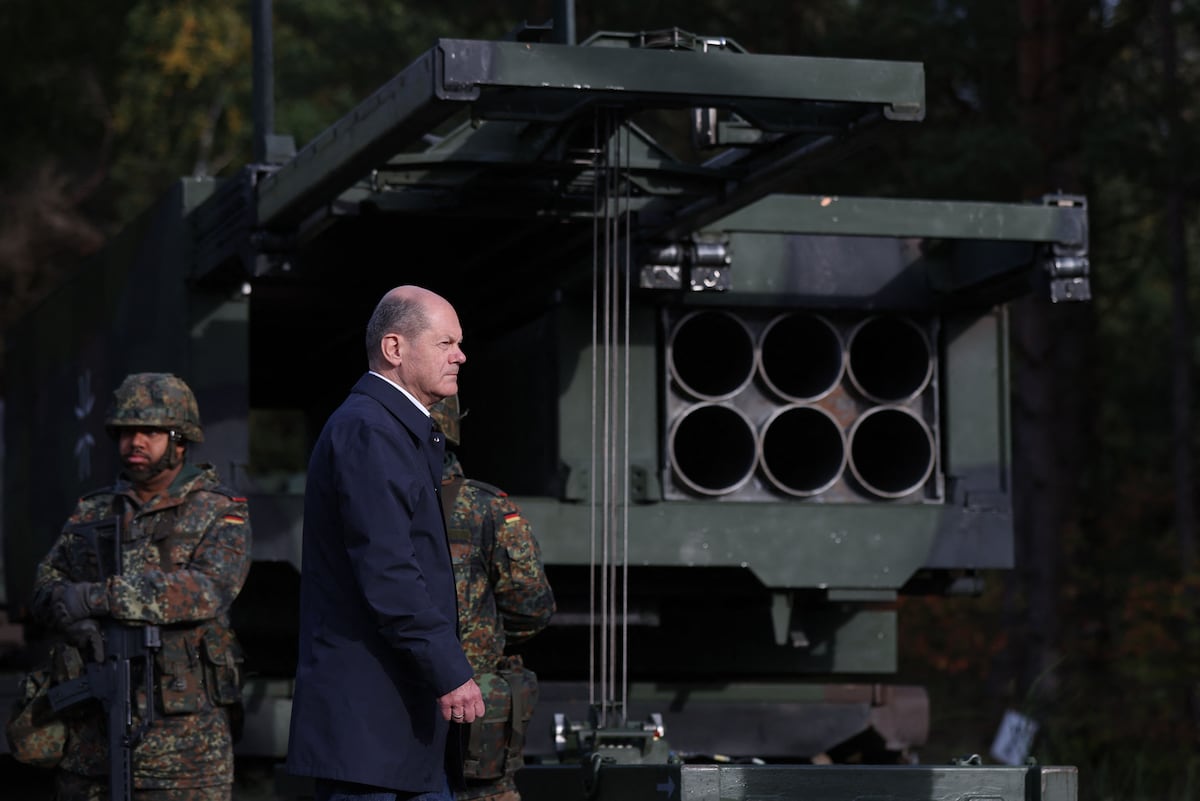
COLOGNE, Germany — The German army has received parliamentary approval to buy an initial batch of Elbit-made PULS rocket artillery systems, a decision that could see Berlin look to European munitions suppliers in the future.
The move, announced just before the Christmas holidays as part of a larger raft of funding approvals for Germany’s armed forces, means the Bundeswehr can spend roughly €65 million, or $68 million USD, on five systems.
The PULS pick, offered by Elbit in conjunction with German-French contractor KNDS , puts an end, for now, to a highly contested race for Germany’s next-generation, multiple-rocket launcher system.
Lockheed Martin and Rheinmetall had pitched a competing offer, named GMARS, that came with the lineup of Lockheed’s munitions offerings, including the ubiquitous Guided MLRS rockets, baked into it.
In the end, the Lockheed-Rheinmetall offer wasn’t far enough along, a German Ministry of Defense spokesman told Defense News.
“A usable prototype was not available,” the spokesman said.
The decision in favor of PULS is meant to deepen cooperation between German artillery forces and those of the neighboring Netherlands, which has previously purchased the Israeli product and whose contract provides a piggybacking option for Germany’s impending buy.
“The Dutch army is deeply integrated into German army structures, and the use of a common weapon system will enable further cooperation,” the spokesman wrote in response to a reporter’s questions.
The PULS, which is short for Precise and Universal Launching System, allows for the deployment of a national fire-control system, thereby enabling user nations to pick their own munition types for integration, the spokesman added.
Whether that includes GMLRS rockets, donated by the United States to Ukraine and resident in the stocks of many NATO nations, remains an open question.
Military decision makers in Berlin are banking on a promise from Elbit that the weapons, in the Unitary variant, can be shot with the PULS fire-control software. But Washington’s political approval is also needed.
“Germany is in close coordination with the United States” to that end, the spokesman in Berlin said.
Last summer, Lockheed executive Howard Bromberg, vice president of strategy and business development for land forces, categorically denied that possibility .
“Our MLRS Family of Munitions cannot be integrated into the PULS system — if Germany was to opt for PULS they could not gain access to our missiles,” he told Defense News on the sidelines of the Eurosatory defense trade show in Paris.
The same would apply to the U.S. Army’s newer Precision Strike Missile, which boasts a range of 500 kilometers and more, according to the company.
It’s unclear how prominent the assured access to Lockheed rockets is in Germany’s long-term defense planning, as German and European manufacturers have adjusted to a surge in demand for munitions of all ranges and propulsion types, guided and unguided.
In September, Elbit and Germany’s Diehl Defence signed a cooperation agreement tailored to PULS users in Europe and Germany in particular. In addition, pan-European missile maker MBDA is jockeying for position in the emerging market of longer-range weapons, deemed a critical element of Europe’s deterrence posture vis-à-vis Russia.
Sebastian Sprenger is associate editor for Europe at Defense News, reporting on the state of the defense market in the region, and on U.S.-Europe cooperation and multi-national investments in defense and global security. Previously he served as managing editor for Defense News. He is based in Cologne, Germany.
德国科隆——德国陆军已获得议会批准,购买首批由埃尔比特公司制造的PULS火箭炮系统。这一决定可能意味着柏林未来会向欧洲军火供应商寻求货源。
这项在圣诞节假期前夕宣布的举措,是德国武装部队一系列更大规模拨款批准的一部分,意味着德国联邦国防军可以花费大约 6500 万欧元(约合 6800 万美元)购买五个系统。
由埃尔比特公司与德法承包商 KNDS 联合提供的 PULS 系统,暂时结束了德国下一代多管火箭炮系统的激烈竞争。
洛克希德·马丁公司和莱茵金属公司提出了一个竞争方案,名为 GMARS,其中包含了洛克希德公司的一系列弹药产品,包括无处不在的制导多管火箭炮系统 (MLRS)。
德国国防部发言人告诉《防务新闻》,最终,洛克希德-莱茵金属公司的报价还不够理想。
发言人表示:“目前还没有可用的原型产品。”
支持 PULS 的决定旨在深化德国炮兵部队与邻国荷兰炮兵部队之间的合作。荷兰此前已购买过以色列的 PULS 产品,其合同为德国即将进行的采购提供了搭便车选项。
发言人在回答记者提问时写道:“荷兰军队与德国军队的结构深度融合,使用通用武器系统将促进进一步的合作。”
发言人补充说,PULS(精确通用发射系统)允许部署国家火控系统,从而使用户国家能够选择自己的弹药类型进行集成。
这是否包括美国捐赠给乌克兰、并储存在许多北约国家的GMLRS火箭,仍然是一个悬而未决的问题。
柏林的军事决策者们寄希望于埃尔比特公司做出的承诺,即统一型武器可以使用PULS火控软件进行射击。但华盛顿的政治批准也必不可少。
柏林发言人表示,“德国正为此与美国密切协调”。
去年夏天,洛克希德公司负责陆军战略和业务发展的副总裁霍华德·布罗姆伯格断然否认了这种可能性。
“我们的 MLRS 系列弹药无法集成到 PULS 系统中——如果德国选择 PULS,他们就无法获得我们的导弹,”他在巴黎举行的欧洲防务展期间告诉《防务新闻》。
该公司表示,同样的情况也适用于美国陆军较新的精确打击导弹,该导弹的射程为 500 公里甚至更远。
目前尚不清楚确保获得洛克希德火箭在德国的长期国防规划中有多重要,因为德国和欧洲的制造商已经调整了对各种射程和推进类型(包括制导和非制导)弹药的需求激增。
9月,埃尔比特系统公司与德国迪尔防务公司签署了一项合作协议,该协议专门针对欧洲,特别是德国的脉冲激光制导(PULS)用户。此外,泛欧导弹制造商MBDA正在积极争取在新兴的远程武器市场占据一席之地,远程武器被认为是欧洲对俄威慑态势的关键要素。
塞巴斯蒂安·斯普伦格是《防务新闻》欧洲版副主编,负责报道该地区的防务市场状况,以及美欧在防务和全球安全领域的合作和多国投资。此前,他曾担任《防务新闻》执行主编。他现居德国科隆。