S-E Asia should look beyond geopolitics, focus on people when facing climate crisis: Al Gore东南亚在面对气候危机时,应超越地缘政治,关注人民:阿尔·戈尔
The former US vice-president was in Singapore an event run by The Climate Reality Project, a non-profit he founded. Read more at straitstimes.com.
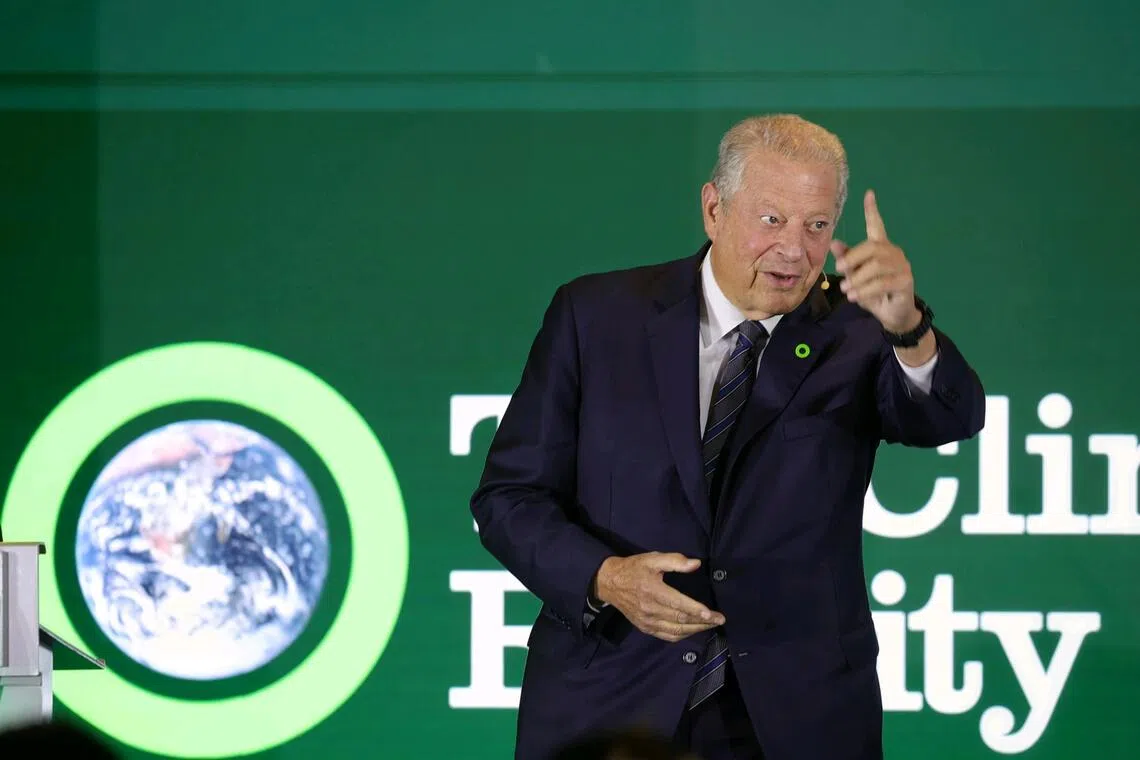
Former US vice-president Al Gore, founder and chairman of The Climate Reality Project, presenting the latest science at a climate leadership training event on Sept 8.
Published Sep 08, 2026, 10:25 PM
Updated Sep 08, 2026, 10:25 PM
Al Gore urged Southeast Asia to prioritise people’s interests over geopolitics by accelerating the transition from fossil fuels to clean energy to address the climate crisis.
He highlighted falling renewable energy costs, rising investments, and worsening climate disasters as key reasons for the region to adopt sustainable solutions.
Gore noted China’s growing climate leadership and hopes for US-China cooperation on climate and AI regulation by the 2028 COP33 conference.
SINGAPORE – Focus on people, not geopolitics – that is former US vice-president Al Gore’s advice to South-east Asian nations who may feel caught between other countries’ priorities in addressing climate change.
“What (the region) should focus on is not how China will react to what they’re doing or how the US will react to what they’re doing, but what will best serve the interests of the people in their nations,” he said on Sept 8 while in Singapore for an event.
He was speaking to journalists on the sidelines of a two-day leadership training event run by The Climate Reality Project, a non-profit he founded to help tackle the climate crisis.
The training on Sept 8 and 9 convenes around 800 sustainability professionals, students and climate activists in the region. It was held at the Suntec Singapore Convention and Exhibition Centre.
Gore was asked how South-east Asia should navigate the US’ and China’s contrasting attitudes towards the climate crisis.
The Trump administration in the US has reversed climate policies by withdrawing from the Paris Agreement, lobbying for fossil fuel expansion and erasing climate research, among other regulatory rollbacks.
China, on the other hand, has been aggressively rolling out renewables, and in record-breaking pace, installed 3 gigawatts of solar energy each day for the whole of May 2025.
Replying the question, Gore said there are multiple factors that have pushed the region to gear towards sustainability.
First, the US-Iran war has demonstrated that the price and supply volatility of oil and gas “is itself a reason to move away from fossil fuels”, he said.
Second, solar, wind and battery storage are enjoying a dramatic and continued decline in prices.
On this front, Gore noted that the South-east Asian market is moving towards adopting clean energy, referring to how investments in renewables in the first half of 2026 increased by 51 per cent, compared with the same period in 2025.
Third, ever-frequent and worsening climate disasters, such as the glacial collapse in Nepal, are serving as a wake-up call to governments.
“Mother Nature is persuading more and more people every day that it is ridiculous for us to slow down this transition, no matter the political power of the fossil fuel polluters,” said Gore.
“It’s becoming increasingly clear that the best interests of their people is obviously served by speeding up this transition (away from fossil fuels).”
His 2006 climate change documentary An Inconvenient Truth won an Academy Award, and in 2007 he received the Nobel Peace Prize along with the Intergovernmental Panel on Climate Change.
He is optimistic that China can step up in climate leadership as it is “moving powerfully towards advocacy for renewables”, while noting that the country’s greenhouse gas emissions has plateaued over the past two years, and even dipped slightly in the second quarter of 2026.
“China has decided to change its historic reluctance to use its diplomatic clout to advocate for global solutions in the diplomatic sphere for the climate crisis, and that is a welcome change,” said Gore.
China’s interest to host the 2028 UN climate change conference (COP33) is also a positive sign, he added.
Gore added: “If China does indeed seek to host COP33... it will do what China always does: it plans its work and works its plan.”
But while ramping up renewables, the world’s second-largest economy is still building new coal-fired power plants.
Coal remains important to the country’s need for energy security, partly because many regions in China suffered the significant loss of hydroelectric power due to droughts, acknowledged Gore.
He said: “China is perhaps the only country in the world that would build new (coal) plants, knowing that they would have less than a 50 per cent utilisation rate,” he said.
“There is a completely different philosophy at work in China’s decision to build these plants.”
By COP33 in 2028, he hopes for closer cooperation between the two superpowers.
“Indeed, the two challenges that are ripe for bi-national cooperation between the US and China are the climate crisis and the regulation of advanced artificial intelligence,” said Gore.
Shabana Begum is a correspondent, with a focus on environment and science, at The Straits Times.
美国前副总统、气候现实项目创始人兼主席阿尔·戈尔于 9 月 8 日在气候领导力培训活动上介绍了最新科学成果。
发布于 2026 年 9 月 8 日晚上 10:25
更新于2026年9月8日晚上10:25
阿尔·戈尔敦促东南亚各国将人民利益置于地缘政治之上,加快从化石燃料向清洁能源的转型,以应对气候危机。
他强调,可再生能源成本下降、投资增加以及气候灾害日益恶化是该地区采取可持续解决方案的关键原因。
戈尔指出中国在气候领域的领导地位日益增强,并希望美中两国能在 2028 年 COP33 气候大会上就气候和人工智能监管问题开展合作。
新加坡——美国前副总统阿尔·戈尔建议东南亚国家,在应对气候变化问题上,如果它们感到自己被夹在其他国家的优先事项之间,那么应该关注人民,而不是地缘政治。
“(该地区)应该关注的不是中国或美国会如何回应他们的所作所为,而是什么最符合他们国家人民的利益,”他在9月8日于新加坡参加一个活动时说道。
他在气候现实项目(The Climate Reality Project)举办的为期两天的领导力培训活动间隙接受了记者的采访。该项目是他创立的非营利组织,旨在帮助应对气候危机。
9月8日至9日举行的培训汇聚了该地区约800名可持续发展领域的专业人士、学生和气候活动家。培训在新加坡新达城会展中心举行。
有人问戈尔,东南亚应该如何应对美国和中国在气候危机问题上截然不同的态度。
美国特朗普政府通过退出《巴黎协定》、游说扩大化石燃料生产、取消气候研究以及其他监管倒退等措施,逆转了气候政策。
另一方面,中国一直在积极推广可再生能源,并以破纪录的速度,在 2025 年 5 月每天安装 3 吉瓦的太阳能发电量。
戈尔在回答这个问题时表示,有多种因素促使该地区转向可持续发展。
他表示,首先,美伊战争表明,石油和天然气的价格和供应波动“本身就是摆脱化石燃料的一个理由”。
其次,太阳能、风能和电池储能的价格正在持续大幅下降。
在这方面,戈尔指出,东南亚市场正在朝着采用清洁能源的方向发展,他提到,与 2025 年同期相比,2026 年上半年对可再生能源的投资增加了 51%。
第三,日益频繁且愈演愈烈的气候灾害,例如尼泊尔的冰川崩塌,正在给各国政府敲响警钟。
戈尔说:“大自然每天都在说服越来越多的人,无论化石燃料污染者拥有多么强大的政治力量,放慢这一转型都是荒谬的。”
“越来越明显的是,加快(摆脱化石燃料的)转型显然最符合人民的利益。”
他的 2006 年气候变化纪录片《难以忽视的真相》获得了奥斯卡奖,2007 年他与政府间气候变化专门委员会一起获得了诺贝尔和平奖。
他乐观地认为,中国可以在气候领导方面有所作为,因为中国“正在大力倡导可再生能源”,同时指出,过去两年中国的温室气体排放量已经趋于平稳,甚至在2026年第二季度略有下降。
戈尔表示:“中国决定改变其历史上不愿利用外交影响力在外交领域倡导全球气候危机解决方案的做法,这是一个值得欢迎的改变。”
他还补充说,中国有意主办 2028 年联合国气候变化大会(COP33)也是一个积极的信号。
戈尔补充道:“如果中国真的寻求主办COP33……它将像中国一贯的做法一样:制定计划并执行计划。”
但是,在大力发展可再生能源的同时,世界第二大经济体仍在建设新的燃煤发电厂。
戈尔承认,煤炭对中国能源安全仍然至关重要,部分原因是由于干旱,中国许多地区的水力发电量大幅下降。
他说:“中国可能是世界上唯一一个明知新建(燃煤)电厂利用率低于50%却仍然建造的国家。”
“中国决定建设这些工厂背后有着完全不同的理念。”
他希望到 2028 年的 COP33 大会上,中美两个超级大国之间能够开展更紧密的合作。
戈尔表示:“事实上,美中两国开展双边合作的两大挑战是气候危机和先进人工智能的监管。”
沙巴娜·贝古姆是《海峡时报》的记者,主要关注环境和科学领域。