Russia’s New Stealthy Lower-Cost Air-Launched Standoff Weapons On Display In Egypt俄罗斯新型隐形低成本空射防区外武器在埃及展出
Moscow is pitching a new generation of precision weapons abroad, even as the war that produced them complicates their export prospects. Moscow is pitching a new generation of precision weapons abroad, even as the war that produced them complicates their export prospects.
Published Sep 8, 2026 12:52 PM EDT
Russia is displaying some of its newest air-launched precision weapons in public for the first time at the El Alamein International Airshow in Egypt this week . The S-71K Kovyor and related S-71M Monokhrom , and the S8000 Banderol , reflect Russia’s effort to field larger numbers of relatively inexpensive standoff weapons alongside its more sophisticated and costly missile types . As such, their development and early employment are closely tied to the war in Ukraine, but they also reflect wider global interest in these kinds of weapons .
The weapons, seen in the tweet embedded below, comprise, clockwise from top left: S-71K Kovyor , an unknown smaller guided munition, S8000 Banderol, and S-71M Monokhrom :
Novel munitions for the Russian aircraft, on an expo. pic.twitter.com/L1UPTb8qhX — krakek (@krakek1) September 6, 2026
Novel munitions for the Russian aircraft, on an expo. pic.twitter.com/L1UPTb8qhX
For Russia, the requirement has become increasingly important as the war in Ukraine has evolved into a prolonged contest in which industrial capacity is as critical as technology. Russia has expended huge numbers of cruise and ballistic missiles against Ukrainian targets while also developing an enormous strike-drone campaign . At the same time, Ukrainian air defenses have become progressively more capable , forcing Moscow to use combinations of missiles, drones, decoys, and different flight profiles to penetrate or saturate the defensive network. One lesson is the fact that a weapon does not necessarily have to be as capable as a high-end cruise missile if it can be manufactured in much greater numbers and still present a credible threat to the target.
The S-71M, which TWZ previously reported on in detail after Ukrainian intelligence obtained an example, is a compact, turbojet-powered weapon with a distinctly angular airframe intended to reduce its radar signature. Imagery from Egypt gives a better look at its front end, including a faceted nose flowing into a broad central fuselage. The nose has at least one optically flat transparency for an infrared or TV seeker. Its wings are sharply swept and fold against the belly of the weapon for carriage, while the rear of the weapon terminates in an inverted-V tail arrangement. The overall shape is notably different from Russia’s more conventional cruise missiles of the past.
An S-71M test article under the wing of a Su-57. via X
Ukrainian analysis found that the S-71M incorporates an OFAB-250-270 high-explosive fragmentation bomb as its warhead and relies primarily on inertial guidance, rather than carrying a sophisticated terminal seeker, although the seeker window raises questions about that.
Ukrainian intelligence also described its construction as being relatively straightforward, with fiberglass composite material making up much of the outer structure and no evidence identified of specialized radar-absorbing coatings.
As we noted previously, the weapon appears intended as a less expensive, but still survivable standoff weapon option that can be produced in significant numbers.
The S-71M has been tested from the Su-57 Felon fighter, also present at El Alamein. In a press release, the United Aircraft Corporation (UAC), responsible for the Su-57, said that the S-71M and the S-71K displayed alongside it “were designed for fifth-generation fighters,” although there is no reason why they couldn’t be launched from a wide variety of platforms.
A Su-57 performing at El Alamein, with one of its main internal weapons bays apparently loaded with Kh-69 standoff missiles:
T-50-9 in El-Alamein, opening both main weapon bays. Two, presumably, Kh-69 can be seen in the front one. Source: @ T汪汪T pic.twitter.com/f6csKc6Y9D — George N. (@GeorgeN28581) September 8, 2026
T-50-9 in El-Alamein, opening both main weapon bays. Two, presumably, Kh-69 can be seen in the front one. Source: @ T汪汪T pic.twitter.com/f6csKc6Y9D
Regardless of launch platform, the nature of the war in Ukraine make that the S-71M particularly useful. Russia has increasingly relied on extemporized glide bombs for attacks against targets relatively close to the front, but those weapons require the launching aircraft to operate within a certain distance of Ukrainian defenses. At least in their earlier iterations, such weapons were also crude and prone to failure. Longer-range cruise missiles offer considerably greater standoff but are more complex and expensive. The S-71M sits somewhere between those categories, providing an air-launched, powered weapon with a relatively large warhead and some degree of low observability without the cost and complexity of a full-size, truly stealthy cruise missile.
The S-71K appears to represent a more capable version of the basic concept. Public information remains limited , but the weapon has been associated with electro-optical guidance and greater onboard processing, potentially giving it a capability to deal with targets in a more flexible manner than the largely pre-programmed S-71M. Exactly how that capability is employed, and how autonomous the weapon actually is, remain less clear from the imagery and information released to date.
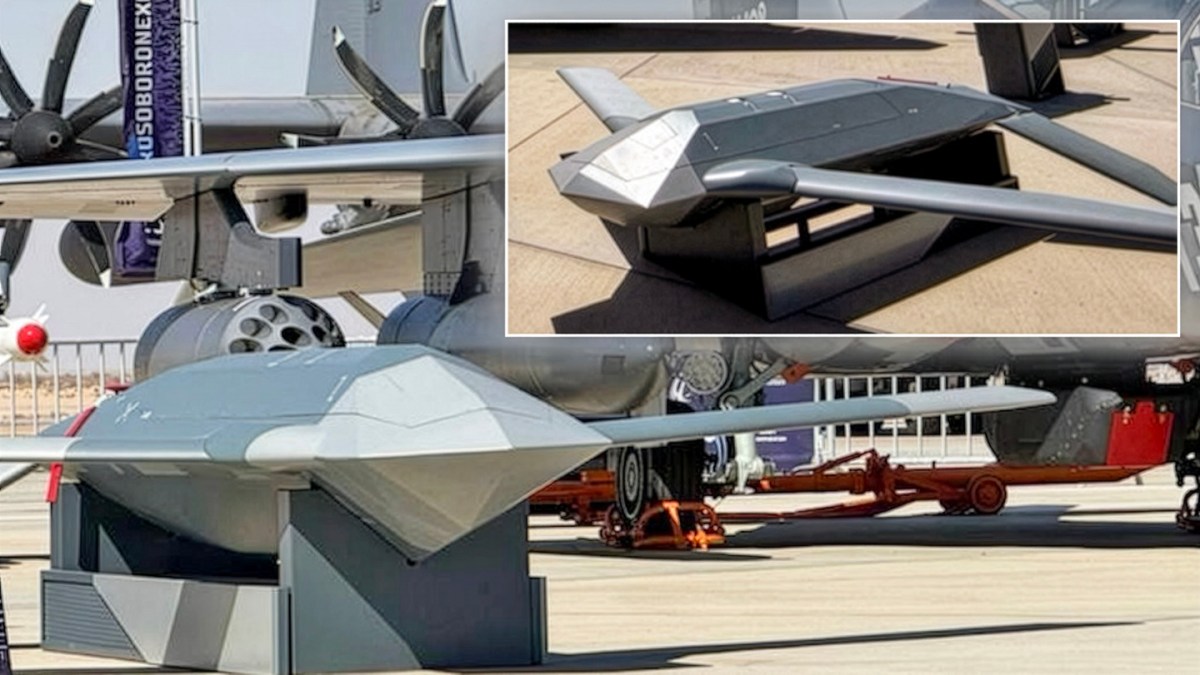
An S-71K missile presented in front of a Su-57 Felon at El Alamein. UAC
A close-up of the same S-71K missile at El Alamein. UAC
A Su-57 undergoes trials with a pair of S-71K missiles under the wings. via X
As displayed at El Alamein, the S-71K retains the overall faceted, low-observable appearance of the S-71M but has a visibly different airframe and wing arrangement. Its body is notably broad and compact relative to its length, with folding wings that are relatively thick, and a more refined inverted-V tail giving it more the appearance of a small uncrewed aircraft than a conventional air-to-surface missile.
A rear view of a test S-71K under the wing of a Su-57. via X
Meanwhile, the Banderol represents a somewhat different path to the same general problem. Ukraine’s intelligence service previously obtained and analyzed an example of the small jet-powered cruise missile, which TWZ reported on last year . The weapon is considerably smaller than Russia’s principal cruise missiles and has been associated with launch from drones and helicopters. Its reported range of around 500 kilometers (311 miles) and relatively small warhead make it something of a complementary system intended to provide another, more economical way of putting a precision weapon onto a target from the air.
The front portion of a Banderol is seen nearest the camera in a line-up at El Alamein, which also includes a Yak-130M combat trainer and a Su-57. UAC
In terms of its appearance, the Banderol is more conventionally missile-like, with an ogival central fuselage, a pointed nose, and sharply swept folding wings. Its proportions underline just how small it is compared with Russia’s better-known air-launched cruise missiles.
An infographic prepared by Ukraine showing the Banderol cruise missile and some of its foreign-sourced components. GUR photo
The Banderol is particularly relevant in the context of the economics of the Ukraine conflict. Russian forces have increasingly used combinations of relatively inexpensive one-way attack drones and more expensive cruise and ballistic missiles. The drones can be produced in large numbers and used to complicate air-defense operations, while the more capable missiles provide greater speed, range, payload, or penetration capability. A small turbojet-powered weapon such as Banderol offers another point on that spectrum.
At leats one image has recently emerged showing a Banderol carried by a Russian Mi-28NM Havoc attack helicopter. This would be in line with unconfirmed reports from Ukraine last month that Russia was using the Mi-28 as an additional launch platform for the weapon, including firing them from over the Sea of Azov to attack targets around Odesa.
An S8000 “Banderol” (“Dan-T”) small cruise missile mounted on a Russian Mi-28NM attack helicopter. pic.twitter.com/Xcx3MmFK3B — OSINTWarfare (@OSINTWarfare) September 6, 2026
An S8000 “Banderol” (“Dan-T”) small cruise missile mounted on a Russian Mi-28NM attack helicopter. pic.twitter.com/Xcx3MmFK3B
Its reported use also illustrates how the distinction between a cruise missile and a large one-way attack drone is becoming increasingly blurred. The Banderol incorporates a conventional missile-like airframe and jet propulsion but has been associated with drone operations and makes extensive use of commercially available components. TWZ ’s earlier examination of the weapon also highlighted the extent to which modern Russian weapons programs can combine relatively simple airframes with foreign-sourced electronics and propulsion technology.
Russia has revealed an Orion (Inokhodets) UAV carrying the S8000 Banderol air-launched cruise missile, marking the clearest Russian footage yet of the weapon integrated with the drone. #Russia #Orion #CruiseMissile #Defense pic.twitter.com/yLHb7h1oW9 — Drone Wars (@Drone_Wars_) July 13, 2026
Russia has revealed an Orion (Inokhodets) UAV carrying the S8000 Banderol air-launched cruise missile, marking the clearest Russian footage yet of the weapon integrated with the drone. #Russia #Orion #CruiseMissile #Defense pic.twitter.com/yLHb7h1oW9
Likely Banderol loitering munition on the ground (perspective exaggerates it's size) and under Orion drone. Banderol has been reported as one of the munition used in recent strikes and appears to use a jet engine and a FAB-100 warhead or similar. pic.twitter.com/j50DUsNuVe — krakek (@krakek1) April 27, 2025
Likely Banderol loitering munition on the ground (perspective exaggerates it's size) and under Orion drone. Banderol has been reported as one of the munition used in recent strikes and appears to use a jet engine and a FAB-100 warhead or similar. pic.twitter.com/j50DUsNuVe
Seen together at El Alamein, the three weapons provide an unusually useful snapshot of where Russian air-launched strike development is heading. They are presented alongside a fourth, so-far unidentified munition. This unnamed weapon is notably short and fat, with a cruciform tail, and an optical window in the nose. Its overall size and shape suggest it may have been developed specifically to arm drones.
The appearance of the weapons at an arms fair underscores the fact that Russia is not the only country confronting the problem of producing and fielding sufficient precision weapons at an acceptable cost. The growing interest in lower-cost cruise missiles , loitering munitions , attritable aircraft , and other forms of expendable precision strike is now evident well beyond Russia.
Russia is also clearly trying to make these weapons harder to intercept, an increasingly important consideration as Ukrainian air defenses have demonstrated an ability to shoot down even glide bombs in some circumstances. The S-71K in particular incorporates unusually pronounced low-observable shaping, suggesting that survivability was also a central requirement from the outset.
There is, however, a significant complication to Russia’s attempt to turn its wartime experience into an export opportunity. Buying any kind of weapons from Moscow has become considerably more difficult because of sanctions , restrictions on access to foreign technology and financing, and the wider political risks associated with maintaining a Russian defense relationship. Those factors matter just as much to a prospective customer as the performance of the weapon itself.
Author’s note: earlier reporting on the S-71 family appears to have transposed the S-71K and S-71M versions. Most authoritative accounts now indicate that the more refined, more stealthy version is the S-71K Kovyor (meaning carpet), while the simpler weapon is the S-71M Monokhrom.
Contact the author: thomas@thewarzone.com
Comments couldn’t be loaded. Please refresh the page.
发布于美国东部时间2026年9月8日下午12:52
本周,俄罗斯在埃及阿拉曼国际航展上首次公开展示了其最新型的空射精确制导武器。S-71K“科维奥尔”(Kovyor)及其衍生型号S-71M“单臂”(Monokhrom),以及S-8000“班德罗尔”(Banderol)防空导弹系统,体现了俄罗斯致力于在其更先进、更昂贵的导弹之外,部署更多数量相对廉价的防区外武器的努力。因此,这些武器的研发和早期部署与乌克兰战争密切相关,但也反映了国际社会对这类武器的广泛关注。
从下方嵌入的推文中可以看到这些武器,从左上角顺时针方向依次为:S-71K Kovyor、一种未知的较小制导武器、S8000 Banderol 和 S-71M Monokhrom:
俄罗斯飞机的新型弹药在展会上亮相。pic.twitter.com/L1UPTb8qhX — krakek (@krakek1) 2026年9月6日
俄罗斯飞机的新型弹药在展会上展出。pic.twitter.com/L1UPTb8qhX
对俄罗斯而言,随着乌克兰战争演变为一场旷日持久的对抗,工业能力与技术同等重要,这一需求变得愈发重要。俄罗斯已向乌克兰目标投入大量巡航导弹和弹道导弹,同时也在发展规模庞大的无人机打击行动。与此同时,乌克兰的防空能力也在不断提升,迫使莫斯科不得不结合导弹、无人机、诱饵以及不同的飞行轨迹来突破或饱和乌克兰的防空网络。由此可见,一种武器即便性能不及高端巡航导弹,只要能够大规模生产并足以对目标构成威胁,其威力依然不容小觑。
S-71M导弹此前曾被TWZ详细报道,当时乌克兰情报部门获得了一枚该型导弹。这是一款结构紧凑、采用涡轮喷气发动机的武器,其棱角分明的机身设计旨在降低雷达反射截面积。来自埃及的图像更清晰地展现了其前端,包括一个多面体状的弹头,与宽阔的中央机身流畅衔接。弹头至少有一个光学平面透明罩,用于安装红外或电视导引头。其机翼后掠角较大,可折叠收拢于弹腹,便于携带;尾部则采用倒V形尾翼。整体外形与俄罗斯以往较为传统的巡航导弹截然不同。
一架苏-57战斗机机翼下挂载着一枚S-71M测试样机。(图片来自X)
乌克兰的分析发现,S-71M 采用 OFAB-250-270 高爆破片炸弹作为其弹头,并且主要依靠惯性制导,而不是携带复杂的末端导引头,尽管导引头窗口对此提出了质疑。
乌克兰情报部门还表示,该建筑的结构相对简单,外部结构主要由玻璃纤维复合材料构成,没有发现任何专门的雷达吸收涂层的证据。
正如我们之前提到的,这种武器似乎旨在成为一种价格较低但仍然具有生存能力的远距离武器选择,并且可以大量生产。
S-71M导弹已在苏-57“重罪犯”战斗机上进行了测试,该战斗机也出现在阿拉曼演习中。负责苏-57战斗机的联合航空制造集团(UAC)在一份新闻稿中表示,S-71M和与其一同展出的S-71K导弹“是为第五代战斗机设计的”,尽管它们也可以从多种不同的平台上发射。
一架在阿拉曼进行表演的苏-57战斗机,其一个主要内部武器舱显然装载着Kh-69防区外导弹:
阿拉曼战役中的T-50-9坦克,打开了两个主武器舱。前部武器舱内可以看到两枚疑似Kh-69导弹。来源:@T汪汪T pic.twitter.com/f6csKc6Y9D — George N. (@GeorgeN28581) September 8, 2026
在阿拉曼,一辆T-50-9坦克正在打开两个主武器舱。前部武器舱内可以看到两枚疑似Kh-69导弹。来源:@T汪汪T pic.twitter.com/f6csKc6Y9D
无论采用何种发射平台,乌克兰战争的性质都使得S-71M导弹系统显得尤为重要。俄罗斯越来越多地依赖临时研制的滑翔炸弹攻击前线附近的目标,但这些武器要求发射飞机在距离乌克兰防御系统一定距离内飞行。至少在其早期版本中,此类武器也较为粗糙且容易发生故障。远程巡航导弹虽然射程更远,但结构更复杂、成本更高。S-71M导弹系统则介于两者之间,它是一种空射动力武器,拥有相对较大的弹头和一定的隐蔽性,同时又不像真正的全尺寸隐形巡航导弹那样成本高昂、结构复杂。
S-71K似乎是其基本概念的升级版。目前公开信息有限,但该武器已与光电制导和更强大的机载处理能力相关联,这可能使其能够比主要依靠预编程的S-71M更灵活地应对目标。然而,从目前公布的图像和信息来看,这种能力的具体运用方式以及该武器的自主程度仍然不甚明了。
在阿拉曼战役中,一枚S-71K导弹展示在一架苏-57“重罪犯”战斗机前。UAC
这是在阿拉曼战役中拍摄的同一枚S-71K导弹的特写镜头。UAC
一架苏-57战斗机正在进行测试,机翼下挂载了两枚S-71K导弹。 via X
在阿拉曼演习中展出的S-71K导弹保留了S-71M导弹整体的多面体低可探测性外观,但其机身和机翼布局明显不同。与长度相比,它的机身明显更宽更紧凑,折叠机翼相对较厚,更精致的倒V形尾翼使其看起来更像是一架小型无人飞行器,而非传统的空地导弹。
一架苏-57战斗机机翼下测试用的S-71K导弹的后视图。(图片来自X)
与此同时,“班德罗尔”导弹则代表了解决同一总体问题的一种略有不同的途径。乌克兰情报部门此前曾获取并分析过一枚小型喷气式巡航导弹,TWZ去年对此进行了报道。该武器比俄罗斯的主要巡航导弹小得多,通常由无人机和直升机发射。据报道,其射程约为500公里(311英里),弹头相对较小,因此它是一种补充系统,旨在提供一种更经济的空中精确打击方式。
在阿拉曼机场的一列飞机中,镜头最靠近一架飞机的是一架“班德罗尔”战斗机的机头部分,该列飞机还包括一架雅克-130M战斗教练机和一架苏-57战斗机。(美国联合航空制造集团)
从外形上看,“班德罗尔”导弹更像传统的导弹,拥有弧形中机身、尖锐的机头和后掠角较大的折叠机翼。其尺寸比例凸显了它与俄罗斯更为人熟知的空射巡航导弹相比是多么小巧。
乌克兰制作的一张信息图,展示了“班德罗尔”巡航导弹及其部分外国来源的零部件。(GUR图片)
在乌克兰冲突的经济背景下,“班德罗尔”无人机显得尤为重要。俄军越来越多地将相对廉价的单向攻击无人机与更昂贵的巡航导弹和弹道导弹相结合使用。无人机可以大量生产,用于干扰防空作战,而性能更强大的导弹则提供更高的速度、更远的射程、更大的有效载荷或更强的穿透能力。像“班德罗尔”这样的小型涡轮喷气式武器则为这种武器组合提供了另一种选择。
最近至少有一张照片显示,一架俄罗斯米-28NM“浩劫”攻击直升机携带了一枚“班德罗尔”导弹。这与上个月来自乌克兰的未经证实的报道相符,该报道称俄罗斯正在使用米-28作为该武器的额外发射平台,包括从亚速海上空发射导弹攻击敖德萨周边目标。
一枚S8000“班德罗尔”(“丹-T”)小型巡航导弹挂载在一架俄罗斯米-28NM攻击直升机上。pic.twitter.com/Xcx3MmFK3B — OSINTWarfare (@OSINTWarfare) 2026年9月6日
一枚S8000“班德罗尔”(“丹-T”)小型巡航导弹挂载在一架俄罗斯米-28NM攻击直升机上。pic.twitter.com/Xcx3MmFK3B
据报道,该武器的使用也表明,巡航导弹和大型单向攻击无人机之间的界限正变得日益模糊。“班德罗尔”导弹采用了类似传统导弹的弹体和喷气推进系统,但一直与无人机作战联系在一起,并大量使用了市售零部件。TWZ此前对该武器的分析也强调了现代俄罗斯武器项目在多大程度上能够将相对简单的弹体与国外电子设备和推进技术相结合。
俄罗斯公布了一架“猎户座”(Inokhodets)无人机,该无人机携带了S-8000“班德罗尔”(Banderol)空射巡航导弹。这是迄今为止俄罗斯方面发布的该导弹与无人机集成的最清晰影像。#俄罗斯 #猎户座 #巡航导弹 #国防 pic.twitter.com/yLHb7h1oW9 — Drone Wars (@Drone_Wars_) July 13, 2026
俄罗斯公开了一架“猎户座”(Inokhodets)无人机,该无人机携带了S-8000“班德罗尔”(Banderol)空射巡航导弹。这是迄今为止俄罗斯方面拍摄到的最清晰的该导弹与无人机集成的画面。#俄罗斯 #猎户座 #巡航导弹 #国防 pic.twitter.com/yLHb7h1oW9
地面上疑似“班德罗尔”(Banderol)巡飞弹(透视效果夸大了其尺寸),位于“猎户座”(Orion)无人机下方。“班德罗尔”据报道是近期空袭中使用的弹药之一,似乎采用喷气式发动机和FAB-100弹头或类似弹头。pic.twitter.com/j50DUsNuVe — krakek (@krakek1) April 27, 2025
地面上疑似“班德罗尔”(Banderol)巡飞弹(透视效果夸大了其尺寸),位于“猎户座”(Orion)无人机下方。“班德罗尔”据报道是近期空袭中使用的弹药之一,似乎采用喷气式发动机和FAB-100弹头或类似弹头。pic.twitter.com/j50DUsNuVe
在阿拉曼战役中同时展出的这三种武器,为我们提供了一个难得的机会,得以了解俄罗斯空射打击武器的发展方向。它们旁边还展示了第四种目前尚未识别的弹药。这种未命名的武器外形独特,短而粗,尾部呈十字形,弹头处设有光学窗口。其整体尺寸和形状表明,它可能是专门为无人机研制的。
这些武器在武器展上的亮相凸显了一个事实:俄罗斯并非唯一面临以可接受的成本生产和部署足够精确武器问题的国家。如今,各国对低成本巡航导弹、巡飞弹、消耗型飞机和其他形式的消耗性精确打击武器的兴趣日益浓厚,这已远远超出俄罗斯的范畴。
俄罗斯显然也在努力提高这些武器的拦截难度,鉴于乌克兰防空系统已展现出在某些情况下击落滑翔炸弹的能力,这一点变得日益重要。特别是S-71K,其外形采用了异常显著的低可探测性设计,表明生存能力从一开始就是其核心要求之一。
然而,俄罗斯试图将战争经验转化为出口机遇的努力面临着一个重大难题。由于制裁、获取外国技术和融资渠道受限,以及维持与俄罗斯的防务关系所带来的更广泛的政治风险,从莫斯科购买任何类型的武器都变得异常困难。对于潜在客户而言,这些因素与武器本身的性能同样重要。
作者注:此前关于S-71系列导弹的报道似乎将S-71K和S-71M两种型号混淆了。目前大多数权威资料表明,更精良、更隐蔽的型号是S-71K“科维奥尔”(意为“地毯”),而结构更简单的型号是S-71M“莫诺克罗姆”。
联系作者:thomas@thewarzone.com
评论加载失败,请刷新页面。