Building the Army of tomorrow: How this force planner is preparing for future warfare打造未来军队:这位部队规划者如何为未来战争做好准备
This SAF scholar believes that the Army’s strength begins with helping every soldier grow, adapt and contribute meaningfully. Here's his story. Read more at straitstimes.com.
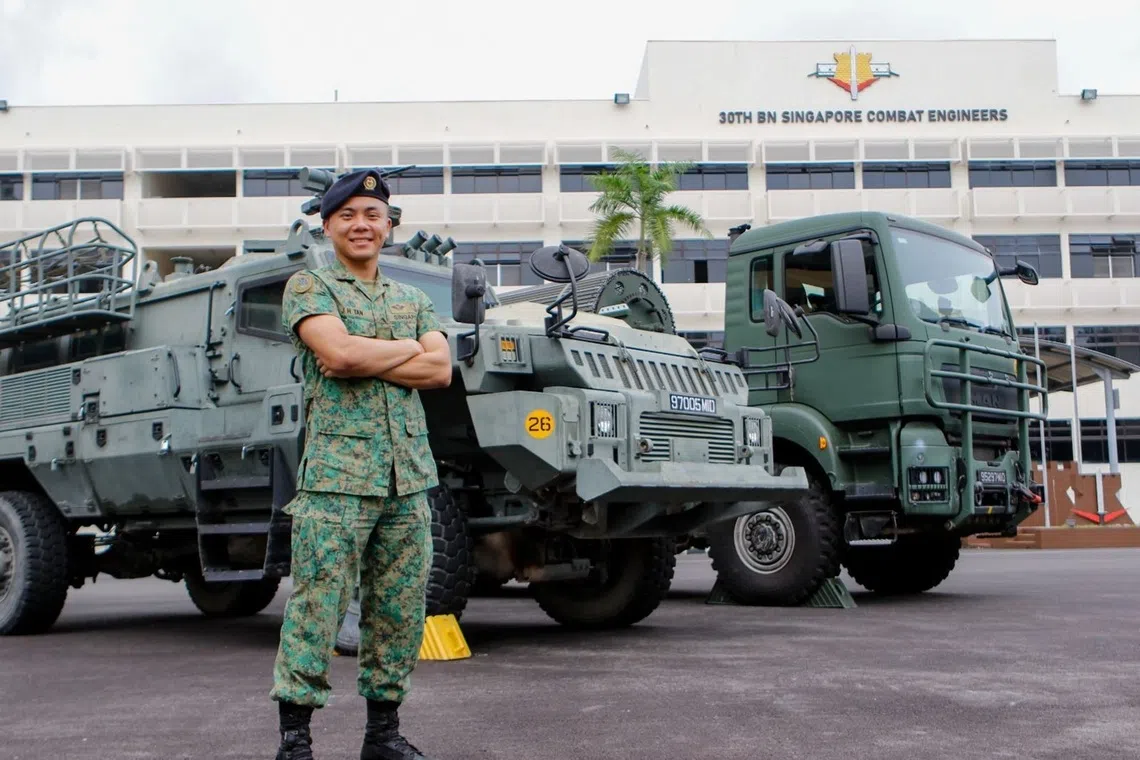
His plans may look decades ahead, but they are grounded in a belief that the Army’s strength begins with helping every soldier grow, adapt and contribute meaningfully
Lieutenant-Colonel Brandon Tan, pictured at 30th Battalion, Singapore Combat Engineers (30 SCE), is helping to shape the Army’s long-term transformation while keeping the individual soldier at the heart of its future.
PHOTO: COURTESY OF BRANDON TAN
Published Sep 09, 2026, 04:00 AM
Lieutenant-Colonel Brandon Tan’s work is, in many ways, laying the foundations for the Army of the future.
As Deputy Assistant Chief of General Staff for Plans and Head Force Plans, Tan helps shape the Army’s long-term development – from its technology, budget, manpower and land-use needs to how it prepares for evolving forms of warfare.
His role requires him to look beyond the Army’s immediate needs and consider what it will take to ensure that the force remains ready and relevant for the challenges ahead.
The plans he works on may not bear fruit for another five, 10 or even 15 years. Yet decisions made today could determine whether the Army is ready for a future in which autonomous systems, artificial intelligence and new defence doctrines change how wars are fought – or whether it can respond to unforeseen disruptions.
For Tan, preparing the Army for the future is not only about anticipating new technologies, policies or threats. It also means developing soldiers and leaders who can adapt, make decisions and lead through change.
The heartbeat of the future Army
For all the emphasis on capability development, technology and long-term planning, Tan believes the Army’s most important asset has not changed through the years: its soldiers.
That conviction shapes the decisions he makes. However advanced the Army becomes, it must still equip its soldiers with the ability to think critically, the agility to adapt and the courage to act when circumstances change.
Tan (right) presents a plaque to a soldier from 30 SCE. The example set by his former wing commander shaped his belief in recognising and bringing out the best in every soldier. PHOTO: COURTESY OF BRANDON TAN
Tan (right) presents a plaque to a soldier from 30 SCE. The example set by his former wing commander shaped his belief in recognising and bringing out the best in every soldier.
From the tank battles and infantry assaults of World War II to future battlefields shaped by autonomous drones and unmanned systems, warfare has changed dramatically. Yet as Tan puts it, war is fundamentally about pitting will against will.
Drawing on military theorist Carl von Clausewitz’s ideas, Tan says: “Technology is a means to an end. It will never fully replace the visceral element of warfare, which requires strong leadership.”
Tan first saw what such leadership looked like during his own time at Officer Cadet School (OCS), where his wing commander’s dedication to those under his charge left a lasting impression on him.
What stood out was how his wing commander led from the front. He never asked the cadets to do anything he would not do himself. Rain or shine, night or day, he was right beside them, coaching, guiding and showing the way.
Despite OCS’s gruelling training schedule, his wing commander also met the cadets regularly to find out how he could best support them, offering advice on career paths and scholarship options, as well as life advice between training sessions.
“Because of him, everybody came to realise that the Army is not looking for a specific archetype of leader,” Tan recalls. “You don’t necessarily have to be the strongest or the fastest person. But you need to have the heart for your people, be willing to put your best foot forward and lead by example.”
His wing commander helped to shape the kind of leader Tan wanted to become. He was later awarded the Singapore Armed Forces (SAF) Merit Scholarship to study biomedical sciences at the University of Cambridge, where his professors further impressed upon him the importance of nurturing and developing people.
Their questions were never about grades or academic achievement. His professors wanted to know two things: What interests you? How can I support you in pursuing it?
What stayed with him most was his professors’ approach to mentorship. He came to believe that every soldier should be asked the same questions he had encountered in Cambridge’s seminar rooms.
“Forcing people down a path where they’re not given any autonomy or latitude is ultimately detrimental to the organisation,” he says.
If the first thing you tell new soldiers is what you need from them, they will question your sincerity, which can dampen their motivation to do more, Tan continues.
“But if we can understand each soldier’s interests and strengths, deploy him meaningfully, and show him how his contribution matters to the team, he is more likely to find purpose in his two years and give his best.”
This matters because national service continues beyond the two years spent as a full-time national serviceman (NSF). How soldiers experience those two years can shape the attitude and sense of responsibility they bring to their subsequent years of Operationally Ready National Service.
“So, we always have to make sure that the last man or woman on the ground is not left behind,” he adds.
Putting people-first leadership into practice
Then-Major Tan (second from right) conducts a hands-on equipment inspection with personnel from 30 SCE, where he encourages soldiers to apply their skills and innovative mindset to improve training and everyday processes. PHOTO: COURTESY OF BRANDON TAN
Then-Major Tan (second from right) conducts a hands-on equipment inspection with personnel from 30 SCE, where he encourages soldiers to apply their skills and innovative mindset to improve training and everyday processes.
As commanding officer of the 30th Battalion, Singapore Combat Engineers (30 SCE), Tan put those lessons into practice. After noticing that many of his men were deeply interested in coding and AI, he gave them the latitude to use those skills to improve their NS experience.
He encouraged them to innovate with easily accessible tools. This gave rise to simple but effective initiatives using tools such as Microsoft 365 and Telegram dashboards to automate routine administrative work, including attendance-taking, fitness tracking and training scheduling, with the necessary security safeguards in place.
Just as importantly, Tan encouraged his soldiers to find ground-up ways to make training safer. A team of NSFs and regulars developed LED markers that could be quickly attached to and removed from combat vehicles to demarcate danger zones. The unit subsequently received the Chief of Army Safety Excellence Award.
Then-Major Tan (left) holds the Best Combat Support Unit Award received by 30 SCE, which reclaimed the honour in 2024 after 48 years. PHOTO: COURTESY OF BRANDON TAN
Then-Major Tan (left) holds the Best Combat Support Unit Award received by 30 SCE, which reclaimed the honour in 2024 after 48 years.
The unit also won the Best Combat Support Unit Award in 2024 – an accolade many units strive to achieve.
“It was a pleasant surprise,” says Tan, laughing as he recalls the moment. “It was not part of our plan. We were simply focused on enabling every individual soldier to contribute their best and building our unit into a place we were all proud to call home.”
And this focus, Tan believes, is key to the continued readiness of the Army.
“Our Army’s true strength lies in our people,” he says. “We can invest in the best equipment, but it is our well-trained, confident and committed soldiers who make the difference. Developing our regulars, NSFs and NSmen means building the foundations of an Army that will safeguard Singapore for generations to come.”
Find out how the SAF Merit Scholarship can kick start your career in the Army.
他的计划或许着眼于未来几十年,但其根基在于这样一种信念:军队的力量始于帮助每一位士兵成长、适应并做出有意义的贡献。
图中为新加坡第30战斗工兵营(30 SCE)的布兰登·谭中校,他正在帮助塑造陆军的长期转型,同时将每一位士兵置于其未来发展的核心。
照片:由布兰登·谭提供
发布于 2026 年 9 月 9 日 上午 4:00
从很多方面来看,布兰登·谭中校的工作正在为未来的军队奠定基础。
作为陆军计划副助理总参谋长兼部队计划主管,谭帮助塑造陆军的长期发展——从其技术、预算、人力和土地利用需求到如何为不断演变的战争形式做好准备。
他的职责要求他超越军队的眼前需求,思考如何确保军队始终做好准备,应对未来的挑战。
他参与制定的计划可能要五年、十年甚至十五年后才能见效。然而,今天做出的决定可能决定陆军是否已做好准备迎接未来——在这个未来,自主系统、人工智能和新的国防理论将改变战争的作战方式——或者它是否能够应对不可预见的突发事件。
在谭看来,让军队为未来做好准备,不仅仅是预测新技术、新政策或新威胁,还意味着培养能够适应变化、做出决策并引领变革的士兵和领导者。
未来军队的心跳
尽管陆军一直强调能力发展、技术和长期规划,但谭认为,多年来陆军最重要的资产并没有改变:那就是士兵。
这种信念影响着他的决策。无论军队发展到何种程度,都必须让士兵具备批判性思维能力、灵活适应变化的能力以及在形势变化时采取行动的勇气。
谭(右)向第30土木工程中队的一名士兵赠送奖牌。他以前的联队长树立的榜样,让他坚信要发现并激发每位士兵的潜能。照片:由布兰登·谭提供
谭(右)向第30土木工程团的一名士兵赠送奖牌。他以前的联队长树立的榜样,塑造了他发掘和激发每位士兵潜能的信念。
从二战时期的坦克大战和步兵突击,到未来由自主无人机和无人系统主导的战场,战争已经发生了翻天覆地的变化。然而,正如谭所言,战争的本质是意志与意志的较量。
谭恩美借鉴军事理论家卡尔·冯·克劳塞维茨的观点说:“技术是达到目的的手段。它永远无法完全取代战争中那种需要强有力的领导的本能因素。”
谭在军官学员学校 (OCS) 时第一次见识到了这种领导力,他的联队长对下属的奉献精神给他留下了深刻的印象。
最令人印象深刻的是他的联队长身先士卒的领导方式。他从不要求学员们做任何他自己不愿意做的事情。无论晴雨,无论白天黑夜,他都始终陪伴在他们身边,指导他们,为他们指明方向。
尽管军官候选学校的训练日程十分艰苦,但他的联队指挥官也定期与学员们见面,了解如何才能最好地支持他们,并就职业道路和奖学金选择以及训练课程之间的生活建议提供建议。
“因为他,大家才意识到军队并不需要某种特定类型的领导者,”谭回忆道。“你不一定要是最强壮或最快的人。但你必须心系部下,愿意竭尽全力,并以身作则。”
他的空军指挥官帮助他塑造了自己想要成为的那种领导者的形象。后来,他获得了新加坡武装部队(SAF)奖学金,前往剑桥大学攻读生物医学科学,在那里,他的教授们进一步让他认识到培养和发展人才的重要性。
他们的问题从来不是关于成绩或学业成就。他的教授们只想知道两件事:你对什么感兴趣?我该如何支持你追求它?
最令他印象深刻的是教授们的指导方式。他逐渐相信,每个士兵都应该被问到他在剑桥研讨室里遇到的那些问题。
他说:“强迫人们走上一条没有自主权或自由度的道路,最终会对组织造成损害。”
谭继续说道,如果你告诉新兵的第一件事就是你需要他们做什么,他们会质疑你的诚意,这会削弱他们继续努力的动力。
“但是,如果我们能够了解每个士兵的兴趣和优势,让他发挥有意义的作用,并让他明白他的贡献对团队的重要性,他就更有可能在两年的服役生涯中找到目标,并尽自己最大的努力。”
这一点至关重要,因为国民服役期远不止两年全职国民服役。士兵在这两年中的经历会影响他们之后几年战备国民服役的态度和责任感。
“所以,我们必须始终确保不会把地面上最后一个人落下,”他补充道。
将以人为本的领导力付诸实践
时任少校的谭(右二)正在与第30土木工程营的官兵一起进行装备实操检查,他鼓励士兵们运用自身技能和创新思维来改进训练和日常工作流程。照片:由布兰登·谭提供
当时的谭少校(右二)与第 30 土木工程兵团的人员一起进行实物装备检查,鼓励士兵们运用他们的技能和创新思维来改进训练和日常流程。
作为新加坡第30战斗工兵营(30 SCE)的指挥官,陈先生将这些经验付诸实践。他注意到许多部下对编程和人工智能有着浓厚的兴趣,于是便允许他们运用这些技能来丰富自己的国民服役经历。
他鼓励他们利用易于获取的工具进行创新。这催生了一些简单而有效的举措,例如使用 Microsoft 365 和 Telegram 控制面板等工具来自动化日常管理工作,包括考勤、健身追踪和培训安排,并采取了必要的安全措施。
同样重要的是,谭鼓励他的士兵们从基层做起,寻找让训练更安全的方法。一支由国民服役人员和正规军士兵组成的团队开发了一种LED指示灯,可以快速安装到作战车辆上或从车辆上拆卸下来,用于标示危险区域。该部队随后获得了陆军总司令安全卓越奖。
时任少校谭(左)手持第30土木工程兵团获得的“最佳战斗支援部队奖”,该部队在时隔48年后于2024年重获此项殊荣。照片:由布兰登·谭提供
当时的谭少校(左)手持第 30 土木工程兵团获得的最佳战斗支援部队奖,该部队在 2024 年时隔 48 年重新获得该荣誉。
该部队还荣获了 2024 年最佳战斗支援部队奖——这是许多部队梦寐以求的荣誉。
“这真是个惊喜,”谭笑着回忆道,“这不在我们的计划之内。我们当时只是专注于让每个士兵都能发挥出最佳水平,把我们的部队建设成一个让我们所有人都引以为豪的家。”
谭认为,这种专注是军队保持持续战备状态的关键。
他说:“我们军队真正的力量在于我们的人民。我们可以投资最好的装备,但真正起作用的是我们训练有素、充满自信且忠诚的士兵。培养我们的正规军、国民服役人员和国民志愿服务人员,意味着为一支能够世世代代保卫新加坡的军队奠定基础。”
了解新加坡武装部队优秀奖学金如何助您开启军旅生涯。