After heavy Reaper drone loses in Iran, Air Force accelerates affordable future replacement在伊朗遭受重创“死神”无人机后,美国空军加快了未来经济实惠的替代机型研发。
The Massed Modular Aircraft effort wants to bring a new ISR, strike drone to the frontlines.
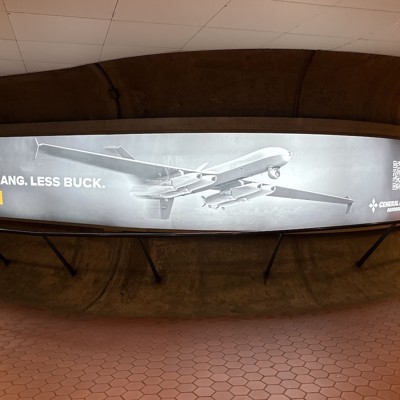
An advertisement for General Atomics' Massed Modular Aircraft offering in the Pentagon metro station. Used with permission
The Massed Modular Aircraft effort wants to bring a new ISR, strike drone to the frontlines.
The loss of dozens of MQ-9 Reapers to Iranian air defenses is speeding up the U.S. Air Force effort to replace its venerable strike-and-sensor remotely piloted aircraft with something cheaper yet better, service leaders say.
“As we get to the end of the MQ-9 life, there was some early talk of where do we want to go afterwards, and candidly, as a result of some of the losses that we've experienced in combat operations, that discussion sort of got accelerated,” said Lt. Gen. Christopher J. Niemi, the Air Force’s chief modernization officer, at a Thursday roundtable with reporters.
The service has lost at least 45 MQ-9s during Donald Trump’s war on Iran, roughly one-quarter of its fleet, the Washington Post reported in August. It’s not clear just how much that fleet cost, but an Air Force fact sheet puts the unit cost of one MQ-9 variant at $51 million in 2011 dollars—or nearly $82 million today.
Niemi said the service wants to buy at least 180 MQ-9 replacements, dubbed Massed Modular Aircraft, or MMA, and at a much cheaper price point. He said the price of one MMA should be about half of the $20 million Collaborative Combat Aircraft, whose first production contracts were awarded in June, four months ahead of schedule.
But those rough price goals—$20 million for a CCA, $10 million for an MMA—are for bare airframes, not the pricey sensors and systems that enable the drones to do their jobs.
As a service spokesperson put it later, the numbers “do not refer to total missionized costs.”
Niemi said this reflects lessons from past and ongoing wars.
“What we're seeing, in part based on our assessment of the threats around the world, and in part based on our real-world experience, is that you're going to lose more military hardware in future conflicts than you have historically, and that's what's driving us to this sort of fundamental principle that we need things that are easier to produce, cheaper to buy, and that we can afford to lose more of them,” he said. “Right now, we don't have a whole lot of that, so we're sort of trying to move the needle by bringing on things like MMA, so we have more options for the warfighter in the future.”
For that $10 million price tag, the service also wants an increased payload of 2,800 pounds and an unfueled combat radius of 2,300 nautical miles and 8,000 nautical miles for a one-way mission, according to a July Defense Innovation Unit solicitation . General Atomics, the Reaper’s manufacturer, has a souped-up version of the MQ-9, the SkyGuardian, which boasts a larger wingspan, range, and endurance. But top service officials don’t seem as likely to bet on it.
“One of the options that would be considered would be something like an MQ-9B, which is basically an updated and improved MQ-9A, but there are some reasons that we don't think that's the direction that we want to go as an Air Force,” Niemi said. “The main reason is, and and we're seeing this in our experience in the Middle East and as we look at threats around the world, that you need to have a portfolio of assets that's more attritable than the ones we've historically had.”
General Atomics spokesperson C. Mark Brinkley defended the Reaper’s service record and pointed out that the Air Force’s top uniformed leader has praised the aircraft’s use during Operation Epic Fury. He also said the company has worked with the Air Force “to hit cost targets for three decades” and that it would continue with other programs.
“The MQ-9’s unique combination of endurance, payload, range, sensors, weapons, connectivity, adaptability and reliability is precisely what enables mission effects that others struggle to replicate,” Brinkley said. “Today’s Reaper isn’t the same Reaper that rolled out 25 years ago. It’s been enhanced and upgraded many, many times. It’s also been called the MVP of Epic Fury, for good reason. We can debate many things, but at least we all agree that it’s a special aircraft that gets the job done.”
The Senate Armed Services Committee is backing the platform in its version of the 2027 National Defense Authorization Act by placing limits on how many can be retired and calls for more to be purchased by 2028.
General Atomics has also reportedly teased a new MMA offering with a 10,000-nautical-mile ferry range and claims that it can carry four Long Range Anti-Ship Missiles. Brinkely, while still defending the Reaper, also boosted its next-generation aircraft.
“Our new Wildfire aircraft addresses all of the concerns posed by the MMA solicitation. We can deliver years earlier and maintain the same high quality,” Brinkley said. “You can have everything that makes Reaper special, plus more, at a price that doesn’t break the bank. Reaper is special. Wildfire is special, too.”
NEXT STORY: The US military gets its own ChatGPT today
五角大楼地铁站内张贴的通用原子公司大规模模块化飞机广告。经许可使用。
大规模模块化飞机计划旨在将一种新型的ISR(情报、监视与侦察)打击无人机推向前线。
美国空军领导人表示,数十架MQ-9“死神”无人机被伊朗防空系统击落,正在加速美国空军用更便宜、性能更好的无人机取代其老旧的打击和侦察型遥控飞机。
“随着MQ-9无人机的寿命接近尾声,我们很早就开始讨论退役后的发展方向,坦白地说,由于我们在战斗行动中遭受了一些损失,这种讨论的进程加快了,”空军首席现代化官克里斯托弗·J·尼米中将在周四与记者举行的圆桌会议上说道。
据《华盛顿邮报》8月份报道,在唐纳德·特朗普对伊朗发动的战争中,美国空军至少损失了45架MQ-9无人机,约占其机队总数的四分之一。目前尚不清楚这批无人机的总价值,但一份空军情况说明书显示,2011年一架MQ-9无人机的单价为5100万美元,相当于今天的近8200万美元。
尼米表示,军方希望采购至少180架MQ-9的替代机型,即所谓的“模块化大规模作战飞机”(MMA),而且价格要便宜得多。他指出,一架MMA的价格应该只有价值2000万美元的“协同作战飞机”(CCA)的一半左右,后者的首批生产合同已于6月授予,比原计划提前了四个月。
但这些粗略的价格目标——CCA 2000 万美元,MMA 1000 万美元——指的是裸机,而不是使无人机能够执行任务的昂贵传感器和系统。
正如一位服务发言人后来所说,这些数字“并不是指任务总成本”。
尼米表示,这反映了过去和正在进行的战争所吸取的教训。
“我们看到的情况,一部分是基于我们对全球威胁的评估,一部分是基于我们的实际经验,那就是未来冲突中军事装备的损失将比以往更多。正是这一点促使我们遵循一个基本原则:我们需要更易于生产、更便宜购买,并且能够承受更多损失的装备,”他说道。“目前,我们在这方面做得还不够,所以我们正试图通过引入综合格斗(MMA)等技术来改变现状,以便未来为作战人员提供更多选择。”
根据国防创新部门7月份发布的招标书,为了这1000万美元的预算,军方还希望无人机的有效载荷增加2800磅,无燃料作战半径达到2300海里,单程飞行半径达到8000海里。死神无人机的制造商通用原子公司也推出了MQ-9的升级版——天空卫士,该机拥有更大的翼展、更远的航程和更长的续航时间。但军方高层似乎并不打算选择它。
“我们考虑的方案之一是MQ-9B,它基本上是MQ-9A的升级改进型,但出于一些原因,我们认为这不是空军应该发展的方向,”尼米说。“主要原因是,我们在中东的经验以及我们审视全球威胁时都看到,我们需要拥有比以往更易损耗的资产组合。”
通用原子公司发言人C·马克·布林克利为“死神”无人机的服役记录辩护,并指出空军最高指挥官曾对该机在“史诗狂怒行动”中的表现给予高度评价。他还表示,公司已与空军合作“三十年,始终致力于实现成本目标”,并将继续与其他项目合作。
布林克利说:“MQ-9无人机在续航能力、有效载荷、航程、传感器、武器、互联性、适应性和可靠性方面的独特组合,正是其能够完成其他无人机难以复制的任务效果的关键所在。如今的‘死神’无人机与25年前推出的‘死神’无人机已截然不同。它经过了多次改进和升级。它也被誉为‘史诗狂怒’行动的MVP,这绝非浪得虚名。我们可以就很多方面展开讨论,但至少我们都认同,这是一款能够出色完成任务的优秀无人机。”
参议院军事委员会在其 2027 年国防授权法案版本中支持该平台,限制了可退役的战机数量,并呼吁在 2028 年前购买更多战机。
据报道,通用原子公司还展示了一款新型多用途攻击机(MMA),其航程可达10000海里,并声称可携带四枚远程反舰导弹。布林克利在继续为“死神”无人机辩护的同时,也大力宣传了其下一代飞机。
“我们新推出的Wildfire飞机解决了MMA招标中提出的所有问题。我们可以提前数年交付,并保持同样的高质量,”布林克利说。“您可以拥有Reaper飞机的所有优点,甚至更多,而且价格实惠。Reaper很特别,Wildfire也很特别。”
下一篇:美军今天将推出自己的 ChatGPT