Near Russian border, NATO grapples with ground robots in combat在靠近俄罗斯边境的地方,北约正与地面机器人展开战斗。
“We are a little bit behind because we’ve been using only the air drones,” a Latvian commander said.
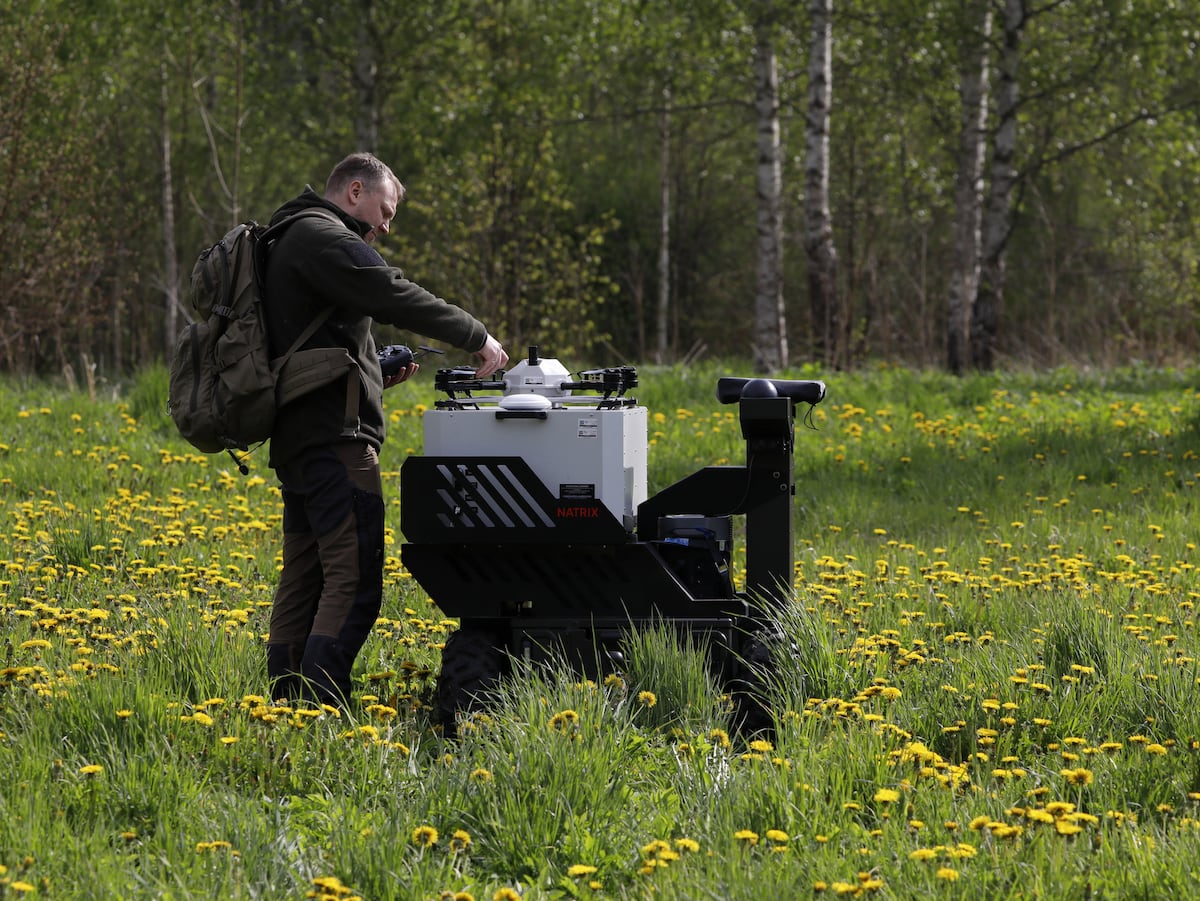
RIGA, Latvia — Exercising in Latvia’s dense pine and birch forests this week, local troops found themselves in an unfair fight against a new enemy: unmanned ground vehicles.
As NATO tries to keep pace with fast-changing drone warfare, the alliance used Latvia’s Crystal Arrow exercise to test unmanned ground combat, equipping opposing forces with wheeled robots. The systems gave the red team an element of surprise over a blue team relying only on aerial drones, said Lt. Col. Andris Brūveris , the Latvian battalion commander leading the opposing side.
“They are force multipliers, and they are here to stay,” said Brūveris, who commands Latvia’s 2nd Mechanized Infantry Battalion, in a briefing with reporters at the Sēlija training area in central Latvia on Monday, during a press trip organized by NATO.
“We are a little bit behind because we’ve been using only the air drones,” he added. “I hope we will move forward with this at a quick pace.”
Ukraine reshaped aerial drone warfare, and now appears poised to do the same for unmanned ground vehicles, with plans to buy 25,000 UGVs by the end of June. For Crystal Arrow, Brūveris relied on Ukrainian veterans for training and tactics, using wheeled robots for gathering intelligence, attacking enemy positions, resupply and casualty evacuation.
At the Sēlija training range, less than 200 kilometers from the border with Russia, the opposing force engaged the blue force using UGVs and aerial drones without direct troop-to-troop contact, according to Brūveris. After two days of reconnaissance, the exercise moved into a kinetic phase on Monday, with the opposing force pushing back the flanks of the blue force.
“We specifically, deliberately employed the UGVs here with the opposing forces to allow the friendly forces to understand what the threat was, and how they would counter that,” Brig. Gen. Chris Gent , Allied Land Command’s deputy chief of staff for transformation and integration, told Defense News.
Lt. Col. Andris Brūveris, center, commander of Latvia's 2nd Mechanized Infantry Battalion, speaks with staff at the Sēlija training area on May 11, 2026, during the Crystal Arrow 2026 exercise. (Rudy Ruitenberg/staff)
Brūveris said he made particular use of a small four-wheeled UGV from Estonia-based startup Ark Robotics , likening it to the ground-based equivalent of an aerial first-person view drone. Battle-proven in Ukraine and reminiscent of a toy radio-controlled car, Ark-1 can be used for reconnaissance or to race a 15-kilogram antitank mine into an enemy position at more than 40 kilometers per hour.
“So I can do road reconnaissance, and at the same time, if there is a valuable target, that’s a suicide drone, so I can do the kinetic effect as well,” Brūveris said. “This is really something new for me, and I implement that in my maneuvers a lot.”
In the exercise, the red team used the Ark-1 for reconnaissance up to 15 kilometers away, including when conditions were too windy to fly UAVs on Monday, according to Brūveris. The opposing force used the kinetic drone to take out a road obstacle defended by the blue forces, as well as hit enemy positions.
Ukraine has leaned on unmanned systems to compensate for Russia’s superior numbers, and ground drones are preferable to sending soldiers into unfamiliar terrain, a Ukrainian veteran with the callsign Sleb, in charge of training at Ark Robotics, told Defense News.
Brūveris said Latvian troops will now need to figure out how to fit UGVs into the military decision-making loop, after having done the same for aerial drones.
“The blue force is my sister battalion from the same brigade,” Brūveris said. “They haven’t seen the drones on the ground, I haven’t used the drones on the ground, so it’s a surprise for both of us. We’re both learning, and afterwards, we’ll have a good chat how it works out.”
NATO Allied Land Command is likewise keen to integrate the feedback as the alliance builds up its Eastern Flank Deterrence Initiative, and leaders including U.S. Army Gen. Chris Donahue, who commands the alliance’s Landcom as the head of United States Army Europe and Africa, made their way to Selija on Tuesday. NATO covered the cost of travel and accommodation for media attending the exercise and event, including for Defense News.
“What we are really interested in hearing is if these systems are able to provide tactical advantage, essentially, in the way that Lt. Col. Brūveris decided to employ them,” Sean Thorne, a Canadian reserve officer in charge of lessons learned and interoperability at Landcom, told Defense News.
He said Landcom is really looking for “organic, bottom-up experimentation” to understand how UGVs can be used at the tactical level.
Latvian troops of the Mechanized Infantry Brigade are pictured in the forests of the Sēlija training area in central Latvia on May 12, 2026, during the Crystal Arrow 2026 exercise. (Rudy Ruitenberg/staff)
What systems to buy and how many remains up to individual countries, with several studies underway about the “optimum force ratio” of crewed and uncrewed systems, Brig. Gen. Gent said. He said the alliance has done the math to decide on, for example, how many UGVs would equal a NATO capability target for a vehicle.
With every nation in NATO trying to shorten the procurement cycle, the next challenge becomes integrating the UGVs into doctrine, training and how troops actually use capabilities, Gent said.
Troops spent two to three days learning the systems alongside Ukrainian veterans and company representatives, according to Brūveris, who called the UGVs fairly simple to operate.
Due to its small size, some troops that received training to operate the UGVs in Crystal Arrow were initially dismissive of Ark-1, according to a Ukrainian with the callsign Backspace, who identified himself as the integration lead for Ark Robotics.
“Even guys from Latvia and Canada, on the first day of our training, they’re laughing, they’re joking that it’s just a toy,” Backspace told Defense News. “But yesterday on the operation, they were shocked. We are doing war like in a movie, because it’s really very powerful.”
Latvian troops were highly motivated, even if Ark Robotics usually takes more time to train troops in Ukraine, said trainer Sleb. A representative for Ukrainian firm UGV Laboratory who identified himself as Denys concurred, saying teaching Latvian operators was “pretty easy.”
“Our task is to learn from them and prepare ourselves, and that’s what we’re doing right now,” Brūveris said of the Ukrainian firms providing training and advice. In the exercise, he used reconnaissance drones at the platoon level, with kinetic ground robots attached to the maneuver companies.
The exercise also allowed suppliers to learn about challenges of the Baltic forest environment, as opposed to Ukraine, according to Brūveris. In addition to Ark Robotics, firms taking part within the NATO Task Force X framework were Latvia’s Natrix , Ukraine’s UGV Laboratory, Poland’s Husarion and Estonia’s Alfatec Group .
The Ark-1 unmanned ground vehicle by Ark Robotics (front) and the Simba UGV by Ukraine's UGV Laboratory are pictured in a demo near the Sēlija training area in Latvia on May 12, 2026, during the Crystal Arrow exercise. (Rudy Ruitenberg/staff)
Unmanned ground systems are at the stage where FPV drones were in 2023, according to Denys at UGV Laboratory. The company supplied its four-wheeled Simba drone, which can carry a load of more than 200 kilograms. The representative said he expects 2027 to be a boom for the industry. “Because right now it is impossible to fight without these UGVs, we wouldn’t survive without it.”
The Simba is used in Ukraine as a logistics drone to supply forward positions, and while not certified to do so, troops also use it to transport wounded soldiers back on return trips, according to Denys. With the Ukrainian battlefield changing fast, the platform is updated about every three months, and the company is working on a version with a weapon turret, he said.
A first lesson from using UGVs in Latvia was the need to plan missions around terrain and network coverage, with dense and boggy local forest interfering with control signals for the Starlink-equipped ground drones, something less of a concern in more open terrain in Ukraine.
Whereas aerial drone use is easy to plan as long as the weather cooperates, relying on satellite internet to control the ground robots meant planning the axis of advance to take into account tree coverage, according to Brūveris.
Brūveris said the exercise made clear Latvia needs ground-based systems to cover all war-fighting functions, including reconnaissance and strike missions. He said proof of their effectiveness was his company commanders in the field all asking when they would get back the UGVs being used for demos on Tuesday, because the robots were needed in the fight.
“These unmanned systems are the future, because one way or the other, it’s cheaper than people’s lives.”
Rudy Ruitenberg is a Europe correspondent for Defense News. He started his career at Bloomberg News and has experience reporting on technology, commodity markets and politics.
拉脱维亚里加——本周,在拉脱维亚茂密的松树和桦树林中进行演习的当地部队发现自己陷入了一场与新敌人的不公平战斗:无人地面车辆。
为了应对快速变化的无人机战争,北约利用拉脱维亚的“水晶箭”演习测试了无人地面作战能力,并为对立双方配备了轮式机器人。拉脱维亚营长安德里斯·布鲁韦里斯中校表示,这些系统使红队在面对仅依赖空中无人机的蓝队时获得了出其不意的优势。
“它们是力量倍增器,而且它们会一直存在,”拉脱维亚第二机械化步兵营营长布鲁韦里斯周一在北约组织的媒体考察之旅中,在拉脱维亚中部塞利亚训练区向记者举行的简报会上说道。
“我们进度有点落后,因为我们一直只使用无人机,”他补充道。“我希望我们能加快推进这项工作。”
乌克兰重塑了空中无人机作战格局,如今似乎也准备在无人地面车辆领域复制这一格局,计划在6月底前采购25000辆无人地面车辆。在“水晶箭”行动中,布鲁维里斯依靠乌克兰退伍军人进行训练和战术演练,利用轮式机器人收集情报、攻击敌方阵地、运送补给和撤离伤员。
据布鲁维里斯称,在距离俄美边境不到200公里的塞利亚训练场,假想敌部队使用无人地面车辆和无人机与蓝军交战,双方没有发生直接的兵力接触。经过两天的侦察,演习于周一进入实战阶段,假想敌部队从蓝军侧翼发起反击。
“我们特意在这里与敌对部队一起使用无人地面车辆,以便让友军了解威胁是什么,以及他们将如何应对,”盟军陆地司令部转型与整合副参谋长克里斯·根特准将告诉《防务新闻》。
2026年5月11日,在“水晶箭-2026”联合军事演习期间,拉脱维亚第二机械化步兵营营长安德里斯·布鲁韦里斯中校(图中)在塞利亚训练区与参谋人员交谈。(鲁迪·鲁伊滕贝格/工作人员摄)
布鲁维里斯表示,他特别使用了一款来自爱沙尼亚初创公司Ark Robotics的小型四轮无人地面车辆(UGV),并将其比作地面版的第一人称视角无人机。这款名为Ark-1的无人地面车辆在乌克兰战场上久经考验,外形酷似玩具遥控车,可用于侦察,或以超过40公里/小时的速度将15公斤重的反坦克地雷运送到敌方阵地。
“所以我可以进行道路侦察,同时,如果目标很重要,比如自杀式无人机,我也可以进行动能打击,”布鲁维里斯说。“这对我来说确实是全新的技能,我经常在演习中运用它。”
据布鲁维里斯称,在演习中,红队使用Ark-1无人机进行最远15公里范围内的侦察,包括周一因风力过大而无法飞行无人机的情况。敌方则使用这款动能无人机摧毁了蓝队防守的道路障碍物,并打击了敌方阵地。
乌克兰依靠无人系统来弥补俄罗斯在数量上的优势,而地面无人机比派遣士兵进入不熟悉的地形更可取。一位代号为“Sleb”的乌克兰退伍军人,在 Ark Robotics 公司负责训练工作,他告诉《防务新闻》。
布鲁维里斯表示,拉脱维亚军队现在需要弄清楚如何将无人地面车辆纳入军事决策流程,此前他们已经将空中无人机纳入了该流程。
“蓝军是我同旅的兄弟营,”布鲁维里斯说。“他们之前没见过地面无人机,我也没用过地面无人机,所以对我们俩来说都是个惊喜。我们都在学习,之后我们会好好聊聊效果如何。”
北约盟军陆地司令部同样热衷于将这些反馈意见纳入联盟的“东翼威慑倡议”建设中。包括美国陆军上将克里斯·多纳休在内的多位领导人于周二前往塞利贾参加演习。多纳休上将同时也是美国陆军欧洲和非洲司令部司令,他指挥着北约盟军陆地司令部。北约承担了包括《防务新闻》在内的所有媒体参加此次演习和活动的差旅和住宿费用。
“我们真正感兴趣的是,这些系统是否能够提供战术优势,本质上,就像布鲁维里斯中校决定使用它们那样,”负责陆军司令部经验教训和互操作性的加拿大预备役军官肖恩·索恩告诉《防务新闻》。
他说,陆战队真正寻求的是“自下而上的有机实验”,以了解如何在战术层面使用无人地面车辆。
2026年5月12日,在“水晶箭-2026”联合军演期间,拉脱维亚机械化步兵旅的士兵在拉脱维亚中部塞利亚训练区的森林中列队。(Rudy Ruitenberg/工作人员摄)
根特准将表示,采购哪些系统以及采购数量仍由各个国家自行决定,目前正在进行多项关于有人驾驶和无人驾驶系统“最佳兵力比例”的研究。他还表示,北约已经计算出,例如,需要多少辆无人地面车辆才能达到北约设定的车辆能力目标。
根特表示,随着北约各国都在努力缩短采购周期,下一个挑战是如何将无人地面车辆融入作战理论、训练以及部队实际使用能力的方式中。
据布鲁维里斯称,士兵们花了两到三天时间与乌克兰退伍军人和公司代表一起学习这些系统,他还称这些无人地面车辆操作起来相当简单。
据一位自称是 Ark Robotics 集成负责人、呼号为 Backspace 的乌克兰人称,由于 Ark-1 的尺寸较小,一些在 Crystal Arrow 接受过 UGV 操作训练的士兵最初对 Ark-1 不屑一顾。
“就连来自拉脱维亚和加拿大的士兵,在训练的第一天,都还在笑,开玩笑说这只是个玩具,”Backspace告诉《防务新闻》。“但昨天在实战中,他们都震惊了。我们打仗就像电影里演的那样,因为它威力真的非常强大。”
教官斯列布表示,尽管方舟机器人公司通常需要更多时间在乌克兰培训士兵,但拉脱维亚士兵的积极性很高。一位自称丹尼斯的乌克兰UGV实验室代表也表示赞同,称培训拉脱维亚操作员“相当容易”。
布鲁维里斯谈到提供培训和咨询的乌克兰公司时说:“我们的任务是向他们学习并做好准备,而这正是我们目前正在做的。” 在演习中,他使用了排级侦察无人机,机动连队则配备了地面机动机器人。
据布鲁维里斯称,此次演习还让供应商了解了波罗的海森林环境(而非乌克兰)所面临的挑战。除Ark Robotics外,参与北约第十特遣部队框架下演习的公司还包括拉脱维亚的Natrix、乌克兰的UGV Laboratory、波兰的Husarion和爱沙尼亚的Alfatec Group。
2026年5月12日,在拉脱维亚塞利亚训练区附近举行的“水晶箭”联合军演期间,Ark Robotics公司的Ark-1无人地面车辆(前)和乌克兰无人地面车辆实验室的Simba无人地面车辆正在进行演示。(Rudy Ruitenberg/工作人员摄)
据UGV实验室的Denys称,无人地面系统目前的发展阶段相当于FPV无人机在2023年的发展阶段。该公司提供了其四轮Simba无人机,该无人机可承载超过200公斤的载荷。这位代表表示,他预计2027年将是该行业的爆发式增长期。“因为现在没有这些无人地面车辆就无法作战,没有它们我们就无法生存。”
据丹尼斯称,辛巴无人机在乌克兰被用作后勤无人机,为前线阵地提供补给。虽然它尚未获得相关认证,但部队也用它来运送受伤士兵返回基地。由于乌克兰战场形势瞬息万变,该平台大约每三个月进行一次升级,公司目前正在研发配备武器炮塔的版本。
在拉脱维亚使用无人地面车辆 (UGV) 的第一个教训是,需要根据地形和网络覆盖范围来规划任务,因为当地茂密的沼泽森林会干扰配备 Starlink 的地面无人机的控制信号,而这在乌克兰更开阔的地形中则不太成问题。
布鲁维里斯表示,虽然只要天气配合,使用无人机进行空中作业很容易计划,但依靠卫星互联网控制地面机器人则意味着需要规划前进轴线,以考虑到树木覆盖情况。
布鲁韦里斯表示,此次演习清楚地表明,拉脱维亚需要地面系统来承担所有作战职能,包括侦察和打击任务。他说,这些系统的有效性体现在他所在连队的指挥官们都在询问周二用于演示的无人地面车辆何时才能归还,因为这些机器人在战斗中至关重要。
“这些无人系统代表着未来,因为无论如何,它们都比人的生命更划算。”
鲁迪·鲁伊滕贝格是《防务新闻》的欧洲记者。他的职业生涯始于彭博新闻社,拥有报道科技、大宗商品市场和政治方面的经验。