Iconic brick-faced Tampines HDB project will be painted to fix water seepage; plan criticised淡滨尼标志性砖墙组屋项目将重新粉刷以解决渗水问题;该计划受到批评
Residents debate plans to paint Tampines’ iconic brick-faced HDB blocks, balancing heritage preservation with maintenance needs and new colour scheme options. Read more at straitstimes.com.
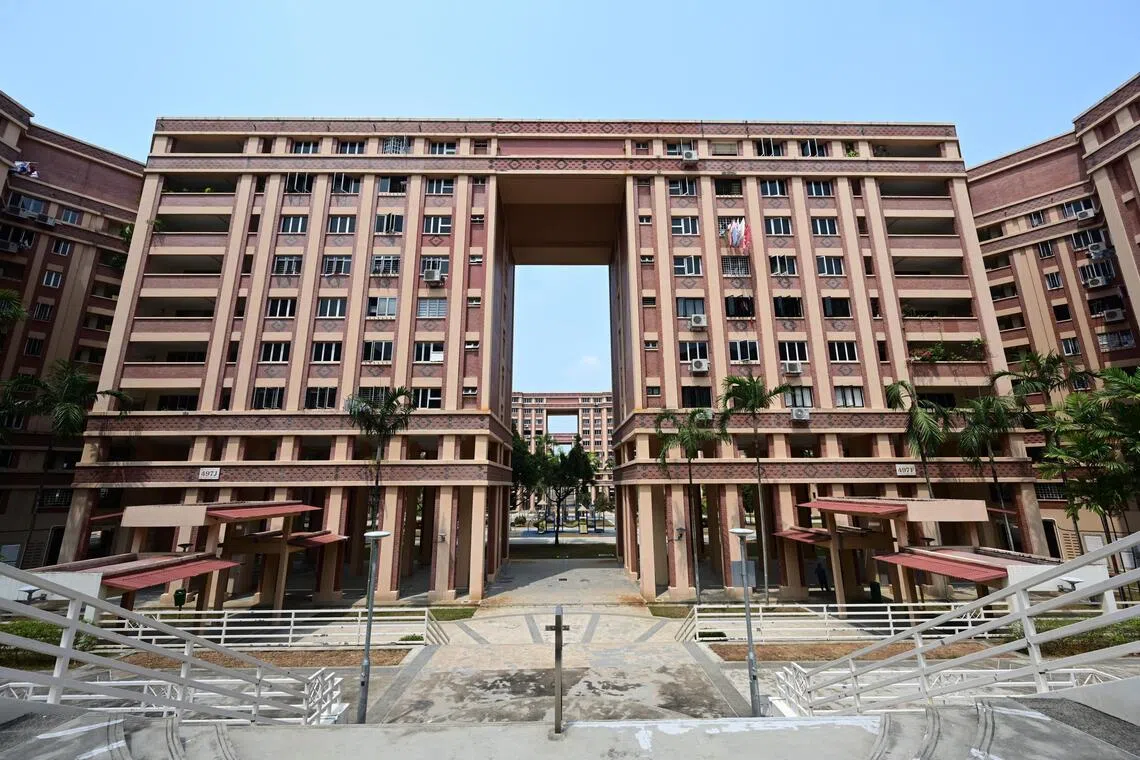
The project was the first to be awarded under the Housing Board’s Design and Build scheme.
ST PHOTO: NG SOR LUAN
Published Sep 09, 2026, 02:40 PM
Updated Sep 09, 2026, 02:40 PM
An iconic Tampines HDB project with distinctive brick facades faces a painting plan that has drawn criticism for potentially affecting its unique architectural character.
Residents are voting on three colour schemes, with opinions split between preserving the brickwork and repainting to address water seepage issues.
Heritage experts and residents urge repairs targeting water ingress causes instead of full painting, warning that paint could damage the bricks and erase the estate's identity.
SINGAPORE – An iconic eight-block public housing project in Tampines with a distinctive brick-faced facade – left largely unpainted for over 30 years – is scheduled for a repair-and-paint job that has drawn some criticism over concerns that the buildings’ unique identity would be lost.
Residents of the eight blocks – 497A to D, 497F to H and 497J Tampines Street 45 – have been asked to cast their votes for one of three proposed colour schemes in the planned Repairs and Redecoration (R&R) exercise to fix water seepage issues .
The poll started on Aug 31 and will end on Sept 13.
Of the three colour scheme options, one closely matches the block’s original colour palette, while another largely retains the palette but introduces some variations. The third is a complete overhaul of the blocks’ look.
While some residents who spoke with The Straits Times said they do not want a radical change in the blocks’ colours, other residents and industry observers opposed the very act of painting over the exposed brick facade.
Yeo Kang Shua, Hokkien Foundation Professor in Architectural Conservation at the Singapore University of Technology and Design, said: “They may not be formally conserved buildings, but that does not mean that their architectural character is without value.
“These blocks have become very recognisable precisely because of their fair-faced brickwork.”
In a statement to ST on Sept 8, Tampines Town Council said residents have various views on how the works should be carried out for the blocks.
“Some would like a more colourful paint scheme and a move away from the brick façade, while others feel that the exposed brick façades should be preserved because of their distinctive character and heritage value,” said the town council .
The three colour scheme options on display at one of the blocks in Tampines Street 45. ST PHOTO: NG SOR LUAN
The three colour scheme options on display at one of the blocks in Tampines Street 45.
It also said it considered residents’ feedback during the last R&R cycle from 2017 to 2019, and painted areas of the walls affected by water seepage, using a colour that closely matched the original brickwork.
“However, as the brickwork has aged since, further seepage has affected residents’ homes,” the town council explained.
Architectural photographer Darren Soh in an Instagram post on Sept 4 called on Tampines Town Council to carry out localised repair works to areas of brick deterioration instead of painting over the brick facade entirely.
Fully painting over the bricks “unfortunately would completely wipe out the spirit and essence of the estate”, he said.
The town council said while treating only the affected areas was considered and would preserve more of the exposed brickwork, it “would also leave residents facing recurring seepage, repeated repairs and the inconvenience that comes with them”.
“Professional evaluations now support painting over the brick surfaces, as the paint provides better protection against weather and water seepage over time,” it said.
Still, heritage advocates like Yeo and Soh hope more can be done to avoid a complete paint-over .
Soh told ST that “a disturbing trend proliferated in the last 10 to 15 years has been the painting over of fair-faced brick or brick-tiled HDB facades in estates such as Bishan North and Hougang”.
He pointed to blocks such as 158 to 161 Hougang Street 11, and various estates in Bishan Street 22 and 24.
“ Many of these estates that used to employ a generous amount of fair-faced red brick in their facades have become painted brick estates. Unfortunately, painting brickwork in a shade of red that tries to match the original brick colour is not the same as leaving the bricks alone,” he said.
Once an opaque coating is applied to bricks, said Yeo, “much of the texture and variation of the original brickwork will inevitably be lost”.
Fair-faced brickwork facade – referring to brickwork that is not covered over with plaster or paint – was intended to be the architectural finish for the blocks, and “its colour, texture, mortar joints and natural variations are all part of the architectural expression of these blocks”, said Yeo.
This is true of all HDB blocks with brick facades and not just the Tampines Street 45 project, he added.
Some of the blocks’ bricks have been painted over in previous Repairs and Redecoration cycles (top), while others have been left exposed (bottom). ST PHOTO: NG SOR LUAN
Some of the blocks’ bricks have been painted over in previous Repairs and Redecoration cycles (top), while others have been left exposed (bottom).
Soh noted that the project – formally called Tampines Neighbourhood 4 Contract 24 (N4 C24) by the HDB – is of historical significance.
The 620-unit project was in 1992 the first to be awarded under the board’s Design and Build scheme, which aimed to promote private architects’ participation in HDB developments, and introduce greater variety in public housing projects.
From the 10 proposals received for the project, the winning team was formed by P&T Consultants – the project’s architect and engineer – and Kajima Overseas Asia, the contractor.
The project received an honourable mention at the 1995 edition of the Singapore Institute of Architects’ Architectural Design Awards – a feat Soh said is usually reserved for projects that cost much more.
A 1995 review of the project in a journal by the Singapore Institute of Architects said: “What is most successful in this project is its sense of identity and presence without having to resort to surface decoration and pastiche.
“The confident use of brick and its articulation demonstrates a sensitivity not commonly seen nowadays among housing projects, both public and private.”
The fair-faced brickwork of the blocks’ facade have made them an icon in Tampines. ST PHOTO: NG SOR LUAN
The fair-faced brickwork of the blocks’ facade have made them an icon in Tampines.
Yeo said painting over fair-faced brickwork should not in itself be taken as a solution to water ingress, adding that this often treats the symptom rather than the underlying cause.
The better approach, he said, is to diagnose the source of the water ingress and carry out the necessary repairs, rather than simply applying a coating over the entire façade.
In fact, applying an impermeable or insufficiently vapour-permeable coating to the bricks could stop the brickwork from drying naturally and cause more damage, he added.
Five residents of Tampines N4 C24 who spoke with ST did not raise concerns over water seepage through the walls , and were generally against a complete overhaul of the blocks’ colours.
Masturah Maidin, 37, a resident of four years, said she was against painting over the bricks.
She pointed to another cluster of HDB blocks at the intersection of Tampines Street 45 and Tampines Avenue 9 that previously had a fair-faced brick facade and was painted over in a black-and-white scheme.
“I understand that some may want a fresher look and that repainting happens all the time, but painting over bricks is really said,” she said. “The blocks that are now black-and-white have lost their charm.”
Another resident, who gave his name as Low and has lived in Tampines N4 C24 since it was built, said he hopes that any change to the blocks’ facade will not depart from its current colour scheme.
Speaking in Mandarin, the 82-year-old retired Chinese teacher said that the longstanding brick facades have made the blocks an icon for Tampines, adding that they were immortalised in the popular Channel 8 sitcom Don’t Worry, Be Happy.
The fair-faced brickwork of the blocks’ facade have made them an icon in Tampines. PHOTO: ST FILE
Yet another long-time resident who gave his name as Ahmad, said he would rather the brickwork be left alone.
“The first colour scheme (which matches the existing colours) is more minimalist, which is preferred, but I feel it still overcomplicates things,” said the 41-year-old.
He said “taxi drivers all know where the ‘Tampines red blocks’ are, they are as recognisable as the chap laus in other HDB towns”, referring to the Hokkien term used to describe 10-storey HDB blocks.
Tampines Town Council said as it plans for improvements, “we will continue to carefully balance the estate’s long-term maintenance needs with preserving the distinctive character and identity that hold special meaning for the community.
“Residents’ views are an important part of this process.”
Ng Keng Gene is a correspondent at The Straits Times, reporting on issues relating to land use, urban planning and heritage.
该项目是建屋发展局设计建造计划下首个中标项目。
圣徒照片:吴索銮
发布于2026年9月9日下午2:40
更新于2026年9月9日下午2:40
淡滨尼一处标志性的组屋项目,以其独特的砖砌外墙而备受争议,一项粉刷计划因可能影响其独特的建筑特色而遭到批评。
居民们正在对三种配色方案进行投票,意见分歧在于是保留砖墙还是重新粉刷以解决渗水问题。
文物专家和居民敦促进行针对渗水原因的维修,而不是全面粉刷,他们警告说,油漆可能会损坏砖块并抹去庄园的特色。
新加坡——淡滨尼一个标志性的八栋公共组屋项目,其独特的砖砌外墙——30多年来基本未曾粉刷——计划进行修缮和粉刷,但此举引发了一些批评,人们担心这些建筑的独特个性会因此丧失。
淡滨尼 45 街 497A 至 D 座、497F 至 H 座和 497J 座这八座楼的居民被要求投票选出三种拟议配色方案之一,这是计划中的维修和重新装修 (R&R) 工作的一部分,旨在解决渗水问题。
本次民意调查于8月31日开始,将于9月13日结束。
三种配色方案中,一种与方块的原始配色方案非常接近,另一种基本保留了原有配色方案但进行了一些变化,第三种方案则对方块的外观进行了彻底的重新设计。
虽然一些接受《海峡时报》采访的居民表示,他们不希望楼宇的颜色发生根本性改变,但其他居民和业内人士则反对在裸露的砖墙上涂漆。
新加坡科技设计大学福建基金会建筑保护教授杨康舒表示:“它们可能不是正式的保护建筑,但这并不意味着它们的建筑特色没有价值。”
“这些街区之所以如此容易辨认,正是因为它们采用了裸露的砖墙。”
淡滨尼市镇理事会在9月8日向《海峡时报》发表声明称,居民们对这些组屋的施工方式持有不同意见。
镇议会表示:“有些人希望采用更鲜艳的油漆方案,并摒弃砖砌外墙,而另一些人则认为应该保留裸露的砖砌外墙,因为它们具有独特的特色和历史价值。”
淡滨尼45街一栋组屋展示的三种配色方案。(海峡时报照片:黄淑銮)
在淡滨尼 45 街的其中一栋楼里,展示了三种配色方案。
该公司还表示,在 2017 年至 2019 年的上一次维修和改造周期中,他们考虑了居民的反馈意见,并使用与原砖砌体颜色非常接近的颜色粉刷了受渗水影响的墙壁区域。
“然而,随着砖墙老化,渗漏进一步影响了居民的房屋,”镇议会解释说。
建筑摄影师 Darren Soh 于 9 月 4 日在 Instagram 上发帖,呼吁淡滨尼市镇理事会对砖块损坏的区域进行局部维修,而不是将整个砖墙全部涂上油漆。
他说,将砖墙完全涂上油漆“很遗憾会彻底抹去这处房产的精神和精髓”。
镇议会表示,虽然只处理受影响的区域是可以考虑的,这样可以保留更多裸露的砖墙,但这“也会让居民面临反复渗漏、反复维修以及由此带来的不便”。
“专业评估现在支持在砖面上涂漆,因为油漆可以更好地防止风吹雨打和水渗入,”报告称。
不过,像 Yeo 和 Soh 这样的文物保护倡导者仍然希望能够采取更多措施来避免彻底粉刷。
Soh 告诉《海峡时报》,“过去 10 到 15 年间,碧山北和后港等地区的组屋外墙,尤其是砖墙或砖瓦外墙,出现了一种令人不安的趋势,那就是被涂上油漆”。
他指着后港 11 街 158 至 161 号楼,以及碧山 22 街和 24 街的各个住宅区。
“许多过去外墙大量使用清水红砖的住宅区,现在都变成了涂漆砖房。不幸的是,用试图与原砖颜色相匹配的红色油漆粉刷砖墙,与保留砖块原有的质感是截然不同的,”他说道。
Yeo表示,一旦在砖块上涂上不透明的涂层,“原砖砌体的许多纹理和变化将不可避免地消失”。
叶先生说,裸露的砖砌外墙——指的是没有用灰泥或油漆覆盖的砖砌外墙——原本是打算作为这些砖块的建筑饰面,“它的颜色、纹理、砂浆接缝和自然变化都是这些砖块的建筑表现形式的一部分”。
他补充说,这种情况适用于所有砖砌外墙的组屋,而不仅仅是淡滨尼45街项目。
部分楼宇的砖块在之前的修缮和重新装修中被重新粉刷过(上图),而另一些则保留了原貌(下图)。(海峡时报摄影:黄素銮)
在之前的修缮和重新装修周期中,一些砖块被涂上了油漆(上图),而另一些砖块则被保留了下来(下图)。
Soh指出,该项目(由建屋发展局正式命名为淡滨尼邻里4期第24期合约(N4 C24))具有历史意义。
这个拥有 620 个单元的项目是 1992 年第一个根据建屋发展局的设计与建造计划授予的项目,该计划旨在促进私人建筑师参与建屋发展局的开发,并在公共住房项目中引入更多样化的方案。
在收到的 10 份项目方案中,最终中标团队由 P&T Consultants(该项目的建筑师和工程师)和 Kajima Overseas Asia(承包商)组成。
该项目在 1995 年新加坡建筑师协会建筑设计奖中获得荣誉提名——Soh 表示,这一成就通常只授予成本更高的项目。
1995 年,新加坡建筑师协会在一份期刊上对该项目进行了评论,称:“该项目最成功之处在于它展现出的身份感和存在感,而无需诉诸表面装饰和模仿。
“砖块的巧妙运用和精细的造型,展现了一种如今在公共和私人住宅项目中都不常见的审美眼光。”
这些组屋外墙的浅色砖砌结构使它们成为淡滨尼的标志性建筑。(海峡时报照片:黄淑銮)
这些楼房外墙的浅色砖砌结构使它们成为淡滨尼的标志性建筑。
Yeo表示,在清水砖墙上涂漆本身并不应被视为解决渗水问题的办法,并补充说,这通常只是治标不治本。
他表示,更好的办法是诊断出渗水源头并进行必要的维修,而不是简单地在整个外墙上涂上一层涂料。
他补充说,事实上,在砖块上涂抹不透水或透气性不足的涂层可能会阻止砖块自然干燥,造成更大的损害。
五位淡滨尼 N4 C24 的居民接受《海峡时报》采访时,并未对墙体渗水表示担忧,并且普遍反对彻底改变楼宇的颜色。
37岁的马斯图拉·迈丁(Masturah Maidin)已在此居住四年,她说她反对在砖墙上涂漆。
她指着淡滨尼 45 街和淡滨尼 9 道交叉口的另一片组屋,那里以前是浅砖外墙,后来被漆成了黑白相间的颜色。
“我理解有些人想要焕然一新的外观,重新粉刷也很常见,但是直接在砖墙上涂漆真的有点过了,”她说。“现在变成黑白相间的砖块已经失去了原有的魅力。”
另一位自称Low的居民,自淡滨尼N4 C24建成以来就一直住在这里,他说他希望对楼宇外立面的任何改动都不会偏离其目前的配色方案。
这位 82 岁的退休中文教师用普通话说道,这些历史悠久的砖砌外墙使这些楼房成为淡滨尼的标志性建筑,并补充说,它们在热门的 8 频道情景喜剧《别担心,要快乐》中得到了永垂不朽的展现。
这些组屋外墙的浅色砖砌结构使它们成为淡滨尼的标志性建筑。(图片:海峡时报档案)
另一位名叫艾哈迈德的老居民表示,他宁愿砖墙保持原样。
这位 41 岁的男子说:“第一种配色方案(与现有颜色相匹配)更简约,这是人们所喜欢的,但我感觉它仍然把事情搞得太复杂了。”
他说:“出租车司机都知道‘淡滨尼红楼’在哪里,它们就像其他组屋区的楼房一样容易辨认”,他指的是福建话中用来描述10层组屋的词语。
淡滨尼市镇理事会表示,在制定改进计划时,“我们将继续谨慎地平衡该住宅区的长期维护需求与保护其对社区具有特殊意义的独特特征和身份。
“居民的意见是这一过程的重要组成部分。”
吴庆根是《海峡时报》的记者,报道与土地利用、城市规划和遗产相关的问题。