Leaning on civilian sales, Airbus pushes H145M helicopter in Poland空客公司依靠民用销售,在波兰大力推广H145M直升机
The bid to sell the H145 light utility helicopter comes more than eight years after Poland scrapped a purchase of Airbus H225M tactical-transport helos.
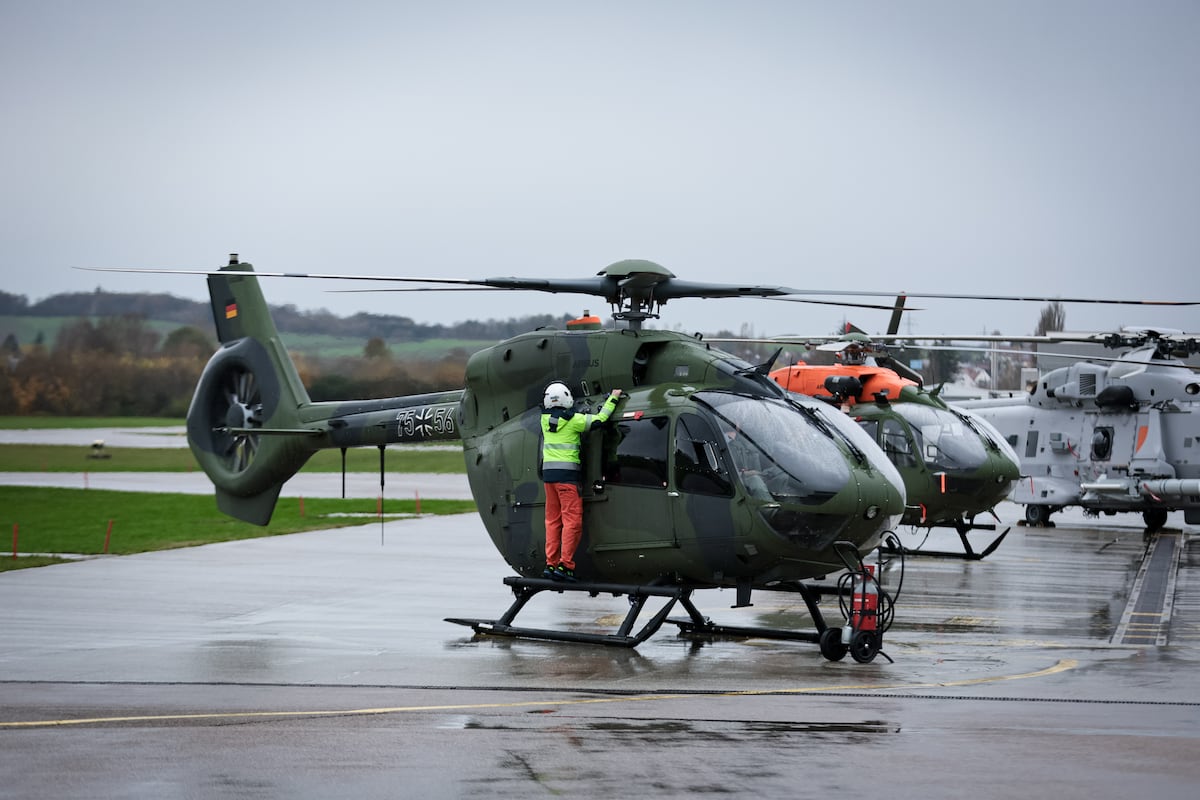
PARIS — Airbus Helicopters is looking to translate success in Poland selling rotorcraft for civilian and para-public markets into military orders, offering the H145M as a versatile option for light attack and training missions, the company’s head of sales for Eastern Europe said.
The twin-engine H145 can serve as an advanced training platform, bridging the gap to heavier helicopters acquired by Poland such as the Apache, while being agile and large enough to provide a multi-role capability, Ludovic Boistot, Airbus Helicopters vice president of sales Eastern Europe and CIS, told Defense News in an interview last week ahead of the Paris Air show.
“We are a key partner to Poland, but in the civil and para-public sectors,” Boistot said. “We are trying to demonstrate that Airbus Helicopters is a good partner, also for defense.”
The bid to sell the H145 light utility helicopter comes more than eight years after Poland scrapped a purchase of Airbus H225M tactical-transport helicopters, following a change of government, and prompting a legal fight by Airbus for compensation. Now the company is again looking to sell military helicopters to Poland, as the government of Prime Minister Donald Tusk signals openness to closer security cooperation with European partners including on defense procurement.
The Airbus Helicopters presence in the civilian market means the company has the setup to support Poland, according to Boistot. Airbus, Babcock and CAE signed a memorandum of understanding last month to partner on providing the Polish Air Force with H145M helicopters, training and simulation.
The company strategy in Poland is to be a partner, and Airbus Helicopters has trained more than 130 engineers there that work on key programs, according to Boistot. With European countries looking to develop their sovereignty, Airbus wants to propose a solution where local Polish entities have all capabilities to perform maintenance on the H145 and can integrate components, he said.
“In terms of cooperation, we have always been here, even if the defense market was not yet successful for us,” Boistot said.
The Polish Ministry of National Defence last year announced plans to buy 24 helicopters for pilot training that could partly replace the military’s Soviet-era Mil Mi-2 rotorcraft. The Polish Armed Forces own less than 60 such helicopters, not all of them operational. Poland upgraded 16 Mi-2s in 2018, enabling the military to use them for training purposes.
The H145 will be a “key element” in Poland, and Airbus Helicopters is sizing up local partners to address the Polish needs “in a structured way,” Boistot said. He said the approach to partnerships in Eastern Europe will vary from country to country, and the fact that Poland has local industry means working together makes sense.
The time frame and technical specification for the potential purchase of training helicopters are yet to be disclosed, a spokesman for the defense ministry told Defense News. Separately, Poland’s armaments agency on Friday announced that it cancelled a procurement process to buy an additional 32 Black Hawk helicopters.
A previous government led by Tusk decided in 2015 to buy 50 H225M Caracal helicopters from Airbus, but the purchase was canceled the following year after the right-wing Law and Justice party took over power in Poland.
As Poland ramps up defense spending in response to a threatening Russia, upgrading its helicopter fleet is one of the key modernization programs. In August 2024, Warsaw ordered 96 AH-64E Apache helicopters in a deal worth about $10 billion, with manufacturer Boeing scheduled to start deliveries in 2028.
With the H145 a reference in Europe in the light utility-helicopter segment, the Polish military buying the model would allow for interoperability and create opportunities for inter-governmental cooperation, according to Boistot.
Some competitors are offering to provide the entire helicopter and training package, whereas Airbus chose to work with Babcock and CAE rather than handle everything itself, something that Boistot said would have been difficult due to the complexity.
Whereas Leonardo has a local manufacturing presence, Airbus Helicopters is counting on knowledge transfer and training engineers locally as a key selling point, according to Boistot. He also said the Leonardo offer may be less suitable for the multi-role capability.
“We are quite confident that the solution we propose would make sense, and I think it’s also good for Poland at some point of time to work with Airbus Helicopters on defense,” Boistot said.
Manned-unmanned teaming, combining helicopters and drones, is another key selling point for Poland and Eastern Europe more broadly, according to the executive. Airbus is “quite advanced” on helicopters cooperating with drones, having performed multiple tests of crewed-uncrewed teaming, Boistot said.
Countries in Eastern Europe and Central Asia still operate hundreds of Soviet-era helicopter designs such as the Mi-8, Mi-17 and Mi-24, and will be a key growth market for helicopters, according to Boistot. Ukraine may also have to replace a lot of Mi-type helicopters, depending on how the war goes, he said.
The Airbus Helicopter head of sales for Eastern Europe said his team is “super busy,” with “a lot going on for most of the platforms.”
The H225 “remains a strong asset,” and prospects for sales in other countries look “promising,” Boistot said, declining to comment on whether countries in Eastern Europe are interested in the model. The executive said Airbus does not currently have a campaign to sell the helicopter in Poland, but would “happy to explain what our offer is now.”
Rudy Ruitenberg is a Europe correspondent for Defense News. He started his career at Bloomberg News and has experience reporting on technology, commodity markets and politics.
Jaroslaw Adamowski is the Poland correspondent for Defense News.
巴黎——空中客车直升机公司东欧销售主管表示,该公司正寻求将向波兰民用和准公共市场销售旋翼机的成功经验转化为军用订单,并将 H145M 作为轻型攻击和训练任务的多功能选择。
空客直升机公司东欧和独联体销售副总裁卢多维克·博伊斯托在上周巴黎航展前接受《防务新闻》采访时表示,双引擎H145可以作为先进的训练平台,弥合波兰采购的更重型直升机(如阿帕奇)之间的差距,同时它足够灵活和庞大,可以提供多用途能力。
“我们是波兰在民用和准公共领域的重要合作伙伴,”博伊斯托特说。“我们正在努力证明,空客直升机公司也是一个优秀的合作伙伴,在国防领域也是如此。”
在波兰政府更迭后取消购买空客H225M战术运输直升机的计划八年多之后,空客公司提起诉讼要求赔偿。如今,空客公司再次寻求向波兰出售军用直升机,因为总理唐纳德·图斯克领导的政府表示愿意与欧洲伙伴加强安全合作,包括国防采购方面的合作。
博伊斯托表示,空客直升机在民用市场的业务意味着该公司有能力为波兰提供支持。上个月,空客、巴布科克和CAE签署了一份谅解备忘录,合作向波兰空军提供H145M直升机、培训和模拟设备。
据博伊斯托特称,公司在波兰的战略是成为合作伙伴,空客直升机已在当地培训了130多名工程师,参与关键项目。他表示,鉴于欧洲各国都在寻求提升自身主权,空客希望提出一种解决方案,使波兰当地企业具备H145直升机的全部维护能力,并能集成相关部件。
“就合作而言,我们一直都在这里,即使国防市场对我们来说还没有取得成功,”博伊斯托说。
波兰国防部去年宣布计划采购24架直升机用于飞行员训练,以部分取代军方现役的苏联时代米-2直升机。波兰武装部队目前拥有不到60架米-2直升机,且并非全部处于服役状态。波兰于2018年对16架米-2直升机进行了升级改造,使其能够用于军事训练。
博伊斯托表示,H145直升机将成为波兰市场的“关键要素”,空客直升机公司正在评估当地合作伙伴,以“系统化的方式”满足波兰的需求。他还指出,东欧各国的合作方式各不相同,而波兰拥有本土产业,因此开展合作是明智之举。
国防部发言人告诉《防务新闻》,采购训练直升机的具体时间和具体技术规格尚未公布。另据报道,波兰军备局周五宣布取消增购32架黑鹰直升机的采购计划。
图斯克领导的前一届政府在 2015 年决定从空客公司购买 50 架 H225M Caracal 直升机,但第二年,右翼法律与公正党在波兰掌权后,这笔采购被取消了。
为应对俄罗斯的威胁,波兰加大国防开支,升级直升机机队是其关键的现代化项目之一。2024年8月,华沙订购了96架AH-64E“阿帕奇”直升机,合同价值约100亿美元,制造商波音公司计划于2028年开始交付。
博伊斯托表示,H145 是欧洲轻型通用直升机领域的标杆,波兰军方购买该型号直升机将实现互操作性,并创造政府间合作的机会。
一些竞争对手提供整套直升机和培训方案,而空客则选择与巴布科克和 CAE 合作,而不是自己处理所有事情。博伊斯托表示,由于复杂性,自己处理所有事情会很困难。
博伊斯托表示,虽然莱昂纳多公司在当地设有制造工厂,但空客直升机公司则将知识转移和本地工程师培训作为其关键卖点。他还指出,莱昂纳多公司的方案可能不太适合多用途直升机的需求。
“我们非常有信心,我们提出的解决方案是合理的,而且我认为,在某个时候,波兰与空客直升机公司在国防领域开展合作对波兰也有好处,”博伊斯托特说。
据这位高管称,直升机与无人机协同作战是空客在波兰乃至整个东欧市场的另一项关键卖点。博伊斯托表示,空客在直升机与无人机协同作战方面“相当先进”,已经进行了多次有人-无人协同作战测试。
博伊斯托特表示,东欧和中亚国家目前仍在使用数百架苏联时代的直升机,例如米-8、米-17和米-24,这些地区将成为直升机的重要增长市场。他还说,乌克兰可能也需要更换大量米系列直升机,具体情况取决于战争的走向。
空客直升机东欧销售主管表示,他的团队“非常忙碌”,“大多数平台都有很多事情要做”。
博伊斯托表示,H225“仍然是一项强劲的资产”,在其他国家的销售前景“一片光明”,但他拒绝就东欧国家是否对该机型感兴趣发表评论。这位高管表示,空客目前没有在波兰开展销售该款直升机的活动,但“乐于解释我们目前的报价”。
鲁迪·鲁伊滕贝格是《防务新闻》的欧洲记者。他的职业生涯始于彭博新闻社,拥有报道科技、大宗商品市场和政治方面的经验。
Jaroslaw Adamowski 是《防务新闻》驻波兰记者。