At Taiwan arms show, vendors bank on cheap weapons for big damage在台湾武器展上,供应商指望用廉价武器造成巨大破坏。
With the support of the U.S. administration seen as iffy, Taipei officials try to diversify their roster or weapons suppliers.
CHRISTCHURCH, New Zealand — The Taipei Aerospace and Defense Exhibition, TADTE for short, opened its doors on Sep. 18 to promote the latest Taiwanese defense products and to showcase recent acquisitions.
The event came as Taiwan considers the best way forward to counter aggressive Chinese maneuvers, which analysts say are designed to soften the island for an eventual confrontation.
Beijing is clear about its ambitions. Defense Minister Dong Jun told an audience of international military officials at the Beijing Xiangshan Forum this week that the “restoration” of Taiwan to China “is an integral part of the post-war international order.”
Dong warned China would “never allow any separatist attempts for Taiwan independence to succeed,” and that it would thwart “any external military interference.”
Current Taiwanese thinking is that asymmetric weapons – ones that do not cost too much to buy but which exact a heavy price on the enemy – are the best way for Taipei to deter a Chinese invasion.
And such systems were prevalent at TADTE 2025. In fact, the number of exhibitors at the show nearly doubled to 490 compared to just two years ago. Furthermore, there were 51 brand new products on display.
Among them were weapons recently acquired from the U.S., such as an M1A2T Abrams tank and HIMARS rocket launcher sitting side-by-side. To date, Taiwan has received 80 of 108 Abrams, and 11 of 29 HIMARS.
American companies, of which more than 40 were exhibiting at TADTE 2025, are supplying smaller asymmetric systems too. One example is AeroVironment and its Switchblade 300 loitering munition.
To diversify its arms sources, Taiwan’s National Chung-Shan Institute of Science and Technology (NCSIST) signed a slew of agreements on the opening day of TADTE 2025. Among them were deals involving the Overwatch Interceptor counter-drone missiles from AirShare in Canada and Dive-LD underwater drones from Anduril Industries.
Furthermore, earlier this year NCSIST inked an agreement to explore mass production of Anduril’s Barracuda-500 low-cost cruise missile in Taiwan.
Li Shih-chiang, NCSIST’s president, explained: “The entire supply chain of the missile will be in Taiwan. That’s the overall direction of all future cooperation.”
“Our goal is that if war or a blockade starts, we’d be able to manufacture every weapon we need to protect ourselves,” Lee added. Reportedly, the aim is to manufacture missiles in Taiwan for no more than quarter of a million dollars each.
Taiwan unveiled the Chiang-Kong (Strong Bow) air defense missile designed to intercept Chinese ballistic missiles in their midcourse phase. (Taiwan MOD)
The Ukraine war demonstrated how stocks of high-cost missiles rapidly deplete in conflicts, and how a constant supply of lower-cost, mass-produced missiles would alleviate this bottleneck. Taiwan therefore wants a truck-launched version of the Barracuda that can hit enemy ships.
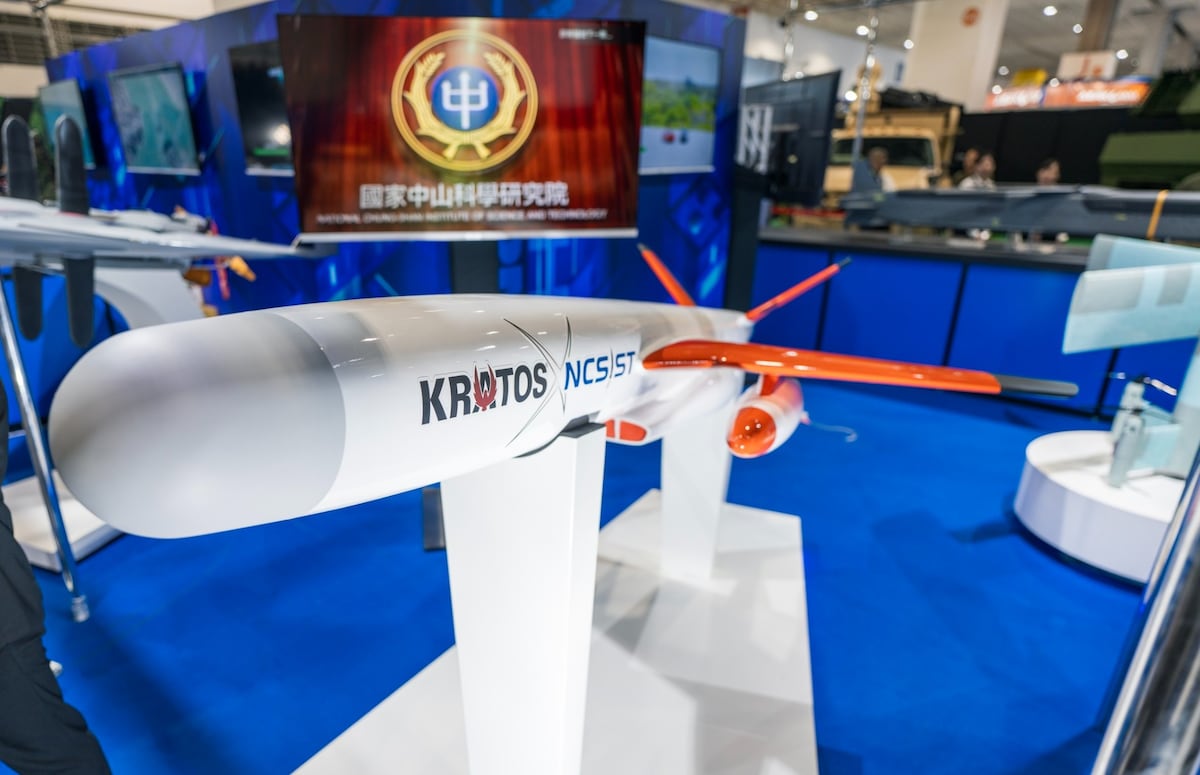
Another result of cooperative activity is the Chien Feng IV (Mighty Hornet IV) loitering munition being developed by NCSIST in conjunction with U.S. company Kratos.
Based on Kratos’ MQM-178 Firejet target drone, the high-speed weapon is designed for precise standoff attacks against ships at ranges approaching 620 miles (1,000km). Acting as a low-cost cruise missile with a high ceiling, it could perform saturation attacks or act as a decoy.
Greater self-sufficiency
The U.S. is Taiwan’s strongest backer, but officials in Taipei believe greater self-sufficiency is imperative.
The The Washington Post reported on Friday that U.S. President Donald Trump had vetoed more than $400 million in American military aid to Taiwan so far this year. He reportedly made this concession whilst attempting to negotiate a trade deal with Beijing.
Weapons being withheld include missiles and loitering munitions, according to the Washington Post.
Taiwan is already building numerous advanced weapons under its own steam. The military unveiled its Chiang-Kong (Strong Bow) air defense missile, an enhanced version of the Tien Kung III. With its high-explosive fragmentation warhead, it can intercept cruise and ballistic missiles in their midcourse phases at altitudes of up to 43.5 miles (70km).
NCSIST president Li revealed that the two-stage Chiang-Kong is already in production. The launcher with four missile canisters relies on a trailer-mounted active electronically scanned array radar, and this missile system will fortify existing air defenses that comprise Tien Kung and Patriot batteries.
The Ministry of National Defense displayed 19 types of unmanned system at TATDE 2025, one of which was the Mighty Hornet III anti-armor loitering munition with X-wing configuration. Operational testing should conclude later in 2025, after which it will be ready for mass acquisition.
Another new Taiwanese weapon is the 3-ton Kuai-Chi unmanned surface vessel (USV) from NCSIST. Traveling at speeds of more than 40 knots, the stealthy USV can ram ships and detonate its onboard explosive payload, or it can launch onboard loitering munitions.
Development of the Kuai-Chi USV is nearing completion. Fitting inside a 40-foot container, the boats can be rapidly shifted around Taiwan by road before being released into the sea.
These types of weapons – loitering munitions, USVs, low-cost missiles – would help create what the U.S. has called a “hellscape” in the Taiwan Strait. The strategy is to utilize uncrewed systems across all domains to saturate any invading Chinese force.
Taiwan has committed to raising its defense budget to 3.3% of gross domestic product next year, on the way to achieving 5% levels by 2030.
Gordon Arthur is an Asia correspondent for Defense News. After a 20-year stint working in Hong Kong, he now resides in New Zealand. He has attended military exercises and defense exhibitions in about 20 countries around the Asia-Pacific region.
新西兰基督城——台北航空航天及防务展(简称TADTE)于9月18日开幕,旨在推广台湾最新的国防产品并展示近期采购的装备。
此次事件发生之际,台湾正在考虑如何以最佳方式应对中国的咄咄逼人的举动。分析人士称,中国的这些举动旨在削弱台湾,为最终的对抗做准备。
北京的野心昭然若揭。国防部长董军本周在北京香山论坛上对国际军事官员表示,台湾“回归中国”是“战后国际秩序不可分割的一部分”。
董警告说,中国“绝不会允许任何分裂台湾的企图得逞”,并将挫败“任何外部军事干涉”。
台湾目前的想法是,非对称武器——购买成本不高但能给敌人造成沉重代价的武器——是台北阻止中国入侵的最佳方式。
这类系统在2025年TADTE展会上十分普遍。事实上,与两年前相比,参展商数量几乎翻了一番,达到490家。此外,还有51款全新产品亮相。
其中包括近期从美国购得的武器装备,例如并排摆放的M1A2T艾布拉姆斯主战坦克和HIMARS高射炮。迄今为止,台湾已接收108辆艾布拉姆斯坦克中的80辆,以及29套HIMARS高射炮中的11套。
超过40家美国公司参加了2025年TADTE展会,它们也在供应小型非对称导弹系统。例如,AeroVironment公司及其Switchblade 300巡飞弹。
为了实现武器来源多元化,台湾中山科学研究院(NCSIST)在2025年台湾武器装备展(TADTE 2025)开幕当天签署了一系列协议。其中包括从加拿大AirShare公司采购Overwatch Interceptor反无人机导弹,以及从Anduril Industries公司采购Dive-LD水下无人机。
此外,今年早些时候,国立科学技术研究院签署了一项协议,探讨在台湾大规模生产安杜里尔公司的梭鱼-500低成本巡航导弹。
国家科学技术研究院院长李世强解释说:“导弹的整个供应链都将在台湾。这是未来所有合作的总体方向。”
李补充说:“我们的目标是,一旦战争或封锁爆发,我们能够制造出保护自身所需的一切武器。” 据报道,他们的目标是在台湾制造导弹,每枚导弹的成本不超过25万美元。
台湾公布了“强弓”防空导弹,该导弹旨在拦截中国弹道导弹的中段飞行阶段。(台湾国防部)
乌克兰战争表明,高成本导弹的库存会在冲突中迅速消耗殆尽,而持续供应低成本、大规模生产的导弹则能缓解这一瓶颈。因此,台湾希望获得一种可由卡车发射、能够打击敌方舰船的“梭鱼”导弹。
合作活动的另一个成果是NCSIST与美国Kratos公司联合开发的“大黄蜂IV”巡飞弹。
这款高速武器以克拉托斯公司的MQM-178“火力喷气”靶机为基础,设计用于对射程接近620英里(1000公里)的舰船进行精确的防区外攻击。它如同低成本、高射程的巡航导弹,可以执行饱和攻击或作为诱饵。
更高的自给自足能力
美国是台湾最坚定的支持者,但台北官员认为,提高自给自足能力势在必行。
《华盛顿邮报》周五报道称,美国总统特朗普今年迄今已否决了超过4亿美元的对台军事援助。据报道,他做出这一让步是为了与北京就贸易协议进行谈判。
据《华盛顿邮报》报道,被扣留的武器包括导弹和巡飞弹。
台湾已自主研发多种先进武器。军方近日公布了其“强弓”防空导弹,这是“天宫三号”导弹的改进型。该导弹配备高爆破片战斗部,可在70公里(43.5英里)高空拦截巡航导弹和弹道导弹的中段飞行阶段。
国家科学技术研究院院长李透露,两级“江公”导弹系统已投入生产。该导弹系统配备四个导弹发射筒,采用拖车式有源相控阵雷达,将与现有的“天公”和“爱国者”导弹系统共同构成强大的防空体系。
韩国国防部在2025年TATDE防务展上展示了19种无人系统,其中包括采用X翼布局的“大黄蜂III”反装甲巡飞弹。该系统的作战测试预计将于2025年晚些时候完成,之后即可投入批量采购。
台湾另一款新型武器是国立海军科学技术研究院(NCSIST)研制的3吨级快船无人水面艇(USV)。这款隐形无人水面艇航速超过40节,可以撞击舰船并引爆其携带的爆炸载荷,也可以发射舰载巡飞弹。
快船无人水面艇的研发工作已接近尾声。这种水面艇可以装入一个40英尺的集装箱,通过公路快速运往台湾各地,然后再投放到海里。
这类武器——巡飞弹、无人水面艇、低成本导弹——将有助于在台湾海峡打造美国所谓的“人间炼狱”。其战略是利用无人系统在各个领域对任何入侵的中国军队进行饱和攻击。
台湾已承诺明年将国防预算提高到国内生产总值的3.3%,并计划到2030年达到5%的水平。
戈登·阿瑟是《防务新闻》的亚洲特派记者。在香港工作20年后,他现居新西兰。他曾到访亚太地区约20个国家,参加过军事演习和防务展览。