Pentagon’s $1.5B reprogramming would shift money to AI center, MV-75 tiltrotor五角大楼15亿美元的重新规划将把资金转移到人工智能中心和MV-75倾转旋翼机项目上。
The request would also reroute money destined for an international counter-ISIS training program.
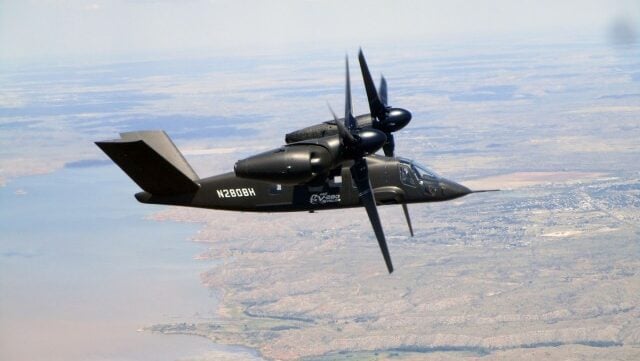
The U.S. Army announced today that its next-generation multi-role vertical lift aircraft, the MV-75 Future Long Range Assault Aircraft, will carry the Native American name “Cheyenne II”. (U.S. Army photo)
WASHINGTON — The Pentagon has requested permission from Congress to reroute about $1.5 billion in funds from fiscal 2026 and 2025 to fund a “high-priority” AI initiative, keep a new Army helicopter program aloft and shift funds related to programs affected by Iran operations.
The reprogramming document sent to Congress in July, which was reviewed by Breaking Defense, seeks to realign $1.2 billion in FY26 funds and $212 million in FY25 funds. Inside Defense was first to report on the request, which must be approved by the congressional defense committees.
The most expensive line item is a request to shift $600 million in FY26 funds to “immediately” build and equip a top secret, high-performance AI compute center. The funds would be used to procure advanced computing infrastructure, hardware and integration services, and would allow the Pentagon to scale AI and machine learning across the Joint Worldwide Intelligence Communications System (JWICS), the document states.
“Designated as a Secretary of War high-priority initiative, this is an emergent, must-pay requirement necessary to maintain technological overmatch and decision superiority,” the reprogramming document states, using the administration’s preferred term for the defense secretary.
The department further warned that “denying or delaying this funding will create critical bottlenecks in support of combat operations, intelligence processing, and cybersecurity modernization, while severely degrading the Department’s ability to execute the mandated modernization strategy.”
One of the Army’s biggest modernization efforts — the MV-75 Cheyenne tiltrotor — would be the second biggest recipient of funding if the reprogramming request is approved by Congress, with the money seen as critical for staving off a stop-work order that would halt progress on the program.
The Army is asking that about $230 million in FY26 funds and $120 million in FY25 funds be reprogrammed into MV-75 research, development test and evaluation (RDT&E), bringing the total RDT&E request to $1.45 billion in FY26 and $1.37 billion in FY25.
Island surge: the Army’s Next Generation Command and Control in action
Lightning Surge exercises are turning soldier feedback on NGC2 into operational software changes in days, not years.
Without the funding, prime contractor Textron could be forced to issue a stop-work order as early as mid-July 2026 “resulting in the delay of the MV-75 prototypes, initial production, and fielding,” the reprogramming document states. “Furthermore, a funding shortfall risks the layoff of 5,000 employees across 1,500 companies within the industrial base.”
The reprogrammed funds would support Textron as it builds and tests eight MV-75 prototype aircraft “in preparation for production in FY 2028,” the reprogramming document reads. Further, such funds will also be used to complete the Critical Design Review this fiscal year and “address cost increases from the prime vendor and critical suppliers.”
Textron did not immediately respond to a request for comment today, and declined to comment on the matter to Breaking Defense when asked about the status of the program last month after Bloomberg reported on the potential work-stop order. The Army also did not respond to a request for comment.
Reprogramming Adds Money For Drones, Counter-UAS
Congress has yet to act on the Trump administration’s supplemental funding request for FY26, which would allow the department to recoup $67 billion in costs associated with the war with Iran, including for ongoing operations and munitions expenditures. While the reprogramming doesn’t make big ticket requests aimed at tackling those problems, the conflict drove a small number of changes to funding, with money shifted both toward and away from key accounts.
The department wants to add $18 million for Army drones, using the funding to buy six additional long-endurance drones, along with multi-mission payloads, attrition air vehicles, support equipment and spare parts, “to include support to Operation Epic Fury,” the document states.
At the same time, the Pentagon intends to pull funding from accounts associated with training partners in the Middle East to fight the Islamic State group, stripping $130 million in FY26 funds from the Counter-Islamic State of Iraq and the Levant Train and Equip Fund — a decrease of $80 million in support to Iraq and $50 million for Syria. It would also remove $36 million in FY25 funds from the same account.
“U.S. force protection posture during Operation EPIC FURY has diminished DoW’s ability to work with our partner forces in the region,” the department said in a justification of the transfer. “Additionally, the phased integration of our Syrian partner force with the new government is impacting Counter-ISIS train and equip activities.”
Outside the scope of Operation Epic Fury, the reprogramming would add $36 million to accelerate the Common Tactical Command and Control system and support testing of counter unmanned aerial system (C-UAS) technology.
The improved command and control capability “directly supports critical initiatives, including establishing an integrated defense for the National Capital Region, standing up a USCENTCOM integration factory, and deploying capabilities to Joint Task Force Southern Border and the Joint C-UAS University,” the document stated.
The reprogramming would shift $40 million into the Pentagon’s acquisition and sustainment enterprise for “Cyber Integration and Logistics Systems Modernization,” with the aim of boosting supply chain cybersecurity and enabling greater acquisition oversight.
It would also add $40 million for a classified effort associated with US Special Operation Command.
美国陆军今天宣布,其下一代多用途垂直起降飞机MV-75未来远程突击飞机将采用美洲原住民语言“夏延二号”(Cheyenne II)命名。(美国陆军照片)
华盛顿——五角大楼已向国会申请批准,将 2026 财年和 2025 财年约 15 亿美元的资金重新分配,用于资助一项“高优先级”人工智能计划,维持一项新的陆军直升机计划的运转,并转移与受伊朗行动影响的项目相关的资金。
据《防务新闻》(Breaking Defense)审阅,7月份提交给国会的这份预算调整文件拟重新分配2026财年的12亿美元资金和2025财年的2.12亿美元资金。《防务内幕》(Inside Defense)率先报道了这一请求,该请求尚需国会国防委员会批准。
其中最昂贵的一项是请求将2026财年的6亿美元资金“立即”用于建设和配备一个绝密的高性能人工智能计算中心。文件指出,这笔资金将用于采购先进的计算基础设施、硬件和集成服务,并将使五角大楼能够在联合全球情报通信系统(JWICS)中扩展人工智能和机器学习的应用。
“这项计划被指定为国防部长的高度优先事项,是一项紧急的、必须支付的需求,以维持技术优势和决策优势,”重新规划文件指出,这里使用了政府对国防部长的首选称呼。
该部门进一步警告说,“拒绝或延迟这项拨款将对支持作战行动、情报处理和网络安全现代化造成严重瓶颈,同时严重削弱该部门执行强制性现代化战略的能力。”
如果国会批准重新拨款请求,陆军最大的现代化项目之一——MV-75“夏延”倾转旋翼机——将成为第二大资金受益者,这笔资金对于避免停工令至关重要,停工令将使该项目的进展停滞不前。
陆军要求将 2026 财年的约 2.3 亿美元资金和 2025 财年的 1.2 亿美元资金重新分配到 MV-75 的研究、开发、测试和评估 (RDT&E) 中,使 2026 财年的 RDT&E 总申请额达到 14.5 亿美元,2025 财年的 RDT&E 总申请额达到 13.7 亿美元。
岛屿突击:陆军下一代指挥控制系统的实战演练
“闪电突击”演习将士兵对 NGC2 的反馈转化为几天内(而不是几年内)的操作软件变更。
重新规划文件指出,如果没有资金,主承包商德事隆公司最早可能在2026年7月中旬被迫下达停工令,“这将导致MV-75原型机、初期生产和部署的延误”。文件还指出,“此外,资金短缺还可能导致工业基地内1500家公司共计5000名员工失业。”
重新分配的资金将用于支持德事隆公司建造和测试八架MV-75原型机,“为2028财年的量产做准备”,重新分配的文件显示。此外,这些资金还将用于完成本财年的关键设计评审,并“应对主要供应商和关键供应商的成本上涨”。
德事隆公司今天未立即回应置评请求。上个月,彭博社报道了可能下达停工令后,德事隆公司在接受《防务新闻》采访时,被问及该项目的进展情况,当时该公司也拒绝置评。陆军方面也未回应置评请求。
重新编程为无人机和反无人机系统增加资金
国会尚未就特朗普政府2026财年的补充拨款请求采取行动。该请求将允许国防部收回与伊朗战争相关的670亿美元费用,其中包括持续作战和军需品支出。虽然此次预算调整并未提出旨在解决这些问题的巨额拨款申请,但这场冲突确实导致了一些资金调整,部分资金流入或流出了一些关键账户。
该部门希望为陆军无人机追加 1800 万美元的拨款,利用这笔资金购买六架额外的长航时无人机,以及多任务有效载荷、消耗战飞行器、支援设备和备件,“包括为‘史诗狂怒行动’提供支持”,该文件指出。
与此同时,五角大楼计划削减与中东地区打击伊斯兰国训练伙伴相关的账户资金,从“伊拉克和黎凡特地区打击伊斯兰国训练和装备基金”中削减2026财年的1.3亿美元资金——其中对伊拉克的支持减少8000万美元,对叙利亚的支持减少5000万美元。此外,还将从同一账户中削减2025财年的3600万美元资金。
“在‘史诗狂怒行动’期间,美军的部队保护态势削弱了国防部与该地区伙伴部队合作的能力,”国防部在一份解释此次移交的理由中表示。“此外,叙利亚伙伴部队与新政府的分阶段整合也影响了打击‘伊斯兰国’的训练和装备活动。”
在“史诗狂怒行动”范围之外,重新规划将增加 3600 万美元,以加速通用战术指挥控制系统的建设,并支持反无人机系统 (C-UAS) 技术的测试。
文件指出,改进后的指挥控制能力“直接支持关键举措,包括为国家首都地区建立一体化防御、建立美国中央司令部集成工厂,以及向南部边境联合特遣部队和联合反无人机系统大学部署能力”。
此次重新规划将把 4000 万美元转移到五角大楼的采购和维护企业,用于“网络集成和物流系统现代化”,旨在提高供应链网络安全并加强采购监督。
此外,还将拨款 4000 万美元用于与美国特种作战司令部相关的机密项目。