Army Now Testing Anthem Long-Range Strike Weapon Built for Mass Production美国陆军正在测试专为大规模生产而设计的“圣歌”远程打击武器
Serial production of the relatively crude but cheap weapon is slated to begin in Texas next year, with plans to also build the weapon in Germany and Israel. Serial production of the relatively crude but cheap weapon is slated to begin in Texas next year, with plans to also build the weapon in Germany and Israel.
Published Sep 9, 2026 1:01 PM EDT
U.S. Army photo by Capt. Jordan Beagle
Covenant, a previously little-known defense startup, has emerged with a new long-range strike weapon, named Anthem, which it says is intended to provide a cheaper, more readily producible alternative to existing cruise missiles. Already in testing with the U.S. Army, the missile reflects the growing focus on weapons in this class that can be manufactured quickly in very large numbers , even if they sacrifice a significant degree of individual-weapon capability compared to more ‘exquisite’ and costly alternatives.
Covenant, a U.S.-Israeli company founded in 2024, unveiled its Anthem weapon system today along with plans for production in the United States, Germany, and Israel. The company says it has already conducted more than 200 test flights of the weapon and has secured roughly $150 million in orders.
Covenant Anthem missile. Covenant
The announcement comes as the United States and its allies are increasingly focused on the availability of long-range precision weapons , particularly the ability to replenish inventories during a major conflict . Covenant’s central pitch is that existing weapons in this category are too expensive and difficult to manufacture in sufficient numbers for a prolonged war, a reality that has been recognized by a bewildering number of new and established industry players .
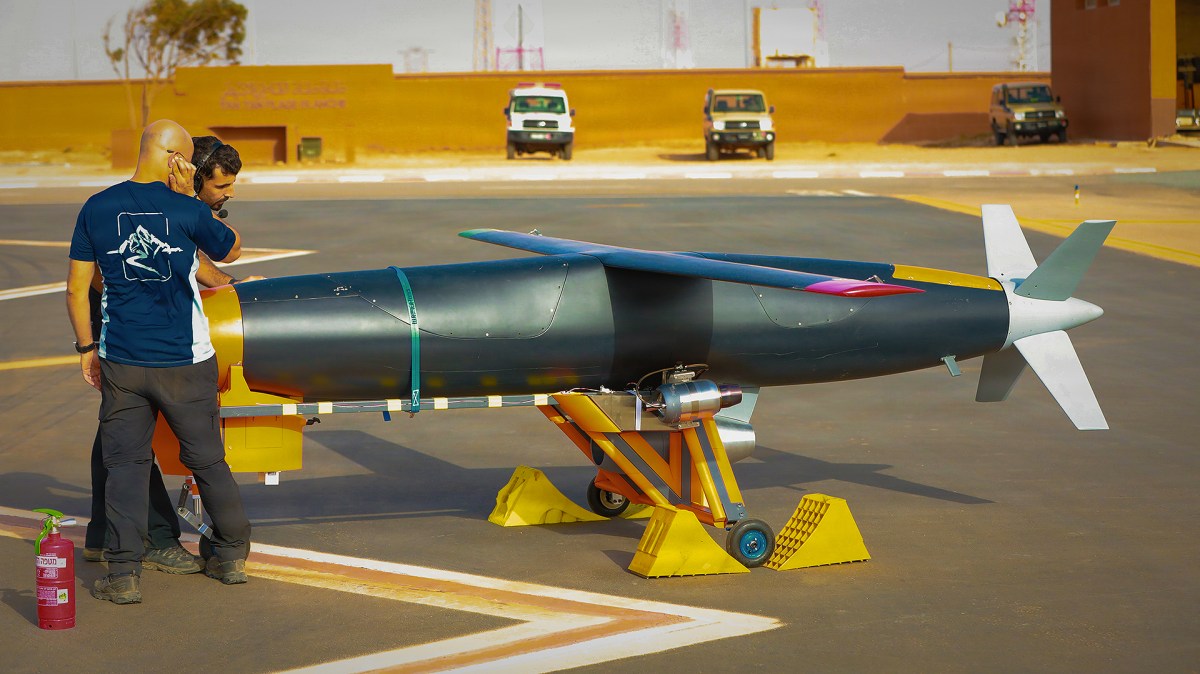
Anthem is being positioned accordingly as a high-volume weapon rather than a one-for-one replacement for larger, more expensive cruise missiles. In its initial form, it is ground-launched, although it is unclear exactly how this is achieved. Imagery of the weapon during Pentagon trials show it being handled on the ground using tricycle undercarriage, pointing to the use of a runway for launch.
An Anthem cruise missile at Tan-Tan, Morocco, on August 6, 2026. U.S. Army photo by Capt. Jordan Beagle
Covenant has not publicly disclosed the weapon’s range, although unconfirmed reports put it at roughly 1,200 kilometers — over 740 miles. The company is also being somewhat deliberate about how it describes Anthem, referring to it as a “deep precision-strike munition” rather than consistently classifying it as a cruise missile.
On the other hand, Reuters reports Covenant executives saying that the missile was developed with an eye toward future conflicts in the Pacific . “We were designed for the China fight,” said Covenant President Abby Denburg. That would also seem to point toward significant range.
The Anthem missile in flight. Covenant
However, more concrete details of its performance, as well as guidance type and projected level of survivability, remain undisclosed.
The company says Anthem can carry a warhead weighing more than 200 kilograms (441 pounds). That is substantially less than the roughly 1,000-pound-class warhead associated with the Tomahawk cruise missile, which can hit targets at over 1,000 miles depending on the exact configuration. Covenant argues that lower cost and much higher production rates would make it possible to employ larger numbers of their weapons against a given target set.
Anthem uses a solid rocket motor for launch and a heavy-fuel jet engine, underslung below the missile body, for cruise flight. Covenant says the system was designed from the outset around readily available components and a supply chain that would avoid dependence on individual suppliers. The company states that it has, for example, multiple solid-rocket-motor suppliers and long-term agreements covering thousands of jet engines.
Cruise missiles are assembled for a live-fire demonstration at the Africa Multidomain Training and Experimentation Center in Morocco. U.S. Army photo by Staff Sgt. Raquel Birk
Overall, the production ambitions are significant. Covenant’s new Dallas, Texas, facility covers approximately 105,000 square feet and is expected to begin serial production during the first quarter of 2027, eventually reaching a stated capacity of 5,000 Anthems per year. Its facility in Saxony, Germany, is intended to reach a similar production rate, while the smaller Israeli site is planned to produce as many as 2,000 weapons annually.
“Germany possesses an exceptionally strong industrial foundation,” Denburg told Bloomberg News . “While its automotive sector is currently undergoing a structural transformation, decades of manufacturing excellence have created precisely the expertise we require.”
That would put the company’s eventual combined production target at up to 12,000 weapons per year, assuming all three facilities reach their planned capacities.
An Anthem cruise missile engages a target during at the Africa Multidomain Training and Experimentation Center in Morocco, on August 6, 2026. U.S. Army photo by Staff Sgt. Raquel Birk
Covenant’s U.S. facility is intended primarily to support American customers, while the German operation is being established around a European supply chain, responding to growing demand for long-range strike weapons across that continent. The company says an unidentified international customer is expected to begin receiving German-built weapons before the end of this year. Meanwhile, U.S. Army deliveries are expected in 2027, under an accelerated qualification contract.
The weapon has already been subjected to U.S.-linked testing. In August, an unnamed defense-industry partner conducted a live-fire demonstration at the Africa Multidomain Training and Experimentation Center in Morocco. The U.S. military’s public material about that event did not identify the weapon or company, but subsequent reporting identified the missile as Covenant’s Anthem.
Covenant now says the system has flown more than 200 times over the past year, including testing involving U.S. government organizations. The company also says Anthem participated in the Army’s Project Convergence Capstone 6 experiments and that its August test helped demonstrate a new framework for allowing industry to use the Moroccan test infrastructure.
Defense-industry partners assemble a cruise missile at the Africa Multidomain Training and Experimentation Center in Morocco. This photo was altered for security purposes by blurring out defense industry names and logos. U.S. Army photo by Staff Sgt. Raquel Birk
Beyond the ground-launched version, Covenant is working on a naval derivative. The company says it has a roughly $70-million contract with the Navy’s Rapid Capabilities Office to adapt Anthem into what it calls Maritime Anthem. The effort includes Defense Exportability Features intended to make the weapon easier to provide to U.S. allies and partners.
The emergence of Anthem also illustrates how the defense industry’s current emphasis on mass production is extending into the long-range strike arena .
The United States already fields weapons such as Tomahawk and JASSM-ER , but those systems are expensive, and production capacity is limited. Covenant is betting that a weapon available in much larger quantities can provide commanders with another layer of long-range strike capacity, even if the destructive power of a single round falls well below that of a Tomahawk. Reuters reports that Covenant expects the weapon to eventually cost in the mid-six-figure range, although the company has not provided a final unit price. Compared to other competitors in the field, Covenant appears to be the crudest design we have seen so far, underscored by its apparent launch method, in which it takes off from an airstrip under power of its booster.
Unnamed defense-industry partners prepare a cruise missile for a live-fire demonstration at the Africa Multidomain Training and Experimentation Center in Tan-Tan, Morocco, on August 5, 2026. It has now been disclosed that this demonstration involved the Anthem. U.S. Army photo by Capt. Jordan Beagle
Recent combat operations have increased concerns about the rate at which more traditional precision weapons can actually be manufactured. Once stockpiles begin to reduce, long-range missiles have proven among the most difficult munitions to replace . That would only become more problematic during a major conflict.
Covenant has attracted venture-capital backing to pursue that problem. The company says it has raised more than $250 million from investors including Andreessen Horowitz, Founders Fund, Lux Capital, 8VC, Aleph, and Lightspeed. Its stated focus, however, is now shifting from development to production.
Anthem in flight. Covenant Covenant
The key question will be whether Covenant can turn the promised production numbers into sustained deliveries. Building thousands of long-range weapons per year requires not only an assembly plant, but also a resilient supply chain, reliable propulsion production, testing capacity, quality control, and the ability to integrate those elements at scale. It will also rely on securing more contracts from domestic and allied customers.
For now, however, Anthem represents an intriguing entrant into a crowded but increasingly important segment of the weapons market.
Contact the author: thomas@thewarzone.com
Comments couldn’t be loaded. Please refresh the page.
发布于美国东部时间2026年9月9日下午1:01
美国陆军上尉乔丹·比格尔拍摄的照片
此前名不见经传的国防初创公司Covenant推出了一款名为“圣歌”(Anthem)的新型远程打击武器。该公司称,这款武器旨在为现有的巡航导弹提供一种更经济、更易于生产的替代方案。该导弹已在美国陆军进行测试,这反映出人们越来越关注能够快速大规模生产的此类武器,即使与更“精良”但成本更高的替代方案相比,它们在单发武器性能方面有所牺牲。
成立于2024年的美以合资公司Covenant今日发布了其“圣歌”(Anthem)导弹系统,并宣布将在美国、德国和以色列进行生产。该公司表示,该导弹系统已完成200多次试飞,并已获得约1.5亿美元的订单。
星盟圣歌导弹。星盟
此次声明发布之际,美国及其盟友正日益关注远程精确武器的可用性,尤其是在重大冲突期间补充库存的能力。Covenant公司的核心论点是,现有此类武器过于昂贵且难以大量生产,无法满足长期战争的需求,而这一现实已被众多新兴和老牌行业参与者所认可。
“圣歌”导弹的定位是高产量武器,而非完全替代更大、更昂贵的巡航导弹。其初始版本采用地面发射,但具体发射方式尚不明确。五角大楼试验期间的影像显示,该导弹使用三轮式起落架在地面上进行操作,这表明其发射可能利用了跑道。
2026年8月6日,一枚“圣歌”巡航导弹在摩洛哥坦坦发射升空。美国陆军上尉乔丹·比格尔摄
Covenant公司尚未公开披露该武器的射程,但有未经证实的报道称其射程约为1200公里(超过740英里)。该公司在描述“圣歌”(Anthem)导弹时也颇为谨慎,称其为“纵深精确打击弹药”,而非一贯将其归类为巡航导弹。
另一方面,路透社报道称,Covenant公司的高管表示,这款导弹的研发着眼于未来在太平洋地区的冲突。“我们的设计目标是应对中国,”Covenant公司总裁艾比·登堡说道。这似乎也暗示着该导弹射程相当远。
“圣歌”导弹正在飞行中。星盟
然而,其性能的更具体细节,以及导向类型和预计生存能力水平,仍未公开。
该公司称,“圣歌”导弹可携带超过200公斤(441磅)的弹头。这远小于“战斧”巡航导弹所配备的约1000磅级弹头,后者根据具体配置,射程可超过1000英里。Covenant公司认为,更低的成本和更高的生产效率使其能够针对特定目标部署更多数量的此类武器。
“圣歌”导弹采用固体火箭发动机进行发射,并在导弹弹体下方悬挂一台重燃料喷气发动机用于巡航飞行。Covenant公司表示,该系统从一开始就围绕易于获取的组件和供应链进行设计,从而避免对单一供应商的依赖。该公司指出,例如,他们拥有多家固体火箭发动机供应商,并签订了涵盖数千台喷气发动机的长期协议。
在摩洛哥的非洲多域训练与试验中心,巡航导弹正在组装,准备进行实弹射击演示。美国陆军参谋军士拉奎尔·伯克摄
总体而言,其生产目标十分宏大。Covenant公司位于德克萨斯州达拉斯的新工厂占地约10.5万平方英尺,预计将于2027年第一季度开始批量生产,最终产能将达到每年5000支“圣歌”导弹。其位于德国萨克森州的工厂也计划达到类似的产能,而规模较小的以色列工厂则计划每年生产多达2000支导弹。
“德国拥有极其强大的工业基础,”登堡告诉彭博新闻社。“虽然其汽车行业目前正在经历结构性转型,但数十年的卓越制造经验已经积累了我们所需的专业技术。”
假设这三个工厂都达到计划产能,那么该公司的最终合并生产目标将达到每年 12,000 件武器。
2026年8月6日,在摩洛哥非洲多域训练与试验中心,一枚“圣歌”巡航导弹击中目标。美国陆军参谋军士拉奎尔·伯克摄。
Covenant公司在美国的工厂主要服务于美国客户,而其德国工厂则围绕欧洲供应链建立,以满足欧洲大陆日益增长的远程打击武器需求。该公司表示,一位未透露姓名的国际客户预计将在今年年底前开始接收德国制造的武器。与此同时,根据一项加速认证合同,美国陆军预计将于2027年开始接收这些武器。
该武器此前已接受过与美国相关的测试。今年8月,一家未具名的国防工业合作伙伴在摩洛哥的非洲多域训练与试验中心进行了实弹演示。美国军方公开的资料并未指明该武器或公司名称,但后续报道指出,该导弹为“盟约”导弹公司的“圣歌”导弹。
Covenant公司表示,该系统在过去一年中已进行了200多次飞行测试,其中包括与美国政府机构的合作测试。该公司还表示,Anthem参与了美国陆军的“融合项目第六阶段”(Project Convergence Capstone 6)实验,其8月份的测试有助于展示一种新的框架,使业界能够利用摩洛哥的测试基础设施。
在摩洛哥的非洲多域训练与试验中心,国防工业合作伙伴正在组装一枚巡航导弹。出于安全考虑,这张照片经过处理,模糊处理了国防工业的名称和标志。美国陆军照片,由参谋军士拉奎尔·伯克拍摄。
除了陆基版本外,Covenant公司还在研发海军衍生版本。该公司表示,已与海军快速能力办公室签订了一份价值约7000万美元的合同,将“圣歌”(Anthem)导弹改进为所谓的“海上圣歌”(Maritime Anthem)。该项目包含国防出口能力特性,旨在使该武器更容易提供给美国的盟友和伙伴。
“圣歌”导弹的出现也表明,国防工业目前对大规模生产的重视正在扩展到远程打击领域。
美国目前已装备了诸如战斧导弹和JASSM-ER等武器,但这些系统造价昂贵且产能有限。Covenant公司押注于一种产量更大的武器,认为即使单发威力远不及战斧导弹,也能为指挥官提供另一层远程打击能力。路透社报道称,Covenant公司预计该武器最终售价将在六位数中段,但该公司尚未公布最终单价。与其他同类产品相比,Covenant公司的这款武器设计似乎最为粗糙,其发射方式也印证了这一点——它依靠助推器从简易跑道起飞。
2026年8月5日,在摩洛哥坦坦的非洲多域训练与试验中心,未具名的国防工业合作伙伴正在准备一枚巡航导弹,用于实弹演示。现已披露,此次演示使用的正是“圣歌”(Anthem)巡航导弹。美国陆军上尉乔丹·比格尔摄。
近期的作战行动加剧了人们对传统精确武器实际生产速度的担忧。一旦库存开始减少,远程导弹已被证明是最难替代的弹药之一。在大规模冲突中,这个问题只会变得更加棘手。
Covenant公司已获得风险投资支持,致力于解决这一问题。该公司表示,已从包括Andreessen Horowitz、Founders Fund、Lux Capital、8VC、Aleph和Lightspeed在内的投资者处筹集了超过2.5亿美元的资金。然而,该公司目前已明确表示,其发展重心正从研发转向生产。
飞行中的赞歌。盟约盟约
关键问题在于,Covenant能否将承诺的产量转化为持续交付。每年生产数千件远程武器不仅需要组装工厂,还需要稳健的供应链、可靠的推进系统生产、测试能力、质量控制以及大规模整合这些要素的能力。此外,它还取决于能否从国内和盟国客户那里获得更多合同。
但就目前而言,《圣歌》是一款引人注目的新产品,它进入了武器市场这个竞争激烈但日益重要的细分领域。
联系作者:thomas@thewarzone.com
评论加载失败,请刷新页面。