First Look At General Atomics’ Wildfire, Its Successor To The MQ-9 Reaper首次曝光通用原子公司“野火”无人机,它是MQ-9“死神”无人机的后继者。
The USAF is hunting for new lower-cost armed drones to perform the same missions as the MQ-9 in the wake of huge Reaper losses.
By Joseph Trevithick , Howard Altman
Published Sep 9, 2026 1:26 PM EDT
General Atomics capture
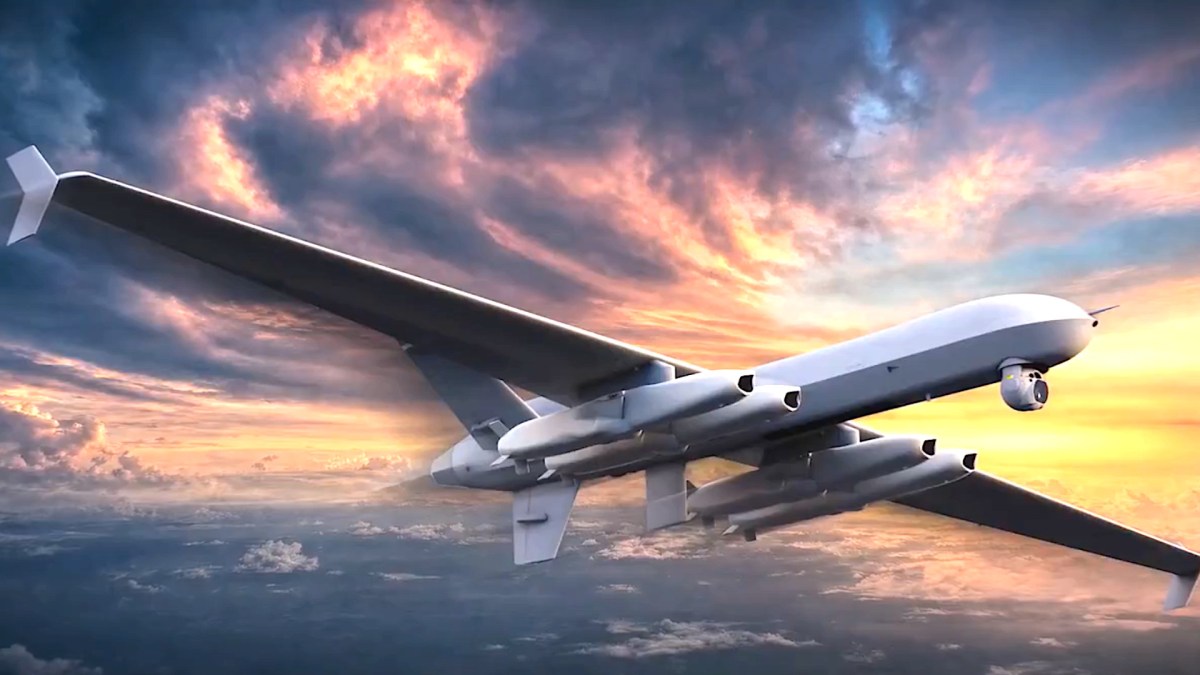
General Atomics has given us the first look at its new Wildfire drone design . The company is developing this armed medium-altitude, long-endurance (MALE) uncrewed aircraft in response to new U.S. Air Force requirements for a lower-cost successor to the MQ-9A Reaper .
A rendering of Wildfire was included in a video montage, seen below, which General Atomics Aeronautical Systems, Inc. division (GA-ASI) released earlier today. GA-ASI first announced work on this new drone last month. The Air Force, in partnership with the Pentagon’s Defense Innovation Unit (DIU), formally kicked off its new search for a Reaper successor, currently called the Massed Modular Aircraft (MMA), in July. GA-ASI also developed the MQ-9A, which is now out of production.
A good idea spreads like Wildfire. #UAS #Airpower pic.twitter.com/eIONVDjZ1n — General Atomics Aeronautical Systems, Inc (GA-ASI) (@GenAtomics_ASI) September 9, 2026
A good idea spreads like Wildfire. #UAS #Airpower pic.twitter.com/eIONVDjZ1n
Wildfire’s pusher-prop design shown is clearly an extension of the existing MQ-9 family, with an overall planform that is extremely similar to that of the Reaper. Like the latest versions of the MQ-9A, the new drone has a sensor turret under the nose and a large blade antenna under the rear fuselage.
The rendering of Wildfire, at top, seen together with a stock picture of a US Air Force MQ-9 Reaper, at bottom. General Atomics capture/USAF
Wildfire does notably lack the Reaper’s distinctive hump on top of the forward fuselage. On the MQ-9A, this feature contains the drone’s satellite communications (SATCOM) antenna. What this might mean about how Wildfire is controlled and otherwise communicates is not immediately clear, but it points to the use of a smaller, lower-cost SATCOM terminal. That, in turn, would most likely be tied to a network like Starshield, the government-focused cousin of SpaceX’s Starlink . We could also see greater semi-autonomous control here, or at least a greater reliance on it.
The resulting shape of the forward end of the fuselage is vaguely reminiscent of GA-ASI’s Gnat series of drones from the 1990s , which evolved into the iconic Predator . The MQ-9 family, in turn, is an outgrowth of the Predator.
A close-up look at the nose end of Wildfire as seen in the newly released rendering. General Atomics capture
A General Atomics Improved Gnat (I-Gnat) drone. General Atomics
The rendering of Wildfire also depicts the drone armed with four Joint Strike Missile (JSM) cruise missiles , with two loaded on what appears to be a single pylon under each wing. The stealthy JSM can be employed as an anti-ship or land-attack weapon. GA-ASI has released renderings of MQ-9s in the past with similar loadouts . The Air Force is already acquiring stocks of JSMs, primarily to arm its F-35A Joint Strike Fighters. Stand-off munitions like the JSM have long been seen as an increasingly important, if not critical, addition to the non-stealth Reaper’s arsenal, helping to keep the drones further away from potential threats.
A close look at two of JSMs in the Wildfire rendering. General Atomics capture
TWZ has reached out to General Atomics for more details.
“General Atomics is looking at it and asking ourselves, ‘What can we really do? No kidding, no BS, actually do,’” GA-ASI spokesperson C. Mark Brinkley did tell us back in August when asked about Wildfire. “Let’s be honest with ourselves first. How do we come out of the box, day one, with a 10,000-nautical-mile ferry range? Can we carry four LRASMs [ AGM-158C Long Range Anti-Ship Missiles ]? Can we swarm 100 aircraft under semi-autonomous control? Can we fuse all of that data into a highly effective common operating picture? Can we do that at scalable, affordable mass?”
“So that was the assignment, and our engineers sharpened their pencils and got to work,” he added. “What came out the other side was our new Wildfire UAS. That thing is a beast, and no one who actually does this for a living and is honestly concerned about America’s warfighting edge can look at it and not want 100 of them as fast as we can make them.”
Wildfire “addresses all of the concerns posed by the MMA solicitation. We can deliver years earlier and maintain the same high quality. You can have everything that makes Reaper special, plus more, at a price that doesn’t break the bank,” Brinkley also told Breaking Defense for a story published last week.
In terms of what the Air Force has said it is looking for with the MMA, as we have previously written :
“[The service] …wants the MMA drone to perform the same general intelligence, surveillance, and reconnaissance (ISR) and strike missions as the MQ-9A. To that end, stated program requirements to date include a speed of at least 200 knots true airspeed, a munition and sensor payload capacity of at least 2,800 pounds, an unrefueled combat radius of at least 2,300 nautical miles with payload, the ability to self-deploy one-way at least 8,000 nautical miles, and the ability to operate from runways no longer than 6,000 feet. The MMAs also need to be highly modular and use open architecture mission systems to make it easier to integrate new capabilities and functionality down the line.”
Another look at an example of a typical MQ-9A Reaper in US Air Force service now. USAF
The Air Force also shared last week that it is targeting a roughly $10 million unit cost for the MMA drones, not including sensors and certain other systems. As mentioned, the Reaper is out of production, but the price tag on a fully-equipped Reaper today is widely reported to be between $30 million and $50 million. The Air Force has itself used the $50 million figure as a reference point in discussing its latest plans for what comes after the MQ-9.
It is unclear how Wildfire might achieve this cost goal while retaining so much obvious Reaper DNA, but even a major 30 to 50 percent reduction in the price tag compared to its predecessor would be a huge deal. In the past, General Atomics’ Brinkley has openly questioned just how cheap an MMA drone could realistically be while still offering comparable capability to MQ-9.
The original timeline for the MMA program envisioned the Air Force reaching initial operational capability in 2031 after receiving 20 of the drones. The service is now looking to accelerate that schedule by around two years. The Air Force expects to eventually acquire around 180 MMAs.
The Air Force has tried, without success, to develop a successor to the MQ-9 on several occasions in the past. However, a key driving factor now is huge losses of Reapers in the course of the ongoing conflict against Iran. The service’s MQ-9 fleet has already shrunk dramatically in recent years, in part due to additional losses during operations targeting Iranian-backed Houthi militants in Yemen last year.
“Although we have plenty of MQ-9As today, we are going through them at a rate that is concerning to us,” Air Force Lt. Gen. Christopher Niemi, the service’s Chief Modernization Officer, told reporters at a roundtable at the Pentagon last week, according to Air & Space Forces Magazine . “There’s not a lot of good options to immediately replace those aircraft.”
GA-ASI has long had a monopoly on MALE combat drone sales in the United States, and is clearly looking to extend that now with Wildfire. However, this market space has been expanding, and other companies are already competing for what could be a very lucrative new deal with the Air Force. Winning the MMA contract could open doors to opportunities elsewhere within the U.S. government and with foreign countries. Variants and derivatives of the MQ-9 are also in service today with the U.S. Marine Corps , the Central Intelligence Agency (CIA), U.S. Customs and Border Protection (CBP), and several additional air arms globally.
A US Marine Corps MQ-9A Reaper. USMC
More information about Wildfire, as well as its competitors, is only likely to continue emerging as the Air Force pushes ahead with new and aggressive plans to finally acquire a follow-on drone to the venerable Reaper.
Contact the author: joe@twz.com
Comments couldn’t be loaded. Please refresh the page.
作者:约瑟夫·特雷维西克、霍华德·奥特曼
发布于美国东部时间2026年9月9日下午1:26
通用原子公司捕获
通用原子公司首次公开了其新型“野火”(Wildfire)无人机设计。该公司正在研发这款武装的中空长航时(MALE)无人机,以响应美国空军对MQ-9A“死神”(Reaper)无人机低成本后继机型的新要求。
通用原子航空系统公司(GA-ASI)今天早些时候发布了一段视频,其中包含了“野火”(Wildfire)无人机的渲染图(如下所示)。GA-ASI上个月首次宣布正在研发这款新型无人机。今年7月,美国空军与五角大楼国防创新部门(DIU)合作,正式启动了“死神”(Reaper)无人机后继机型的研发工作,该项目目前被称为“模块化大规模飞机”(MMA)。GA-ASI此前还研发了MQ-9A无人机,该机型现已停产。
好点子传播速度极快。#无人机系统 #空中力量 pic.twitter.com/eIONVDjZ1n — 通用原子航空系统公司 (GA-ASI) (@GenAtomics_ASI) 2026年9月9日
好点子传播速度极快。#无人机系统 #空中力量 pic.twitter.com/eIONVDjZ1n
图中所示的“野火”无人机采用推进式螺旋桨设计,显然是现有MQ-9系列无人机的延伸,其整体平面形状与“死神”无人机极为相似。与最新版本的MQ-9A一样,这款新型无人机在机头下方装有传感器转塔,在机身后部下方装有大型刀片天线。
上图为“野火”无人机的渲染图,下图为美国空军MQ-9“死神”无人机的示意图。通用原子公司/美国空军
值得注意的是,Wildfire无人机的前机身顶部缺少Reaper无人机标志性的隆起。在MQ-9A无人机上,这个隆起部分容纳了无人机的卫星通信(SATCOM)天线。Wildfire的操控方式和通信方式为何会与Reaper有所不同,目前尚不清楚,但这表明它可能使用了更小、更低成本的卫星通信终端。而这很可能意味着Wildfire会接入类似Starshield的网络,Starshield是SpaceX的Starlink的政府专用版本。我们或许还会看到Wildfire拥有更强的半自主控制能力,或者至少会更加依赖这种控制方式。
机身前端的最终造型隐约让人联想起通用原子航空系统公司(GA-ASI)上世纪90年代的“蚊蚋”(Gnat)系列无人机,该系列后来发展成为标志性的“捕食者”(Predator)无人机。而MQ-9系列无人机,反过来又是“捕食者”无人机的衍生产品。
这是最新发布的渲染图中Wildfire火箭机头部分的特写。通用原子公司拍摄
通用原子公司改进型蚋(I-Gnat)无人机。通用原子公司
“野火”无人机的渲染图还显示,该无人机配备了四枚联合攻击导弹(JSM)巡航导弹,每侧机翼下方似乎各挂载两枚。这种隐形JSM导弹可用于反舰或对地攻击。通用原子航空系统公司(GA-ASI)此前也发布过类似配置的MQ-9无人机渲染图。美国空军已经开始采购JSM导弹,主要用于装备其F-35A联合攻击战斗机。像JSM这样的防区外弹药长期以来被视为“死神”无人机武器库中日益重要甚至至关重要的补充,有助于无人机远离潜在威胁。
仔细观察Wildfire渲染图中的两枚JSM导弹。通用原子公司拍摄
TWZ已联系通用原子公司以获取更多详情。
“通用原子公司正在研究这个问题,并扪心自问:‘我们究竟能做到什么?别开玩笑,别装腔作势,我们到底能做到什么?’”通用原子航空系统公司(GA-ASI)发言人C·马克·布林克利在8月份被问及“野火”导弹项目时曾这样告诉我们。“首先,让我们坦诚面对自己的问题。我们如何才能从一开始就拥有10000海里的航程?我们能否携带四枚AGM-158C远程反舰导弹?我们能否在半自主控制下操控100架飞机?我们能否将所有这些数据融合到一个高效的通用作战图景中?我们能否以可扩展且经济的方式实现这一切?”
“这就是我们的任务,我们的工程师们立刻开始工作,”他补充道。“最终的成果就是我们全新的‘野火’无人机系统。这玩意儿简直是头猛兽,任何真正从事这行、关心美国作战优势的人,看到它都会恨不得我们能以最快的速度生产出100架。”
“Wildfire解决了MMA征集活动中提出的所有问题。我们可以提前数年交付,并保持同样的高质量。您可以以实惠的价格,拥有Reaper的所有优点,甚至更多,”布林克利在上周发表于Breaking Defense的一篇报道中说道。
至于空军此前曾表示希望通过MMA项目实现的目标,我们之前已经写过:
“[该部门]……希望MMA无人机能够执行与MQ-9A相同的通用情报、监视和侦察(ISR)以及打击任务。为此,迄今为止公布的项目要求包括:至少200节的真实空速,至少2800磅的弹药和传感器有效载荷,至少2300海里的无加油作战半径(含有效载荷),至少8000海里的单程自主部署能力,以及在不超过6000英尺的跑道上起降的能力。MMA无人机还需要高度模块化,并采用开放式架构的任务系统,以便于日后集成新的功能和特性。”
再来看一架目前美国空军服役的典型MQ-9A“死神”无人机。
空军上周还透露,MMA无人机的单价目标约为1000万美元,不包括传感器和其他一些系统。如前所述,“死神”无人机已停产,但据广泛报道,目前一架全副武装的“死神”无人机的售价在3000万美元至5000万美元之间。空军在讨论MQ-9之后的后续计划时,也曾以5000万美元作为参考数字。
目前尚不清楚“野火”(Wildfire)无人机如何在保留“死神”(Reaper)无人机诸多显著特征的同时实现这一成本目标,但即便价格仅比其前代产品降低30%至50%,也将是一项巨大的进步。此前,通用原子公司(General Atomics)的布林克利(Brinkley)曾公开质疑,一款能够提供与MQ-9无人机相媲美的性能的MMA无人机,其价格究竟能低到什么程度。
MMA项目的最初时间表设想空军在接收20架无人机后,于2031年达到初始作战能力。目前,空军正寻求将这一时间表提前约两年。空军预计最终将采购约180架MMA无人机。
美国空军过去曾多次尝试研发MQ-9的后继机型,但均未成功。然而,目前推动研发的关键因素是持续的伊朗冲突中MQ-9“死神”无人机的大量损失。近年来,空军的MQ-9机队规模已大幅缩减,部分原因是去年在也门打击伊朗支持的胡塞武装的行动中又遭受了损失。
据《空军与太空部队杂志》报道,空军中将、空军现代化首席官克里斯托弗·尼米上周在五角大楼举行的一次圆桌会议上告诉记者:“虽然我们现在拥有大量的MQ-9A无人机,但它们的损耗速度令我们担忧。目前并没有太多好的方案可以立即替换这些飞机。”
通用原子航空系统公司(GA-ASI)长期以来一直垄断着美国中空长航时(MALE)作战无人机的销售,如今显然希望凭借“野火”(Wildfire)无人机进一步扩大其市场份额。然而,这一市场空间正在不断扩大,其他公司也已加入竞争,力图与美国空军达成一项利润丰厚的新协议。赢得MMA合同可能会为该公司打开通往美国政府其他部门以及与外国合作的大门。目前,MQ-9的各种衍生型号也已在美国海军陆战队、中央情报局(CIA)、美国海关与边境保护局(CBP)以及全球其他一些国家的空军部队服役。
美国海军陆战队MQ-9A“死神”无人机。
随着空军推进新的、积极的计划,最终采购一款能够取代久经考验的“死神”无人机的后续机型,有关“野火”无人机及其竞争对手的更多信息很可能会继续涌现。
联系作者:joe@twz.com
评论加载失败,请刷新页面。