US Army exports multinational combat training center to Philippines美国陆军向菲律宾出口多国联合作战训练中心
The Army is taking a full-scale exportable Joint Pacific Multinational Training Center west of the International Date Line for the first time.
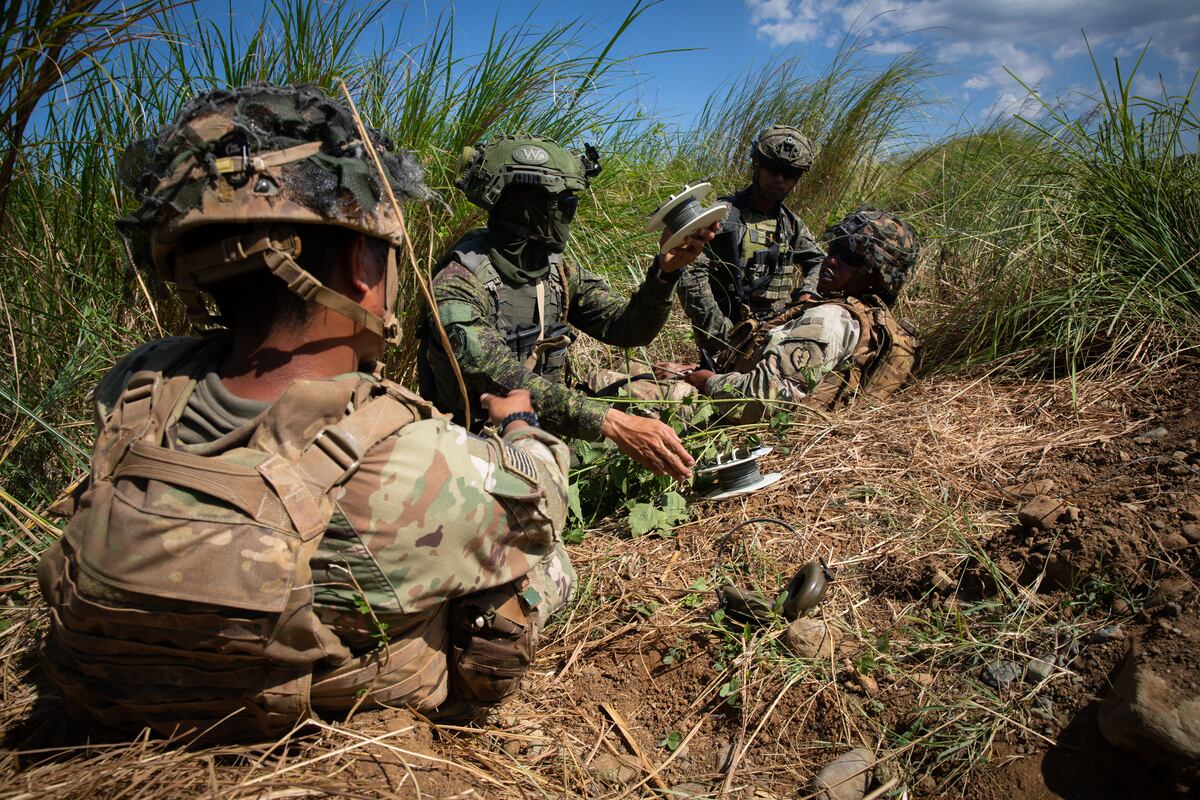
MANILA and HONOLULU – The U.S. Army is exporting its Joint Pacific Multinational Combat Training Center to the Philippines as the Southeast Asia country seeks to enhance and modernize its defense strategy.
The Philippines’ “concept of operations is shifting into one of more territorial defense operations and they’re beginning to train with that,” Gen. Charles Flynn, U.S. Army Pacific commander, told Defense News in an interview at the Association of the U.S. Army’s LANPAC conference in Honolulu.
The U.S. Army is bringing its JPMRC Exportable to Fort Magsaysay located in central Luzon where jungle training and even special operations training takes place and can accommodate a larger scale collective training event. Even so, the Philippines Armed Forces lack a training center at the scale of the JPMRC.
The center set up is nearly complete and the JPMRC rotation will begin this month, according to leaders in charge of the effort.
U.S. joint forces and the Philippines Armed Forces recently completed major exercises together – the first phase of Salaknib as well as Balikatan . Balikatan wrapped up on May 9 and a second phase of Salaknib is beginning with JPMRC X as a focus.
During Balikatan, “we executed long-range air assaults off the northern portion of Luzon with our 3rd Brigade Combat Team, and across the joint force projecting force into the islands in the Luzon Strait,” Maj. Gen. Marcus Evans, U.S. Army commander of the 25th Infantry Division based in Hawaii, told Defense News at LANPAC.
“What that provided us is an opportunity to work with the joint force, work with the Philippines Army and our experience with their 5th Infantry Division and 7th Infantry Division over the course of these last three months has really been exceptional. We will culminate this at the end of May, beginning of June with a Joint Pacific Multinational Readiness Center rotation forward in the Philippines, which will be the first one west of the International Date Line,” Evans said.
The 25th ID will have the full complement of instrumentation which allows the Army to collect data and “allows us to see ourselves and our Philippine army teammates and grow from lessons learned that we’re experiencing in a jungle environment,” he said.
The U.S. Army took an exportable version of JPMRC “to a lesser degree” out to Australia for Talisman Sabre in 2023 as well as in Indonesia for Super Garuda Shield, Evans said.
“What is different about this year is that we are going to take our full suite of instrumentation capabilities,” Evans explained.
“As an example, we’re going to be able to monitor our forces as well as the Philippines Armed Forces as they are executing operations that simulate a combat environment,” he said. “We will be able to assess indirect fires employment, we will be able to assess how quickly they are able to treat their casualties, how quickly they are able to move and sustain the force, what their water consumption is, what their power generation capability is, how effective they are with using their mission command.”
The Army has spent the last 45 days at Fort Magsaysay to prepare the center for the training, Evans said. “I personally flew and … went through the terrain, went with our aviation brigade looking at different helicopter landing zones,” he noted.
Because there is not an infrastructure for such training in the Philippines, Evans said, the Army is bringing in towers with sensors and other technology from Hawaii, flying it to the Philippines and using helicopters to set them on top of a mountain to be able to emit signals and collect training data. “It’s a Herculean effort,” he said.
Over a period of about two weeks, observer controllers will be able to provide after action reviews using real-time data collected through instrumentation and technology and fed into a model to help understand how to act, learn and adapt, according to Evans.
The Army’s 25th Infantry Division headquarters, through Balikatan, is already integrated and combined with the Philippines 7th ID headquarters, Brig. Gen. David Zinn, told Defense News at the division’s camp at Fort Magsaysay earlier this month.
“That may lend itself to introduce some of those capabilities” during the JPMRC X event, he said. “There is a variety of expertise that we learned from our [Filipino] partners.
“One, they understand the environment and they certainly understand the human terrain very well in the country. They conduct civil affairs operations very well, integrated into their operations as part of their planning,” Zinn said. “They modify the load plans and travel light and they’re able to move pretty quickly, tactically, in the terrain in the environment.”
The JPMRC X will continue to participate in exercises down the road in the Pacific.
“I think there is opportunities across Operation Pathways that we could look forward to in the future,” Evans said. Operation Pathways is a series of exercises conducted throughout the year between the U.S. Army and its partners and allies throughout the Indo-Pacific theater.
But first, the 25th ID will have its own annual JPMRC rotation which will occur on Oahu and also in Palau, according to Evans.
The Army is likely to take JPMRC X to Thailand for the Cobra Gold exercise next year and also back to the Philippines during next year’s Balikatan and Salaknib, Flynn said.
“We’re getting to the point where it’s being asked for so much that we have to moderate and kind of do proper scheduling because of the requests for that capability,” he added.
Correction — This story incorrectly identified the unit that runs JPRMC in Hawaii. The unit that runs JPMRC in Hawaii is the 196th Infantry Brigade.
Jen Judson is an award-winning journalist covering land warfare for Defense News. She has also worked for Politico and Inside Defense. She holds a Master of Science degree in journalism from Boston University and a Bachelor of Arts degree from Kenyon College.
马尼拉和檀香山——随着东南亚国家菲律宾寻求加强和现代化其国防战略,美国陆军正在向菲律宾输出其联合太平洋多国作战训练中心。
美国陆军太平洋司令查尔斯·弗林将军在檀香山举行的美国陆军协会LANPAC会议上接受《防务新闻》采访时表示,菲律宾的“作战概念正在转向更多领土防御作战,他们也开始进行这方面的训练”。
美国陆军正将其可出口型联合多用途训练中心(JPMRC)部署到位于吕宋岛中部的马格赛赛堡,该堡垒是丛林训练乃至特种作战训练的基地,能够容纳更大规模的联合训练活动。即便如此,菲律宾武装部队仍然缺乏像JPMRC这样规模的训练中心。
据负责该项目的领导人称,中心建设已接近完成,JPMRC轮换将于本月开始。
美国联合部队和菲律宾武装部队近期完成了多项联合演习——“萨拉克尼布”(Salaknib)第一阶段以及“肩并肩”(Balikatan)联合演习。“肩并肩”演习已于5月9日结束,“萨拉克尼布”第二阶段演习即将开始,重点是联合多边军事演习X(JPMRC X)。
“在‘肩并肩’联合军演期间,我们派出第3旅战斗队在吕宋岛北部海域执行远程空中突击,并向吕宋海峡的岛屿投送联合部队力量,”驻扎在夏威夷的美国陆军第25步兵师指挥官马库斯·埃文斯少将在LANPAC会议上告诉《防务新闻》。
埃文斯说:“这为我们提供了一个与联合部队、与菲律宾陆军合作的机会,过去三个月里,我们与他们的第五步兵师和第七步兵师的合作经验非常出色。我们将在五月底六月初完成此次合作,届时联合太平洋多国战备中心将轮换部署到菲律宾,这将是首次在国际日期变更线以西进行的此类轮换。”
他说:“第 25 步兵师将配备全套仪器,使陆军能够收集数据,并‘让我们能够看到自己和我们的菲律宾陆军队友,并从我们在丛林环境中经历的经验教训中成长’。”
埃文斯说,美国陆军“在一定程度上”将可出口的 JPMRC 版本推广到澳大利亚用于 2023 年的“护身军刀”演习,以及推广到印度尼西亚用于“超级迦楼罗之盾”演习。
“今年的不同之处在于,我们将启用我们全部的仪器设备,”埃文斯解释说。
“举例来说,我们将能够监控我方部队以及菲律宾武装部队在模拟作战环境下的行动,”他说道。“我们将能够评估间接火力运用情况,评估他们救治伤员的速度,评估他们调动和维持部队的速度,评估他们的用水量,评估他们的发电能力,评估他们运用任务指挥的效率。”
埃文斯说,陆军过去45天一直在马格赛赛堡进行训练准备工作。“我亲自驾驶飞机……勘察了地形,还和我们的航空旅一起考察了不同的直升机着陆区,”他指出。
埃文斯说,由于菲律宾缺乏此类训练的基础设施,陆军正从夏威夷运来配备传感器和其他技术的设备塔,空运到菲律宾,然后用直升机将其架设在山顶上,以便发射信号并收集训练数据。“这是一项艰巨的任务,”他说。
据埃文斯称,在大约两周的时间里,观察员控制员将能够利用通过仪器和技术收集的实时数据,并将这些数据输入模型,提供事后行动审查,以帮助了解如何行动、学习和适应。
陆军第25步兵师司令部通过“肩并肩”联合军事演习,已经与菲律宾第7步兵师司令部整合合并。本月初,陆军准将戴维·津恩在马格赛赛堡的师部营地告诉《防务新闻》。
他表示,“这或许有助于我们在JPMRC X活动期间展示其中的一些能力。” “我们从(菲律宾)合作伙伴那里学到了各种各样的专业知识。”
“首先,他们了解当地环境,尤其对该国的人文地形非常熟悉。他们能够很好地开展民事事务行动,并将这些行动融入到他们的作战计划中,”津恩说道。“他们会调整负重计划,轻装出行,因此能够在各种地形环境中快速、灵活地进行战术部署。”
JPMRC X 未来将继续参加在太平洋地区的演习。
埃文斯说:“我认为‘路径行动’中蕴藏着许多值得我们期待的未来机遇。”“路径行动”是美国陆军及其在印太地区的伙伴和盟友全年开展的一系列联合演习。
但首先,据埃文斯称,第 25 步兵师将有自己的年度联合多用途机动部队轮换训练,轮换地点包括瓦胡岛和帕劳。
弗林表示,陆军明年可能会将 JPMRC X 带到泰国参加“金色眼镜蛇”演习,明年还会将其带回菲律宾参加“肩并肩”和“萨拉克尼布”演习。
“现在对这项功能的需求如此之大,以至于我们不得不加以控制,并根据对这项功能的需求进行适当的安排,”他补充道。
更正——本报道错误地指出了负责夏威夷联合太平洋区域医疗中心(JPMRC)的单位。负责夏威夷联合太平洋区域医疗中心(JPMRC)的单位是第196步兵旅。
珍·贾德森是一位屡获殊荣的记者,为《防务新闻》报道陆地战争。她也曾为《政治报》和《内幕防务》工作。她拥有波士顿大学新闻学硕士学位和凯尼恩学院文学学士学位。