Austal eyes 1,000 new hires for nuclear submarine work奥斯塔公司计划招聘1000名新员工从事核潜艇工作
Austal intends to grow its workforce by one-third as it opens a new facility devoted entirely to producing nuclear submarine components.
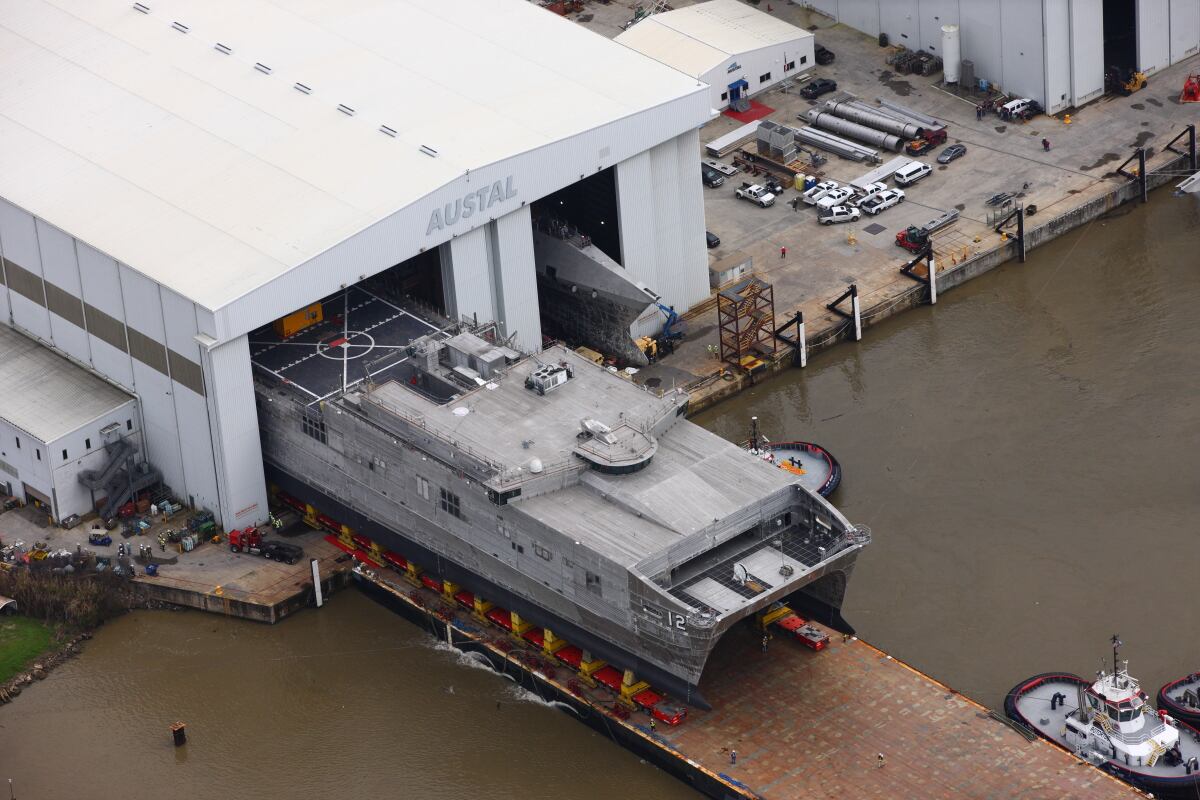
MOBILE, Ala. — Blue and yellow machines whirred, autonomously welding the steel that Austal’s Alabama shipyard will need to build nuclear submarine components as the company moves away from aluminum vessels.
Two massive yellow cranes moved horizontally across the ceiling above, illuminated by LED lights that grew dimmer farther down the 117,00-square-foot facility, delineating the point where a wall was knocked down one year ago to expand the building for the steel line.
Aluminum modules for the very last littoral combat ship under production stand among the steel sheets, which the Australia-based company will need for its new contracts: offshore patrol cutters for the U.S. Coast Guard, towing and salvage chips for the U.S. Navy, and key components for Columbia- and Virginia-class submarines.
Austal is banking on nuclear-powered submarine work as a major driver of growth in the coming years, to the point where the company will need to increase its workforce by a third. That would involve 1,000 additional hires to staff a new facility at the shipyard by the end of next year.
The planned facility, which is currently under design, is a physical manifestation of recent U.S. government investments aimed at expanding submarine production capacity.
“We’re putting a new building in that’s going to be dedicated fully to submarine work,” Larry Ryder, Austal’s vice president for business development and external affairs, told Defense News in an interview on Thursday. “It’s going to be about 1,000 jobs of output, supporting the submarine-industrial base.”
Broken down further, the company expects to hire an additional 200 employees at its Alabama shipyard for submarine work this year, with another 800 to join them once the facility is up and running next year.
The shipyard received a $50 million Defense Production Act grant to construct the new submarine module facility, which Austal matched with another $50 million from its own coffers. The facility will take about a year to construct.
Industrial base capacity has come under close scrutiny amid the recent trilateral AUKUS agreement , in which the U.S. and U.K. will help Australia acquire its own fleet of nuclear submarines. The U.S. Navy ultimately aims to build one Columbia-class and two Virginia-class submarines per year, and AUKUS mandates the U.S. sell Australia five of the latter class in the 2030s as an interim capability.
General Dynamics Electric Boat’s shipyard in Connecticut, which produces both submarine classes, ultimately elected to subcontract the production of multiple modules for these vessels to Austal, hoping that outsourcing to another shipyard will accelerate production timelines.
“We had capacity, we needed work, and the Navy knows we do quality work on time,” Ryder said. “Took a little while to get the relationship with Electric Boat. Like any prime, we’re all reluctant to give away work and trust somebody else with the quality. But we’ve got a real good relationship with them going now.”
Once Austal completes the command-and-control systems modules and the electronic deck modules for the submarines, it will ship them by barge to Electric Boat for installation.
The submarine work marks a significant turn of fortune for Austal after it lost a $5.5 billion Navy contract in 2020 to build a new class of frigates as the Littoral Combat Ship program neared its conclusion.
“It was about a year and a half ago we were looking at laying off 1,000 folks,” Ryder said. “Now we’re trying to hire 1,000 folks.”
Bryant Harris is the Congress reporter for Defense News. He has covered U.S. foreign policy, national security, international affairs and politics in Washington since 2014. He has also written for Foreign Policy, Al-Monitor, Al Jazeera English and IPS News.
阿拉巴马州莫比尔——蓝色和黄色的机器嗡嗡作响,自主焊接着奥斯塔公司位于阿拉巴马州的造船厂建造核潜艇部件所需的钢材,该公司正逐步摆脱铝制船舶的制造。
两台巨大的黄色起重机在天花板上方水平移动,LED 灯照亮了它们,灯光越往下越暗,照亮了这座 117,000 平方英尺的厂房,也勾勒出一年前为了扩建钢铁生产线而拆除的一堵墙的位置。
在澳大利亚公司新合同所需的钢板中,摆放着最后一艘正在生产的濒海战斗舰的铝制模块:为美国海岸警卫队制造近海巡逻舰,为美国海军制造拖曳和打捞船,以及为哥伦比亚级和弗吉尼亚级潜艇制造关键部件。
奥斯塔公司将核动力潜艇业务视为未来几年增长的主要驱动力,为此,该公司需要将员工人数增加三分之一。这意味着到明年年底,船厂新设施需要额外招聘1000名员工。
该规划中的设施目前正在设计中,是美国政府近期为扩大潜艇生产能力而进行的投资的实体体现。
“我们正在建造一座新大楼,将完全用于潜艇相关工作,”奥斯塔公司负责业务发展和对外事务的副总裁拉里·莱德周四在接受《防务新闻》采访时表示。“这将创造约1000个就业岗位,为潜艇工业基地提供支持。”
具体来说,该公司预计今年将在其位于阿拉巴马州的造船厂增聘 200 名员工从事潜艇相关工作,待该设施明年投入运营后,还将有 800 名员工加入。
该造船厂获得了《国防生产法》提供的5000万美元拨款,用于建造新的潜艇模块设施,奥斯塔公司也从自身资金中拿出5000万美元与之匹配。该设施的建设工期约为一年。
在近期美英三方签署的《奥库斯协议》(AUKUS)的背景下,工业基础产能受到了密切关注。根据该协议,美国和英国将帮助澳大利亚建立自己的核潜艇舰队。美国海军的最终目标是每年建造一艘哥伦比亚级和两艘弗吉尼亚级潜艇,而《奥库斯协议》则要求美国在2030年代向澳大利亚出售五艘弗吉尼亚级潜艇,作为过渡性能力。
通用动力电船公司位于康涅狄格州的造船厂生产这两种潜艇,最终决定将这些潜艇的多个模块的生产外包给奥斯塔公司,希望外包给其他造船厂能够加快生产进度。
“我们有产能,我们需要工作,而且海军也知道我们能按时完成高质量的工作,”莱德说。“和通用动力电船公司建立合作关系花了一段时间。像任何一家主承包商一样,我们都不愿意轻易把工作拱手让给别人,把质量交给别人。但现在我们和他们的合作关系非常融洽。”
奥斯塔公司完成潜艇的指挥控制系统模块和电子甲板模块后,将用驳船将其运送到通用动力电船公司进行安装。
在濒海战斗舰项目接近尾声时,奥斯塔公司于 2020 年失去了一份价值 55 亿美元的海军合同,该合同旨在建造一种新型护卫舰,而潜艇项目标志着该公司命运的重大转变。
莱德说:“大约一年半前,我们还在考虑裁员1000人。现在我们却在努力招聘1000人。”
布莱恩特·哈里斯是《防务新闻》的国会记者。自2014年以来,他一直在华盛顿报道美国外交政策、国家安全、国际事务和政治。他还曾为《外交政策》、《Al-Monitor》、《半岛电视台英语频道》和IPS新闻撰稿。