Singapore lets artists express concern for global conflicts, but content cannot provoke unrest新加坡允许艺术家表达对全球冲突的关切,但作品内容不得引发动乱。
Singapore allows artistic expression on global conflicts within limits to protect public order and national security, with approved performances cited. Read more at straitstimes.com.
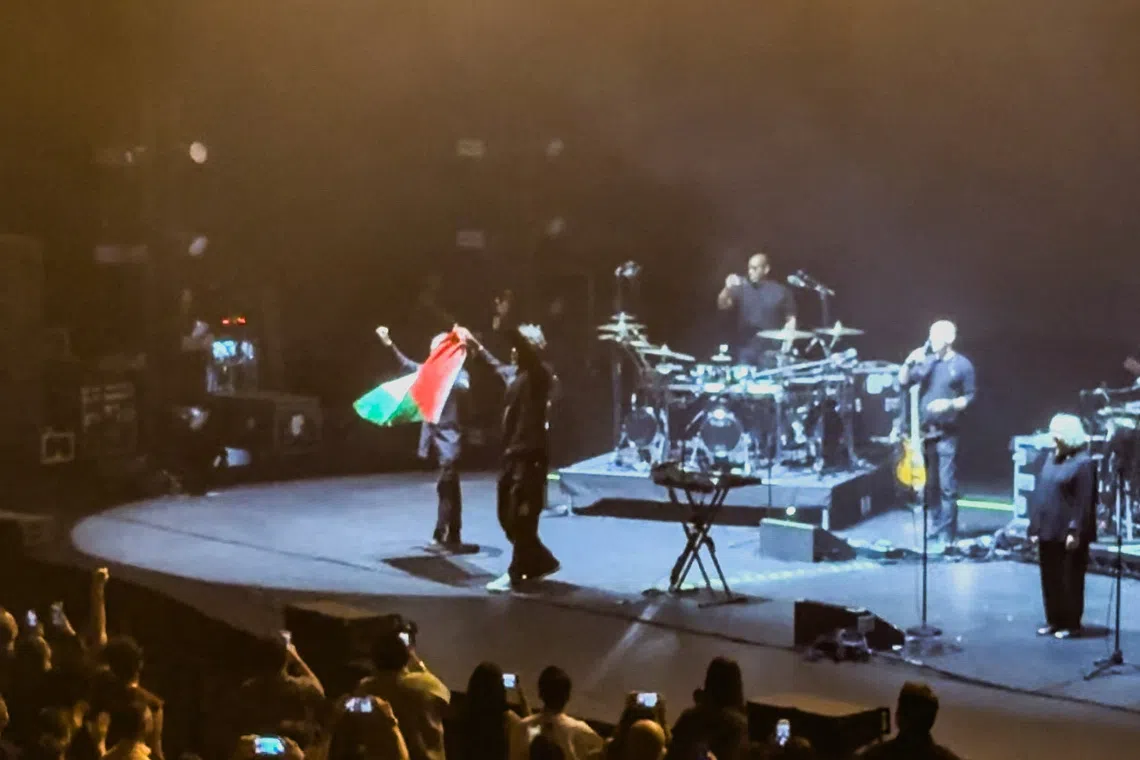
Robert Del Naja and Grant Marshall from Massive Attack stand with a Palestinian flag onstage at the end of their performance in Singapore on July 29, in this screengrab from video obtained from social media.
Published Sep 10, 2026, 02:57 PM
Updated Sep 10, 2026, 03:01 PM
The Singapore Government allows artists to express humanitarian concerns about global conflicts but says such expressions must not threaten public order or national security.
Several performances addressing conflicts like Israel-Gaza and themes of genocide have been approved under licensing rules and content ratings by IMDA.
Artists, both local and foreign, must comply with Singapore laws and licensing conditions; early engagement with IMDA is encouraged for clarity on acceptable content.
SINGAPORE - The Singapore Government recognises the humanitarian impact of global conflicts and does not prohibit artists from expressing concern for those who are affected, said Senior Minister of State for Digital Development and Information Tan Kiat How.
This is provided their content does not undermine public order, national security or stability in Singapore, he said on Sept 10 in Parliament.
Approvals had been given for several performances that feature such causes, including those covering the Israel-Gaza conflict and which explore themes of genocide, he added.
Tan was replying a question from Hazlina Abdul Halim (East Coast GRC) on how the Government assesses artists’ conduct on international conflicts.
Her question comes after two members of British trip-hop band Massive Attack were issued warnings by the police and banned from re-entering Singapore. They had displayed a Palestinian flag at their concert here on July 29, with one of them shouting “Free Palestine”.
The entry ban also means that the Infocomm Media Development Authority (IMDA) will not grant any future application for performances by the band.
Elaborating, Tan said that local and foreign artists performing here are expected to comply with Singapore’s laws and the conditions of their licence during their events.
The condition that artistic expression should not undermine public order here is made clear in IMDA’s Arts Entertainment Classification Code that all licensees must comply with. The code classifies arts entertainment according to their suitability for different age groups, covering plays, stand-up comedies, art exhibitions and literary readings, dance performances, and music performances like variety shows and concerts.
Besides the intent of the actions, IMDA will also consider the likely impact of their performance to assess if the conditions are met, Tan added.
“Moreover, Singapore should not be used by foreigners as a platform to further political causes, including those relating to conflicts or political issues overseas,” he said.
In follow-up queries, Hazlina asked Tan if there was an example of a performance by an international artist with a social cause that was allowed here.
She also asked whether any changes were made after Massive Attack’s actions and in the lead up to an upcoming November concert by Guns N’ Roses, a band known for displaying a Ukrainian flag during one of its songs.
Tan cited three performances that were allowed here. In May, R18 event To The Unforgotten was organised to celebrate humanity and offer solidarity to various groups around the world. It featured a song, poem and multimedia elements on the Israel-Gaza conflict.
Another performance was 6 Microlectures On Genocides, which was last staged in May. The R18 show comprised short works that explored themes of genocide, war crimes and contemporary conflicts.
The third example was a stand-up comedy called Namaste in 2024 with an Advisory 16 rating. It had a segment where the comedian spoke about the Israel-Gaza conflict.
Tan said that the licensing framework is designed to protect young people from unwanted content and also allow people to make decisions on what they can watch. At the same time, boundaries are needed for content that may stir up public disorder or national security considerations.
He added that any assessment on licensing “has to be contextual” because it is based on the prevailing sentiment and assessment by the agencies and the regulator at a given point in time.
With this in mind, Tan encouraged arts applicants to engage IMDA early, and the agency will contact other relevant public agencies for their inputs if needed. This is so that clarity and guidance can be given earlier.
Singapore Parliament
IMDA/Infocomm Media Development Authority
Ministry of Digital Development and Information
这张截图来自社交媒体上的视频,显示 Massive Attack 乐队的 Robert Del Naja 和 Grant Marshall 在 7 月 29 日新加坡演出结束后,在舞台上与一面巴勒斯坦国旗站在一起。
发布于 2026 年 9 月 10 日下午 2:57
更新于2026年9月10日下午3:01
新加坡政府允许艺术家表达对全球冲突的人道主义关切,但表示此类表达不得威胁公共秩序或国家安全。
根据新加坡媒体发展局 (IMDA) 的许可规则和内容评级,一些涉及以色列-加沙冲突和种族灭绝主题的演出已经获得批准。
无论是本地艺术家还是外国艺术家,都必须遵守新加坡的法律和许可条件;鼓励尽早与新加坡资讯通信媒体发展局 (IMDA) 联系,以明确可接受的内容。
新加坡——新加坡政府承认全球冲突造成的人道主义影响,并不禁止艺术家表达对受影响者的关切,数码发展及新闻部高级政务部长陈杰豪表示。
他于9月10日在国会表示,前提是他们的内容不会破坏新加坡的公共秩序、国家安全或稳定。
他还补充说,一些以这类主题为内容的演出已经获得批准,其中包括涉及以色列-加沙冲突和探讨种族灭绝主题的演出。
谭先生是在回答东海岸集选区议员哈兹丽娜·阿卜杜勒·哈利姆提出的问题,即政府如何评估艺术家在国际冲突中的行为。
此前,英国迷幻电子乐队 Massive Attack 的两名成员因在7月29日于新加坡举行的演唱会上展示巴勒斯坦国旗,其中一人高喊“解放巴勒斯坦”,而被警方警告并禁止再次入境新加坡。
入境禁令也意味着新加坡资讯通信媒体发展局(IMDA)将不会批准该乐队未来的任何演出申请。
Tan进一步解释说,在新加坡表演的本地和外国艺术家在演出期间应遵守新加坡的法律和许可证条款。
新加坡资讯通信媒体发展局(IMDA)的《艺术娱乐分类守则》明确规定,艺术表达不得扰乱公共秩序,所有持牌机构都必须遵守该守则。该守则根据艺术娱乐活动对不同年龄段的适宜性进行分类,涵盖戏剧、脱口秀、艺术展览和文学朗诵、舞蹈表演以及综艺节目和演唱会等音乐表演。
谭补充说,除了行动的意图之外,IMDA还会考虑其行动可能产生的影响,以评估是否满足条件。
“此外,新加坡不应被外国人用作推进政治事业的平台,包括那些与海外冲突或政治问题有关的事业,”他说。
在后续询问中,哈兹丽娜问谭,是否有国际艺术家以社会公益为目的的表演被允许在这里进行的例子。
她还询问,在 Massive Attack 的行动之后,以及在 Guns N' Roses 即将于 11 月举行的演唱会之前,是否做出了任何改变。Guns N' Roses 曾因在演唱一首歌曲时展示乌克兰国旗而闻名。
谭列举了三场获准在此上演的演出。五月份,名为《致不被遗忘者》(To The Unforgotten)的R18级活动举办,旨在颂扬人性,声援世界各地的不同群体。该活动以歌曲、诗歌和多媒体形式呈现了以色列-加沙冲突。
另一场演出是《关于种族灭绝的六场微型讲座》,该演出最近一次上演是在五月份。这场限制级(R18)演出由一系列短篇作品组成,探讨了种族灭绝、战争罪行和当代冲突等主题。
第三个例子是一部名为《Namaste》的单口喜剧,于 2024 年上映,评级为 16 岁以上观看。其中有一段喜剧演员谈到了以色列-加沙冲突。
谭表示,许可制度旨在保护青少年免受不良内容的侵害,同时也让人们能够自主选择观看内容。与此同时,对于可能引发公共骚乱或危害国家安全的内容,也需要划定界限。
他还补充说,任何关于许可证发放的评估“都必须结合具体情况”,因为它取决于特定时间点各机构和监管机构的普遍看法和评估。
鉴于此,谭先生鼓励艺术类申请者尽早与新加坡资讯通信媒体发展局(IMDA)联系,该机构也会在必要时联系其他相关公共机构征求意见,以便尽早提供清晰的指导。
新加坡国会
新加坡资讯通信媒体发展局/IMDA
数字发展和信息部