Australia sizes up a continent-size gap in air defenses澳大利亚正在评估其防空能力方面存在的大陆级缺口
Military leaders are prizing sensors over interceptors in what will be Australia’s future network of weapons for defending would-be targets.
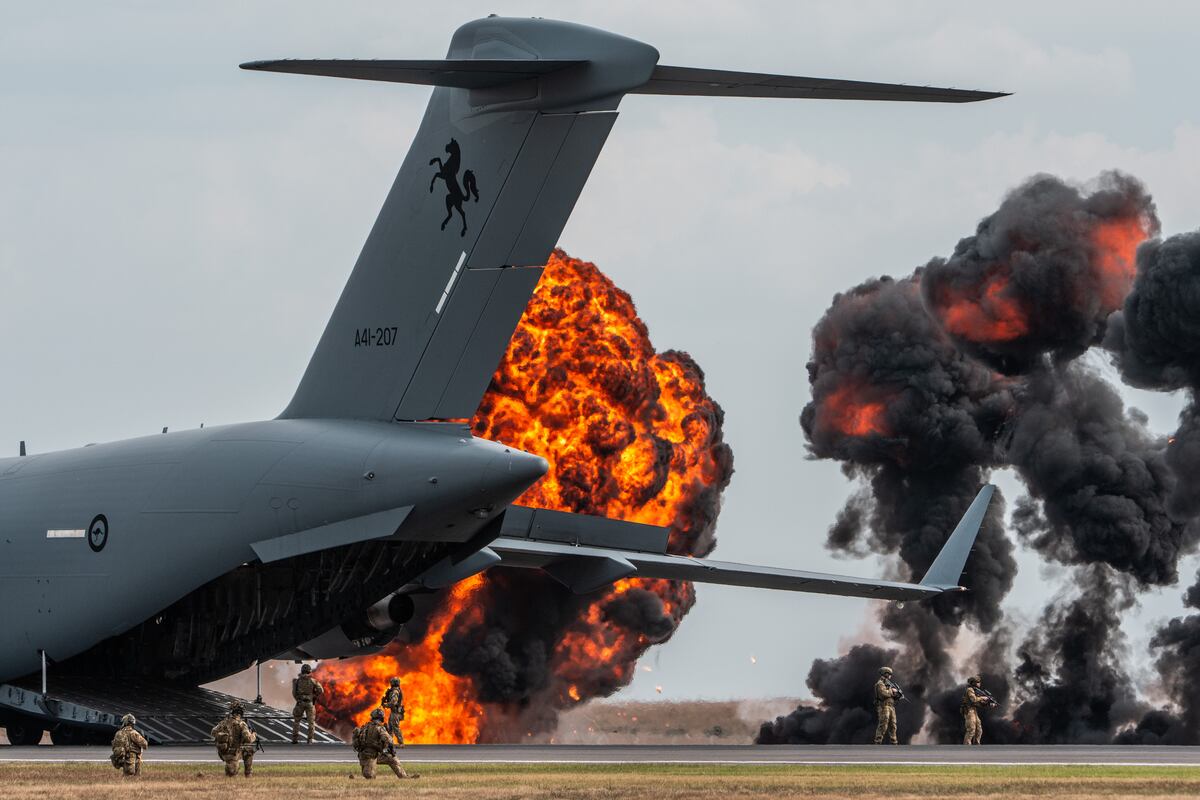
MELBOURNE, Australia — Australian military leaders are scrambling to cobble together fresh air defense capabilities, as China’s missile arsenal is growing and Beijing’s warships have started showing up in Australasia.
Global companies offered weaponry to that end at the recent Avalon International Airshow, held near Melbourne in late March.
For now it appears that military leaders are prizing sensors over interceptors in what will be Australia’s future network of weapons for defending would-be targets in a conflict.
Air Vice-Marshal Nick Hogan, head of Air Force Capability, acknowledged that an integrated, medium-range air defense capability has been delayed.
“What’s most important to us is seeing and sensing first, so getting the command and control right first, and then getting the kinetics that might be required to effect anything coming towards us,” he told Defense News at the Avalon event.
Hogan was referring primarily to Project Air 6500, which is slowly delivering an integrated air battle management system.
One lesson from Ukraine is the need for air defense, and Hogan said Australia was learning from evolutions seen globally. However, Australia currently owns only NASAMS batteries and three air-warfare destroyers.
Australia’s only land-based air defense capability comes from recently inducted NASAMS missile batteries. (Gordon Arthur/staff)
While major Australian cities and military bases are often on coasts, there are simply not enough ships to protect them all. Furthermore, it is likely the U.S. will demand an air defense umbrella to protect a nuclear submarine base being established in Western Australia.
The Defence Strategic Review of 2023 urged acceleration of medium-range and high-speed missile defenses, with authors lamenting the low priority placed on integrated air and missile defense.
Instead of “pursuing a long-term, near-perfect solution at unaffordable cost,” the review said the government must allocate “sufficient resources to the Chief of Air Force to deliver the initial capability in a timely way”.
According to Hogan, ground-based defenses may not be the ideal solution for Australia.
“When you have a limited inventory, you want to be able to be as flexible as possible, so that might be using maritime stocks on land, it might be using land stocks in the maritime domain,” he said. “There are many options to go forward. What we’re trying to do is make sure, where possible, we can get the biggest return on investment using sovereign capabilities.”
Asked about a timeline for implementation, Hogan said: “As soon as we can practically make it happen.”
Potential solutions, such as Raytheon’s Patriot and systems from Israel and South Korea, were being promoted at Avalon Airshow 2025.
Officials have also begun addressing an Australian weakness in countering drones, albeit at a limited level.
Last year, Anduril Australia signed a three-year deal to trial a counter-drone capability at RAAF Base Darwin in the north, but this is an isolated step forward.
Nonetheless, Air Marshal Stephen Chappell, Chief of Air Force, said: “We’re investing in our northern base infrastructure,” including “the ability to passively defend, use deception, be able to recover, be able to agilely move forces around”.
Hardened aircraft shelters are no longer part of the equation.
“That was a fantastic concept for its day, but probably its day has passed,” Chappell said.
“We’re already working with our civilian sector and our industry sectors in the northern half of Australia using non-military airfields to land, refuel and, in the future, rearm, combat aircraft or other aircraft in order to regenerate airpower from non-military bases.”
A recent report by the U.S.-based Hudson Institute think tank assessed that as few as ten missiles, each with a warhead spraying cluster munitions over a 450-foot diameter, could neutralize all aircraft parked in the open at various key U.S. bases. Australia’s situation is no different. Likewise, loitering munitions could easily penetrate regular aircraft shelters.
Air Vice-Marshal Glen Braz, Air Commander Australia, argued the air service is “very deliberate about our passive efforts” to protect bases.
“As threats evolve, and warfare evolves, we’d seek to have layers of defense systems that we’d want to have in place,” Braz said. “But we’re very much training our teams to fight the network of bases as a system.”
Meanwhile, officials used the the Avalon airshow to provide an assessment of key aerial platforms in the pipeline.
They had good things to say about the influx of F-35s, the fifth-generation warplane made by Lockheed Martin.
“We had the last nine aircraft arrive in December, so we’re thrilled to have our 72 F-35s with us in Australia across our three operational squadrons, the training unit and integrated training center,” Chappell told Defense News.
Elsewhere, the RAAF continues testing of Boeing Defence Australia’s MQ-28A Ghost Bat unmanned aircraft. Hogan said he is “very pleased” with progress.
“This year we’re going to demonstrate the capabilities of the platform over a number of activities,” Hogan said. “We’ll test all of the payloads we’ve planned for potential use on the platform, with the exception of it being armed. That’s one that remains in our thinking, but we’re going to focus on other payloads first.”
Competition for the Ghost Bat is brewing under Project Air 6015, where the RAAF will make recommendations to government on the way forward for collaborative combat aircraft, probably by year’s end.
Hogan said the MQ-28A will be a “very strong contender in any options we take forward to government.”
Regardless, Anduril believes its YFQ-44A Fury stands a chance. The American company displayed a full-sized model of the aircraft at the Avalon show.
Gordon Arthur is an Asia correspondent for Defense News. After a 20-year stint working in Hong Kong, he now resides in New Zealand. He has attended military exercises and defense exhibitions in about 20 countries around the Asia-Pacific region.
澳大利亚墨尔本——随着中国导弹库的不断扩充和北京军舰开始出现在澳大拉西亚地区,澳大利亚军方领导人正争分夺秒地拼凑新的防空能力。
在 3 月下旬于墨尔本附近举行的阿瓦隆国际航展上,全球各大公司都提供了用于此目的的武器装备。
目前看来,在澳大利亚未来用于防御冲突中潜在目标的武器网络中,军方领导人更看重传感器而非拦截器。
空军能力主管、空军副元帅尼克·霍根承认,一体化的中程防空能力建设已被推迟。
“对我们来说,最重要的是先看到和感知,所以首先要做好指挥和控制,然后再获得应对任何朝我们袭来的目标所需的动能,”他在阿瓦隆活动上告诉《防务新闻》。
霍根主要指的是“空中6500项目”,该项目正在逐步交付一套综合空中作战管理系统。
乌克兰战争的教训之一是防空的重要性,霍根表示澳大利亚正在从全球各地的经验中吸取教训。然而,澳大利亚目前仅拥有NASAMS防空导弹系统和三艘防空驱逐舰。
澳大利亚唯一的陆基防空能力来自近期列装的NASAMS导弹系统。(戈登·阿瑟/工作人员)
虽然澳大利亚的主要城市和军事基地通常都位于沿海地区,但舰艇数量远远不足以保护它们。此外,美国很可能会要求提供防空保护伞,以保护正在西澳大利亚州建设的核潜艇基地。
2023 年国防战略评估报告敦促加快中程和高速导弹防御的发展,报告作者对综合防空和导弹防御的重视程度较低表示遗憾。
审查报告指出,政府不应“以不堪承受的成本追求长期的、近乎完美的解决方案”,而应“向空军司令分配足够的资源,以便及时交付初始能力”。
霍根认为,地面防御可能不是澳大利亚的理想解决方案。
他说:“库存有限时,我们需要尽可能灵活应对,这可能意味着在陆地上利用海上储备,也可能意味着在海上利用陆地储备。我们有很多选择。我们正在努力确保,在条件允许的情况下,利用自主能力获得最大的投资回报。”
当被问及实施时间表时,霍根表示:“一旦我们能够切实可行,就会立即实施。”
在 2025 年阿瓦隆航展上,雷神公司的“爱国者”导弹系统以及以色列和韩国的系统等潜在解决方案得到了推广。
尽管目前程度有限,但官员们也已开始着手解决澳大利亚在应对无人机方面的弱点。
去年,安杜里尔澳大利亚公司签署了一项为期三年的协议,在北部的达尔文皇家空军基地试用反无人机能力,但这只是向前迈出的孤立一步。
尽管如此,空军司令斯蒂芬·查佩尔空军上将表示:“我们正在投资建设北方基地基础设施”,包括“被动防御能力、欺骗能力、恢复能力以及灵活调动部队的能力”。
加固型飞机掩体已不再是考虑因素。
“在当时,那是一个非常棒的想法,但可能已经过时了,”查佩尔说。
“我们已经在澳大利亚北部与民用部门和工业部门合作,利用非军事机场为战斗机或其他飞机提供降落、加油以及未来重新武装,以便从非军事基地恢复空中力量。”
美国智库哈德逊研究所最近的一份报告评估认为,仅需十枚导弹,每枚导弹都配备一个弹头,能够将集束弹药散布在直径450英尺(约137米)的范围内,就能摧毁美国多个重要基地露天停放的所有飞机。澳大利亚的情况也与之类似。同样,巡飞弹也很容易穿透常规的飞机掩体。
澳大利亚空军司令格伦·布拉兹空军中将表示,空军“非常重视被动防御措施”,以保护基地。
布拉兹说:“随着威胁和战争方式的演变,我们会寻求建立多层防御系统。但我们现在主要训练的是我们的团队,让他们能够将基地网络视为一个整体系统来对抗。”
与此同时,官员们利用阿瓦隆航展对正在筹建中的关键空中平台进行了评估。
他们对洛克希德·马丁公司生产的第五代战机F-35的大量引进给予了高度评价。
“我们最后九架飞机于 12 月抵达,因此我们很高兴我们的 72 架 F-35 战机能够部署在澳大利亚的三个作战中队、训练部队和综合训练中心,”查佩尔告诉《防务新闻》。
另一方面,澳大利亚皇家空军继续测试波音防务澳大利亚公司的MQ-28A“幽灵蝙蝠”无人机。霍根表示,他对测试进展“非常满意”。
霍根说:“今年我们将通过一系列活动来展示该平台的性能。我们将测试所有计划在该平台上使用的有效载荷,但不包括武装载荷。武装载荷仍然是我们考虑的方向,但我们将首先专注于其他有效载荷。”
在“空中6015计划”下,针对“幽灵蝙蝠”战机的竞争正在酝酿之中。澳大利亚皇家空军将就协同作战飞机的未来发展方向向政府提出建议,预计在年底前完成。
霍根表示,MQ-28A 将是“我们向政府提出的任何方案中都非常强有力的竞争者”。
尽管如此,安杜里尔公司仍然相信其YFQ-44A“狂怒”战斗机有获胜的希望。这家美国公司在阿瓦隆航展上展示了该机型的全尺寸模型。
戈登·阿瑟是《防务新闻》的亚洲特派记者。在香港工作20年后,他现居新西兰。他曾到访亚太地区约20个国家,参加过军事演习和防务展览。