From customer to sanctioned ‘proliferator,’ drones extend Iran’s reach从客户到受制裁的“扩散者”,无人机扩大了伊朗的影响范围。
Iranian contractors and government officials have picked up on market demand, frequenting arms expos and other events in Russia, Iraq, Qatar and more.
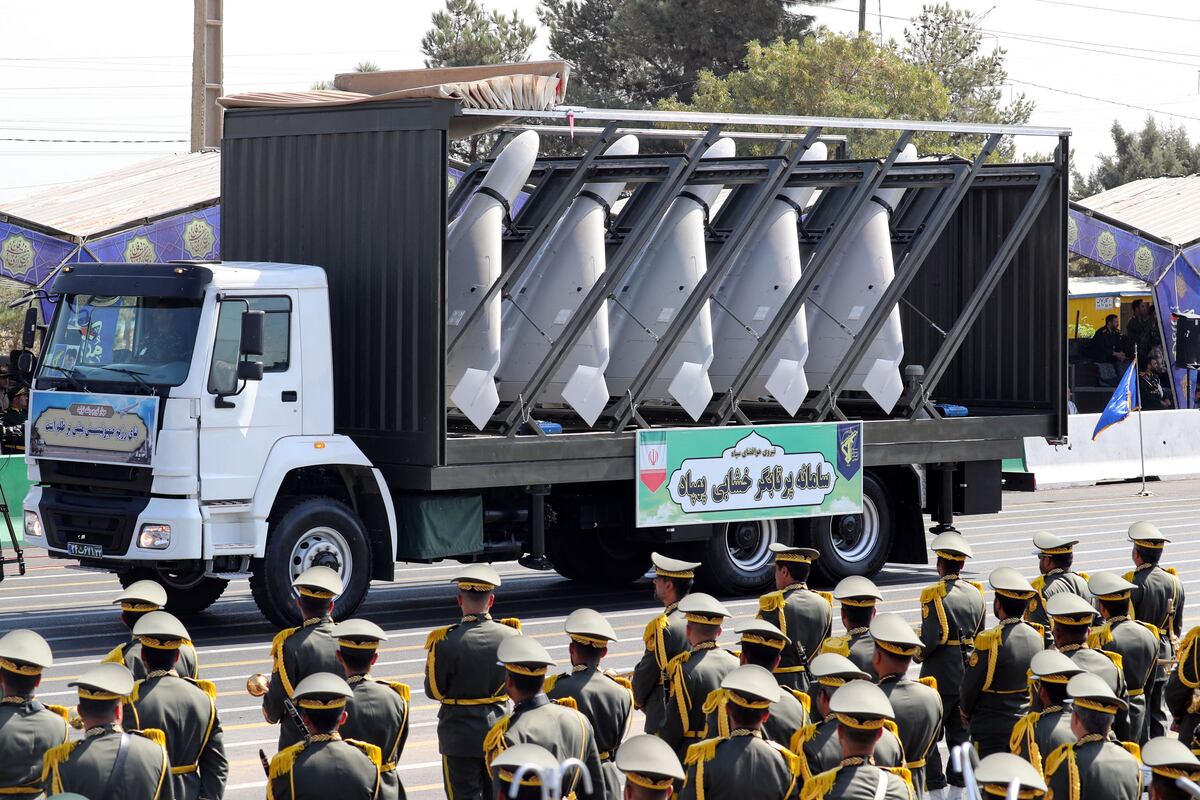
Days after Iran’s unprecedented and largely unsuccessful bombarding of Israel, the U.S. and U.K. levied additional sanctions on the regime’s manufacturers and sources of materiel.
The joint move, made in direct response to the attack, targeted 16 people and two organizations supporting Tehran’s flowering arms industry, according to the Treasury Department. They include those who work on behalf of the Islamic Revolutionary Guard Corps and its unmanned aerial vehicle production arm.
The economic slap is meant to debase Tehran’s growing source of cash and cachet: weapons. Drones such as the Shahed and Mohajer , missiles, and their derivatives have been spotted or reported in the hands of Russian, Sudanese and Houthi forces, among others.
“We’re using Treasury’s economic tools to degrade and disrupt key aspects of Iran’s malign activity, including its UAV program and the revenue the regime generates to support its terrorism,” Treasury Secretary Janet Yellen said in a statement April 18. More than 600 people and entities tied to Iran’s “terrorist activity, its human rights abuses and its financing of Hamas, the Houthis, Hezbollah and Iraqi militia groups” have been dinged in the last three years, she added.
The international reach of Iranian technologies reflects its growing profile in the arms world and its goals of international influence, U.S. defense officials, outside analysts and defense industry executives told C4ISRNET. Parts of UAVs recovered in Ukraine and Iraq, analysis of military parades in Yemen, reports of transfers to the African continent, interdicted shipments in the Gulf of Oman and footage of production lines in Russia underline its ambition.
“Iran used to be a customer,” U.S. Navy Rear Adm. Mike Brookes told C4ISRNET during the Sea-Air-Space defense conference in Maryland. “Now, they are a producer and proliferator, and I think Russia is a great example.”
Iran’s weekend barrage comprised roughly 170 drones, 120 ballistic missiles and 30 cruise missiles, according to Israel’s armed forces. Almost all the overhead threats were intercepted, with support from the U.S., U.K., France and others.
The Shahed appeared to be the salvo’s centerpiece. The one-way attack drones are assembled using simplistic parts — including from Western sources — and are capable of flying more than 1,000 miles with warheads weighing dozens of pounds. Their popularity is booming.
Iran has since 2022 supplied Russia with more than 1,000 Shahed and Mohajer UAVs, according to U.S. estimates. Footage of Russian production lines, buttressed by Tehran’s expertise, surfaced online earlier this year. On display were rows of black and grey Shahed clones known as Geran: airframes with triangular bodies, rounded spines, stubby nose cones and vertical stabilizers extending above and below the wings.
This comparison from a Defense Intelligence Agency report examines Shahed and Geran drone parts. (Photo provided/DIA)
Shahed lookalikes known as Waid have also been adopted by Houthi rebels. The Defense Intelligence Agency documented the commonalities, and in a recent appraisal of worldwide threats warned Iran would lean on partisans to do its bidding. The Islamic Revolutionary Guard Corps maintains a division dubbed Department 8,000, which develops UAVs and provides training to outside forces.
“Iran pursues interests, maintains depth and extends its reach through a network of militant proxies,” said Brookes, who serves as the commander of the Office of Naval Intelligence. The organization collects, analyzes and distributes information about foreign fighters.
“Iran currently proliferates weapons throughout the region and is becoming a burgeoning global proliferation risk,” he added. “Ten years ago, Iran was a local threat. Today, it is a regional menace with much broader malign-influence activities.”
Militaries and extremist groups are increasingly deploying drones and other unmanned systems to surveil and attack targets from greater and safer distances. Explosive drones can supplement missile stockpiles, as well, offering users a cheaper and less complex option.
Iranian contractors and government officials have picked up on the market demand, frequenting arms expos and other events in Russia, Iraq, Qatar, Serbia and Saudi Arabia, according to Behnam Ben Taleblu, a senior fellow at the Foundation for Defense of Democracies think tank.
Iran showcased its Shahed-149 Gaza drone at the 2024 Doha International Maritime Defence Exhibition and Conference. It resembles the MQ-9 Reaper , made by U.S.-based General Atomics.
“Iran is gearing up to go from arms proliferator to arms seller,” Taleblu told C4ISRNET in an interview. “With Iranian weapons like drones — be they unmanned combat aerial vehicles or one-way attack drones — spread across conflict zones in four continents, the regime is ready to share battle-proven but lesser-quality alternatives to current day military technology at half the price and with no regulatory hang-ups.”
In short, he added, Tehran is “quietly positioning itself as arms supplier to the third world.”
The ordnance flung at Israel is the latest evidence of the allure of drones and their ability to level the playing field. Taleblu has described them as the “ poor man’s cruise missile ,” exemplifying that quantity has a quality of its own.
A Shahed drone can cost tens of thousands of dollars. Sophisticated missiles or interceptors, like those relied upon by warships in the Red Sea, can cost many times more and are fewer and farther between. The U.S. Navy has expended close to $1 billion in munitions in the half-year its vessels have been patrolling the waters in the Greater Middle East.
“Israel, U.S. and its allies were fortunate enough to intercept 99% of Iran’s attack with limited damage and injury, but this is another sign that the use of UAVs on the battlefield are here to stay,” Andy Lowery, the chief executive at directed-energy company Epirus, told C4ISRNET. “And the tactics our adversaries employ when using UAVs will continue to get more sophisticated with the use of AI-enabled drone swarms.”
The danger drones and other unmanned technologies pose is factoring into U.S. military modernization. Counter-drone armaments including directed energy are in high demand.
Concept art from defense contractor Lockheed Martin shows the potential for directed-energy weapons against unmanned systems. (Photo provided/Lockheed Martin)
The U.S. Army in 2022 inked a $66 million deal with Epirus to supply the Leonidas high-power microwave weapon in advancement of the service’s Indirect Fire Protection Capability venture. An initial prototype was delivered 2023. The company is also expected to test its products against boats and motors in an upcoming naval exercise, taking a cue from recent Houthi attacks involving explosives-strapped unmanned surface vessels.
“The munitions that were used to defend against the attack are not infinite. There will be supply chain, logistics, and budgetary constraints to resupply,” Lowery said of the Iranian onslaught. “From a strategic standpoint, this attack demonstrates the benefit of having a counter-electronics solution with an unlimited magazine as part of a layered defense approach.”
The Pentagon is spending an average $1 billion a year developing directed-energy weapons, according to the Government Accountability Office , a federal watchdog. At least than 31 directed-energy projects were underway across the military as of this year.
Army Gen. Michael Kurilla, the leader of U.S. Central Command, has said he would welcome additional directed-energy weaponry to address overhead threats: rockets, artillery, mortars. He’s also said attack drones are at the heart of a “nascent military partnership” between Iran and Russia.
The U.S. Army this year dispatched three Stryker-mounted lasers to Iraq for evaluation. A fourth will soon follow.
“Because the evolution of counter-UAS is extremely fast and the threat is real, as seen in Iraq and Syria up until February,” a defense official told C4ISRNET last month, “deployed units can use this environment to operate, test and further develop these new capabilities in real-world conditions while identifying crucial lessons on the impact of operational surroundings.”
Colin Demarest was a reporter at C4ISRNET, where he covered military networks, cyber and IT. Colin had previously covered the Department of Energy and its National Nuclear Security Administration — namely Cold War cleanup and nuclear weapons development — for a daily newspaper in South Carolina. Colin is also an award-winning photographer.
在伊朗史无前例地对以色列进行轰炸,但这次轰炸在很大程度上并不成功之后几天,美国和英国对该政权的制造商和物资来源实施了额外的制裁。
据美国财政部称,此次联合行动是对袭击事件的直接回应,目标是16名个人和两个支持德黑兰蓬勃发展的军火工业的组织。其中包括为伊斯兰革命卫队及其无人机生产部门工作的人员。
这次经济打击旨在削弱德黑兰日益增长的资金和威望来源:武器。据报道,包括俄罗斯、苏丹和胡塞武装在内的多个国家都已发现或持有“沙赫德”和“穆哈杰尔”等无人机、导弹及其衍生武器。
“我们正在利用财政部的经济手段来削弱和破坏伊朗恶意活动的关键方面,包括其无人机项目以及该政权为支持其恐怖主义活动而获得的收入,”财政部长珍妮特·耶伦在4月18日的一份声明中表示。她补充说,过去三年里,已有超过600名与伊朗“恐怖活动、侵犯人权以及资助哈马斯、胡塞武装、真主党和伊拉克民兵组织”有关联的个人和实体受到制裁。
美国国防官员、外部分析人士和国防工业高管告诉C4ISRNET,伊朗技术的国际影响力反映了其在军火领域日益增长的地位及其国际影响力目标。在乌克兰和伊拉克缴获的无人机部件、对也门阅兵式的分析、向非洲大陆转移武器的报道、在阿曼湾截获的运输船以及俄罗斯生产线的影像都凸显了伊朗的雄心壮志。
“伊朗过去是我们的客户,”美国海军少将迈克·布鲁克斯在马里兰州举行的海空天防务会议上告诉C4ISRNET,“现在,他们成了生产商和扩散者,我认为俄罗斯就是一个很好的例子。”
据以色列军方称,伊朗周末发动的空中袭击动用了约170架无人机、120枚弹道导弹和30枚巡航导弹。在美英法等国的支持下,几乎所有空中威胁都被拦截。
“沙赫德”无人机似乎是此次武器齐射的核心。这种单向攻击无人机由一些简单的部件组装而成——部分部件来自西方——能够携带重达数十磅的弹头飞行超过1000英里。它们的受欢迎程度正在迅速增长。
据美国估计,自2022年以来,伊朗已向俄罗斯提供了超过1000架“沙赫德”(Shahed)和“穆哈杰尔”(Mohajer)无人机。今年早些时候,网上流传出俄罗斯生产线的视频,这些生产线得到了德黑兰技术的鼎力支持。视频中展示了一排排被称为“格朗”(Geran)的黑灰色“沙赫德”仿制机:机身呈三角形,背部呈圆形,机头短小,垂直尾翼延伸至机翼上方和下方。
这张来自美国国防情报局报告的对比图分析了“沙赫德”(Shahed)和“格伦”(Geran)无人机的零部件。(图片由美国国防情报局提供)
胡塞武装也招募了与沙赫德长相相似的瓦伊德。美国国防情报局记录了这些相似之处,并在最近一份全球威胁评估报告中警告称,伊朗将依靠其武装力量为其效力。伊斯兰革命卫队下设一个名为“8000部门”的单位,负责研发无人机并为外部武装力量提供训练。
“伊朗通过其武装代理人网络追求自身利益、保持纵深并扩大影响力,”布鲁克斯说道,他同时也是美国海军情报局局长。该机构负责收集、分析和分发有关外国战斗人员的信息。
他补充说:“伊朗目前正在整个地区扩散武器,并日益成为全球扩散风险的源头。十年前,伊朗还只是一个局部威胁。如今,它已成为一个区域性威胁,其恶意影响活动范围更广。”
军队和极端组织越来越多地部署无人机和其他无人系统,以便从更远、更安全的距离监视和攻击目标。爆炸性无人机还可以补充导弹储备,为用户提供一种更便宜、更简单的选择。
据保卫民主基金会智库高级研究员贝赫纳姆·本·塔勒布鲁称,伊朗承包商和政府官员已经注意到市场需求,经常出入俄罗斯、伊拉克、卡塔尔、塞尔维亚和沙特阿拉伯的武器展览会和其他活动。
伊朗在2024年多哈国际海事防务展览会上展示了其“沙赫德-149加沙”无人机。该无人机与美国通用原子公司生产的MQ-9“死神”无人机相似。
“伊朗正准备从武器扩散国转变为武器销售国,”塔莱布鲁在接受C4ISRNET采访时表示。“伊朗的武器,例如无人机——无论是无人作战飞行器还是单向攻击无人机——已经遍布四大洲的冲突地区,该政权准备以一半的价格,且不受任何监管障碍,向其他国家提供经过实战检验但质量稍逊于现有军事技术的替代品。”
他补充说,简而言之,德黑兰正在“悄悄地将自己定位为第三世界的武器供应国”。
向以色列投掷的弹药再次证明了无人机的吸引力及其改变战局的能力。塔勒布鲁将其描述为“穷人的巡航导弹”,这充分说明了数量本身就具有优势。
一架“沙赫德”无人机造价可能高达数万美元。而像红海战舰所使用的那种先进导弹或拦截器,价格则要高出数倍,而且数量更少,部署也更分散。美国海军在过去半年里,其舰艇在中东海域巡逻,已在弹药上花费了近10亿美元。
“以色列、美国及其盟友很幸运地拦截了伊朗99%的攻击,将损失和人员伤亡控制在有限范围内,但这再次表明,无人机在战场上的应用将长期存在,”定向能公司Epirus的首席执行官安迪·洛厄里告诉C4ISRNET。“随着人工智能无人机群的运用,我们的对手在使用无人机时所采用的战术也将变得更加复杂。”
无人机和其他无人技术构成的危险正在影响着美国的军事现代化进程。包括定向能武器在内的反无人机武器需求量很大。
国防承包商洛克希德·马丁公司提供的概念图展示了定向能武器对抗无人系统的潜在能力。(图片由洛克希德·马丁公司提供)
2022年,美国陆军与Epirus公司签署了一份价值6600万美元的合同,采购其Leonidas高功率微波武器,以推进陆军的间接火力防护能力项目。首批原型机已于2023年交付。该公司预计还将在即将举行的海军演习中测试其产品对船只和发动机的攻击能力,此举借鉴了近期胡塞武装使用绑有炸药的无人水面舰艇发动的袭击。
“用于防御此次袭击的弹药并非无限。补给将面临供应链、后勤和预算方面的限制,”洛厄里在谈到伊朗的猛烈攻击时说道。“从战略角度来看,这次袭击表明,拥有无限弹药的反电子武器解决方案,作为多层防御体系的一部分,具有显著优势。”
据联邦监督机构政府问责局(GAO)称,五角大楼每年平均花费10亿美元用于研发定向能武器。截至今年,军方至少有31个定向能武器项目正在进行中。
美国中央司令部司令、陆军上将迈克尔·库里拉表示,他欢迎增加定向能武器,以应对来自空中的威胁,例如火箭弹、火炮和迫击炮。他还表示,攻击型无人机是伊朗和俄罗斯之间“新兴军事伙伴关系”的核心。
今年,美国陆军向伊拉克派遣了三台安装在“斯特瑞克”装甲车上的激光指示器进行评估。第四台也将很快到位。
一位国防官员上个月告诉 C4ISRNET:“由于反无人机系统的发展速度极快,而且威胁是真实存在的,正如我们在伊拉克和叙利亚直到 2 月份所看到的那样,部署部队可以利用这种环境在真实条件下操作、测试和进一步开发这些新能力,同时找出有关作战环境影响的关键经验教训。”
科林·德马雷斯特曾是C4ISRNET的记者,负责报道军事网络、网络安全和信息技术方面的新闻。此前,他曾为南卡罗来纳州的一家日报报道美国能源部及其下属的国家核安全管理局,主要关注冷战后的清理工作和核武器研发。科林还是一位屡获殊荣的摄影师。