Why the Pentagon picked an Indiana Navy base to host a nuclear microreactor为什么五角大楼选择印第安纳州的一个海军基地来建造核微型反应堆?
The program is driving hard to meet President Trump’s 2028 deadline, officials said, but they have yet to release a formal solicitation, let alone pick a specific vendor and design.
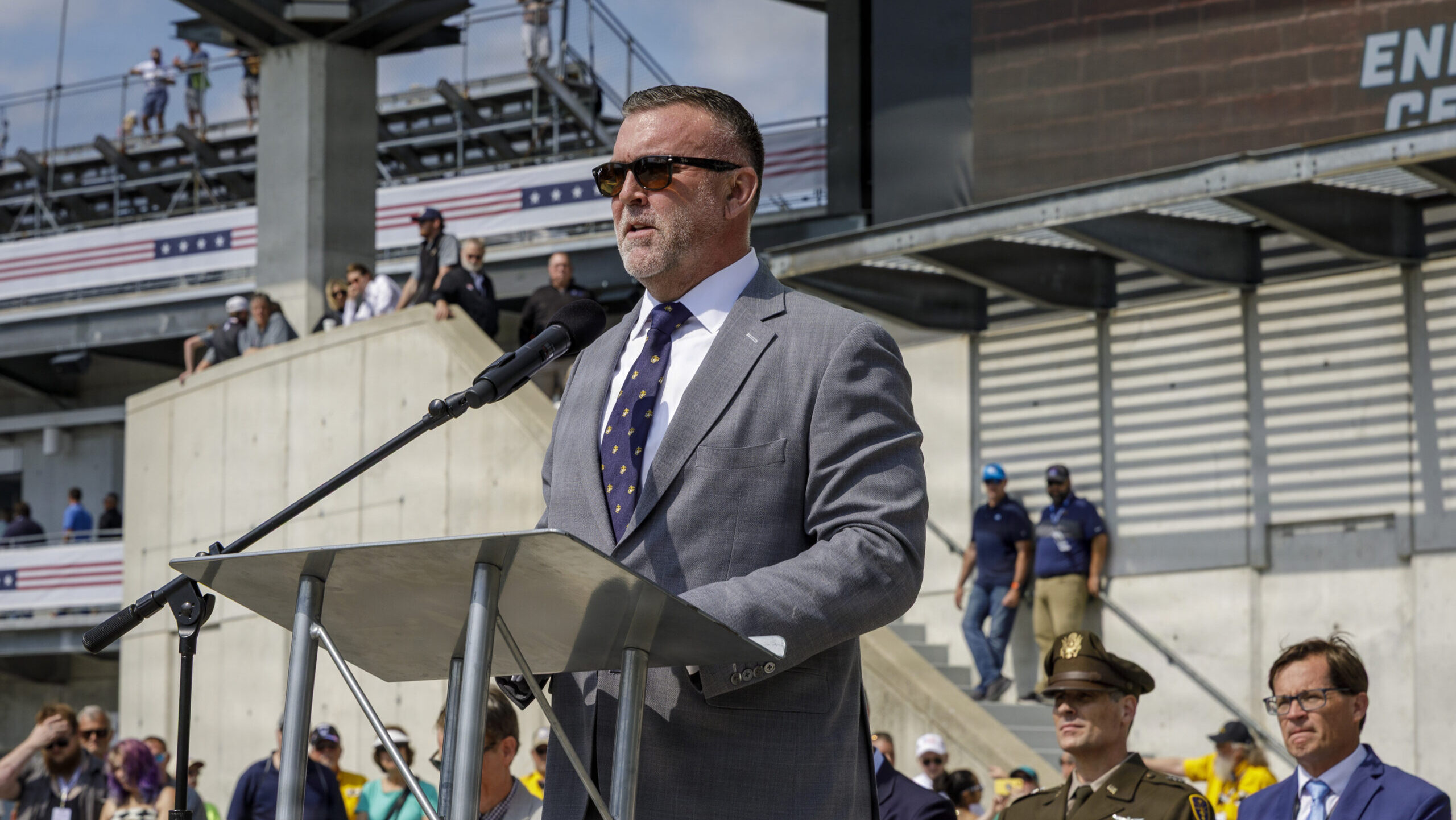
Michael Dodd, assistant secretary of war for critical technologies, delivers remarks to enlistees during a Joint Enlistment Ceremony at Indianapolis Motor Speedway at Speedway, Indiana, May 17, 2026. (U.S. Army National Guard photo by Sgt. Austin Goss)
WASHINGTON — The Pentagon announced Wednesday it has picked Crane Naval Warfare Center in Indiana to host a next-gen nuclear reactor — a decision, one top official told reporters, that was primarily driven by a need meet President Donald Trump’s ambitious deadline to deploy a first reactor on a military base “ no later than September 30, 2028 .”
“Time had priority for us….looking at site selection,” Michael Dodd, assistant secretary of defense for critical technologies , told reporters Wednesday afternoon. “The site selection was less about, ‘are we going to connect it to an AI data center or a DE [directed energy] system or power parts of the critical infrastructure,’ [than] ‘where could we actually meet those timelines?’”
“The timelines are aggressive, to put it mildly,” he said on the sidelines of the NDIA Emerging Technologies Conference on Wednesday . “We needed a delegation that was going to lean forward and work with us very collaboratively in order to do that. Indiana and the governor and our delegation were just tremendous.” ( Gov. Mike Braun , both Senators, and all seven House members are Republicans ).
In the drive to deliver on deadline, some major technical issues remain to be determined, Dodd acknowledged.
“You may be getting a little bit in front of where we are in the process,” Dodd told reporters when pressed for specifics on the advanced design. “We have not released yet the Commercial Solutions Opening ” — a form of streamlined government solicitation — “[or] begun any sort of source selection, down-selecting.”
“Our announcement today, earlier today, is really first and foremost that we’re going to meet the president’s executive order [deadline],” Dodd said. “But the performers therein have not yet identified their systems, all the redundancies and safety and security that will be part and parcel for how we select and then ultimately deploy those systems.”
That said, Dodd emphasized that the Army’s JANUS program, which is leading the military’s nuclear power push, is “well underway…identifying different systems and performers that meet the program requirements.”
Island surge: the Army’s Next Generation Command and Control in action
Lightning Surge exercises are turning soldier feedback on NGC2 into operational software changes in days, not years.
In August , JANUS awarded five companies a total of $2.2 billion to build prototypes. Army official Jeff Waksman acknowledged significant unknowns , from regulatory issues to technical questions about safety, security, and nuclear waste.
Speaking a day later at the same NDIA conference, Pentagon CTO Emil Michael called the program the leading edge of “a renaissance in nuclear technology” that will accompany “an explosion in the abundance of energy. ”
Afterwards, Michael told reporters he was confident that previous Pentagon efforts had set the program up for success in meeting the president’s deadline. “We know from an R&D standpoint where these companies are in terms of their ability to deliver an SMR [Small Modular Reactor],” he said. “We think we’re going to get there by ’28.”
Just getting agreement on a site is a big achievement, Michael argued, after decades of stymied nuclear power projects across the United States.
“This is not a simple thing,” Michael told reporters. [In] this country, we have made it impossible to build a nuclear reactor…You have to get regulatory approval for those things, and that’s not been an easy process in this country.”
Just getting from last May’s Executive Order to this week’s site selection, he argued, is “good progress.”
As for the safety concerns that hamstrung nuclear power projects in the US after the Three Mile Island accident — which resulted in zero deaths and no clear evidence of increased cancer rates — Michael argued those were overblown even for older reactors, let alone the advanced designs under consideration for Crane.
“We know it’s clean, and we know it’s safe, and we know it can be made safer,” he told reporters. Meanwhile, he argued, demands for electrical power are rising rapidly in both the civilian and military sectors, in large part by AI and the giant data centers required to run it.
“You’re having this explosion of data centers,” Michael said. “I call them ‘combat compute commands,’” he added, because of how increasingly important they are for day-to-day Defense Department operations.
That doesn’t mean the military plans to put the new microreactors on forward bases in range of enemy strikes, Michael told reporters. “We have a hundred other means for energy that’s efficient and clean before you get to active battle zones,” he said.
2026年5月17日,美国陆军部负责关键技术的助理部长迈克尔·多德在印第安纳州斯皮德韦的印第安纳波利斯赛车场举行的联合入伍仪式上向新兵发表讲话。(美国陆军国民警卫队中士奥斯汀·戈斯摄)
华盛顿——五角大楼周三宣布,已选择印第安纳州的克莱恩海军作战中心作为下一代核反应堆的所在地。一位高级官员告诉记者,这一决定主要是为了满足唐纳德·特朗普总统雄心勃勃的最后期限,即“最迟在 2028 年 9 月 30 日”在军事基地部署第一个反应堆。
“对我们来说,时间是首要考虑因素……我们首先考虑的是选址,”负责关键技术的国防部助理部长迈克尔·多德周三下午告诉记者。“选址的关键不在于‘我们是否要将其连接到人工智能数据中心或定向能系统,或者为关键基础设施的部分区域供电’,而在于‘我们究竟在哪里才能真正满足这些时间要求?’”
“说得委婉点,时间安排非常紧迫,”他周三在NDIA新兴技术大会间隙说道。“我们需要一个积极主动、与我们密切合作的代表团才能完成这项任务。印第安纳州、州长和我们的代表团都非常出色。”(州长迈克·布劳恩、两位参议员和全部七位众议员均为共和党人)。
多德承认,在努力按时完成任务的过程中,一些重大的技术问题仍有待解决。
当被问及先进设计方案的具体细节时,多德告诉记者:“你们可能有点超前于我们目前的进展。我们尚未发布商业解决方案开放公告(一种简化的政府招标形式),也未开始任何形式的供应商筛选或最终筛选工作。”
多德说:“我们今天早些时候发布的公告,首先也是最重要的一点是,我们将遵守总统行政命令规定的最后期限。但参与执行的各方尚未确定他们的系统,以及所有冗余措施、安全保障措施等,这些都将是我们选择并最终部署这些系统的重要组成部分。”
尽管如此,多德强调,陆军的 JANUS 计划正在引领军方的核能发展,目前“进展顺利……正在确定符合该计划要求的不同系统和性能”。
岛屿突击:陆军下一代指挥控制系统的实战演练
“闪电突击”演习将士兵对 NGC2 的反馈转化为几天内(而不是几年内)的操作软件变更。
8月份,JANUS向五家公司授予总计22亿美元的合同,用于建造原型机。陆军官员杰夫·瓦克斯曼承认存在诸多未知因素,包括监管问题以及有关安全、安保和核废料处理的技术难题。
一天后,在同一场 NDIA 会议上,五角大楼首席技术官埃米尔·迈克尔称该计划是“核技术复兴”的前沿,并将伴随“能源的爆炸式增长”。
随后,迈克尔告诉记者,他相信五角大楼之前的努力已经为该项目按时完成总统设定的目标奠定了基础。“从研发的角度来看,我们清楚这些公司在交付小型模块化反应堆(SMR)方面的能力,”他说。“我们认为我们能在2028年之前实现目标。”
迈克尔认为,在美国各地核电项目受阻数十年后,能够就选址达成一致本身就是一项巨大的成就。
“这并非易事,”迈克尔告诉记者。“在这个国家,我们已经让建造核反应堆变得不可能……你必须获得监管部门的批准,而这在这个国家并非易事。”
他认为,从去年五月的行政命令到本周的选址,本身就是“良好的进展”。
至于三里岛事故后美国核电项目因安全问题而受阻——该事故最终没有造成人员死亡,也没有明确的证据表明癌症发病率上升——迈克尔认为,即使对于较老的反应堆来说,这些担忧也被夸大了,更不用说克莱恩核电站正在考虑的先进设计了。
“我们知道它是清洁的,我们知道它是安全的,我们也知道它可以变得更安全,”他告诉记者。与此同时,他指出,民用和军用领域对电力的需求都在迅速增长,这在很大程度上是由于人工智能以及运行人工智能所需的大型数据中心。
“数据中心的数量正在爆炸式增长,”迈克尔说。“我称它们为‘作战计算指挥中心’,”他补充道,因为它们对国防部的日常运作越来越重要。
迈克尔告诉记者,这并不意味着军方计划将新型微型反应堆部署在敌方打击范围内的前沿基地。“在进入战区之前,我们还有上百种其他高效清洁的能源来源,”他说。