These new units take center stage in massive Pacific exercise这些新部队在大规模太平洋演习中扮演核心角色。
The multidomain task forces are getting their turn in the spotlight in Talisman Sabre 2023.
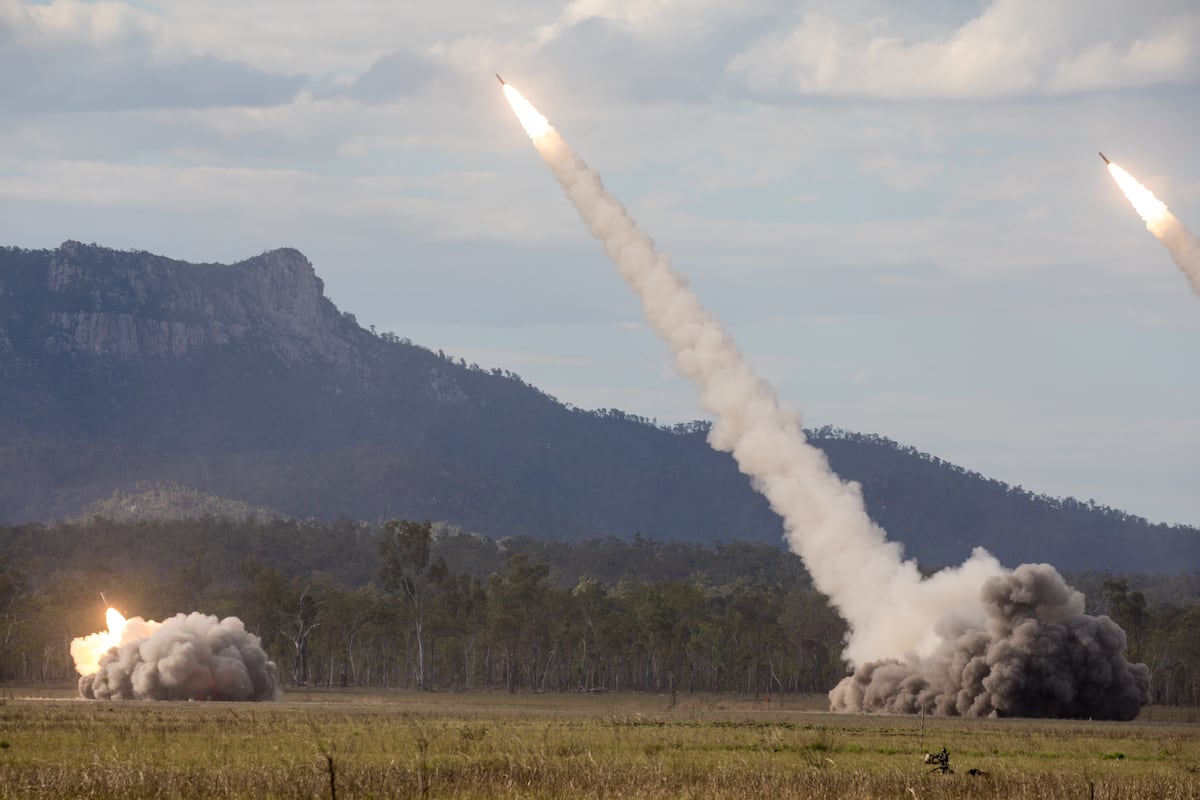
As the largest-ever version of the joint military exercise known as Talisman Sabre nears its end this week, the Army has seen its own set of firsts that have converged in two specific units the service sees as leading its future approach to warfighting.
The 3rd Multidomain Task Force , activated in September 2022 out of Fort Shafter, Hawaii, saw its first operational deployment in Talisman Sabre, an exercise in its 10th biennial iteration as a joint U.S.-Australian Pacific theater exercise that has grown to include 13 nations and more than 30,000 troops.
The task force had its first-ever exercise in February, part of Northern Edge 23 held in Alaska, said U.S. Army Pacific commander Gen. Charles Flynn .
Along with the original two members the exercise included France, Indonesia, Japan, South Korea, New Zealand, the United Kingdom, Canada and Germany. This is the first participation for Fiji, Papua New Guinea and Tonga.
Simultaneously, the 1st Multidomain Task Force has worked an extensive deployment for more than six months this year in the Philippines, that’s contributed to this exercise also, Flynn told Army Times.
The 1st Multidomain Task Force was the first such formation for the Army and was activated in 2017. That unit also conducted the first long-range deployment of the Long-Range Hypersonic Weapon over 3,100 miles from Joint Base Lewis-McChord, Washington to Cape Canaveral, Florida, according to an Army release. The 2nd Multidomain Task Force is based out of Europe.
These task forces knit together a range of domains and capabilities that the Army is relying on to fight its first new doctrine, Multi-Domain Operations, in more than 40 years as it shifts the force to the multi-domain operations way of fighting.
Those domains and capabilities include “theater-specific units that employ long-range precision effects, including cyber, electronic warfare, intelligence and long-range fires,” according to an Army release. Within the task force the multidomain effects battalion serves as the “targeting brain” of the force, Flynn said.
“It is creating the interoperability needed with our allies and partners and it is also creating opportunities for the joint force to improve our joint cueing, joint targeting, joint collection and our joint ability to sense, move and communicate, and see, sense and understand what’s actually happening in the environment,” Flynn told Army Times.
The Japanese and Australian militaries are currently adjusting their doctrine to a multidomain approach. The Japanese have pursued a “cross-domain” approach in recent years. Indonesia, the Philippines and other partners are considering such approaches, Flynn said.
There might be a reason for those moves.
Dubbed the “Olympics” of Pacific-based exercises, the event has a build-up phase that’s also very Army-centric. Operation Pacific Pathways, formerly Pacific Pathways, is an ongoing rotation of Army units to do in-country training with partner nations such as Indonesia, which saw U.S. trainers there for training missions Garuda Shield and Super Garuda Shield in recent years.
Led by the Joint Base Lewis-McChord-centered Army I Corps, Pathways dates to 2014 and has grown from short-term, small unit deployments to dispersed brigades coordinating training across multiple partner nations in the Pacific for months or more.
“The end state of Operation Pathways is we are creating joint interior lines,” Flynn said.
The “joint interior lines” refer to a string of defenses between partner nations to push back on Chinese military incursion, such as documented cases of Chinese military provocation in disputed territorial waters of the Philippines, Japan and other Pacific nations.
Army Pacific commander Gen. Charles Flynn receives a brief on the training objectives of exercise Talisman Sabre 23 at Lavarack Barracks in Townsville, Queensland, Australia, July 28, 2023. (Sgt. 1st Class John Healy/Army)
At the same time, the Joint Pacific Multinational Readiness Center , one of the Army’s newest combat training centers outside of the continental United States in more than 30 years, holds land-based training in Alaska and Hawaii. The center has spent recent years building an “exportable” combat training center model, twice deployed to Indonesia.
The concept uses center training cadre and equipment in a host nation to simulate the wider-ranging field exercises conducted at areas such as the National Training Center in Fort Irwin, California or the Joint Readiness Training Center in Fort Polk, Louisiana — standard pre-combat deployment culminating rotations.
Australia is building out its own combat training center near Lavarack Barracks in Townsville, Queensland, Australia. Japan has its own U.S.-type combat training center in Hokkaido called Yausubetsu Training Area. Indonesia, Flynn said, is in the process of constructing a similar kind of training center.
The 15-day Talisman Sabre exercise is part of a larger, regional effort to counter perceived Chinese military aggression and territorial disregard by Chinese vessels and personnel. The exercise changes the spelling of “Sabre” to “Saber” as it rotates between Australian and U.S. control every other year.
That’s not a simulated scenario either, the Australian Broadcasting Corporation, a news outlet, reported that Australian forces from multiple platforms had photographed a Chinese military spy, identified as “carrying the People’s Liberation Army Navy (PLAN) fleet designation number 793 ship near the Australian coast,” on July 23, the second day of the exercise.
Chief of Joint Operations, Australian Army Lt. Gen. Greg Bilton, told the news outlet that the forces were responding to the spy ship spotting.
“They’ll passively collect, and we’ll adjust — there’s some things we don’t necessarily want to give away and we have methods of being able to employ our forces without giving those more sensitive aspects of our training away,” Bilton said.
Such developments bolster what Flynn told Army Times on July 26 the exercise intends.
Flynn called the scale, varied activities and number of partner nations a strong signal to the Chinese military, calling such exercises the “greatest counterweight” to Chinese military encroachment on partner nation’s territories.
“When (the Chinese military) sees the U.S. partnered with that many countries, conducting the scale and scope of operations, they ought to take note of that and that ought to put some doubt in their minds,” Flynn said.
CLARIFICATION: This article has been updated to accurately reflect the establishment of the Joint Pacific Multinational Training Center as one of the Army’s newest centers outside of the continental United States in more than 30 years .
Todd South has written about crime, courts, government and the military for multiple publications since 2004 and was named a 2014 Pulitzer finalist for a co-written project on witness intimidation. Todd is a Marine veteran of the Iraq War.
随着史上规模最大的联合军事演习“护身军刀”本周接近尾声,陆军也迎来了一系列“第一”,这些“第一”汇聚在陆军认为将引领其未来作战方式的两个特定单位中。
第 3 多域特遣部队于 2022 年 9 月在夏威夷沙夫特堡成立,其首次作战部署是在“护身军刀”演习中。该演习是美澳联合太平洋战区演习,已举办 10 届,目前已发展到包括 13 个国家和 3 万多名士兵。
美国太平洋陆军司令查尔斯·弗林将军表示,该特遣部队于2月份进行了首次演习,这是在阿拉斯加举行的“北方边缘23”演习的一部分。
除最初的两个成员国外,此次演习还包括法国、印度尼西亚、日本、韩国、新西兰、英国、加拿大和德国。斐济、巴布亚新几内亚和汤加则是首次参加。
弗林告诉《陆军时报》:“与此同时,第一多域特遣部队今年在菲律宾进行了超过六个月的大规模部署,这也为本次演习做出了贡献。”
第一多域特遣部队是陆军首支此类部队,于2017年组建。据陆军发布的消息,该部队还完成了远程高超音速武器的首次远程部署,飞行距离超过3100英里,从华盛顿州刘易斯-麦科德联合基地抵达佛罗里达州卡纳维拉尔角。第二多域特遣部队驻扎在欧洲。
这些特遣部队将陆军赖以应对其 40 多年来第一个新理论——多域作战——的各种领域和能力整合在一起,从而将部队的作战方式转变为多域作战。
根据陆军发布的消息,这些领域和能力包括“运用远程精确打击能力的战区特定部队,包括网络战、电子战、情报和远程火力打击”。弗林表示,在特遣部队中,多域作战营是部队的“目标定位中心”。
弗林告诉《陆军时报》:“它正在创造与我们的盟友和伙伴所需的互操作性,同时也为联合部队创造了机会,以提高我们的联合引导、联合目标定位、联合情报收集以及联合感知、移动和通信能力,并观察、感知和了解环境中实际发生的事情。”
日本和澳大利亚军队目前正在调整其作战理论,向多域作战模式转型。近年来,日本一直奉行“跨域”作战模式。弗林表示,印度尼西亚、菲律宾和其他伙伴国也在考虑采用类似的作战模式。
这些举动或许有其原因。
这项被誉为太平洋地区“奥运会”的演习,其筹备阶段也以陆军为中心。太平洋通道行动(原名太平洋通道)是一项持续进行的陆军部队轮换计划,旨在与印度尼西亚等伙伴国家开展实地训练。近年来,美国教官曾赴印度尼西亚执行“迦楼罗之盾”和“超级迦楼罗之盾”训练任务。
由以刘易斯-麦科德联合基地为中心的陆军第一军领导的“路径”计划始于 2014 年,并已从短期的小规模部队部署发展到分散的旅级单位,协调太平洋地区多个伙伴国家的训练长达数月或更长时间。
弗林说:“‘路径行动’的最终目标是建立联合内线。”
“联合内线”指的是伙伴国家之间为抵御中国军事入侵而建立的一系列防御措施,例如有记录的中国在菲律宾、日本和其他太平洋国家有争议的领海进行军事挑衅的案例。
2023年7月28日,在澳大利亚昆士兰州汤斯维尔的拉瓦拉克军营,美国陆军太平洋司令部司令查尔斯·弗林将军听取了关于“护身军刀23”演习训练目标的简报。(陆军一级军士长约翰·希利/摄)
与此同时,联合太平洋多国战备中心(Joint Pacific Multinational Readiness Center)——美国陆军30多年来在美国本土以外新建的最新作战训练中心之一——在阿拉斯加和夏威夷开展陆上训练。该中心近年来致力于打造“可输出”的作战训练中心模式,并曾两次部署到印度尼西亚。
该概念利用东道国的中心训练干部和设备,模拟在加利福尼亚州欧文堡国家训练中心或路易斯安那州波尔克堡联合战备训练中心等地进行的更广泛的实地演习——标准的战前部署最终轮换。
澳大利亚正在昆士兰州汤斯维尔附近的拉瓦拉克军营附近建设自己的作战训练中心。日本在北海道拥有自己的美式作战训练中心,名为矢须别训练场。弗林表示,印度尼西亚也正在建设类似的训练中心。
为期15天的“护身军刀”演习是更大规模的区域性行动的一部分,旨在应对人们认为中国军事侵略以及中国舰艇和人员对领土的漠视。该演习每两年由澳大利亚和美国轮流主持,因此演习名称中的“Sabre”拼写改为“Saber”。
澳大利亚广播公司(一家新闻媒体)报道称,这也不是模拟场景,7月23日,也就是演习的第二天,澳大利亚军队从多个平台上拍摄到一艘中国军事间谍船,该间谍船被确认为“中国人民解放军海军(PLAN)舰队编号为793的舰艇在澳大利亚海岸附近”。
澳大利亚陆军联合行动司令格雷格·比尔顿中将告诉新闻媒体,部队正在对发现间谍船的情况做出反应。
比尔顿说:“他们会被动地收集信息,我们会进行调整——有些东西我们不一定想泄露出去,我们有办法在不泄露我们训练中那些更敏感方面的情况下运用我们的力量。”
这些进展印证了弗林在7月26日接受《陆军时报》采访时所说的演习目的。
弗林称此次演习的规模、活动种类和伙伴国家数量向中国军方发出了强烈的信号,称此类演习是制衡中国军事侵略伙伴国家领土的“最大力量”。
弗林说:“当(中国军方)看到美国与这么多国家合作,开展如此大规模和范围的军事行动时,他们应该注意到这一点,这应该让他们产生一些疑虑。”
澄清:本文已更新,以准确反映联合太平洋多国训练中心的成立,这是美国陆军 30 多年来在美国本土以外建立的最新中心之一。
自2004年以来,托德·索斯为多家出版物撰写有关犯罪、法院、政府和军事方面的文章,并因与人合著的关于恐吓证人的文章入围2014年普利策奖决赛。托德是参加过伊拉克战争的海军陆战队老兵。