Work At Underground Test Site A New Indicator Of Possible Strikes On Iran’s Pickaxe Mountain Bunker地下试验场的活动成为伊朗“镐山”掩体可能遭受打击的新迹象
Pickaxe Mountain presents immense targeting challenges and that's where specialized test sites in New Mexico come in to play.
新闻视频
By Joseph Trevithick
Published Sep 10, 2026 6:01 PM EDT
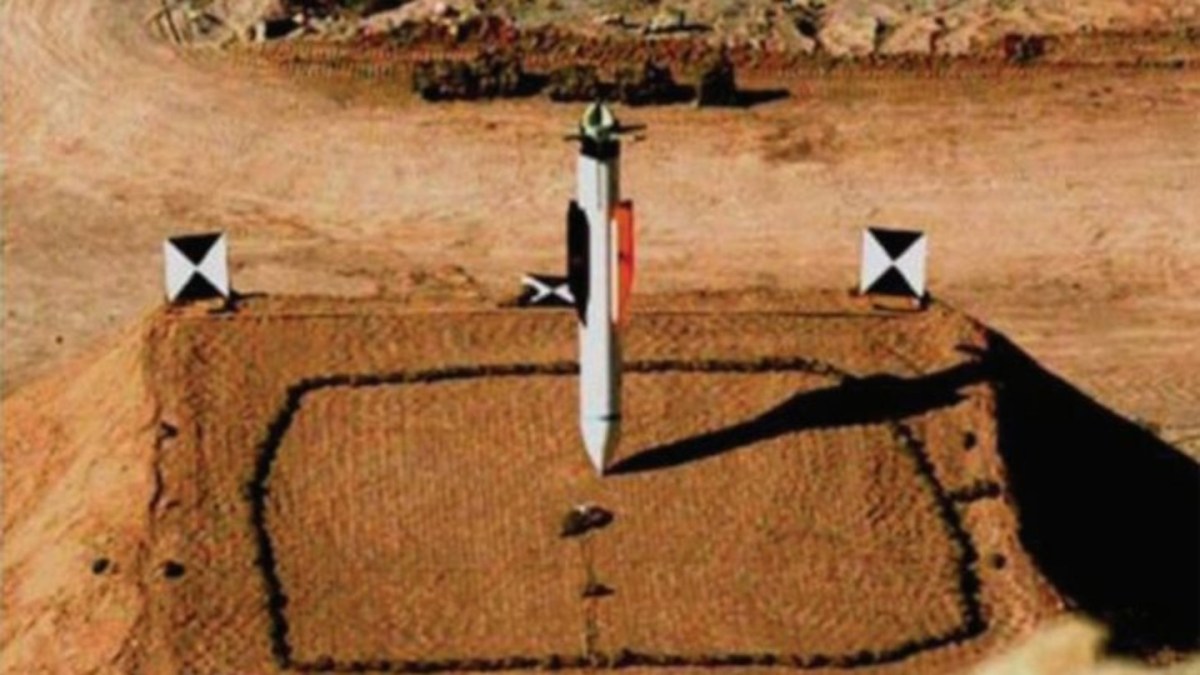
A picture showing a GBU-57/B Massive Ordnance Penetrator about to hit a test target. US Military
Work at a specialized underground weapons test site in New Mexico, contracted earlier this year, was linked to planning for a potential new operation targeting Iranian nuclear facilities, according to a report from CNN . The U.S. military has notably left Iran’s hardest-to-reach site under Pickaxe Mountain untouched so far, but President Donald Trump and other U.S. officials have been openly talking about striking it .
On February 27, the day before U.S. and Israeli forces launched their initial wave of strikes on Iran , the Pentagon’s Defense Threat Reduction Agency (DTRA) quietly announced it had awarded a sole-source deal to Pate Construction Co., Inc., for new construction at the so-called Alternate Seismic Hardrock in Situ Test (ALT-SHIST) site. The work was needed to support an upcoming classified live-fire test. ALT-SHIST is situated within the White Sands Missile Range (WSMR), a sprawling U.S. Army-managed complex in New Mexico’s Jornada del Muerto desert basin. DTRA is a relatively small and obscure organization that plays a leading role in U.S. military efforts to develop new and improved ways to respond to Weapons of Mass Destruction (WMD) threats.
WSMR and DTRA have come up in discussions about strikes on Iran in the past. The U.S. military’s heaviest conventional air-dropped weapon, the 30,000-pound-class GBU-57/B Massive Ordnance Penetrator (MOP) bunker buster bomb, has been extensively tested at multiple sites there in the past. DTRA was also directly involved in its initial development. MOPs made their combat debut during U.S. strikes last year on underground Iranian nuclear facilities at Fordow and Natanz as part of Operation Midnight Hammer . The possibility has been raised that a different site within WSMR may have been used to test the plan of attack against Fordow, which involved two ventilation shafts being hit with six GBU-57/Bs each. The bombs were dropped in rapid succession, with each one burrowing deeper and deeper into the facility below. WSMR also happens to contain the site of the first atomic bomb test in 1945.
A map showing the general location of White Sands Missile Range, with an inset giving a better sense of how expansive it is. Holloman Air Force Base, which juts into the southern end of the range complex, is also highlighted. Google Maps
“The plans for the test [at ALT-SHIST] were connected to the Iran war,” CNN said in its story, published yesterday , citing unnamed sources “familiar with the matter.” Beyond that, the planned testing was tied to a “need to develop a way to target Iran’s deepest-buried underground facilities and, likely, simulate U.S. strikes against specific nuclear facilities.”
CNN said it was unable to independently verify whether or not the test in question had occurred.
A formal justification for the sole-source contract to Pate Construction that DTRA released in February did not mention Iran or elaborate on the need for the new testing at ALT-SHIST, but stressed there was an urgent requirement critical to U.S. national security.
“The services required are the immediate and mission-critical enabling services for a ‘real-world’ national security ordinance [sic; ordnance] test. This is not routine construction; it is the highly specialized remediation and operational preparation of a unique, subterranean test facility at White Sands Missile Range (WSMR),” according to the justification document, which DTRA officials had approved on February 24. “The work is a critical path dependency for a live-fire test designed to validate classified capabilities against rapidly emerging threats.”
“As the incumbent contractor for over a decade, Pate Construction Co., Inc. possesses unparalleled and non-transferable tacit knowledge of this specific subterranean test facility. This is a unique Government structure with complex geological and security considerations, and Pate Construction Co., Inc.’s direct, hands-on experience is a tangible asset that no other source possesses,” the document adds. “Pate Construction Co., Inc. is the only contractor that currently maintains a fully mobilized presence at WSMR with the specific heavy equipment and security-cleared operators required.”
CNN ‘s piece says apparent work at ALT-SHIST was visible in satellite imagery of the site between mid-February and mid-March, but the outlet said it was unable to confirm whether or not this was related to the contract with Pate Construction.
We reviewed satellite imagery showing work at a remote DTRA/STRATCOM test site that coincided with this contracting action, but we couldn’t confirm its purpose. The Pentagon didn’t respond to our questions regarding the test, and we couldn’t independently confirm it occurred. pic.twitter.com/k8zyvqWy56 — Davis Winkie (@davis_winkie) September 9, 2026
We reviewed satellite imagery showing work at a remote DTRA/STRATCOM test site that coincided with this contracting action, but we couldn’t confirm its purpose. The Pentagon didn’t respond to our questions regarding the test, and we couldn’t independently confirm it occurred. pic.twitter.com/k8zyvqWy56
ALT-SHIST is an active test site, and any work observed there earlier this year could well have been linked to other projects. For instance, additional publicly available DTRA contracting documents offer details about planned work on a specific part of the ALT-SHIST site, called Tunnel 7, tracing back to last year, as part of a project nicknamed Millstone Willemite 6 (MW-6).
“This task requires the construction contractor to repair and address the damage to Tunnel 7 caused by prior incidents, in accordance with government-provided designs, specifications, and other contract documents,” according to one contracting document dated September 15, 2025. “The contractor will also be responsible for providing support during testing activities, as well as safing after each test and general support between tests. All tunnel construction must be completed by 15 June 2027.”
“The contractor shall repair a D-shape tunnel and overburden using the D-shape of 20 feet depth and width, inside the tunnel. The contractor shall remove and repair any damage to the ribs, crown, and invert to Tunnel 7,” that same document continues. “After the repair of Tunnel 7, the contractor shall provide general construction support to instrument the tunnel in preparation for testing and then safe the tunnel for re-entry post-testing.”
The schedule for the MW-6-related work indicates that it is separate from what Pate Construction was hired to do at the site back in February.
A view out into a mountainous part of the White Sands Missile Range complex. USACE
ALT-SHIST, which was first established in 1995, is also not the only site DTRA makes use of within WSMR. As its name indicates, it is an alternate to the original SHIST site, use of which began in 1993.
“There was a small addition made to the SHIST site, but that area has been heavily used since 2007,” according to an environmental impact study the U.S. Army Corps of Engineers (USACE) completed in 2015 . “The granite bedrock at these sites has been fractured and damaged by extensive testing. There are no existing granite areas adjacent to those sites where similar testing can be performed.”
A map showing the relative locations of SHIST and ALT-SHIST, as well as other test sites, at the northern end of the WSMR complex. USACE
USACE conducted that study in support of the establishment of a new test site at WSMR, simply called the Granite Test Site, to succeed the original SHIST. The Granite Test Site is now in use. There are many more sites within the range complex designed to simulate underground and otherwise hardened targets. This is also just one aspect of the wide array of testing that occurs on a daily basis at WSMR.
All three also appear to have been involved in the testing and development of the Massive Ordnance Penetrator (MOP). 5/10 pic.twitter.com/3aWSYXIZln — Fabian Hinz (@fab_hinz) June 25, 2025
All three also appear to have been involved in the testing and development of the Massive Ordnance Penetrator (MOP). 5/10 pic.twitter.com/3aWSYXIZln
However, the presence of large areas of undisturbed granite is a key factor here, as that is particularly relevant for testing weapons designed to penetrate into extremely deeply buried facilities. CNN ‘s piece yesterday noted that Iran’s Pickaxe Mountain site is built underneath a granite mountain.
“The mountain in White Sands, they specifically picked mountainous areas that were solid rock, and they used state-of-the-art tunneling technology to make the kind of cavities in the mountain that you would put this kind of [Iranian nuclear] facility in,” Gary Stradling, a retired scientist who previously worked for the Department of Energy’s Los Alamos National Laboratory (LANL), told TWZ in an interview last year . “I think that there is a lot of work that DOD has done in these kinds of facilities that is highly classified, and I couldn’t talk to you about it. This is very sophisticated work. It is not casual, and it’s not speculative. These are real experts who are doing the work. Careful, technical, quantitative work to be able to deliver this kind of war-fighting capability to the services.”
TWZ spoke to Stradling, who did work tied to earth-penetrating munitions at various points during his lengthy career, in the wake of Operation Midnight Hammer.
Me, standing at the edge of a MOP crater on a mountain top at White Sands Test Range, where detailed studies of massive earth penetrators were studied for effectiveness against deeply buried targets by the Defense Threat Reduction Agency (DTRA) —formerly Defense Nuclear Agency.… pic.twitter.com/JYq1V2xO6q — Gary Stradling (@gary_stradling) June 24, 2025
Me, standing at the edge of a MOP crater on a mountain top at White Sands Test Range, where detailed studies of massive earth penetrators were studied for effectiveness against deeply buried targets by the Defense Threat Reduction Agency (DTRA) —formerly Defense Nuclear Agency.… pic.twitter.com/JYq1V2xO6q
The U.S. military notably did not strike Pickaxe Mountain, which is situated immediately to the southwest of Iran’s nuclear facility at Natanz, during Operation Midnight Hammer. The site also went untouched by Israel during last year’s 12 Day War. American and Israeli forces did not target it during major combat operations earlier this year, either. All of this underscores the targeting challenge the site presents, even for strikes using MOPs, which TWZ explored in detail earlier this year and that has continued to make it a point of particular discussion.
A satellite image taken on August 21, 2026, showing activity around tunnel entrances at Iran’s Pickaxe Mountain site. Satellite image ©2026 Vantor
CNN ‘s report yesterday was primarily focused on a new assessment of ongoing construction at Pickaxe Mountain from the Center for Strategic and International Studies (CSIS) think tank in Washington, D.C.
Satellite “images reveal more road activity at Pickaxe Mountain in 2026 than at any point in the site’s history,” according to a report CSIS published yesterday . “There is a clear surge in construction activity in 2026 that corresponds to the raising and hardening of the portal accesses, paving of the internal road network, reinforcement around access areas, and the flattening and removal of excavation spoil.”
“This assessment can neither refute nor substantiate the Israeli intelligence claim that Iran moved centrifuges into Pickaxe Mountain,” CSIS’s report also noted. “The continuous construction, the absence of an increased internal security posture, and the lack of observed nonconstruction vehicles and equipment suggest the underground facility is not yet capable of enrichment work, if that is the intended purpose. Further analysis of daily activity would be needed to establish the site’s pattern of life beyond its current construction footprint.”
A broader overview of Pickaxe Mountain, as well as Iran’s nuclear site at Natanz, seen at the upper right corner, as of August 21, 2026. Satellite image ©2026 Vantor
This is in line with TWZ ‘s own previous reporting on Pickaxe Mountain back in July, when there were already signs of growing activity following the establishment of a shaky ceasefire between the United States and Iran the preceding month. As we wrote at that time :
“As with the strikes on Fordow, multiple bombs could be dropped on the same impact point to try to penetrate further down into Pickaxe Mountain. Whether there might be similar ventilation shafts or other weak points that could be exploited at Pickaxe Mountain is unknown. …”
A graphic with details about the employment of MOPs on strikes at Fordow during Operation Midnight Hammer. DOD
“A strike ‘right in the front door’ on the tunnel entrances at Pickaxe Mountain would be another option to at least hamper access to the facility inside for a time. This could be combined with strikes aimed at sections of the tunnel networks that run deeper inside the facility, but that are still close enough to the surface to be reachable by available conventional munitions. For instance, MOPs may not be able to hit the main cavern areas, but they could possibly hit certain tunnels that might lead to them.”
“Even a combined strike on entrances and shallow tunnels at Pickaxe Mountain could still present certain challenges. Firm intelligence on exactly where the tunnels snake under the mountain could be limited, making it difficult to select the best impact points. This is exactly why the U.S. military has been investing heavily in advanced, void-sensing fuzes for MOP and other bunker buster bombs for decades now. These fuzes detect when a munition has penetrated into a sufficiently large space, such as a room or tunnel in an underground facility, to help maximize damage. Fuzes that can effectively ‘count’ floors also help to ensure the munition has burrowed sufficiently deep before detonating.”
“…the U.S. military could conduct follow-on strikes on the entry points at Pickaxe Mountain to disrupt any attempt to regain access, as well.”
“Destroying Pickaxe Mountain will be a scientific and targeting challenge,” CSIS also noted in its report yesterday. “It is an underground fortress buttressed by granite. It is one of the only facilities in Iran’s nuclear program that the United States has not yet struck. Structurally degrading Pickaxe Mountain requires more than just kinetic force – it takes actionable high-confidence intelligence and sophisticated mathematical modeling.”
With all this in mind, it is not at all hard to imagine how new testing at ALT-SHIST, as well as other sites, would be essential for exploring additional options for striking Pickaxe Mountain and/or other deeply-buried targets in Iran using MOPs and/or other munitions.
A US Air Force B-2 bomber drops a GBU-57/B MOP during a test. USAF
It’s also worth noting here that GBU-57/Bs are understood to be in relatively short supply, though it is unknown how many of them are currently in inventory. Furthermore, the U.S. Air Force’s B-2 Spirit bombers are currently the only aircraft certified to employ the huge MOPs operationally. There was a report in 2024 that prime contractor Boeing was working to expand its capacity to produce these bombs. A MOP successor, the GBU-76/B Next Generation Penetrator (NGP), is in development now, but prototyping work is expected to run through the end of Fiscal Year 2028.
President Donald Trump certainly has raised the prospect of a strike on Pickaxe Mountain publicly on several occasions since July. He has also repeatedly said that the site is being persistently surveilled, particularly from space.
“There’s another place called Pickaxe Mountain, another nice place. We may have to give them a shot there, too, because someone said there was a little movement at the site,” Trump said yesterday during a speech at a convention the Republican Party is hosting in Dallas, Texas, ahead of this year’s midterm elections. “We don’t need much. We see everything, you know, because of Space Force.”
“We may hit Pickaxe [Mountain] very soon,” the President also said while speaking to reporters at the White House last Friday.
Trump on Pickaxe Mountain: We may have to give them a shot there too. We see everything. We can the see tag on their coat. “Muhammad Al-Fayed” It’s never Muhammad Jones. pic.twitter.com/UQm939OruL — Acyn (@Acyn) September 10, 2026
Trump on Pickaxe Mountain: We may have to give them a shot there too. We see everything. We can the see tag on their coat. “Muhammad Al-Fayed” It’s never Muhammad Jones. pic.twitter.com/UQm939OruL
Trump on Iran: We may hit Pickaxe Mountain very soon because if there is anything going on with Pickaxe. pic.twitter.com/kwlHZuV6M7 — Clash Report (@clashreport) September 4, 2026
Trump on Iran: We may hit Pickaxe Mountain very soon because if there is anything going on with Pickaxe. pic.twitter.com/kwlHZuV6M7
Whether growing activity at Pickaxe Mountain finally prompts a U.S. strike site, either alone or as part of a larger operation, remains to be seen. If and when such a mission is launched, past and future testing at sites like ALT-SHIST in New Mexico will all but certainly have played an important part.
Contact the author: joe@twz.com
Comments couldn’t be loaded. Please refresh the page.
作者:约瑟夫·特雷维西克
发布于美国东部时间2026年9月10日下午6:01
一张照片显示一枚GBU-57/B大型穿透弹即将击中测试目标。美国军方
据美国有线电视新闻网(CNN)报道,今年早些时候承包的位于新墨西哥州的一处专门地下武器试验场的建设工作,与一项可能针对伊朗核设施的新行动计划有关。值得注意的是,美军迄今为止尚未触及伊朗位于皮克克斯山下最难到达的核设施,但美国总统唐纳德·特朗普和其他美国官员一直在公开谈论打击该设施的可能性。
2月27日,就在美以联军对伊朗发动第一波空袭的前一天,五角大楼的国防威胁降低局(DTRA)悄然宣布,已将位于新墨西哥州霍尔纳达德尔穆埃尔托沙漠盆地的白沙导弹靶场(WSMR)的新建工程独家授予佩特建筑公司(Pate Construction Co., Inc.)。这项工程是为了支持即将进行的秘密实弹试验。白沙导弹靶场是一个由美国陆军管理的庞大综合设施。DTRA是一个规模相对较小且鲜为人知的机构,但它在美国军方开发应对大规模杀伤性武器(WMD)威胁的新方法和改进措施方面发挥着主导作用。
过去,在讨论对伊朗的打击行动时,白沙导弹靶场(WSMR)和国防威胁降低局(DTRA)都曾被提及。美军最重的常规空投武器——重达3万磅的GBU-57/B巨型穿甲弹(MOP)钻地炸弹,过去曾在该靶场的多个地点进行过广泛测试。DTRA也直接参与了该炸弹的早期研发。去年,作为“午夜铁锤行动”的一部分,美军对伊朗福尔多和纳坦兹地下核设施发动空袭,MOP炸弹在实战中首次亮相。有人提出,WSMR内的另一个地点可能曾被用于测试针对福尔多的攻击计划,该计划包括用六枚GBU-57/B炸弹分别击中两个通风井。炸弹连续快速投放,每一枚都深入地下设施。WSMR恰好也是1945年首次原子弹试验的地点。
这张地图显示了白沙导弹靶场的大致位置,插图更清晰地展现了其广阔的规模。霍洛曼空军基地也突出显示,该基地伸入靶场南端。谷歌地图
CNN在昨天发表的报道中援引“知情人士”的匿名消息称,“(在ALT-SHIST进行的)试验计划与伊朗战争有关。” 除此之外,此次试验计划还与“开发一种能够打击伊朗最深层地下设施的方法,并可能模拟美国对特定核设施的打击”有关。
CNN表示,他们无法独立核实相关测试是否真的进行过。
美国国防威胁降低局 (DTRA) 于 2 月份发布的关于与 Pate Construction 签订单一来源合同的正式理由中,没有提及伊朗,也没有详细说明在 ALT-SHIST 进行新测试的必要性,但强调存在对美国国家安全至关重要的紧急需求。
根据国防威胁降低局(DTRA)官员于2月24日批准的理由文件,“所需服务是为‘真实世界’的国家安全弹药测试提供的即时且至关重要的保障服务。这并非常规建设;而是对白沙导弹靶场(WSMR)一处独特的地下测试设施进行高度专业化的修复和运行准备工作。”文件还指出,“这项工作是实弹测试的关键路径组成部分,该测试旨在验证针对快速出现的新威胁的机密能力。”
“作为十多年来的现任承包商,Pate Construction Co., Inc. 拥有无可比拟且无法转让的关于该地下试验设施的隐性知识。这是一个独特的政府设施,地质和安全方面都存在诸多复杂问题,而 Pate Construction Co., Inc. 的直接实践经验是其他任何公司都不具备的宝贵资产,”该文件补充道。“Pate Construction Co., Inc. 是目前唯一一家在 WSMR 保持全面动员,并配备所需重型设备和通过安全审查的操作人员的承包商。”
CNN 的报道称,从 2 月中旬到 3 月中旬的卫星图像中可以看到 ALT-SHIST 现场有明显的施工活动,但该媒体表示无法确认这是否与 Pate Construction 的合同有关。
我们查看了卫星图像,图像显示,在国防威胁降低局/战略司令部 (DTRA/STRATCOM) 的一个偏远测试场地,与此次合同签订时间相吻合,但我们无法确认其目的。五角大楼没有回应我们关于此次测试的询问,我们也无法独立证实测试是否发生。pic.twitter.com/k8zyvqWy56 — Davis Winkie (@davis_winkie) September 9, 2026
我们查看了卫星图像,图像显示,在国防威胁降低局/战略司令部 (DTRA/STRATCOM) 的一个偏远测试场地,与此次合同签订时间相吻合,但我们无法确认其目的。五角大楼没有回应我们关于此次测试的询问,我们也无法独立证实测试是否发生。pic.twitter.com/k8zyvqWy56
ALT-SHIST是一个活跃的试验场,今年早些时候在那里观察到的任何活动都可能与其他项目有关。例如,其他公开的DTRA合同文件详细记录了ALT-SHIST场地特定区域(称为7号隧道)的计划工作,这些工作可以追溯到去年,是代号为“Millstone Willemite 6”(MW-6)的项目的一部分。
根据一份日期为2025年9月15日的合同文件,“这项任务要求施工承包商按照政府提供的设计、规范和其他合同文件,修复和处理先前事故对7号隧道造成的损坏。承包商还将负责在测试活动期间提供支持,并在每次测试后提供安全保障,以及在两次测试之间提供一般性支持。所有隧道建设必须在2027年6月15日之前完成。”
“承包商应在隧道内部,使用20英尺深、20英尺宽的D形结构修复D形隧道及其覆盖层。承包商应清除并修复7号隧道的拱肋、拱顶和拱底的任何损坏,”该文件继续写道。“7号隧道修复完成后,承包商应提供一般施工支持,以便对隧道进行仪器安装,为测试做准备,并在测试后确保隧道安全,以便重新进入。”
MW-6 相关工作的进度安排表明,这与 Pate Construction 公司在 2 月份受雇在该现场进行的工作是分开的。
从远处眺望白沙导弹靶场山区。美国陆军工程兵团
ALT-SHIST 最初建立于 1995 年,但它并非 DTRA 在 WSMR 内使用的唯一站点。顾名思义,它是 SHIST 原始站点的备用站点,而 SHIST 原始站点的使用始于 1993 年。
根据美国陆军工程兵团 (USACE) 于 2015 年完成的一份环境影响研究报告,“SHIST 场地虽有少量扩建,但自 2007 年以来该区域一直被频繁使用。这些场地的花岗岩基岩因大量试验而出现裂缝和损坏。这些场地附近没有现成的花岗岩区域可以进行类似的试验。”
一张地图显示了位于白沙导弹靶场北端的SHIST和ALT-SHIST以及其他试验场的相对位置。美国陆军工程兵团
美国陆军工程兵团开展了这项研究,旨在支持在白沙导弹靶场(WSMR)建立一个新的试验场,即花岗岩试验场,以取代原有的希特勒尔试验场(SHIST)。花岗岩试验场现已投入使用。靶场综合体内还有许多其他试验场,用于模拟地下目标和其他加固目标。这只是白沙导弹靶场每天进行的众多测试项目之一。
这三人似乎都参与了巨型穿甲弹(MOP)的测试和研发。5/10 pic.twitter.com/3aWSYXIZln — Fabian Hinz (@fab_hinz) June 25, 2025
这三人似乎都参与了巨型穿甲弹(MOP)的测试和研发。5/10 pic.twitter.com/3aWSYXIZln
然而,大片未受扰动的花岗岩的存在是关键因素,因为这对于测试旨在穿透极深埋地下设施的武器尤为重要。CNN昨天的报道指出,伊朗的“镐山”试验场就建在一座花岗岩山下。
“在白沙导弹靶场,他们特意挑选了坚硬的山体,并运用最先进的隧道技术在山体中开挖出适合建造这种(伊朗核)设施的空腔,”曾在美国能源部洛斯阿拉莫斯国家实验室(LANL)工作的退休科学家加里·斯特拉德林去年在接受TWZ采访时表示。“我认为国防部在这些设施方面做了很多高度机密的工作,我无法向你透露。这是一项非常复杂的工作,并非随意之举,也并非臆测。这是由真正的专家在进行的。他们进行的是细致、技术性强且量化的工作,旨在为各军种提供这种作战能力。”
在“午夜铁锤行动”之后,TWZ 采访了斯特拉德林,他在漫长的职业生涯中曾多次从事与穿透地壳弹药相关的工作。
我站在白沙导弹靶场山顶上一个巨型钻地弹坑的边缘,国防威胁降低局(DTRA,前身为国防核武器局)曾在这里对巨型钻地弹进行详细研究,以评估其对深埋目标的有效性…… pic.twitter.com/JYq1V2xO6q — Gary Stradling (@gary_stradling) June 24, 2025
我站在白沙导弹靶场山顶上一个巨型穿透弹坑的边缘,国防威胁降低局(DTRA,前身为国防核武器局)曾在这里对巨型穿透弹进行详细研究,以评估其对深埋目标的有效性…… pic.twitter.com/JYq1V2xO6q
值得注意的是,在“午夜铁锤行动”中,美军并未打击位于伊朗纳坦兹核设施西南侧的皮克克斯山。去年的“十二日战争”期间,以色列也未对该地点进行攻击。今年早些时候,美以军队在重大作战行动中也未将其列为打击目标。所有这些都凸显了该地点的打击难度,即使使用多目标打击程序(MOPs)也难以有效命中。TWZ网站今年早些时候对此进行了详细探讨,而这也使得该地点持续成为讨论的焦点。
这张卫星图像拍摄于2026年8月21日,显示了伊朗镐山遗址隧道入口附近的活动。卫星图像©2026 Vantor
CNN昨天的报道主要集中在华盛顿特区战略与国际研究中心(CSIS)智库对皮克克斯山正在进行的建设工程的最新评估上。
根据战略与国际研究中心(CSIS)昨日发布的一份报告,卫星图像显示,2026年皮克克斯山(Pickaxe Mountain)的道路活动将比该遗址历史上任何时期都更加频繁。报告指出:“2026年建筑活动明显激增,这与入口通道的抬升和加固、内部道路网络的铺设、通道区域周围的加固以及挖掘废料的平整和清除相对应。”
“这项评估既不能反驳也不能证实以色列情报部门关于伊朗将离心机转移到皮克克斯山的说法,”战略与国际研究中心(CSIS)的报告还指出。“持续的施工、内部安全态势并未加强,以及未观察到非施工车辆和设备,表明该地下设施目前尚不具备浓缩铀作业能力(如果这是其预期用途)。需要对日常活动进行进一步分析,才能确定该设施在当前施工范围之外的运作模式。”
2026年8月21日,图中展示了皮克克斯山(Pickaxe Mountain)的全景,以及位于右上角的伊朗纳坦兹核设施。卫星图像 ©2026 Vantor
这与TWZ此前7月份关于皮克克斯山的报道相符,当时已有迹象表明,在美伊两国于前一个月达成脆弱的停火协议后,该地区的活动日益频繁。正如我们当时所写:
“与对福尔多山的袭击一样,多枚炸弹可能投掷在同一落点,试图进一步渗透到皮克克斯山内部。皮克克斯山是否存在类似的通风井或其他可被利用的薄弱点,目前尚不得而知。……”
一张图表,详细介绍了在“午夜铁锤行动”期间,福尔多战役中使用移动作战平台(MOP)的情况。美国国防部
“直接打击皮克克斯山隧道入口是另一种选择,至少可以暂时阻碍敌方进入设施内部。这可以与打击设施内部更深处但仍靠近地表、可用常规弹药能够覆盖的隧道网络部分相结合。例如,大型作战弹可能无法击中主要洞穴区域,但或许可以击中通往这些区域的某些隧道。”
“即使对皮克克斯山入口和浅层隧道进行联合打击,仍然会面临一些挑战。关于隧道在山下蜿蜒的具体位置,可靠的情报可能有限,这使得选择最佳打击点变得困难。正因如此,几十年来,美军一直在大力投资研发用于MOP和其他掩体炸弹的先进空隙感应引信。这些引信能够探测弹药何时穿透到足够大的空间,例如地下设施中的房间或隧道,从而最大限度地扩大杀伤力。能够有效‘计数’楼层的引信还有助于确保弹药在引爆前已钻入足够深的地下。”
“……美军还可以对皮卡克斯山入口进行后续打击,以阻止任何重新夺回通道的企图。”
“摧毁镐山将是一项科学和目标定位方面的挑战,”战略与国际研究中心(CSIS)昨天在其报告中也指出。“它是一座由花岗岩加固的地下堡垒。它是伊朗核计划中美国尚未打击的少数几个设施之一。要从结构上破坏镐山,需要的不仅仅是动能——它需要可操作的高可信度情报和复杂的数学建模。”
考虑到所有这些因素,不难想象,在 ALT-SHIST 以及其他地点进行新的测试,对于探索使用 MOP 和/或其他弹药打击伊朗境内的镐山和/或其他深埋目标的更多选择至关重要。
美国空军一架B-2轰炸机在测试中投掷了一枚GBU-57/B MOP炸弹。
值得注意的是,GBU-57/B 的供应相对短缺,但目前尚不清楚其库存数量。此外,美国空军的 B-2“幽灵”轰炸机是目前唯一获得认证可实际使用这种巨型穿甲弹的飞机。2024 年的一份报告显示,主承包商波音公司正在努力扩大其生产这种炸弹的能力。GBU-76/B“下一代穿透弹”(NGP)是 MOP 的后继型号,目前正在研发中,但原型制作工作预计将持续到 2028 财年末。
自7月以来,唐纳德·特朗普总统确实多次公开提出袭击皮克克斯山的可能性。他还反复表示,该地点正受到持续监视,特别是来自太空的监视。
“还有个地方叫镐山,也是个不错的地方。我们或许也得去那里试试,因为有人说那里有点动静,”特朗普昨天在德克萨斯州达拉斯举行的共和党全国代表大会上发表讲话时说道,此次大会是为今年的中期选举做准备。“我们不需要太多。你知道,多亏了太空部队,我们什么都看得见。”
“我们可能很快就会到达镐山,”总统上周五在白宫对记者说。
特朗普在镐山上:我们或许也得给他们一次机会。我们什么都看得见。我们甚至能看到他们外套上的标签。“穆罕默德·法耶德”。绝不是穆罕默德·琼斯。 pic.twitter.com/UQm939OruL — Acyn (@Acyn) September 10, 2026
特朗普在镐山上:我们或许也得给他们一次机会。我们什么都看得见。我们甚至能看到他们外套上的标签。“穆罕默德·法耶德”。绝不是穆罕默德·琼斯。pic.twitter.com/UQm939OruL
特朗普谈伊朗:我们可能很快就会去皮克克斯山,因为如果皮克克斯山那边有什么动静的话。 pic.twitter.com/kwlHZuV6M7 — Clash Report (@clashreport) September 4, 2026
特朗普谈伊朗:我们可能很快就会去皮克克斯山,因为如果皮克克斯山那边有什么动静的话。 pic.twitter.com/kwlHZuV6M7
皮克克斯山日益频繁的活动最终是否会促使美国将其作为打击目标,无论是单独行动还是作为更大规模行动的一部分,目前尚不得而知。如果此类任务最终启动,那么过去和未来在新墨西哥州ALT-SHIST等地进行的测试几乎肯定会发挥重要作用。
联系作者:joe@twz.com
评论加载失败,请刷新页面。