For India, it’s ‘Pick your fighter,’ as Delhi weighs US, Russian bids对印度而言,现在是“选择你的战斗机”,德里正在权衡美国和俄罗斯的报价。
India wants to catch up quickly to China in fighter jets. But buying on the global market could torpedo the country's homegrown program.
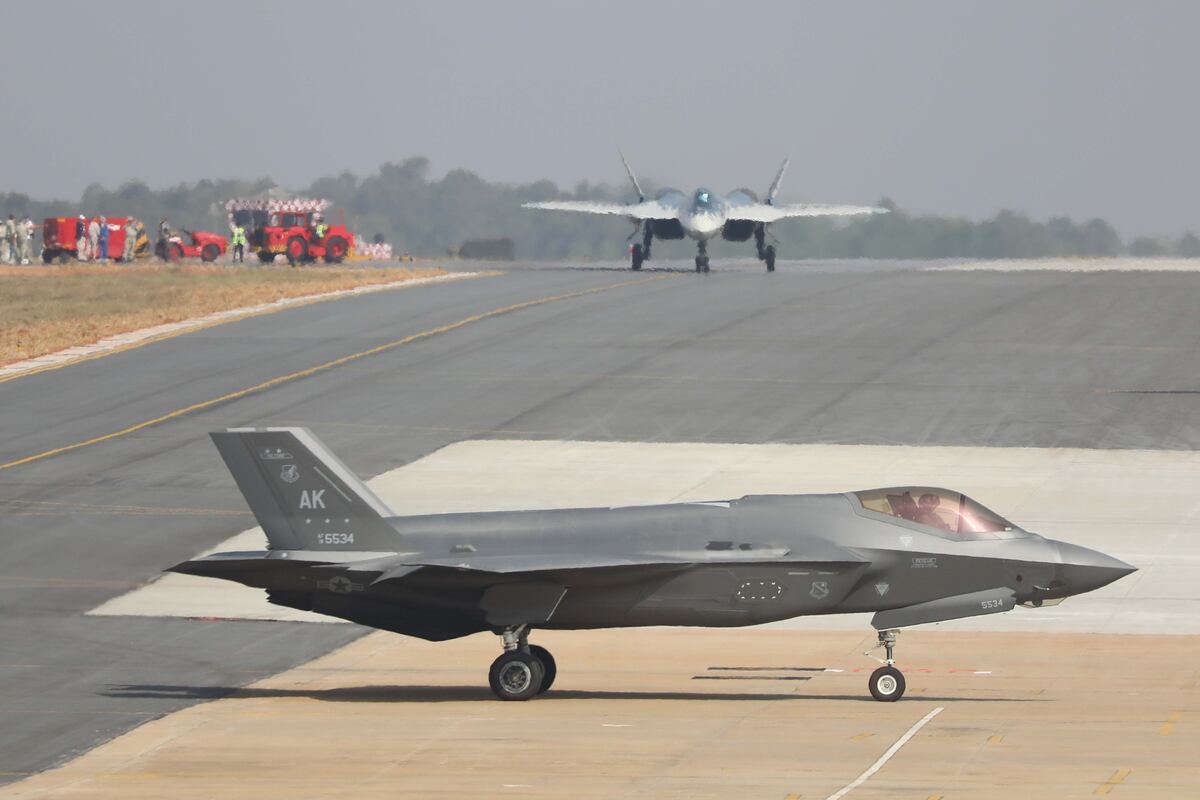
BENGALURU, India — The cream of the U.S. and Russian air forces shared a runway at the recent Aero India 2025 exhibition in Bengaluru, as both the Lockheed Martin F-35A and Sukhoi Su-57E attempted to woo the Indian Air Force towards an unlikely deal.
Emanating from opposing blocs, the surprising juxtaposition of these latest fifth-generation fighters at Aero India, held here Feb. 10-14, illustrates India’s non-aligned stance. Historically, Delhi has relied on Russia for military equipment, though the U.S. has made significant inroads into the market in recent years.
The latest competitive jostling surrounds fifth-generation fighters. A Rosoboronexport official said India could manufacture the Su-57 at home with full technology transfer. Russia’s defense export agency said it has held informal talks with Hindustan Aeronautics Limited (HAL) on the subject, and believes the Su-57 could be built at HAL’s Nasik facility where Su-30MKI jets are currently assembled.
Ironically, India had previously pulled out of an Indo-Russian collaborative project that ultimately resulted in the Su-57.
The Russian Air Force received its first Su-57 in 2020. Alexander Mikheev, director general of Rosoboronexport, declared at the air show here: “The first foreign customer of the promising, multifunctional, fifth-generation fighter Su-57E in 2025 will begin operating this aircraft which will be delivered by Rosoboronexport.”
A few days later, Algerian media reported that their country is, in fact, the Su-57E’s first export customer.
Thickening the plot, when Indian Prime Minister Narendra Modi met U.S. President Donald Trump at the White House in mid-February, Trump promised he was “paving the way to ultimately provide India F-35 stealth fighters.”
A joint leaders’ statement issued Feb. 13 said the U.S. was reviewing “its policy on releasing fifth-generation fighters” to India. Trump’s vow to put the technologically sensitive F-35 on the table is unprecedented, especially given India’s close relationship with Russia.
Lockheed Martin immediately responded: “We’re encouraged by the recent announcement by President Trump to provide the F-35 to India. We look forward to working closely with both governments on upcoming strategic procurements, including the fighters.”
Trump’s dangling offer of the F-35 took Delhi by surprise.
“I don’t think, with regard to the acquisition of an advanced aviation platform by India, that process has started as yet,” an Indian Ministry of External Affairs spokesperson said. “So this is currently something that’s at the stage of a proposal.”
India has an airpower gap with nemesis China, but it is unclear whether the F-35 is the right solution.
Apart from the U.S. being paranoid about F-35 technologies falling into the wrong hands, how would the advanced fighter integrate into India’s existing command-and-control networks?
The F-35 will unlikely be permitted to plug into networks containing India’s backbone of Russian-designed Su-30MKI fighters, for example.
The unexpected Russian Su-57E and American F-35 offers also come amidst Modi’s efforts to boost defense equipment self-reliance. In fact, India is presently pursuing its own indigenous, fifth-generation Advanced Medium Combat Aircraft (AMCA) program.
The government displayed a full-scale model of the AMCA for the first time at Aero India 2025. The project promises, optimistically, first fighter deliveries in 2034. However, buying either the F-35 or Su-57 runs the risk of asphyxiating India’s AMCA effort.
A model of India's fifth-generation AMCA fighter is on display at Aero India 2025. (Gordon Arthur/staff)
India has signed $50 billion in defense contracts with Russia over the past 20 years. The Stockholm International Peace Research Institute reported that 36% of Indian defense imports came from Russia over 2019-2023. However, this represented a 34% drop compared to the preceding 2014-2018 timeframe.
As the world’s largest weapon importer from 2008-2023, India accounted for 10% of global arms imports. In that same period, according to a recent U.S. Congressional Research Service report, 62% of Delhi’s military imports came from Russia, 11% from France, 10% from the U.S. and 7% from Israel.
The same report remarked, “The U.S. government is actively encouraging India to reduce its dependence on Russian-origin defense articles.”
India is too important a market for the U.S. to ignore. Prior to 2008, American sales of defense articles to Delhi were virtually nonexistent, but since then it has accrued more than US$20 billion in sales.
Important American exports include C-130J Super Hercules, C-17A Globemaster IIIs, P-8I aircraft, CH-47F Chinooks, MH-60Rs, AH-64E Apaches, Hellfire and Stinger missiles, M777A2 howitzers, SIG Sauer SIG716 assault rifles and Harpoon anti-ship missiles.
India’s latest American deal, worth a mammoth $4 billion , is for 31 MQ-9B drones.
The Trump-Modi statement noted a “deepening convergence of U.S.-India strategic interests.” To further advance defense ties, the two will sign a new ten-year framework for a major defense partnership later this year.
The statement also announced plans to “pursue this year new procurements and co-production arrangements” for Javelin missiles, Stryker 8x8 vehicles and six additional P-8I maritime patrol aircraft “following agreement on sale terms.”
Earlier this month, India declared a 9.53% hike to $78.3 billion in its 2025-2026 defense budget.
“In the current geopolitical scenario where the world is witnessing a changing paradigm of modern warfare, the Indian Armed Forces need to be equipped with state-of-the-art weapons and have to be transformed into a technologically advanced combat-ready force,” reads a Ministry of Defence statement.
Delhi now has a choice – to renew reliance on Russia by buying the Su-57E; continue switching allegiance to the U.S. with an F-35 order; or spurn both by putting all its eggs in the AMCA basket and accepting a prolonged capability gap vis-à-vis China in the near term.
Gordon Arthur is an Asia correspondent for Defense News. After a 20-year stint working in Hong Kong, he now resides in New Zealand. He has attended military exercises and defense exhibitions in about 20 countries around the Asia-Pacific region.
印度班加罗尔——在最近于班加罗尔举行的 2025 年印度航空展上,美国和俄罗斯空军的顶尖战机同场竞技,洛克希德·马丁公司的 F-35A 和苏霍伊公司的 Su-57E 都试图赢得印度空军的青睐,达成一项不太可能的交易。
在2月10日至14日于此地举行的印度航展上,来自对立阵营的这些最新型第五代战斗机并肩亮相,这种令人惊讶的景象凸显了印度的不结盟立场。历史上,德里一直依赖俄罗斯的军事装备,尽管近年来美国已在印度市场取得了显著进展。
最新的竞争焦点集中在第五代战斗机领域。俄罗斯国防出口公司一位官员表示,印度可以通过全面技术转让在国内生产苏-57战斗机。俄罗斯国防出口公司称,已就此与印度斯坦航空有限公司(HAL)进行了非正式会谈,并认为苏-57可以在HAL位于纳西克的工厂生产,该工厂目前也组装苏-30MKI战斗机。
具有讽刺意味的是,印度此前曾退出印俄合作项目,而该项目最终催生了苏-57战斗机。
俄罗斯空军于 2020 年接收了首架苏-57 战斗机。俄罗斯国防出口公司总经理亚历山大·米赫耶夫在本次航展上宣布:“首位外国客户将于 2025 年开始使用这款前景广阔、功能多样的第五代战斗机苏-57E,该飞机将由俄罗斯国防出口公司交付。”
几天后,阿尔及利亚媒体报道称,该国实际上是苏-57E战斗机的第一个出口客户。
更令人震惊的是,2月中旬,印度总理纳伦德拉·莫迪在白宫会见美国总统唐纳德·特朗普时,特朗普承诺他正在“为最终向印度提供F-35隐形战斗机铺平道路”。
2月13日发表的联合领导人声明称,美国正在重新审视“向印度交付第五代战斗机的政策”。考虑到印度与俄罗斯的密切关系,特朗普誓言将技术敏感的F-35战斗机摆上谈判桌的做法史无前例。
洛克希德·马丁公司立即回应道:“我们对特朗普总统近日宣布向印度提供F-35战斗机感到鼓舞。我们期待与两国政府在即将到来的战略采购项目中密切合作,包括战斗机采购。”
特朗普抛出F-35战机的提议让德里方面感到意外。
印度外交部发言人表示:“我认为,就印度采购先进航空平台而言,这一进程尚未启动。目前,这还处于提案阶段。”
印度与宿敌中国在空中力量上存在差距,但F-35是否是正确的解决方案尚不明确。
除了美国担心 F-35 技术落入坏人之手之外,这种先进的战斗机将如何融入印度现有的指挥控制网络?
例如,F-35 不太可能被允许接入包含印度主力装备——俄罗斯设计的苏-30MKI 战斗机的网络。
俄罗斯出人意料地向印度提供苏-57E和美国F-35战机,也正值莫迪努力提升国防装备自主能力之际。事实上,印度目前正在推进其自主研发的第五代先进中型战斗机(AMCA)项目。
印度政府在2025年印度航空展上首次展示了AMCA的全尺寸模型。该项目乐观地预测,首批战斗机将于2034年交付。然而,购买F-35或苏-57都有可能扼杀印度的AMCA项目。
印度第五代AMCA战斗机的模型正在2025年印度航空展上展出。(戈登·阿瑟/工作人员摄)
过去20年,印度与俄罗斯签署了价值500亿美元的国防合同。斯德哥尔摩国际和平研究所报告称,2019年至2023年期间,印度36%的国防进口来自俄罗斯。然而,与之前的2014年至2018年期间相比,这一比例下降了34%。
2008年至2023年间,印度是世界上最大的武器进口国,占全球武器进口总额的10%。同期,根据美国国会研究服务处最近的一份报告,德里62%的军事进口来自俄罗斯,11%来自法国,10%来自美国,7%来自以色列。
同一份报告指出,“美国政府正积极鼓励印度减少对俄罗斯国防产品的依赖。”
印度市场对美国而言至关重要,不容忽视。2008年以前,美国对印度的国防产品销售几乎为零,但自那以后,销售额已超过200亿美元。
美国重要的出口产品包括 C-130J 超级大力神运输机、C-17A 环球霸王 III 运输机、P-8I 反潜巡逻机、CH-47F 支奴干直升机、MH-60R 直升机、AH-64E 阿帕奇武装直升机、地狱火导弹和毒刺导弹、M777A2 榴弹炮、SIG Sauer SIG716 突击步枪和鱼叉反舰导弹。
印度最近与美国达成的一项价值高达 40 亿美元的巨额交易,购买了 31 架 MQ-9B 无人机。
特朗普和莫迪的联合声明指出,“美印战略利益日益趋同”。为进一步推进防务关系,两国将于今年晚些时候签署一项新的十年期重要防务伙伴关系框架协议。
声明还宣布计划“在今年推进新的采购和合作生产安排”,采购标枪导弹、斯特瑞克8x8装甲车和六架额外的P-8I海上巡逻机,“此前已就销售条款达成协议”。
本月初,印度宣布将 2025-2026 财年国防预算增加 9.53%,达到 783 亿美元。
“在当前地缘政治形势下,世界正在见证现代战争范式的转变,印度武装部队需要配备最先进的武器,并必须转型成为一支技术先进的作战部队,”国防部在一份声明中写道。
德里现在面临一个选择——要么通过购买苏-57E战斗机重新依赖俄罗斯;要么通过订购F-35战斗机继续效忠美国;要么放弃两者,将所有鸡蛋放在AMCA的篮子里,并接受在短期内与中国长期存在的能力差距。
戈登·阿瑟是《防务新闻》的亚洲特派记者。在香港工作20年后,他现居新西兰。他曾到访亚太地区约20个国家,参加过军事演习和防务展览。